Drizzle ORM vs Prisma: The Node.js Database Showdown (2026)
If you are building a Node.js backend in 2026, choosing an ORM is no longer just about convenience — it is a performance, deployment, and hiring decision. Prisma dominated the last few years with its generated client and delightful DSL, but Drizzle ORM has rapidly eaten into that lead by offering a SQL-first, zero-dependency alternative that feels right at home on the edge.
This guide is a hands-on comparison of Drizzle and Prisma across the dimensions that actually matter in production: cold-start latency, bundle size, type inference, migrations, raw-SQL escape hatches, and tooling. By the end you will know exactly which ORM fits your project — and what to look for when you hire the engineers who will live inside it.
Why Your Node.js ORM Choice Matters More in 2026
Serverless and edge runtimes have changed the calculus. A 300 ms cold start inside Cloudflare Workers or Vercel Edge Functions used to be invisible — today it is the difference between keeping a user and losing them. Your ORM is now a first-class runtime concern: bundle size, connection pooling style, and how quickly your query layer warms up all show up in real p99 latency numbers.
The developer experience dimension
Developer experience is still the deciding factor for most teams. A delightful API that plays well with TypeScript and IDE autocomplete makes juniors productive in hours instead of weeks. It also directly affects hiring: engineers who have built real features with Prisma or Drizzle can hit the ground running at your company.
The performance & cost dimension
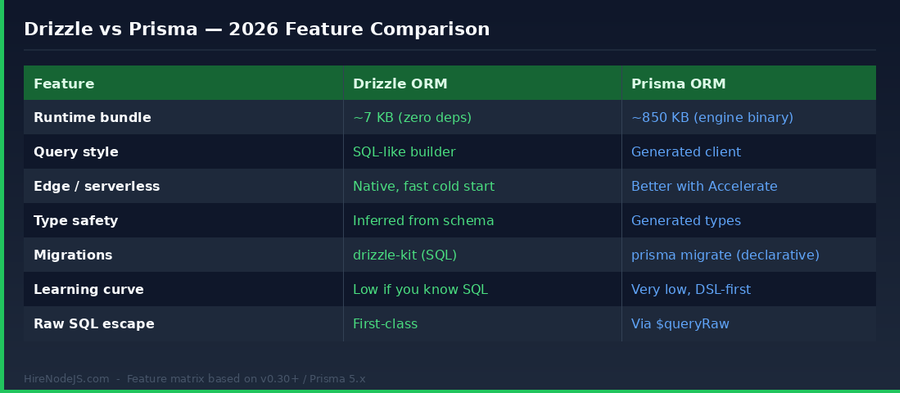
On a serverless platform, every megabyte you ship and every millisecond you waste on a cold start costs money. Drizzle's ~7 KB runtime and zero-dependency design is a genuine competitive advantage on Workers and Lambda@Edge. Prisma has been closing the gap with Accelerate and connection pooling products, but it is still a heavier runtime footprint.
Prisma ORM in 2026: What It Does Well
Prisma is still the ORM with the smoothest on-ramp. You write a declarative schema in prisma/schema.prisma, run prisma generate, and you get a fully typed client with first-class support for migrations, seeding, Prisma Studio, and recently Accelerate for connection pooling and query caching.
Strengths
The auto-generated client is hard to beat for day-to-day ergonomics — nested writes, relation filters, and typed includes are concise and safe. Prisma Studio gives non-engineers a read-only window into the data. And the docs, community, and ecosystem around Prisma remain the gold standard in the TypeScript ORM space.
Trade-offs
Prisma ships a Rust-based query engine that must be bundled with your app. On serverless and edge platforms this is a sharper penalty than it used to be, and some team members will resent the declarative DSL when they need to express a complex window function or a recursive CTE.
Drizzle ORM in 2026: SQL-First, Serverless-Ready
Drizzle takes a different philosophical stance: it is a thin, type-safe SQL builder that compiles to real SQL at build time. You describe your schema in TypeScript, and every query you write is inferred end-to-end without a code generation step — no separate binary, no engine.
Strengths
The headline wins are obvious on the edge: ~7 KB runtime, zero native dependencies, and first-class support for Cloudflare Workers, Bun, Deno, and Vercel Edge. The SQL-like API means anyone fluent in SQL feels at home — and the produced queries are explicit, so you always know what is being sent to the database.
Trade-offs
The flip side of SQL-first is less magic. Nested relations require more explicit joins or the Drizzle relational query API, and migrations are closer to hand-written SQL than the declarative diff you get from Prisma. Teams used to heavy generation and Prisma Studio will feel a slight drop in convenience.
Performance, Bundle Size, and Edge Readiness
In synthetic benchmarks, both ORMs are so close on traditional long-running Node.js servers that the difference is drowned out by network and disk latency. The real divergence shows up on serverless and edge: Drizzle initializes in low single-digit milliseconds, while Prisma's engine adds a measurable cold-start tax you must design around (or pay Accelerate to mitigate).
Connection pooling
Hire Pre-Vetted Node.js Developers
Skip the months-long search. Our exclusive talent network has senior Node.js experts ready to join your team in 48 hours.
For Postgres on serverless, both libraries lean on external poolers such as PgBouncer, Neon's serverless driver, or Supabase's connection pooling. Drizzle integrates directly with driver-native pooling, while Prisma's Accelerate is a managed pooling + caching layer that is excellent but adds a dependency and a cost center.
Query efficiency
Drizzle's queries are transparent — you can console.log the generated SQL during development and know exactly what indexes to add. Prisma occasionally emits an N+1 for nested includes under specific conditions, so you still want the same habit of inspecting logs under load.
Schema, Migrations, and Day-2 Operations
Schema and migration workflow is where many teams form their strongest opinions. Prisma's declarative model is elegant: edit the schema file, run prisma migrate dev, and Prisma computes the SQL diff. It is frictionless right up until you need a non-trivial migration (e.g. moving data, splitting tables, or backfilling).
Drizzle: SQL-centric migrations
Drizzle-kit generates SQL migration files that you can edit by hand before they run. DBAs and senior backend engineers usually find this model easier to trust because nothing is hidden — you see the exact SQL that will hit production.
Here is what a realistic query looks like in each ORM, side by side — a paginated product search that joins categories and filters by tenant:
// Drizzle ORM — SQL-first, inferred types, no code generation
import { db } from './db';
import { products, categories } from './schema';
import { and, eq, ilike, desc } from 'drizzle-orm';

export async function searchProducts(tenantId: string, q: string, page = 1) {
  const pageSize = 20;
  return db
    .select({
      id: products.id,
      name: products.name,
      price: products.price,
      category: categories.name,
    })
    .from(products)
    .leftJoin(categories, eq(categories.id, products.categoryId))
    .where(and(
      eq(products.tenantId, tenantId),
      ilike(products.name, `%${q}%`),
    ))
    .orderBy(desc(products.createdAt))
    .limit(pageSize)
    .offset((page - 1) * pageSize);
}

// Prisma ORM equivalent — declarative, generated client
// import { prisma } from './prisma';
// export async function searchProducts(tenantId: string, q: string, page = 1) {
//   const pageSize = 20;
//   return prisma.product.findMany({
//     where: { tenantId, name: { contains: q, mode: 'insensitive' } },
//     include: { category: true },
//     orderBy: { createdAt: 'desc' },
//     take: pageSize,
//     skip: (page - 1) * pageSize,
//   });
// }
What This Means for Hiring Node.js Developers
ORM choice has become a hiring filter. If you are building on the edge or on Bun, you almost certainly want engineers who have shipped Drizzle in production. If your stack is a classic Node + Postgres monolith on EC2, Prisma experience is cheaper to find and onboard. Teams hiring Node.js developers should weight real repository experience with the ORM over generic ‘used it in a tutorial' claims.
Skills to screen for
Regardless of ORM, senior candidates should be able to discuss N+1 patterns, index design, transaction boundaries, and connection pooling. For a Drizzle-heavy stack, look for candidates who have worked on TypeScript codebases with strict mode enabled. For Prisma-heavy stacks, look for experience with schema evolution, data migrations, and PostgreSQL tuning.
Interview questions that work
Ask candidates to walk through a recent migration that went wrong. Strong candidates will describe how they reversed it, how they communicated the change, and how they wrote a regression test. Ask them to explain the difference between a transaction isolation level of READ COMMITTED and SERIALIZABLE — anyone writing production ORM code should know this cold.
Hire Expert Node.js Developers — Ready in 48 Hours
Building the right system is only half the battle — you need the right engineers to build it. HireNodeJS.com specialises exclusively in Node.js talent: every developer is pre-vetted on real-world projects, API design, event-driven architecture, and production database work with Prisma, Drizzle, TypeORM, and raw SQL.
Unlike generalist platforms, our curated pool means you speak only to engineers who live and breathe Node.js. Most clients have their first developer working within 48 hours of getting in touch — see how it works. Engagements start as short-term contracts and can convert to full-time hires with zero placement fee.
Conclusion: Pick the ORM Your Team Will Ship Fastest With
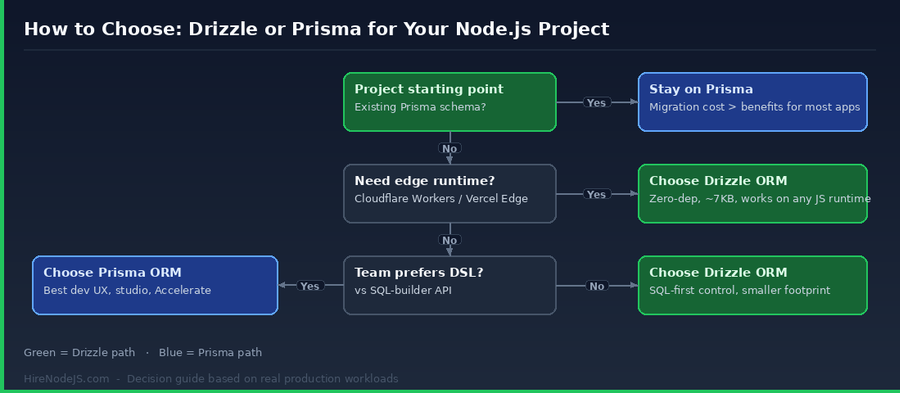
There is no universally right answer. Prisma is still the better choice for classic Node.js backends where developer experience and tooling trump raw footprint, and for teams that love a declarative schema. Drizzle is the better choice if you are running on the edge, on Bun, or if you want your SQL to be explicit rather than generated.
Both ORMs are production-grade in 2026. Choose based on your runtime, your team's comfort with SQL, and the developers you can realistically hire. The worst outcome is the ORM that no one on your team enjoys working in — that is the one that silently slows every feature down.
Frequently Asked Questions
Is Drizzle ORM production-ready in 2026?
Yes. Drizzle is used in production at companies across fintech, SaaS, and edge platforms, has stable v0.3x releases, and first-class support for Postgres, MySQL, and SQLite. Its SQL-first design also means fewer surprises compared to heavier ORMs.
Should I migrate from Prisma to Drizzle?
Only migrate if you are hitting real pain points — cold-start latency on the edge, engine binary size in serverless, or friction with complex raw SQL. For most traditional Node.js servers, Prisma is still an excellent choice and a migration is not worth the risk.
Which ORM is faster: Drizzle or Prisma?
At the query level, both are within a few percent on long-running Node.js servers. Drizzle wins noticeably on cold-start and in serverless/edge environments because it ships no engine binary and has a ~7 KB runtime.
Does Drizzle support relations like Prisma?
Yes — Drizzle has a relational query API (db.query.table.findMany with a with clause) that gives you a Prisma-like developer experience, while still compiling to explicit SQL under the hood.
Which ORM is easier to hire for?
Prisma has a larger pool of experienced developers today because it has been mainstream longer. Drizzle is catching up fast, especially among engineers comfortable with SQL and TypeScript. HireNodeJS maintains vetted candidates experienced with both.
Can I use Drizzle and Prisma in the same project?
Technically yes, but it is rarely a good idea long-term. Pick one as the primary ORM and use raw SQL via the driver for the few edge cases the ORM cannot express cleanly. Dual ORMs double your maintenance and onboarding cost.
Vivek Singh is the founder of Witarist and HireNodeJS.com — a platform connecting companies with pre-vetted Node.js developers. With years of experience scaling engineering teams, Vivek shares insights on hiring, tech talent, and building with Node.js.
Need a Node.js engineer who ships fast, type-safe database code?
HireNodeJS connects you with pre-vetted senior Node.js engineers experienced with Drizzle, Prisma, and raw SQL — available within 48 hours. No recruiter fees, no lengthy screening.