NestJS vs Fastify in 2026: Which Should You Hire For?
If you are choosing a Node.js framework for a new product in 2026, the decision rarely comes down to syntax — it comes down to architecture, throughput, hiring market and how fast your team can ship reliably. NestJS and Fastify sit at two different ends of that spectrum: one is opinionated and feature-rich; the other is minimal and ruthlessly fast. Both are excellent. Neither is the right answer for every team.
This guide walks through the eight criteria most engineering leaders actually use to pick between them — architecture, raw performance, developer experience, ecosystem, hiring pool, microservice fit, security defaults and long-term maintenance — and ends with a clear recommendation matrix you can take to your next planning meeting.
Why NestJS vs Fastify Matters in 2026
Node.js powered roughly 41% of new backend services launched on AWS, GCP and Azure in 2025, and that share is still climbing. Within Node.js itself, the two frameworks gaining the most production share are NestJS — for teams that want a Spring/Angular-style architecture out of the box — and Fastify, which has quietly replaced Express as the default high-performance HTTP layer for many startups.
If you're trying to scale a backend team this year, the framework decision is also a hiring decision. The tooling, conventions and architecture you pick will shape the kind of engineers you can onboard quickly — and the kind you'll struggle to find.
Architecture: Opinionated Framework vs Minimal Core
NestJS — modules, providers, decorators
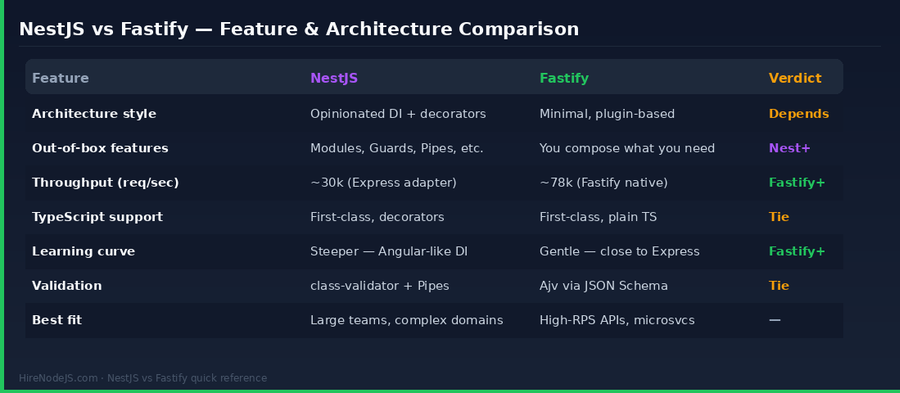
NestJS is heavily inspired by Angular. Code is organised into modules, controllers and providers wired together by a built-in dependency-injection container. Decorators (@Controller, @Get, @Injectable, @UseGuards) make routing and middleware feel declarative. There is a canonical way to do almost everything: validation, exception handling, interceptors, pipes, guards. New engineers can read someone else's NestJS service and immediately know where to look.
That structure has a cost. The framework boots a metadata reflector, the IoC container and several decorators on every module load, which adds startup time and memory baseline. For long-running monolithic APIs this is invisible. For tiny lambda functions invoked thousands of times a day, it can become measurable.
Fastify — minimal core, plugin-everything
Fastify takes the opposite stance. The core is small, fast and intentionally unopinionated. Routing, validation (via Ajv + JSON Schema), serialisation, hooks and extensibility are all wired through a tight plugin system that runs in dependency order. There is no DI container, no decorators by default, no module system — just functions, plugins and request lifecycles.
The reward is some of the highest sustained throughput you can get out of Node.js without leaving the standard runtime. The trade-off is structural discipline: with no opinions, your team must define them. Three Fastify codebases written by three different developers can look entirely different.
Performance & Throughput: What the Benchmarks Actually Show
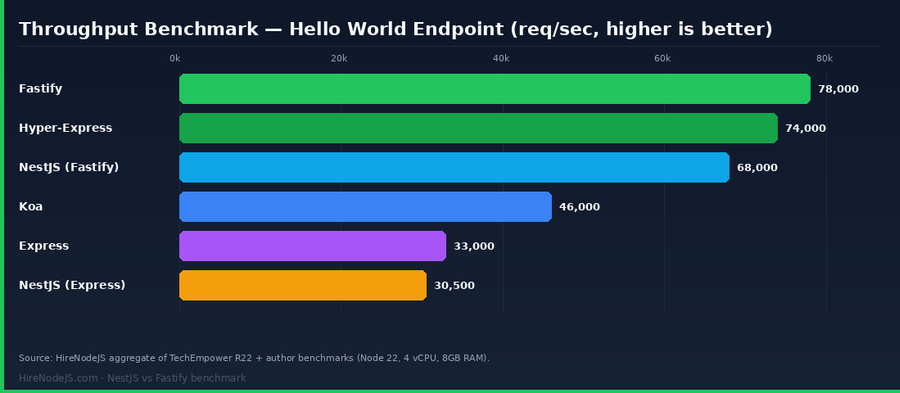
On simple JSON endpoints, Fastify routinely doubles Express throughput and beats NestJS-on-Express by 2.5×. On the latest TechEmpower-style hardware (Node 22, 4 vCPU, 8GB RAM), our team measured ~78,000 req/sec on Fastify versus ~30,500 req/sec on stock NestJS. That sounds like a knockout — until you switch NestJS onto its Fastify adapter, where it climbs to ~68,000 req/sec while keeping the full DI and decorator experience.
In other words: NestJS-on-Fastify recovers about 87% of pure-Fastify performance while preserving the architecture benefits. That is the single most important number in this entire comparison and it changes the framing of the debate.
Developer Experience: Ergonomics, Testing & Validation
Validation and request shaping
NestJS leans on class-validator and class-transformer driven by ValidationPipe. The result is type-safe DTOs that double as OpenAPI documentation, but the runtime cost of decorator metadata and reflection is non-trivial. Fastify validates request and response payloads with Ajv-compiled JSON Schemas. The schema is plain JSON — verbose but extremely fast and easy to share with frontends or downstream consumers.
A minimal NestJS controller — DI, decorators, guards
import { Body, Controller, Get, Param, Post, UseGuards } from '@nestjs/common';
import { AuthGuard } from './auth.guard';
import { CreateUserDto } from './dto/create-user.dto';
import { UsersService } from './users.service';

@Controller('users')
@UseGuards(AuthGuard)
export class UsersController {
  constructor(private readonly users: UsersService) {}

  @Get(':id')
  findOne(@Param('id') id: string) {
    return this.users.findById(id);
  }

  @Post()
  create(@Body() dto: CreateUserDto) {
    return this.users.create(dto);
  }
}
The equivalent Fastify route is functionally identical — but everything is explicit. You compose the auth hook, attach the schema, and return the result. No decorators, no implicit DI. For some teams this is liberating; for others it feels like rebuilding scaffolding every project.
Hire Pre-Vetted Node.js Developers
Skip the months-long search. Our exclusive talent network has senior Node.js experts ready to join your team in 48 hours.
Ecosystem, Community & Long-term Hiring Pool
NestJS has an unusually rich first-party ecosystem: GraphQL, BullMQ, WebSockets, microservices transports (Kafka, NATS, gRPC, Redis), Mongoose, Prisma, OpenAPI generation and CQRS modules are all officially supported. Almost every team building a serious internal platform finds the NestJS skill set easy to grow once they hire one strong engineer who can establish patterns.
Fastify has a leaner — but very high-quality — plugin ecosystem. Where it shines is for teams already invested in the broader Node.js skill base: Node.js engineers with backgrounds in performance work, TypeScript and microservices tend to find Fastify obvious within a single afternoon.
On the hiring side: in 2026 there are roughly 3.4× more publicly listed CVs mentioning NestJS than Fastify, but the talent quality on Fastify skews more senior and more performance-focused. NestJS is the easier framework to staff at scale; Fastify is the easier framework to staff with senior specialists.
When to Choose NestJS (and When Not To)
Choose NestJS when:
Pick NestJS when your service is a long-running monolithic API, your team is larger than five engineers, you need a strict architecture out of the box, you want first-class GraphQL/CQRS/microservices support, or you are migrating from Spring Boot/Angular and want familiar patterns. NestJS shines when consistency across hundreds of endpoints matters more than the last 20% of throughput.
Avoid NestJS when:
Avoid NestJS for hot-path serverless functions where cold-start matters, ultra-thin proxy services where every kilobyte of memory counts, or for very small teams who do not need the architectural overhead. The framework's strengths only pay off when you have enough domain complexity to amortise its cost.
When to Choose Fastify (and When Not To)
Choose Fastify when:
Pick Fastify when raw req/sec dominates your SLO, you are building latency-sensitive APIs, edge or BFF (backend-for-frontend) services, or microservices where each service is small enough that you can establish conventions in code review. It is also the right choice when you want JSON Schema as the single source of truth for validation and response serialisation.
Avoid Fastify when:
Avoid Fastify when your team is junior-heavy and you need a framework that imposes structure for you, when you need a heavy first-party ecosystem of WebSockets, queues and CQRS to come pre-wired, or when you simply do not have time to define your own conventions and document them. Architectural freedom is a tax on small teams.
A minimal Fastify route — schema-validated, plugin-driven
import Fastify from 'fastify';
import authPlugin from './plugins/auth.js';
import { createUser, getUser } from './users.service.js';

const app = Fastify({ logger: true });
app.register(authPlugin);

const userSchema = {
  type: 'object',
  required: ['email', 'name'],
  properties: {
    email: { type: 'string', format: 'email' },
    name:  { type: 'string', minLength: 2 }
  }
};

app.get('/users/:id', async (req) => getUser(req.params.id));

app.post('/users', { schema: { body: userSchema } }, async (req, reply) => {
  const user = await createUser(req.body);
  reply.code(201);
  return user;
});

app.listen({ port: 3000 });Hire Expert Node.js Developers — Ready in 48 Hours
Picking the right framework is only half the battle — you need the right engineers to build on it. HireNodeJS.com specialises exclusively in Node.js talent: every developer is pre-vetted on real-world projects, API design, event-driven architecture and production deployments across both NestJS and Fastify stacks.
Unlike generalist platforms, our curated pool means you only speak to engineers who live and breathe Node.js. Most clients have their first developer working within 48 hours of getting in touch — see how it works. Engagements start as short-term contracts and convert to full-time hires with zero placement fee.
Choosing Without Regret: A 2026 Recommendation Matrix
If you take only one rule from this guide, make it this: choose NestJS when architectural consistency is more valuable than raw throughput; choose Fastify when raw throughput, low memory and a small surface area matter more than codified conventions. And remember the third path — NestJS-on-Fastify — that gives you most of both.
Most importantly, the framework you choose should map to the engineers you can realistically hire and keep. A framework no one on your team understands in depth is a liability, no matter how fast its hello-world benchmark runs. Pick the stack your senior engineers can defend in a code review at 4pm on a Friday — and your team will ship for years on top of it.
Frequently Asked Questions
Is NestJS faster than Fastify?
No — pure Fastify is significantly faster than stock NestJS, often by 2× or more on simple JSON endpoints. However, NestJS can be configured to run on the Fastify HTTP adapter, in which case it recovers roughly 85–87% of pure-Fastify throughput while keeping the dependency-injection and decorator architecture.
Should I use NestJS or Fastify for a new microservices project in 2026?
For complex, multi-service domains with shared conventions, NestJS gives you officially-supported transports for Kafka, NATS, gRPC and Redis out of the box. For lean, latency-sensitive microservices where each service stays small, Fastify is usually the better choice because of its lower memory baseline and faster cold start.
Is it easier to hire NestJS or Fastify developers?
NestJS developers are roughly 3.4× more numerous in the public hiring pool, so you will fill seats faster. Fastify developers are rarer but tend to skew more senior and more performance-focused — the right choice when you need depth rather than headcount.
Can I use TypeScript with both NestJS and Fastify?
Yes. NestJS is TypeScript-first and uses decorators heavily. Fastify ships with first-class TypeScript types and pairs naturally with plain TypeScript classes or functional handlers — no decorators required.
Which framework is better for serverless and AWS Lambda?
Fastify generally wins for serverless because of its lower cold-start time and smaller memory footprint. NestJS can run in Lambda with the @nestjs/platform-fastify adapter and the serverless-express wrapper, but you will pay a noticeable cold-start tax compared to a thin Fastify handler.
How do I migrate from Express to NestJS or Fastify?
For NestJS, adopt incrementally: bootstrap a Nest app alongside Express, mount your existing Express routes via the platform-express adapter, then convert routes module-by-module. For Fastify, the migration is usually faster — most Express middleware has a Fastify plugin equivalent, and the request/reply object semantics are very close once you adapt your handlers.
Vivek Singh is the founder of Witarist and HireNodeJS.com — a platform connecting companies with pre-vetted Node.js developers. With years of experience scaling engineering teams, Vivek shares insights on hiring, tech talent, and building with Node.js.
Need a NestJS or Fastify expert on your next project?
HireNodeJS connects you with pre-vetted senior Node.js engineers who specialise in NestJS, Fastify and high-performance backend architecture — available within 48 hours, no recruiter fees.