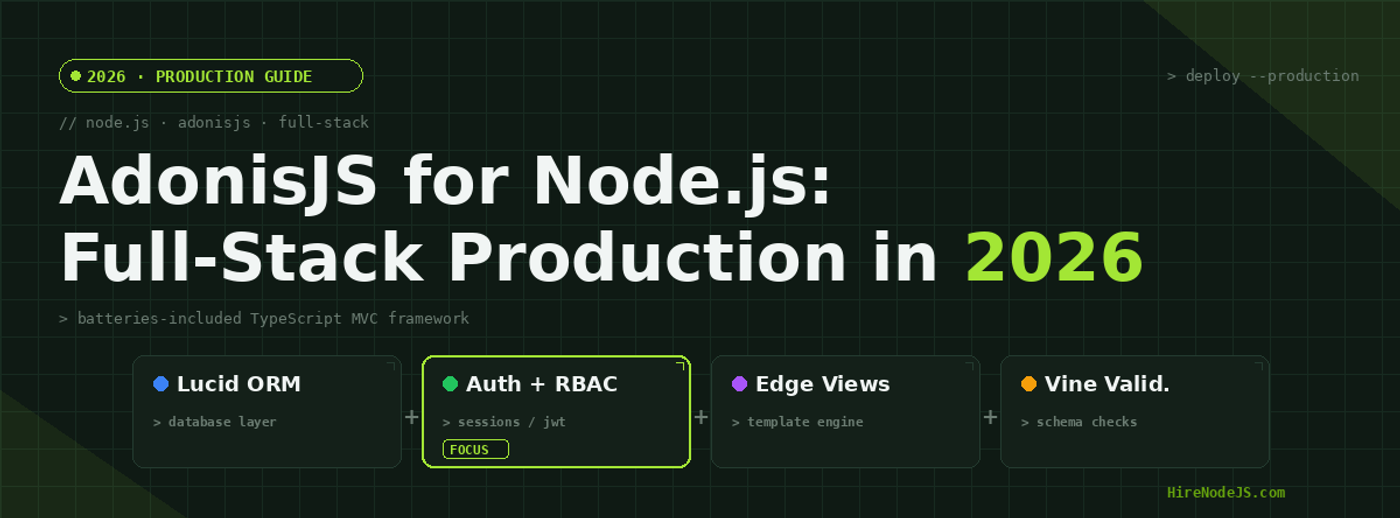
AdonisJS for Node.js: The Full-Stack Production Guide 2026
AdonisJS has quietly become one of the most complete full-stack frameworks in the Node.js ecosystem. While Express and Fastify dominate the minimalist end of the spectrum and NestJS owns enterprise DI-heavy architectures, AdonisJS occupies a unique position: it ships with everything you need to build production applications out of the box, from an ORM and authentication to mail services and job queues.
In 2026, engineering teams evaluating Node.js frameworks are increasingly drawn to AdonisJS for its Laravel-inspired developer experience combined with first-class TypeScript support. This guide covers architecture, core features, performance characteristics, and practical patterns for shipping AdonisJS applications to production.
Why AdonisJS Is Gaining Traction in 2026
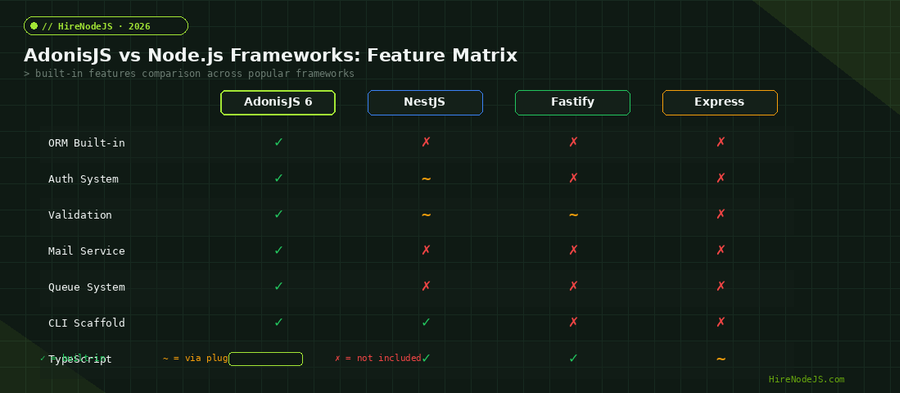
The JavaScript ecosystem has long suffered from decision fatigue. Building a Node.js API with Express means choosing an ORM, a validator, an auth library, a mailer, a queue system, and a testing framework separately. Each choice introduces compatibility risks, version conflicts, and learning curves. AdonisJS eliminates this overhead by providing a cohesive, opinionated stack where every component is designed to work together.
Batteries-Included Philosophy
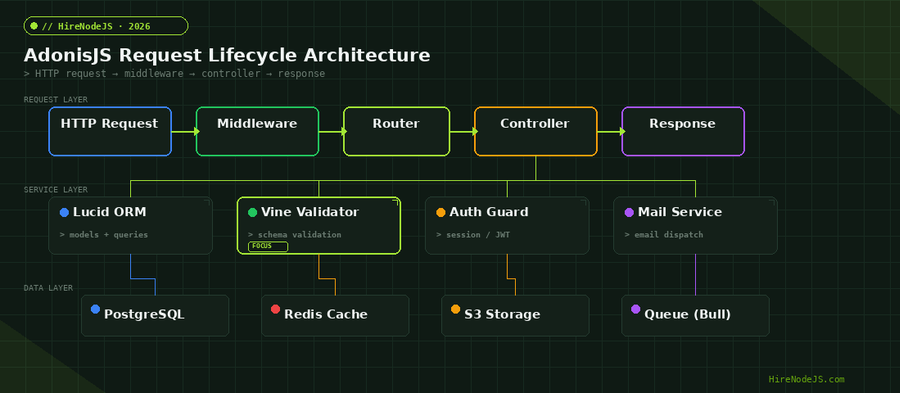
AdonisJS ships with Lucid ORM for database operations, Vine for schema validation, a full authentication system supporting sessions and JWT, Edge for server-side templating, and built-in support for mail, queues, and scheduled tasks. The framework's CLI can scaffold models, controllers, middleware, and migrations in seconds, dramatically reducing boilerplate.
TypeScript-First Architecture
Unlike frameworks that bolt on TypeScript as an afterthought, AdonisJS 6 is written entirely in TypeScript. Every API surface is fully typed, and the framework leverages advanced TypeScript features like conditional types and template literal types for route parameter inference. This means your IDE catches errors before your tests do.
Lucid ORM: Database Operations Done Right
Lucid is AdonisJS's Active Record ORM, inspired by Laravel's Eloquent. It supports PostgreSQL, MySQL, SQLite, and MSSQL out of the box, with a query builder that generates efficient SQL while keeping your code expressive and readable.
Models and Relationships
Lucid models define your database schema as TypeScript classes with decorators. Relationships — hasOne, hasMany, belongsTo, manyToMany — are declared as properties, and the query builder automatically handles joins. For teams working with PostgreSQL or MySQL in production, Lucid provides connection pooling, read replicas, and transaction support with minimal configuration.
import { BaseModel, column, hasMany } from '@adonisjs/lucid/orm'
import type { HasMany } from '@adonisjs/lucid/types/relations'
import Post from '#models/post'

export default class User extends BaseModel {
  @column({ isPrimary: true })
  declare id: number

  @column()
  declare email: string

  @column()
  declare fullName: string

  @hasMany(() => Post)
  declare posts: HasMany<typeof Post>

  // Scoped query for active users
  static active() {
    return this.query().where('isActive', true)
  }
}

// Usage in controller
const users = await User.active()
  .preload('posts', (query) => {
    query.where('published', true).orderBy('createdAt', 'desc')
  })
  .paginate(page, 20)
Migrations and Seeders
Database migrations in AdonisJS use a dedicated migration system that tracks applied changes and supports rollbacks. The CLI generates timestamped migration files, and the framework handles schema creation, column alterations, and index management. Factory-based seeders make it trivial to populate development and staging databases with realistic test data.
Authentication and Authorization Patterns
AdonisJS provides a first-party authentication package that supports multiple guards: session-based auth for server-rendered apps, API token auth for stateless APIs, and a basic auth guard for simple use cases. Each guard is fully typed and integrates directly with your User model.
Session-Based Authentication
For traditional web applications, AdonisJS's session guard handles login, logout, CSRF protection, and remember-me tokens. The auth middleware can be applied globally or per-route, and the framework provides helpers for checking authentication state in Edge templates.
JWT and API Token Authentication
For API-first architectures, the access token guard generates opaque tokens stored in the database. Unlike raw JWT implementations that require manual refresh token rotation and blacklisting, AdonisJS tokens are revocable by default. You can also implement JWT-based auth using the framework's extensible guard system.
Hire Pre-Vetted Node.js Developers
Skip the months-long search. Our exclusive talent network has senior Node.js experts ready to join your team in 48 hours.
Vine: Schema Validation That Compiles to Fast Code
Vine is AdonisJS's validation library, purpose-built for performance. Unlike runtime validators that parse schemas on every request, Vine compiles your schema definitions into optimized JavaScript functions at boot time. The result is validation that runs 5-8x faster than Zod or Yup in benchmarks, with full TypeScript inference.
Defining Validation Schemas
Vine schemas are defined using a fluent API that mirrors the structure of your data. The compiled validators provide detailed error messages, support custom rules, and integrate with AdonisJS's request lifecycle so validated data is automatically typed in your controllers.
Custom Validation Rules
You can extend Vine with custom rules for domain-specific validation — checking that an email is unique in the database, verifying that a slug follows your naming convention, or validating complex business rules. This is particularly valuable for teams building SaaS applications where backend developers need to enforce intricate data constraints at the API layer.
Testing AdonisJS Applications in Production
AdonisJS includes Japa, its own testing framework, which provides a clean API for unit tests, integration tests, and functional (HTTP) tests. Japa supports test groups, lifecycle hooks, datasets for parameterized testing, and a plugin system for extending functionality.
Functional Testing with the HTTP Client
The built-in API client lets you send HTTP requests to your application and assert on responses without starting an external server. Combined with database transactions that automatically rollback after each test, you get fast, isolated tests that exercise your full stack — routes, middleware, controllers, and database queries.
Database Testing Patterns
AdonisJS's testing utilities include database refresh plugins that truncate tables between tests, factories for generating model instances with realistic data, and assertions for verifying database state. The framework encourages testing against a real database rather than mocking, which catches query-level bugs that unit tests miss.
Deploying AdonisJS to Production
Running AdonisJS in production requires attention to environment configuration, process management, and infrastructure choices. Whether you deploy on bare metal, Docker containers, or serverless platforms, the framework provides built-in health checks and graceful shutdown handling.
Environment Configuration
AdonisJS uses a validated environment configuration system. Instead of silently falling back to defaults when environment variables are missing, the framework throws at boot time if required variables are not set. This catches misconfigurations before they cause runtime errors in production.
Docker and Process Management
For containerized deployments, AdonisJS's build step compiles TypeScript to JavaScript and tree-shakes unused dependencies, producing a lean production artifact. Pair this with a multi-stage Dockerfile and Kubernetes for horizontal scaling and zero-downtime deployments.
Hire Expert Node.js Developers — Ready in 48 Hours
Building the right system is only half the battle — you need the right engineers to build it. HireNodeJS.com specialises exclusively in Node.js talent: every developer is pre-vetted on real-world projects, API design, event-driven architecture, and production deployments.
Unlike generalist platforms, our curated pool means you speak only to engineers who live and breathe Node.js. Most clients have their first developer working within 48 hours of getting in touch. Engagements start as short-term contracts and can convert to full-time hires with zero placement fee.
Conclusion: Is AdonisJS Right for Your Next Project?
AdonisJS is the strongest choice in the Node.js ecosystem for teams that want a batteries-included, TypeScript-first framework with a clear structure and excellent developer experience. It trades some raw throughput compared to Fastify for a dramatically more complete feature set — built-in ORM, authentication, validation, mail, queues, and testing that all work together without configuration overhead.
If your team is building a SaaS product, an API-driven platform, or any application where development velocity matters more than squeezing out the last 10% of request throughput, AdonisJS deserves serious evaluation. And if you need experienced engineers who can hit the ground running with AdonisJS or any Node.js framework, HireNodeJS has you covered.
Frequently Asked Questions
Is AdonisJS production-ready in 2026?
Yes. AdonisJS 6 is stable and used in production by companies worldwide. The framework has a well-maintained release cycle, comprehensive documentation, and a growing ecosystem of first-party packages.
How does AdonisJS compare to NestJS for building APIs?
AdonisJS is batteries-included with a built-in ORM, auth, and validation, while NestJS is a DI-heavy framework that requires third-party packages for most features. AdonisJS is simpler to set up; NestJS offers more architectural flexibility for large enterprise teams.
Can I use AdonisJS with React or Vue on the frontend?
Absolutely. AdonisJS works as a pure API backend with any frontend framework. It also ships with Inertia.js support for building server-driven single-page applications with React, Vue, or Svelte without a separate API layer.
What database does AdonisJS support?
AdonisJS's Lucid ORM supports PostgreSQL, MySQL, MariaDB, SQLite, and Microsoft SQL Server. PostgreSQL is the most commonly used database in production AdonisJS applications.
How fast is AdonisJS compared to Fastify and Express?
AdonisJS handles approximately 34,000 requests per second for JSON serialization, compared to Fastify's 58,000 and Express's 18,000. While not the fastest, AdonisJS's built-in features eliminate the overhead of configuring and integrating separate packages.
How do I hire developers who know AdonisJS?
AdonisJS developers are typically experienced Node.js engineers familiar with MVC patterns. Platforms like HireNodeJS.com can connect you with pre-vetted Node.js developers who can work with AdonisJS and other frameworks within 48 hours.
Vivek Singh is the founder of Witarist and HireNodeJS.com — a platform connecting companies with pre-vetted Node.js developers. With years of experience scaling engineering teams, Vivek shares insights on hiring, tech talent, and building with Node.js.
Need a Node.js Developer Who Ships Full-Stack Apps?
HireNodeJS connects you with pre-vetted senior Node.js engineers experienced in AdonisJS, NestJS, and Fastify — available within 48 hours. No recruiter fees, no lengthy screening, just top talent ready to build.