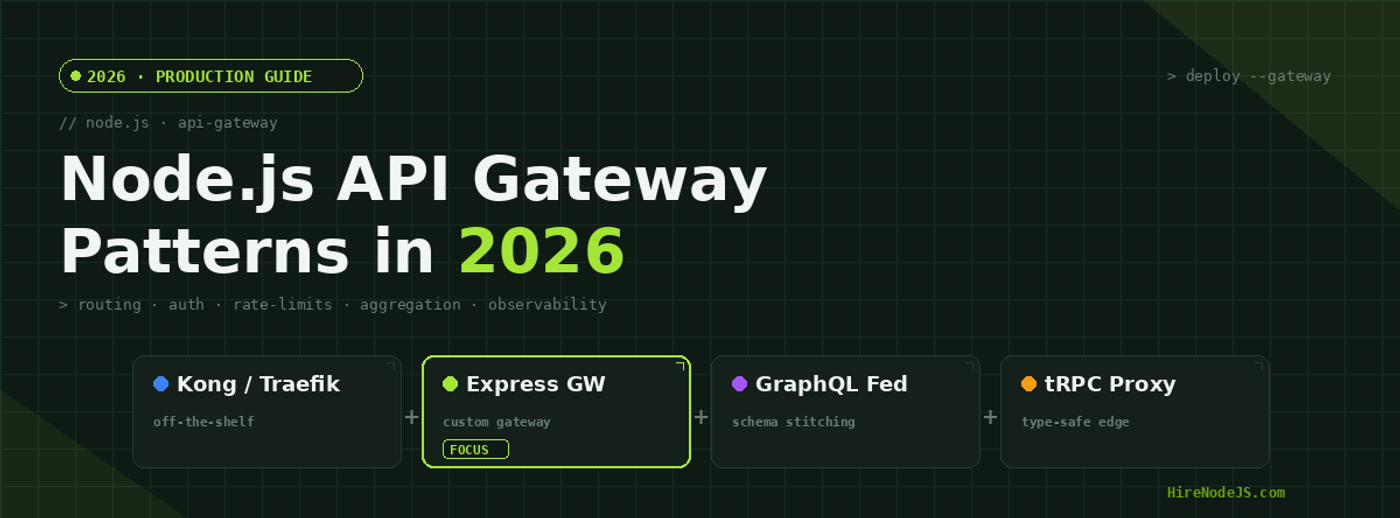
Node.js API Gateway Patterns: The 2026 Production Guide
Every Node.js application that grows beyond a single service eventually needs an API gateway. Whether you are routing traffic between microservices, enforcing authentication, or aggregating responses from multiple backends, the gateway becomes the front door of your architecture. In 2026, the Node.js ecosystem offers more gateway options than ever — from battle-tested proxies like Kong and Traefik to fully custom solutions built on Express or Fastify.
This guide walks you through the most effective API gateway patterns for Node.js applications, compares the leading solutions with real benchmark data, and provides production-ready code you can deploy today. Whether you are a startup shipping your first microservices split or an enterprise team scaling to hundreds of endpoints, you will find a pattern that fits. If you need to hire a Node.js developer who understands gateway architecture, this post also serves as a solid vetting resource.
What Is an API Gateway and Why Your Node.js App Needs One
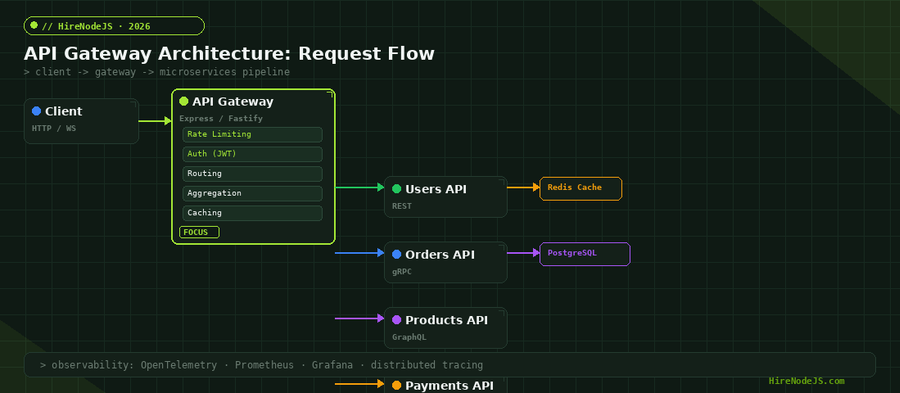
An API gateway sits between your clients and your backend services. Instead of exposing every microservice directly to the internet, clients send all requests to the gateway, which handles routing, authentication, rate limiting, request transformation, and response aggregation before forwarding traffic to the appropriate service.
Without a gateway, each service must independently handle cross-cutting concerns like JWT validation, CORS headers, and request logging. This leads to duplicated logic, inconsistent security enforcement, and a nightmare of configuration drift across services. A well-designed gateway centralises these concerns in one place.
Core Responsibilities of a Node.js API Gateway
A production-grade API gateway handles six primary responsibilities: request routing and load balancing, authentication and authorization (typically JWT or OAuth2), rate limiting and throttle controls, request and response transformation, response caching and aggregation, and observability including logging, metrics, and distributed tracing. Teams building backend systems at scale consider the gateway a critical infrastructure component.
Five API Gateway Patterns for Node.js in 2026
Not every application needs the same gateway architecture. The right pattern depends on your team size, traffic volume, service count, and how much control you need over the request pipeline. Here are the five patterns that dominate Node.js production deployments in 2026.
Pattern 1: Simple Reverse Proxy
The simplest gateway pattern is a reverse proxy that routes requests based on URL path prefixes. Tools like http-proxy-middleware in Express or @fastify/http-proxy make this trivial to set up. Each path prefix maps to a downstream service, and the proxy forwards requests with minimal transformation.
Pattern 2: Backend for Frontend (BFF)
The BFF pattern creates separate gateway instances for each client type — one for web, one for mobile, one for third-party API consumers. Each BFF tailors response shapes, field selections, and aggregation logic to the needs of its specific client. This prevents the one-size-fits-all problem where mobile clients receive enormous payloads designed for desktop.
Pattern 3: Aggregation Gateway
When a single client request needs data from multiple services, the aggregation gateway issues parallel requests to each service, combines the results, and returns a unified response. This reduces client-side complexity and eliminates multiple round trips. It is especially powerful for dashboard pages that pull from five or six services simultaneously.
Pattern 4: GraphQL Federation Gateway
GraphQL federation extends the gateway concept by composing a unified GraphQL schema from multiple subgraph services. Apollo Federation and Mercurius Gateway are the leading Node.js implementations. Clients query a single endpoint and the gateway resolves fields across services transparently.
Pattern 5: Edge Gateway with Serverless Functions
Edge gateways push routing and auth logic to CDN edge nodes using platforms like Cloudflare Workers or Vercel Edge Functions. The Node.js-compatible Hono framework has become the go-to choice for edge gateways in 2026, offering sub-millisecond cold starts and a familiar middleware API.
Building a Custom API Gateway with Express and Fastify
For teams with experienced Node.js developers, building a custom gateway offers the most control. You choose exactly which middleware runs, how requests are transformed, and how errors are handled. Here is a production-ready gateway skeleton using Express with http-proxy-middleware, JWT authentication, and rate limiting.
import express from 'express';
import { createProxyMiddleware } from 'http-proxy-middleware';
import rateLimit from 'express-rate-limit';
import jwt from 'jsonwebtoken';

const app = express();

// Rate limiting: 100 requests per 15 minutes per IP
const limiter = rateLimit({
  windowMs: 15 * 60 * 1000,
  max: 100,
  standardHeaders: true,
  legacyHeaders: false,
  message: { error: 'Too many requests, please try again later.' }
});
app.use(limiter);

// JWT authentication middleware
function authenticate(req, res, next) {
  const token = req.headers.authorization?.split(' ')[1];
  if (!token) return res.status(401).json({ error: 'Missing token' });

  try {
    req.user = jwt.verify(token, process.env.JWT_SECRET);
    next();
  } catch (err) {
    return res.status(403).json({ error: 'Invalid token' });
  }
}

// Service routing
const services = {
  '/api/users':    { target: 'http://users-service:3001',    auth: true },
  '/api/orders':   { target: 'http://orders-service:3002',   auth: true },
  '/api/products': { target: 'http://products-service:3003', auth: false },
  '/api/payments': { target: 'http://payments-service:3004', auth: true },
};

for (const [path, config] of Object.entries(services)) {
  const middlewares = [];
  if (config.auth) middlewares.push(authenticate);

  middlewares.push(createProxyMiddleware({
    target: config.target,
    changeOrigin: true,
    pathRewrite: { [`^${path}`]: '' },
    on: {
      proxyReq: (proxyReq, req) => {
        if (req.user) {
          proxyReq.setHeader('X-User-Id', req.user.sub);
          proxyReq.setHeader('X-User-Role', req.user.role);
        }
      }
    }
  }));

  app.use(path, ...middlewares);
}

// Health check
app.get('/health', (req, res) => res.json({ status: 'ok', uptime: process.uptime() }));

app.listen(3000, () => console.log('API Gateway listening on port 3000'));
This gateway handles four services with path-based routing. The authenticate middleware runs only on protected routes, injecting user identity headers into proxied requests so downstream services can authorize without re-validating the token. The rate limiter uses a sliding window of 100 requests per 15-minute window per IP.
Hire Pre-Vetted Node.js Developers
Skip the months-long search. Our exclusive talent network has senior Node.js experts ready to join your team in 48 hours.
Rate Limiting and Authentication Strategies
Rate limiting at the gateway level is your first line of defence against abuse, DDoS attacks, and runaway clients. In a Node.js gateway, you have three main strategies: fixed-window counters, sliding-window logs, and token-bucket algorithms. For most applications, the sliding-window approach provides the best balance of accuracy and memory efficiency.
Token-Based Authentication at the Gateway
JWT validation is the most common authentication pattern at the gateway. The gateway verifies the token signature and expiry, extracts claims like user ID and role, and forwards them as headers to downstream services. This means individual microservices never need to know about JWTs — they just trust the gateway-injected headers.
Redis-Backed Rate Limiting for Distributed Gateways
When you run multiple gateway instances behind a load balancer, in-memory rate limiting breaks down because each instance tracks its own counters. The solution is Redis-backed rate limiting using libraries like rate-limiter-flexible. Redis provides atomic increment operations and key expiry, making it ideal for distributed counters.
Observability: Logging, Metrics, and Distributed Tracing
A gateway without observability is a black hole. Every request that passes through your gateway should generate structured logs, increment metrics counters, and propagate trace context to downstream services. In the Node.js ecosystem, OpenTelemetry has become the standard instrumentation library for all three pillars.
Structured Logging with Pino
Pino is the fastest JSON logger in Node.js and integrates seamlessly with both Express and Fastify gateways. Log every incoming request with its method, path, status code, response time, and trace ID. Ship logs to your aggregation platform (Elasticsearch, Loki, or Datadog) for search and alerting.
Prometheus Metrics
Expose a /metrics endpoint from your gateway using prom-client. Track request count by route and status code, request duration histograms, active connections, and upstream service response times. These metrics feed Grafana dashboards and PagerDuty alerts that keep your team informed before users notice problems.
Performance Optimization for High-Traffic Gateways
A gateway that adds 50ms of latency to every request is unacceptable at scale. Node.js gateways can achieve sub-5ms overhead with the right architecture. The key optimisations are connection pooling to upstream services, response caching with Redis, and efficient JSON serialisation.
Connection Pooling
By default, Node.js creates a new TCP connection for every outbound HTTP request. In a gateway proxying thousands of requests per second, this creates massive overhead from TCP handshakes and TLS negotiation. Use undici (the modern HTTP client built into Node.js) with its connection pool configured to keep 10-20 persistent connections per upstream host.
Response Caching
Cache GET responses at the gateway level using Redis with cache-control header awareness. Set short TTLs (30-60 seconds) for dynamic data and longer TTLs (5-15 minutes) for reference data. This single optimisation can reduce upstream load by 60-80 percent for read-heavy APIs.
Hire Expert Node.js Developers — Ready in 48 Hours
Building the right system is only half the battle — you need the right engineers to build it. HireNodeJS.com specialises exclusively in Node.js talent: every developer is pre-vetted on real-world projects, API design, event-driven architecture, and production deployments.
Unlike generalist platforms, our curated pool means you speak only to engineers who live and breathe Node.js. Most clients have their first developer working within 48 hours of getting in touch. Engagements start as short-term contracts and can convert to full-time hires with zero placement fee.
Conclusion: Choosing the Right API Gateway Pattern
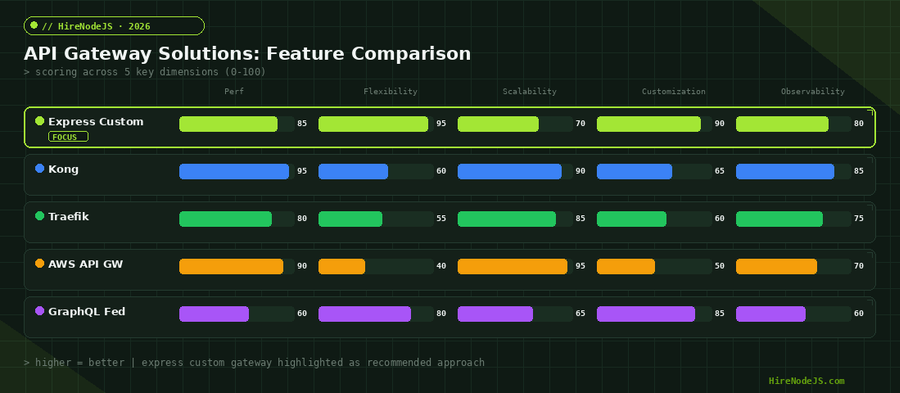
API gateway architecture is not one-size-fits-all. A startup with three microservices benefits from a simple Express reverse proxy. A growing company with 20 services and multiple client types should consider the BFF pattern. An enterprise with hundreds of services and dedicated platform teams may find Kong or Traefik more maintainable than a custom solution.
Whatever pattern you choose, invest in observability from day one, enforce authentication and rate limiting at the gateway layer, and benchmark your setup under realistic load before going to production. The Node.js ecosystem has mature, battle-tested tools for every gateway pattern covered in this guide. If you need experienced engineers to design and implement your gateway architecture, HireNodeJS can connect you with senior developers who have built gateways at scale.
Frequently Asked Questions
What is the best Node.js API gateway for microservices?
For most teams, a custom Express or Fastify gateway offers the best balance of flexibility and control. For teams that prefer configuration over code, Kong in DB-less mode is the strongest option with its extensive plugin ecosystem.
How much latency does an API gateway add to requests?
A well-optimised Node.js gateway adds 2-5ms of latency per request. This includes JWT validation, rate limit checks, and proxy overhead. Connection pooling with undici and response caching can keep overhead minimal even at high traffic volumes.
Should I use Kong or build a custom API gateway in Node.js?
Build custom when you need fine-grained control over request transformation, custom aggregation logic, or tight integration with your Node.js codebase. Use Kong when your team prefers declarative configuration and you need enterprise features like service mesh integration out of the box.
How do I handle authentication in a Node.js API gateway?
Validate JWTs at the gateway and forward user claims as trusted headers to downstream services. This centralises auth logic and keeps microservices simple. Use libraries like jsonwebtoken or jose for token validation, and consider JWKS endpoints for key rotation.
What is the BFF pattern and when should I use it?
The Backend for Frontend pattern creates separate gateway instances for each client type — web, mobile, and third-party APIs. Use it when different clients need significantly different response shapes, field selections, or aggregation strategies to avoid over-fetching.
How do I rate limit a distributed Node.js API gateway?
Use Redis-backed rate limiting with libraries like rate-limiter-flexible. Redis provides atomic counters shared across all gateway instances, ensuring consistent limits regardless of which instance handles the request. Combine IP-based and user-based limits for accuracy.
Vivek Singh is the founder of Witarist and HireNodeJS.com — a platform connecting companies with pre-vetted Node.js developers. With years of experience scaling engineering teams, Vivek shares insights on hiring, tech talent, and building with Node.js.
Building Microservices? Hire Gateway Architects Who Have Done It at Scale.
HireNodeJS connects you with pre-vetted senior Node.js engineers who specialise in API gateway design, microservices architecture, and production-grade distributed systems. Get your first developer within 48 hours — no recruiter fees.