Node.js + Apollo Federation in 2026: GraphQL at Scale
If you run a Node.js GraphQL API that started as a single schema and now spans four teams, three repos, and a backlog of breaking-change PRs, you have already hit the wall federation was built to break. In 2026, Apollo Federation v2 is the de-facto pattern for splitting a GraphQL graph into independently owned subgraphs while still presenting a single supergraph to clients.
This guide walks through what Apollo Federation actually is, when it is worth the operational cost, how to design subgraphs that compose cleanly, and how to migrate a monolithic Node.js GraphQL server without freezing your product roadmap. It is written for engineering leads and senior backend developers who already ship GraphQL in production and want to scale it past one team.
Why Federation, Why Now
The monolith schema reaches a breaking point
A single GraphQL schema is wonderful for the first 6–12 months. By month 18 it usually has more than 600 types, three teams pushing changes to the same SDL files, and a CI pipeline that takes 40 minutes because every PR rebuilds the whole codegen. Resolvers grow octopus arms into every database. Adding a new field becomes a four-team Slack thread.
What Apollo Federation v2 changes
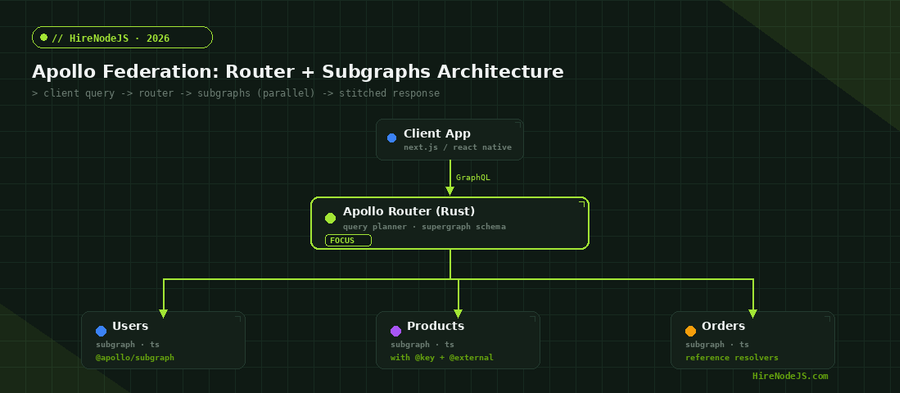
Apollo Federation v2 introduced the Apollo Router written in Rust, contributes/@override directives for safe schema migrations, and a much stricter composition model. The router replaces the old @apollo/gateway Node process and handles query planning at 3–5× the throughput. Combined with subgraphs written in TypeScript using @apollo/subgraph, you get one supergraph URL for clients and N independently deployable services for engineers.
Apollo Router vs the Legacy Node Gateway
Why the Rust router wins
The Apollo Router parses incoming GraphQL operations, builds a query plan from the composed supergraph schema, and dispatches sub-queries to the right subgraphs in parallel. Doing this in Rust rather than V8 means no garbage collection pauses on the hot path, much lower p99 latency, and dramatically lower memory at the same load. In practice, teams migrating from @apollo/gateway report 40–60% lower router CPU at the same RPS.
When to keep a Node.js gateway
There is one good reason to keep Node at the gateway layer: custom middleware that has to call into existing JavaScript libraries (legacy auth SDKs, internal logging shims, V8-only crypto modules). For everything else — rate limiting, JWT validation, header forwarding, response shaping — the Rust router has first-class extension points (Rhai scripts, native plugins, coprocessors) and you should use them.
Designing Subgraphs That Compose Cleanly
Pick boundaries that match team ownership
The single best predictor of federation success is whether subgraph boundaries match team boundaries. If the Users subgraph and the Orders subgraph are both owned by the same six engineers, you have created the operational overhead of microservices with none of the autonomy benefits. Carve subgraphs along Conway's Law — one subgraph per team or per bounded context that one team owns end-to-end.
Use @key wisely — fewer keys, simpler joins
An @key directive declares which fields uniquely identify an entity across subgraphs. Every additional @key on a type costs you in composition complexity and router CPU. Start with a single canonical @key (usually the id field) per shared entity. Add a second only when you have a real cross-subgraph query that needs lookup by a different field. Multiple keys per entity are a code smell more often than a feature.
A Working Node.js Subgraph in TypeScript
Here is a minimal, runnable Products subgraph using @apollo/subgraph and @apollo/server v4. It declares a Product entity that other subgraphs can extend, exposes a reference resolver so the router can fetch products by id, and uses DataLoader to prevent the N+1 problem when the router calls it for many ids at once.
import { ApolloServer } from '@apollo/server';
import { startStandaloneServer } from '@apollo/server/standalone';
import { buildSubgraphSchema } from '@apollo/subgraph';
import { gql } from 'graphql-tag';
import DataLoader from 'dataloader';
import { fetchProductsByIds, listProducts } from './productRepo.js';

const typeDefs = gql`
  extend schema
    @link(url: "https://specs.apollo.dev/federation/v2.6",
          import: ["@key", "@shareable"])

  type Product @key(fields: "id") {
    id: ID!
    name: String!
    priceCents: Int!
    inStock: Boolean! @shareable
  }

  type Query {
    products(limit: Int = 20): [Product!]!
  }
`;

const resolvers = {
  Query: {
    products: (_p, { limit }) => listProducts(limit),
  },
  Product: {
    // Reference resolver — called by the router to hydrate Product
    // when another subgraph (e.g. Orders) returns a Product reference.
    __resolveReference: (ref, ctx) => ctx.productLoader.load(ref.id),
  },
};

const server = new ApolloServer({
  schema: buildSubgraphSchema({ typeDefs, resolvers }),
});

const { url } = await startStandaloneServer(server, {
  listen: { port: 4002 },
  context: async () => ({
    productLoader: new DataLoader(fetchProductsByIds), // batches N+1
  }),
});

console.log(`Products subgraph ready at ${url}`);Composition, Schema-Check & CI
Rover and schema-check are non-negotiable
The Apollo Rover CLI composes your subgraph SDLs into a supergraph schema and runs schema-check against the current production schema. Wire rover subgraph check into every PR that touches a *.graphql file. Without it, a single bad PR in the Orders subgraph can break composition for the whole supergraph and you only find out when the router fails to start in staging.
Hire Pre-Vetted Node.js Developers
Skip the months-long search. Our exclusive talent network has senior Node.js experts ready to join your team in 48 hours.
Contract checks across subgraphs
Beyond schema validity, run contract tests that assert the supergraph still serves the queries your client apps actually make. Apollo Studio captures real operation signatures from production traffic; feed those signatures into PR checks so a Products subgraph change that removes a field used by the mobile app is rejected before merge, not after deploy.
Migrating from a Monolithic GraphQL Server
Strangler-fig, not big bang
The migrations that succeed treat the monolith as the first subgraph. Stand up the Apollo Router in front of it, prove zero regression, then carve out one bounded context at a time. Each carve-out is: (1) define the new subgraph SDL, (2) move resolvers, (3) remove from monolith SDL, (4) ship behind a feature flag in the router. Most teams take 3–6 months to fully extract; the value compounds from the first extraction.
Backwards compatibility with @override
The @override directive lets a new subgraph take ownership of a field from the old one without a coordinated cutover. Define the field in the new subgraph with @override(from: "monolith"), deploy, watch traces shift, then remove the field from the monolith. This is the single most important migration tool in Federation v2 — use it liberally.
Operational Concerns: Observability, Errors, Auth
Distributed tracing is mandatory
A single client query can hit four subgraphs through the router. Without distributed tracing you have no way to answer 'why was this slow?'. Enable OpenTelemetry on the router and every subgraph, ship to Tempo/Jaeger/Datadog, and make sure trace IDs propagate via the apollographql-client-trace-id header.
Auth at the edge, identity in context
Validate JWTs at the router using Rhai or a coprocessor — never inside subgraphs. The router then forwards a verified user identity header (x-user-id, x-user-roles) to subgraphs over the internal network. Subgraphs treat that header as ground truth; they never re-validate the JWT. This is faster, simpler, and avoids the trap of every subgraph importing your auth library.
Federation pushes hard on the seniority bar of your Node.js team. Junior engineers write resolvers; senior engineers design the entity model, set up composition CI, and own the observability story. If you are scaling a federated Node.js graph and need engineers who have done it before, HireNodeJS connects you with pre-vetted senior Node.js developers available within 48 hours — including engineers with Apollo Federation v2 production experience.
Caching, persisted queries, and the response layer
Persisted queries are an unsung superpower in federated graphs. The client registers a query hash at build time; at runtime it sends only the hash and variables. The router resolves the hash to a cached query plan, skips parsing, and answers in single-digit milliseconds for the hot path. Combine persisted queries with response caching keyed on user identity and you get a federated graph that handles thousands of RPS on modest hardware. If your team is also leaning on a Redis or in-memory cache layer to back the router, persisted queries cut downstream load by an additional 30–40%.
Database boundaries inside subgraphs
Each subgraph should own its own database. Sharing a Postgres instance across subgraphs is a federation anti-pattern: it couples teams at the storage layer and defeats the autonomy you paid for at the schema layer. If you need to give a subgraph access to data it doesn't own, expose that data over GraphQL from the owning subgraph — not by joining tables. For teams that need help shipping the data layer, HireNodeJS matches you with backend developers experienced in PostgreSQL and event-driven sync patterns that keep subgraph data stores aligned.
Error contracts and partial responses
GraphQL's killer feature is partial-data responses: if one subgraph fails, the router can still return the data from the others. Lean into this. Wrap every cross-subgraph call in a circuit breaker, return null + an entry in the errors array on failure, and let client UIs degrade gracefully. The alternative — failing the whole supergraph response when one subgraph hiccups — turns federation from a resilience win into a single point of failure.
Hire Expert Node.js Developers — Ready in 48 Hours
Building a federated GraphQL graph is only half the battle — you need the right engineers to design the entity model, write subgraph schemas, and run the router in production. HireNodeJS.com specialises exclusively in Node.js talent: every developer is pre-vetted on real-world GraphQL, event-driven architecture, and production deployments.
Unlike generalist platforms, our curated pool means you speak only to engineers who live and breathe Node.js. Most clients have their first developer working within 48 hours of getting in touch. Engagements start as short-term contracts and can convert to full-time hires with zero placement fee.
Conclusion: Federation Pays Off — If You Earn It
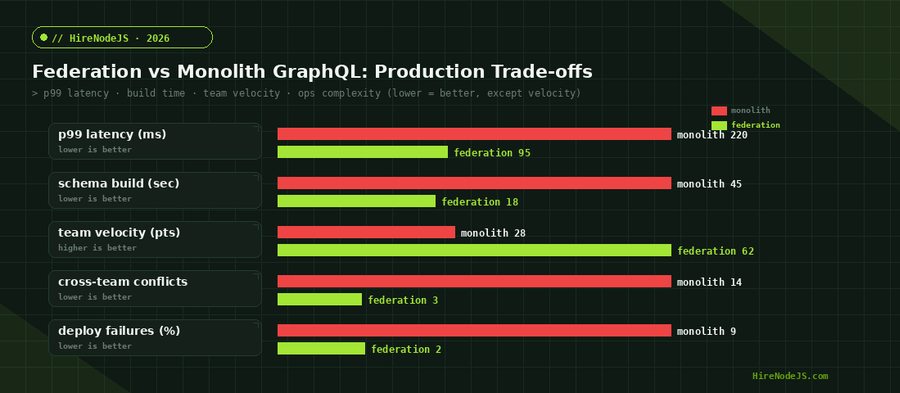
Apollo Federation v2 lets a Node.js GraphQL graph scale past the limits of any single team or codebase, but it is not free. The router is operational surface area. Composition rules will bite you. You will spend real engineering time on entity modelling and CI. The payoff is real autonomy: teams ship subgraphs independently, breaking changes get caught in CI not in production, and clients still see a single graph.
If you are still on a monolithic schema with one team and clean ownership, federation is overkill — invest in DataLoader, caching, and tracing first. If you have three or more teams, a CI pipeline that is starting to crawl, and PR conflicts on the schema every week, federation is the answer. Start with the strangler-fig migration, lean on @override, and budget the first migration to take longer than you expect — every subsequent one will be 3× faster.
Frequently Asked Questions
What is Apollo Federation and when should I use it for Node.js?
Apollo Federation is a GraphQL architecture for splitting a single graph into multiple independently deployed subgraphs, each owned by a different team. Use it when you have 3+ teams touching one Node.js GraphQL schema or when your CI pipeline starts to choke on the monolithic schema size.
Is Apollo Federation v2 production-ready in 2026?
Yes — Federation v2 with the Apollo Router (Rust) is the production-default for federated GraphQL in Node.js shops in 2026. The Rust router replaces the older @apollo/gateway Node process and delivers significantly lower p99 latency at the same RPS.
Should I use Apollo Router or stick with @apollo/gateway?
Use Apollo Router. The Node-based @apollo/gateway is no longer the recommended path: it is slower, harder to scale, and missing most of the v2 features. Migrate to the Rust router unless you absolutely need V8-only middleware.
How do I handle authentication in a federated GraphQL setup?
Validate JWTs once at the router using Rhai scripts or a coprocessor, then forward verified identity headers (x-user-id, x-user-roles) to subgraphs over the internal network. Subgraphs trust those headers and never re-validate the JWT.
What is the @key directive and how should I use it?
@key declares the fields that uniquely identify an entity across subgraphs. Start with a single canonical @key per shared entity (usually id). Add additional keys only when you have a concrete cross-subgraph query that needs lookup by a different field.
How do I hire Node.js developers with Apollo Federation experience?
Federation experience is relatively rare even among senior Node.js engineers. Platforms like HireNodeJS.com specialise in pre-vetted Node.js talent and can match you with engineers who have shipped Federation v2 in production, typically within 48 hours.
Vivek Singh is the founder of Witarist and HireNodeJS.com — a platform connecting companies with pre-vetted Node.js developers. With years of experience scaling engineering teams, Vivek shares insights on hiring, tech talent, and building with Node.js.
Need a Node.js + Apollo Federation expert?
HireNodeJS connects you with pre-vetted senior Node.js engineers who have shipped federated GraphQL in production. Available within 48 hours, no recruiter fees.