Node.js Authentication in 2026: JWT, OAuth 2.0, and Sessions
Authentication in 2026 looks very different from the era of homemade login forms and a single secret string copy-pasted into config. Modern Node.js apps run across multiple regions, talk to mobile clients and other services, and increasingly delegate identity to external providers. The wrong choice — a long-lived JWT with no rotation, sessions without CSRF protection, or an OAuth flow with a sloppy redirect URI — is now one of the most common ways production Node.js systems get breached.
This guide walks through the three patterns every Node.js team has to choose between in 2026: stateless JWT-based auth, classic server sessions, and federated OAuth 2.0 (with PKCE). You will get production-ready code, the trade-offs nobody mentions in the README, and the security pitfalls that show up in nearly every audit we run. By the end you will know which pattern fits your product, and what to look for when interviewing engineers to build it.
Why Node.js authentication choices matter more in 2026
Three things changed in the last 18 months. Browsers deprecated long-lived third-party cookies, OWASP refreshed its API Security Top 10 with three auth-specific entries, and most production Node.js apps now ship with at least one mobile or service-to-service client. Each of these tilts a different lever in your authentication design — cookie strategy, token lifetime, and revocation — and they often pull in opposite directions.
The blast radius is bigger than your auth route
A weak password hash or a leaked signing key does not stop at /login. It usually exposes background jobs, internal admin endpoints, and the data pipeline that runs as a service account. In a microservices architecture, every additional service multiplies the surface area where a stolen token can be replayed.
Hiring auth-aware engineers is harder than it sounds
Most candidates can implement a JWT login route. Far fewer can explain when a refresh token must rotate, why an HMAC-signed JWT and an RS256 JWT cannot be casually swapped, or how to invalidate sessions in a multi-region Redis setup. If you need help finding senior engineers who actually do this well, HireNodeJS connects you with pre-vetted backend developers who have shipped production auth at scale.
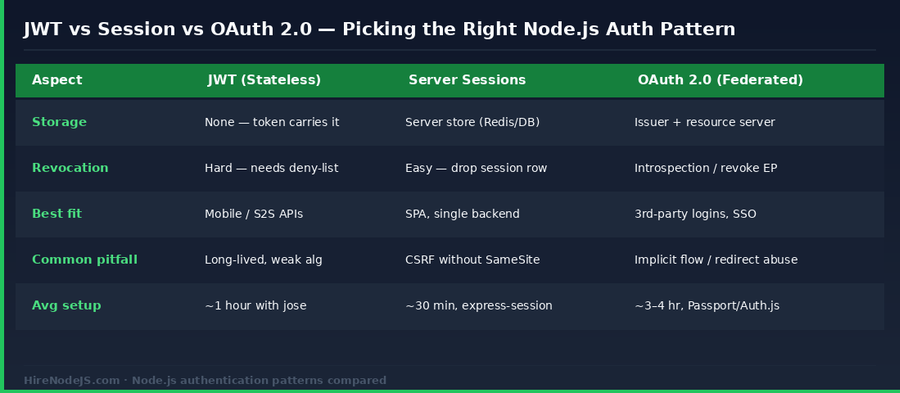
JWT authentication: stateless, fast, easy to misuse
JSON Web Tokens are the default reflex for new Node.js APIs, especially when there is a mobile client. The token itself carries the user identity and a small payload, signed by the server. There is nothing to look up on each request, which is why JWT scales beautifully across regions.
When JWT is the right call
JWT shines when your API is consumed by clients you cannot keep a session for: mobile apps, single-page apps with cross-origin requirements, IoT devices, and other backend services. It also fits nicely with serverless platforms where instance memory is ephemeral.
Production-grade JWT in Node.js with jose
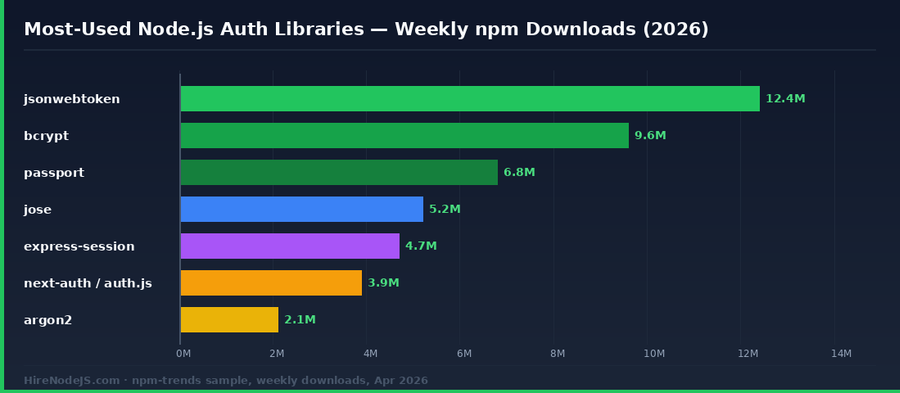
The community has largely moved off jsonwebtoken for new code in favour of jose, which uses the WebCrypto API and supports modern algorithms out of the box. Below is a minimal but production-shaped sign + verify pair using EdDSA keys.
// auth/jwt.js
import { SignJWT, jwtVerify, generateKeyPair } from 'jose';

// In production: load these from KMS / Vault, not generated each boot.
const { privateKey, publicKey } = await generateKeyPair('EdDSA');

export async function signAccessToken(user) {
  return new SignJWT({ role: user.role })
    .setProtectedHeader({ alg: 'EdDSA' })
    .setSubject(user.id)
    .setIssuer('https://api.example.com')
    .setAudience('example-web')
    .setIssuedAt()
    .setExpirationTime('15m')   // SHORT — refresh tokens handle longevity
    .setJti(crypto.randomUUID())
    .sign(privateKey);
}

export async function verifyAccessToken(token) {
  const { payload } = await jwtVerify(token, publicKey, {
    issuer: 'https://api.example.com',
    audience: 'example-web',
    algorithms: ['EdDSA'],
  });
  return payload;
}
Two more details separate production-grade JWT from tutorial JWT. First, treat your signing key like a database password — load it from a secret manager, rotate it on a schedule (90 days is a reasonable starting point), and publish a JWKS endpoint so clients can fetch the next public key before you cut over. Second, never put anything sensitive in the payload — the body of a JWT is base64-encoded, not encrypted, and anyone with the token can read it.
Algorithm choice also matters. EdDSA (Ed25519) is fast, has small keys, and produces compact signatures — ideal for mobile clients on flaky networks. RS256 is the safe choice when you need wider library compatibility. HS256 is acceptable for single-service systems but couples every consumer to the signing secret, which becomes painful the moment you split a service in two.
Server sessions: still the safest default for browser SPAs
Despite the JWT hype, classic server sessions remain the lowest-risk choice when your app is a browser-only SPA talking to a single backend. The token never leaves your server — the client only carries an opaque session ID in an HttpOnly cookie — which closes off an entire class of XSS-driven token theft.
Express + Redis sessions in 2026
A correctly configured express-session backed by Redis is still a great fit for monoliths and modular monoliths. The configuration below shows the four cookie flags that matter most.
// auth/session.js
import express from 'express';
import session from 'express-session';
import { RedisStore } from 'connect-redis';
import { createClient } from 'redis';

const redis = createClient({ url: process.env.REDIS_URL });
await redis.connect();

const app = express();

app.use(session({
  store: new RedisStore({ client: redis, prefix: 'sess:' }),
  secret: process.env.SESSION_SECRET,   // 32+ bytes random
  resave: false,
  saveUninitialized: false,
  rolling: true,
  cookie: {
    httpOnly: true,        // blocks JS access -> blunts XSS
    secure: true,          // HTTPS only
    sameSite: 'lax',       // CSRF default; use 'strict' for sensitive flows
    maxAge: 1000 * 60 * 60 * 8,  // 8 hours
  },
}));

app.post('/login', loginRateLimiter, async (req, res) => {
  const user = await verifyPassword(req.body.email, req.body.password);
  if (!user) return res.status(401).json({ error: 'Invalid credentials' });
  req.session.regenerate(err => {            // prevents fixation
    if (err) return res.status(500).end();
    req.session.userId = user.id;
    res.json({ ok: true });
  });
});
Two non-obvious wins: setting rolling: true means the cookie is refreshed on each request so active users do not get logged out mid-task, and req.session.regenerate() on login defeats session fixation attacks.
The reason this design holds up so well in 2026 is the combination of HttpOnly + SameSite. HttpOnly stops document.cookie from reading the session ID, which neutralises the most common XSS-driven account takeover. SameSite=Lax (or Strict for purely first-party flows) closes off the classic CSRF vector without you having to wire up CSRF tokens by hand for every state-changing route. Add a Content Security Policy on top and most cookie-based attack patterns disappear.
Hire Pre-Vetted Node.js Developers
Skip the months-long search. Our exclusive talent network has senior Node.js experts ready to join your team in 48 hours.
OAuth 2.0 and OIDC: when you should not roll your own
Once you need "Sign in with Google", "Sign in with GitHub", enterprise SSO, or a single identity that spans multiple of your products, you have crossed into OAuth 2.0 territory. OpenID Connect (OIDC) sits on top of OAuth and adds a standardised identity token — most modern providers expose both.
Use Auth.js (NextAuth) or Passport — but understand what they do
In 2026 the two pragmatic choices are Auth.js for Next.js or any Node.js HTTP framework, and Passport for older Express monoliths. Both abstract a lot of detail, which is why hiring an engineer who actually understands the underlying OAuth flow matters. Senior Node.js developers from HireNodeJS will know that Authorization Code with PKCE is the only flow you should use in 2026 — Implicit and Resource Owner Password Credentials are deprecated.
PKCE is now mandatory, not optional
A useful rule of thumb when picking a provider: if you only need login (authentication), Google, GitHub, or Microsoft Entra are zero-cost and well documented. If you also need authorization, multi-tenant identity, or enterprise features like SCIM provisioning and SAML support, look at managed identity platforms (Auth0, Clerk, WorkOS, FusionAuth). Building these in-house with Passport plus a database is possible, but it is a multi-quarter project that almost always under-estimates compliance work like audit logs, MFA enrollment, and account recovery flows.
Public clients (mobile apps, SPAs) cannot keep a client secret. PKCE — Proof Key for Code Exchange — replaces the secret with a per-request hashed challenge, making intercepted authorization codes useless. Your OAuth library should be doing this for you; if it is not, you have picked the wrong library.
Password hashing, rate limiting, and the boring 90%
Choosing JWT vs sessions vs OAuth gets all the airtime, but most actual auth breaches in 2026 come from the boring fundamentals: weak password hashing, no rate limit on /login, and verbose error messages that leak whether an email is registered.
Use argon2id, not bcrypt, not SHA-anything
argon2id is now the OWASP-recommended default. It is memory-hard, which makes GPU-based cracking dramatically more expensive than bcrypt at the same wall-clock time. The argon2 npm package is a thin native binding and is fast enough for any production login route.
// auth/password.js
import argon2 from 'argon2';

export async function hashPassword(plain) {
  return argon2.hash(plain, {
    type: argon2.argon2id,
    memoryCost: 19 * 1024,   // 19 MiB — OWASP minimum 2026
    timeCost: 2,
    parallelism: 1,
  });
}

export async function verifyPassword(stored, plain) {
  try { return await argon2.verify(stored, plain); }
  catch { return false; }   // hash format issue -> treat as miss
}
If you are migrating an existing app off bcrypt, do it lazily rather than forcing a global password reset. On successful login, re-hash the supplied plaintext with argon2id and update the row. Within a few weeks of normal traffic, your active users are migrated. The rest can stay on bcrypt — your verifyPassword should detect the algorithm prefix and route to the correct verifier.
Refresh tokens, revocation, and multi-device logout
Short-lived access tokens are only useful when paired with a refresh token strategy that lets users stay logged in for weeks. Done wrong, the refresh token becomes the long-lived secret you were trying to avoid. Done right, it gives you per-device control and instant revocation.
The rotating refresh token pattern
Issue an opaque refresh token (random 256-bit string, NOT a JWT) stored server-side as a hash, scoped to a device. Every refresh exchange invalidates the old token and issues a new one. Reuse of a previously-seen refresh token instantly invalidates the entire family — that is your detection of a stolen token.
Revocation across regions
On the client side, prefer "silent refresh" — when an access token is within ~30 seconds of expiry, exchange the refresh token in the background and retry the original request transparently. This avoids the user-visible 401 → redirect → re-login loop that is the single biggest source of churn in mobile apps. Browser SPAs can do the same trick by intercepting fetch() responses with a service worker or an Axios interceptor.
When a user explicitly logs out, do not just delete the access token. Revoke the refresh token server-side and remove every active session row tied to that device. "Log out everywhere" — a now-standard feature — is just the same operation applied to every device row for the user.
For multi-region deployments, store the refresh-token deny-list and the active-session table in a low-latency, replicated store. Most teams reach for Redis for this — sub-millisecond reads on every authenticated request, and TTLs you can lean on for automatic cleanup. Postgres works too if you can tolerate ~5–10ms reads.
Hire Expert Node.js Developers — Ready in 48 Hours
Building solid authentication is half the battle — you also need engineers who understand the security implications of every architectural choice. HireNodeJS.com specialises exclusively in Node.js talent: every developer is pre-vetted on real-world projects covering JWT rotation, OAuth 2.0 / OIDC, session security, and production deployments across AWS, GCP, and on-prem.
Unlike generalist platforms, our curated pool means you speak only to engineers who live and breathe Node.js. Most clients have their first developer working within 48 hours of getting in touch. Engagements start as short-term contracts and can convert to full-time hires with zero placement fee.
Summary: pick the right auth pattern, then nail the basics
There is no single "best" Node.js authentication pattern in 2026 — there is the one that fits your client mix and operational reality. JWT for mobile and service-to-service, server sessions for browser-only SPAs talking to a single backend, OAuth 2.0 / OIDC when you need federated identity. Whichever you pick, the wins come from the boring fundamentals: short-lived access tokens, rotating refresh tokens, argon2id password hashing, rate-limited login routes, and pinned algorithms in your verify calls.
If you would rather have an engineer who has built this five times before than learn it from your own incident postmortems, the right hire pays for itself before the first audit cycle.
Frequently Asked Questions
Should I use JWT or sessions for a Node.js web app in 2026?
For a browser-only SPA talking to one backend, server sessions with HttpOnly + SameSite cookies are still the safest default. Reach for JWT when you have mobile clients, service-to-service traffic, or strict horizontal-scaling requirements where session lookups are a bottleneck.
Is bcrypt still safe for password hashing in Node.js?
bcrypt is acceptable but no longer the recommended default. OWASP now suggests argon2id with at least 19 MiB memory cost. Use the argon2 npm package — bcrypt is fine for legacy systems, but new code should default to argon2id.
How long should a JWT access token live?
Keep access tokens short — 5 to 15 minutes is the 2026 norm. Pair them with a rotating refresh token that lasts days or weeks. This keeps your blast radius small if a token leaks while still giving users a long, seamless login.
Do I need PKCE for OAuth 2.0 in a Node.js mobile or SPA client?
Yes. PKCE is mandatory for any public client — mobile apps and single-page apps included — because they cannot safely keep a client secret. The OAuth 2.1 draft removes the Implicit and Password Credentials flows entirely.
Where should I store JWTs in the browser?
Prefer HttpOnly cookies with SameSite=Lax (or Strict). Browser local storage is reachable from any JavaScript on the page, which means a single XSS bug exfiltrates every user token. If you must use a token store, scope it tightly and shorten lifetimes.
How do I invalidate a JWT before it expires?
Pure JWT does not give you that for free. Either keep a server-side deny-list of jti claims (cheap if you use Redis with TTLs), or move stateful sessions for the routes that need instant revocation. A rotating refresh token plus a short access-token TTL is the most common pragmatic answer.
Vivek Singh is the founder of Witarist and HireNodeJS.com — a platform connecting companies with pre-vetted Node.js developers. With years of experience scaling engineering teams, Vivek shares insights on hiring, tech talent, and building with Node.js.
Need Node.js developers with security-first thinking?
HireNodeJS connects you with pre-vetted senior backend engineers who have shipped JWT, OAuth 2.0, and session-based auth in production. Available within 48 hours — no recruiter fees, no lengthy screening.