Node.js Authorization Patterns: RBAC, ABAC & CASL in 2026
Authorization is the silent guardian of every production Node.js application. While authentication verifies who a user is, authorization determines what that user can do — and getting it wrong leads to data breaches, privilege escalation, and compliance failures. In 2026, with SaaS products growing more complex and multi-tenant architectures becoming the norm, choosing the right authorization pattern is no longer optional — it is a critical architectural decision.
This guide walks you through the three dominant authorization patterns in the Node.js ecosystem — RBAC, ABAC, and the increasingly popular CASL library — with production-ready code, performance benchmarks, and practical advice for teams looking to hire Node.js developers who understand security at a deep level.
Understanding Authorization Models in Node.js
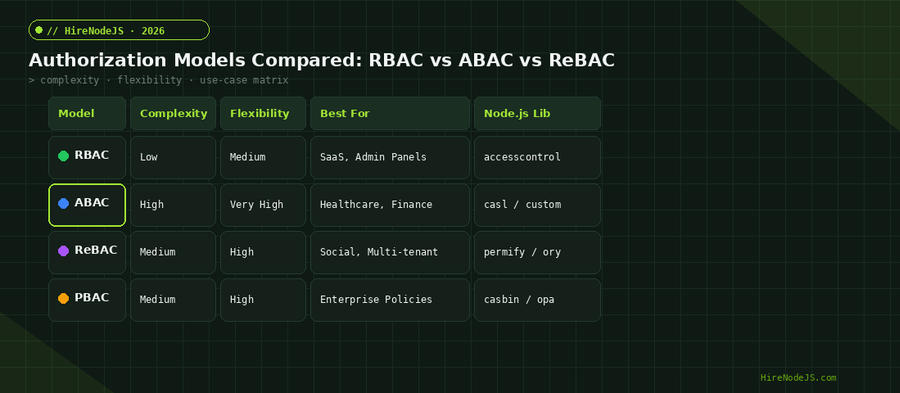
Before writing a single line of middleware, engineering teams need to understand the fundamental differences between authorization models. Each model trades simplicity for flexibility, and the right choice depends on your product requirements, team size, and compliance obligations.
What Is RBAC (Role-Based Access Control)?
RBAC is the most widely adopted authorization pattern in web applications. Users are assigned roles — such as admin, editor, or viewer — and each role carries a predefined set of permissions. When a user attempts an action, the system checks whether their role includes the required permission. This model works exceptionally well for applications with a clear hierarchy: admin dashboards, content management systems, and internal tools where roles map cleanly to job functions.
What Is ABAC (Attribute-Based Access Control)?
ABAC evaluates access decisions based on attributes of the user, the resource, and the environment. Instead of checking a static role, ABAC evaluates dynamic conditions: Can this user edit this document if they are in the same department and the document was created less than 24 hours ago? This model is essential in healthcare, finance, and government applications where access policies are complex and context-dependent.
Where Does CASL Fit In?
CASL is an isomorphic authorization library for JavaScript and TypeScript that bridges the gap between RBAC and ABAC. It lets you define abilities — what a user can do — using a fluent API that supports both role-based rules and attribute-based conditions. The key advantage is that CASL abilities can be shared between your Node.js backend and your frontend, eliminating the common problem of duplicating authorization logic across the stack.
Setting Up CASL in a Node.js Application
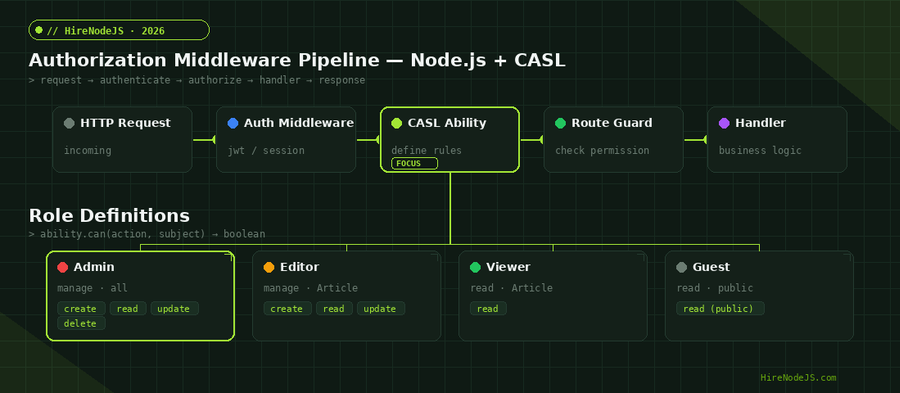
CASL provides a clean, declarative API for defining user abilities. The setup involves three steps: installing the package, defining ability rules based on user roles, and creating middleware that checks abilities on every request.
Installing CASL and Defining Abilities
Start by installing the core CASL packages. The @casl/ability package provides the rule engine, while @casl/mongoose integrates directly with Mongoose for document-level permission checks.
import { AbilityBuilder, createMongoAbility } from '@casl/ability';

export function defineAbilitiesFor(user) {
  const { can, cannot, build } = new AbilityBuilder(createMongoAbility);

  switch (user.role) {
    case 'admin':
      can('manage', 'all'); // full access to everything
      break;

    case 'editor':
      can('read', 'Article');
      can('create', 'Article');
      can('update', 'Article', { authorId: user.id }); // only own articles
      cannot('delete', 'Article');
      break;

    case 'viewer':
      can('read', 'Article');
      can('read', 'Comment');
      break;

    default:
      can('read', 'Article', { published: true }); // guests see public only
  }

  return build();
}
Creating Authorization Middleware
The middleware pattern integrates cleanly with Express or Fastify. Each route handler declares the action and subject it requires, and the middleware checks the user's ability before the request reaches the backend developer's business logic.
RBAC Implementation Patterns for Production
Pure RBAC remains the most practical choice for the majority of Node.js applications. The pattern is straightforward: store roles in your database, attach the role to the user's session or JWT payload, and check permissions in middleware. The key to a maintainable RBAC system is keeping roles and permissions in a database rather than hardcoding them.
Database-Driven Role Management
Store roles and permissions in PostgreSQL or MongoDB rather than in application code. This allows non-engineering teams to adjust permissions through an admin interface without requiring a deployment. A typical schema uses three tables: users, roles, and a join table mapping roles to granular permissions.
Hierarchical Roles
Many SaaS applications need hierarchical roles where an admin inherits all editor permissions, and an editor inherits all viewer permissions. Implement this by defining a role hierarchy map and recursively resolving permissions at runtime. CASL supports this natively through its ability builder — define viewer rules first, then layer editor rules on top, and finally admin rules.
Hire Pre-Vetted Node.js Developers
Skip the months-long search. Our exclusive talent network has senior Node.js experts ready to join your team in 48 hours.
ABAC: When Roles Are Not Enough
Attribute-based access control shines in scenarios where permissions depend on context. Consider a healthcare application where a doctor can view patient records only if they are the assigned physician, the patient has consented to data sharing, and the access is happening during business hours from an approved network. RBAC cannot express this — you would need a separate role for every combination of conditions.
Implementing ABAC with CASL Conditions
CASL supports ABAC through its conditions API. When defining abilities, you can pass a conditions object that the library evaluates at runtime against the actual resource. This is where CASL's Mongo-like query syntax becomes powerful — you can express complex conditions using operators like $eq, $in, $gt, and $exists.
Performance Considerations for ABAC
ABAC evaluations are inherently more expensive than role checks because they require loading resource attributes before making a decision. For high-throughput Node.js APIs, cache ability definitions per user session using Redis, and avoid re-evaluating conditions on every request when the underlying data has not changed.
Multi-Tenant Authorization Strategies
Multi-tenant SaaS applications face a unique authorization challenge: users in Tenant A must never access resources belonging to Tenant B, even if they share the same role name. A viewer in one organization is completely unrelated to a viewer in another. This tenant isolation layer sits beneath your RBAC or ABAC logic and must be enforced at the database query level, not just in middleware.
Tenant-Scoped CASL Abilities
The cleanest approach is to include the tenant ID as a condition in every CASL ability definition. When you define that an editor can update articles, add the condition that the article's tenantId must match the user's tenantId. This ensures that even if a bug bypasses your middleware, the ability check itself prevents cross-tenant access.
Row-Level Security as a Safety Net
For maximum safety, pair your application-level authorization with database-level row-level security (RLS). PostgreSQL supports RLS natively, allowing you to define policies that filter rows based on the current session's tenant context. This defense-in-depth approach means that even a SQL injection attack cannot leak data across tenants.
Testing Authorization Logic
Authorization bugs are among the most dangerous vulnerabilities in any application, and they are notoriously difficult to catch in manual testing. A comprehensive test suite should verify both positive cases (the user can perform the action) and negative cases (the user is correctly denied). Test at three levels: unit tests for ability definitions, integration tests for middleware, and end-to-end tests for complete request flows.
Unit Testing CASL Abilities
CASL abilities are pure functions — given a user object, they return a set of rules. This makes them ideal for unit testing. Write tests for every role in your system, verifying each action-subject pair. Pay special attention to edge cases: what happens when a user has multiple roles? What about a role with both a can and a cannot rule for the same action?
Integration Testing with Supertest
Use Supertest to verify that your Express or Fastify routes correctly enforce permissions. Create test users with different roles, authenticate them, and verify that protected endpoints return 403 for unauthorized users and 200 for authorized ones. Automate this in your CI pipeline so that every pull request is checked for authorization regressions.
Hire Expert Node.js Developers — Ready in 48 Hours
Building the right authorization system is only half the battle — you need the right engineers to build it. HireNodeJS.com specialises exclusively in Node.js talent: every developer is pre-vetted on real-world projects, API design, event-driven architecture, and production deployments.
Unlike generalist platforms, our curated pool means you speak only to engineers who live and breathe Node.js. Most clients have their first developer working within 48 hours of getting in touch. Engagements start as short-term contracts and can convert to full-time hires with zero placement fee.
Conclusion: Choosing the Right Authorization Pattern
Authorization is not a one-size-fits-all problem. RBAC works for the vast majority of applications and should be your default starting point. When your product requirements demand contextual, attribute-based decisions — healthcare, finance, multi-tenant SaaS — move to ABAC or adopt CASL to get the best of both worlds. The key is to start simple, enforce permissions at every layer, test aggressively, and never trust the client.
Whether you are building a new Node.js application from scratch or refactoring authorization in an existing system, investing in a solid authorization architecture pays dividends in security, maintainability, and user trust. If your team needs experienced engineers who understand these patterns deeply, explore the HireNodeJS platform to find pre-vetted talent ready to ship.
Frequently Asked Questions
What is the best authorization library for Node.js in 2026?
CASL is the most popular isomorphic authorization library for Node.js in 2026, with over 285K weekly npm downloads. It supports both RBAC and ABAC patterns and shares ability definitions between backend and frontend.
What is the difference between RBAC and ABAC in Node.js?
RBAC assigns permissions based on user roles (admin, editor, viewer), while ABAC evaluates access based on attributes of the user, resource, and environment. RBAC is simpler to implement; ABAC handles complex, context-dependent policies.
How do I implement role-based access control in Express.js?
Install @casl/ability, define abilities per role using AbilityBuilder, then create Express middleware that calls ability.can(action, subject) before each route handler. Store roles in your database rather than hardcoding them.
Can CASL handle multi-tenant authorization?
Yes. Include the tenantId as a condition in your CASL ability definitions so every permission check is automatically scoped to the current tenant. Pair this with database-level row-level security for defense in depth.
How do I test authorization logic in a Node.js API?
Test at three levels: unit tests for CASL ability definitions (pure functions), integration tests with Supertest to verify HTTP 403/200 responses per role, and end-to-end tests covering complete auth flows including edge cases like multiple roles.
How much does it cost to hire a Node.js developer with security expertise?
Senior Node.js developers with authorization and security expertise typically cost between $60-$120 per hour depending on region and engagement type. HireNodeJS connects you with pre-vetted engineers available within 48 hours.
Vivek Singh is the founder of Witarist and HireNodeJS.com — a platform connecting companies with pre-vetted Node.js developers. With years of experience scaling engineering teams, Vivek shares insights on hiring, tech talent, and building with Node.js.
Need Node.js Developers with Security-First Thinking?
HireNodeJS connects you with pre-vetted senior Node.js engineers who understand authorization, authentication, and security patterns at a deep level. Available within 48 hours — no recruiter fees.