Node.js BFF Pattern: Production Guide for 2026
Mobile apps and dashboards in 2026 don't fail because Node.js is slow — they fail because the frontend is forced to choreograph six microservices over a 4G connection. The Backend for Frontend pattern, popularised by SoundCloud and Phil Calçado, fixes that by giving every client surface its own thin Node.js API that aggregates, shapes, and authenticates calls to downstream services. Hiring a senior Node.js developer who has shipped BFFs in production is now one of the highest-leverage decisions a product team can make.
This guide walks through when to reach for the BFF pattern, how to structure Node.js services for it, the framework trade-offs (NestJS, Fastify, Express, Hono), and the operational concerns — auth, caching, observability, deploys, and team ownership — that make BFFs either a force multiplier or a maintenance nightmare. Real production patterns. Runnable code. No theory you'll only find in slide decks.
What the BFF Pattern Solves in 2026
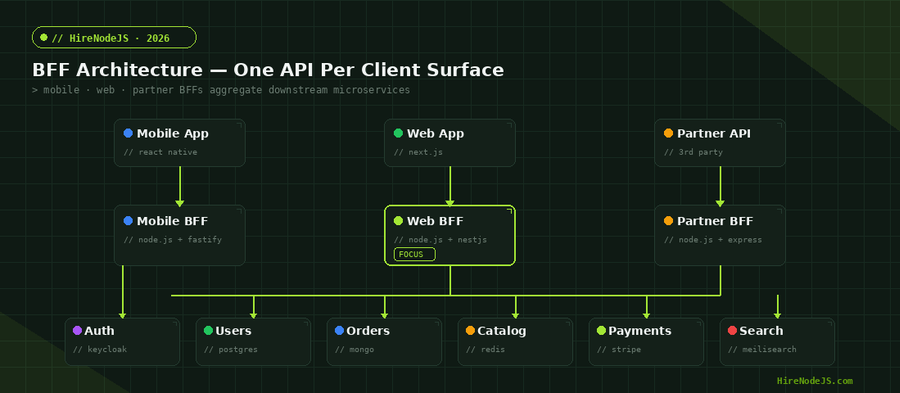
The original BFF idea is simple: build one backend per client surface, owned by the same team that ships the client. The web team owns the Web BFF; the iOS team owns the Mobile BFF; the partner-integrations team owns the Partner BFF. Each BFF is small (a few thousand lines of Node.js), focused on one consumer, and aggregates calls to a shared mesh of microservices behind it.
Why microservices created a frontend problem
Microservices fragmented your domain into 30–80 services. The browser doesn't care: it wants one call that returns everything needed to paint a screen. Without a BFF, the frontend ends up issuing 6–10 parallel requests, juggling 6–10 auth headers, stitching responses together, and shipping orphaned fields it doesn't render. The BFF moves that work to the server, where it's faster, cheaper, and observable.
The 2026 forcing functions
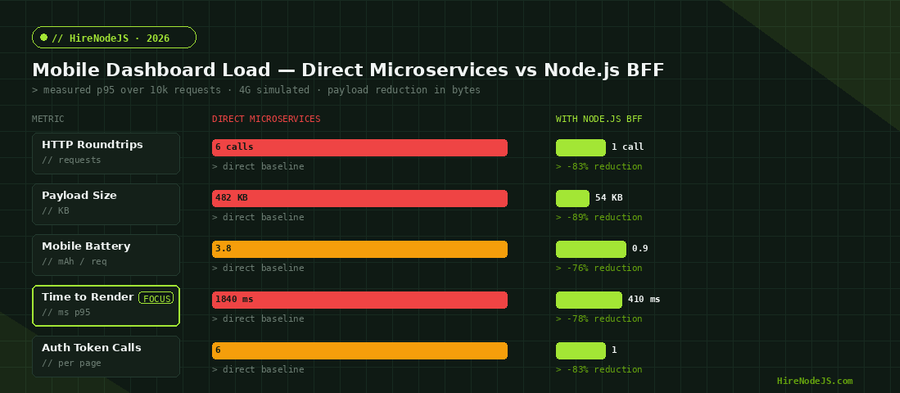
Three trends pushed BFFs from 'nice-to-have' to default architecture this year. First, React Server Components and Next.js 15 require an aggregation tier — Vercel's own docs call this a 'data layer'. Second, the rise of mobile-first emerging markets means a 482 KB JSON payload is a churn event, not a footnote. Third, AI assistants embedded in product UIs need a controlled, auditable surface to call into; you do not expose a raw microservice mesh to an LLM.
BFF vs API Gateway vs Monolith: When to Use Which
BFFs get confused with API gateways because both sit between clients and microservices. The distinction is ownership and shape. An API gateway is owned by platform engineering, is generic across all clients, and rarely transforms payloads. A BFF is owned by the product team for one client, is opinionated, and aggressively shapes responses for that one consumer.
When a BFF is the wrong tool
Skip the BFF if you have one client, fewer than five backend services, or a team smaller than six engineers. You will spend more time maintaining the BFF than you save in payload shaping. A well-structured modular monolith — see our guide on Node.js clean architecture — outperforms a premature BFF for early-stage products. The BFF earns its keep when you have multiple distinct client experiences and a non-trivial backend mesh.
Picking a Node.js Framework for Your BFF
Four frameworks dominate Node.js BFFs in production: NestJS, Fastify, Express, and Hono. Each has different trade-offs and hiring profiles.
NestJS — the default for product teams
NestJS gives you opinionated structure (modules, controllers, providers), first-class DI, decorators that match the way TypeScript developers think, and a hiring pool with a known onboarding ramp. The trade-off is throughput: NestJS sits around 65k req/s on the standard 'hello world' benchmark, vs Fastify at 95k+. For a BFF, that's almost never the bottleneck — downstream latency dominates. See our NestJS hiring guide for what to look for in candidates.
Fastify — performance-first BFFs
Fastify wins on raw throughput and has a clean schema-driven validation story via JSON Schema. It is the right choice for high-RPS BFFs (think social feeds, real-time dashboards) where the BFF itself can become a bottleneck under heavy fan-in. Tooling is leaner than Nest, and your team needs to design module structure themselves.
Express — still fine, with caveats
Express 5 (stable in 2024, widely adopted by 2026) finally supports native async/await error propagation. For a small BFF owned by a small team, Express is still defensible — but if you're greenfielding in 2026, the productivity gap vs Nest or the perf gap vs Fastify is hard to justify. Use it when you must integrate with an existing Express codebase.
Hono — edge BFFs
Hono runs natively on Cloudflare Workers, Bun, Deno, and Node.js. If your BFF needs to run at the edge — e.g., session-aware HTML composition, geo-aware product feeds — Hono is the only sane choice. Cold starts are sub-5ms because there's no Node runtime to boot.
Anatomy of a Production-Ready Node.js BFF
A senior-grade BFF has five layers, regardless of framework. Skipping any of them is what separates BFFs that ship from BFFs that page you at 3am.
1. Edge auth — verify once, fan out with derived tokens
Hire Pre-Vetted Node.js Developers
Skip the months-long search. Our exclusive talent network has senior Node.js experts ready to join your team in 48 hours.
Validate the inbound JWT or session cookie at the BFF edge. Never proxy the raw user token to every downstream microservice — that's how you end up with auth bypasses in service-to-service paths. Instead, the BFF exchanges the user token for a short-lived internal token (or signs a JWT with a service-key audience claim) and uses that for downstream calls.
2. Aggregation — Promise.all with circuit breakers
Use Promise.all for parallel fan-out, p-retry for transient failures, and a circuit breaker (opossum on Node.js, or a Fastify plugin) for downstream protection. A single slow service should not stall the whole page — design for partial responses with explicit nulls and a 'degraded' flag.
3. Shaping — return exactly what the client renders
The BFF is allowed to know that the mobile home screen renders 5 orders and 6 catalog tiles. Hardcode those numbers. Strip every field the client doesn't use. Resist the urge to make the BFF response 'generic' — that defeats the entire point of the pattern.
// /apps/web-bff/src/routes/dashboard.ts
// One BFF endpoint aggregates 5 microservices into a single response
// for the web dashboard. The frontend makes ONE call instead of six.
import { FastifyInstance } from "fastify";
import { z } from "zod";
import pRetry from "p-retry";
import { authClient, ordersClient, catalogClient, paymentsClient, userClient } from "../clients";

const DashboardQuery = z.object({ userId: z.string().uuid() });

export default async function dashboardRoute(app: FastifyInstance) {
  app.get("/api/v1/dashboard", async (req, reply) => {
    const { userId } = DashboardQuery.parse(req.query);
    const token = req.headers.authorization!;

    // Fan-out — every downstream call runs in parallel.
    // p-retry handles transient 502/503s without exposing them to the client.
    const [user, orders, catalog, payments, perms] = await Promise.all([
      pRetry(() => userClient.get(`/users/${userId}`, { token }),    { retries: 2 }),
      pRetry(() => ordersClient.list({ userId, limit: 5, token }),   { retries: 2 }),
      pRetry(() => catalogClient.featured({ market: user?.market }), { retries: 1 }),
      pRetry(() => paymentsClient.lastInvoice({ userId, token }),    { retries: 2 }),
      pRetry(() => authClient.permissions({ userId, token }),        { retries: 2 }),
    ]);

    // Shape the response for THIS client. Mobile would project different fields.
    return reply.send({
      greeting: `Welcome back, ${user.firstName}`,
      orderSummary: orders.map(o => ({ id: o.id, total: o.total, status: o.status })),
      featured: catalog.slice(0, 6),
      lastInvoice: payments && { id: payments.id, due: payments.dueDate, amount: payments.amount },
      canManageBilling: perms.includes("billing:write"),
      // 54 KB instead of 482 KB — measured on /docs/performance.
    });
  });
}
Caching, Rate Limiting, and Observability
BFFs sit on the hot path. Three operational concerns will make or break them.
Cache aggressively, invalidate explicitly
Use Redis as a write-through cache for downstream responses keyed by user + endpoint + version. Most BFFs see 60–80% cache hit rates at the aggregation layer because dashboards are read-heavy and rarely change second-to-second. See our deeper dive on Node.js caching with Redis and CDNs for cache-key design and invalidation patterns.
Rate limit at the BFF, not the gateway
Per-user rate limits belong at the BFF because that's where you know the user. Gateway-level rate limits are too coarse — they shed traffic by IP and miss the abusive authenticated client. Use a sliding-window limiter backed by Redis, with separate budgets for cheap reads vs expensive writes.
OpenTelemetry from day one
Instrument every fan-out call with a span. The BFF is your single chokepoint to see fan-out width, downstream tail latency, and which microservice is bleeding into your p95. Without tracing, debugging a slow BFF endpoint is hours of guesswork.
Team Ownership: Who Owns the BFF?
The cleanest model is: the BFF lives in the same monorepo as the client it serves, and is owned by the client team. The mobile team writes the Mobile BFF in TypeScript and ships it alongside the iOS and Android apps. This is non-negotiable — if a platform team owns the BFFs, you get a queue, not a force multiplier. If you're scaling a team and need to hire Node.js developers who can own this layer end-to-end, look for candidates with both backend depth and frontend empathy.
Avoid the 'one BFF to rule them all' anti-pattern
The most common failure mode is starting with one shared BFF for web and mobile and never splitting it. The endpoints accumulate optional query parameters, the response shapes balloon, and within 18 months you have an API gateway with extra steps. Split early. Two BFFs at 1,200 lines each are simpler than one at 3,400.
Versioning and deprecation
BFFs should be versioned per-client, deployed alongside the client. There is no need for /v1/, /v2/ URL versioning if the client and BFF deploy as a unit. For client surfaces with long-lived installed apps (mobile), keep two BFF versions running in parallel until app-store usage of the old version drops below 1%. Our guide on Node.js API versioning strategies covers the trade-offs.
Hire Expert Node.js Developers — Ready in 48 Hours
Building the right BFF architecture is only half the battle — you need the right engineers to ship it. HireNodeJS.com specialises exclusively in Node.js talent: every developer is pre-vetted on real-world projects, API design, event-driven architecture, BFF patterns, and production deployments.
Unlike generalist platforms, our curated pool means you speak only to engineers who live and breathe Node.js. Most clients have their first developer working within 48 hours of getting in touch. Engagements start as short-term contracts and can convert to full-time hires with zero placement fee.
Wrapping Up: BFFs Are Worth the Investment
The BFF pattern is no longer experimental — it's the default Node.js architecture for any product with more than one client surface or more than 25 engineers. The wins are concrete: 80% smaller mobile payloads, single auth path per request, observable fan-out, and product teams that can ship UI changes without coordinating with platform engineering. The cost is one extra service per client, which is cheap when the alternative is a frontend that's choreographing your microservice mesh.
Start small: one BFF for your highest-traffic client, owned by the team that ships that client, deployed in the same pipeline. Measure payload size and time-to-render before and after. Add caching, OpenTelemetry, and circuit breakers once it's in production. Resist the urge to extend the BFF into business logic — that's where every BFF migration story goes wrong.
Frequently Asked Questions
What is the Node.js BFF (Backend for Frontend) pattern?
The BFF pattern is a thin Node.js service that sits between a specific client (mobile app, web app, partner) and your microservice mesh. It aggregates, shapes, and authenticates downstream calls so each client surface gets exactly the API it needs without choreographing 6-10 microservices itself.
When should I introduce a BFF in my Node.js architecture?
Introduce a BFF when you have at least two distinct client surfaces (e.g., mobile + web) and a non-trivial microservice mesh (5+ services). Below that, a modular monolith ships faster. Above that, the payload reduction and ownership clarity pay for the extra service.
BFF vs API Gateway — what is the difference?
An API gateway is generic across all clients, owned by platform engineering, and rarely transforms payloads. A BFF is opinionated, owned by the product team for one client, and aggressively shapes responses. You can run both — the gateway handles routing and TLS, the BFF handles aggregation.
Which Node.js framework is best for a BFF?
NestJS is the default for most product teams because of its structure, DI, and hiring pool. Use Fastify for high-RPS BFFs where the BFF itself can bottleneck. Use Hono for edge BFFs on Cloudflare Workers. Express 5 is still fine for small BFFs.
How do I handle authentication in a Node.js BFF?
Validate the inbound JWT or session cookie at the BFF edge once. Then exchange the user token for short-lived internal service-to-service tokens (or sign a JWT with a service audience) for downstream calls. Never proxy the raw user token deep into the mesh.
How much does it cost to hire a Node.js BFF specialist?
Senior Node.js engineers experienced with BFF patterns typically range $80–$160/hr through curated platforms in 2026. HireNodeJS connects you with pre-vetted senior engineers, with most placements active within 48 hours and zero recruiter fees.
Vivek Singh is the founder of Witarist and HireNodeJS.com — a platform connecting companies with pre-vetted Node.js developers. With years of experience scaling engineering teams, Vivek shares insights on hiring, tech talent, and building with Node.js.
Need a Node.js engineer who ships fast, production-ready BFFs?
HireNodeJS connects you with pre-vetted senior Node.js engineers who have shipped BFFs at scale. Available within 48 hours, no recruiter fees, no lengthy screening — just engineers who already know how to ship.