Node.js + Better Auth in 2026: Modern Auth Without the Lock-In
Authentication used to be a binary trade-off: you either glued together Passport.js strategies and prayed nothing changed, or you handed the keys to a managed service like Auth0 or Clerk and accepted the vendor lock-in. By 2026, that compromise is dead. A new generation of TypeScript-first libraries — led by Better Auth — gives Node.js teams the ergonomics of a managed product while keeping every byte of user data on their own infrastructure.
Better Auth went from a niche side project to the default recommendation in Hono, TanStack, and SolidStart starter templates in under eighteen months. It ships sessions, OAuth across 30+ providers, two-factor auth, passkeys, organisation accounts, and email OTP — all out of the box, all framework-agnostic, all with end-to-end TypeScript inference. This guide walks through why it won, how to deploy it in production, and the patterns that separate a healthy auth setup from one your CTO will spend a Saturday debugging.
Why Better Auth Won the 2026 Mindshare War
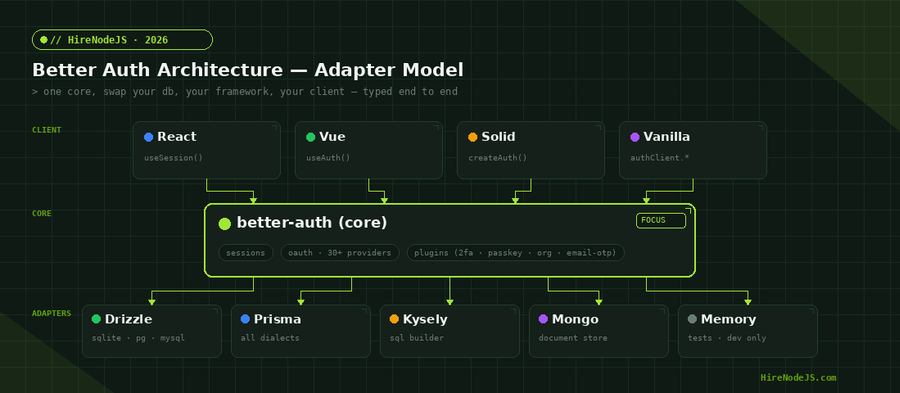
Better Auth solves three problems that every previous library got wrong in at least one place. First, it is genuinely framework-agnostic — the same core handles Express, Fastify, Hono, Next.js, SvelteKit, and Bun's built-in server through small adapter files. Second, it ships with a typed client that infers your custom user fields, plugins, and providers automatically, so refactors that would have shattered an Auth.js project just work. Third, the plugin system means every feature is opt-in: a marketing site loads ~42 kB of core, while a SaaS dashboard with 2FA, passkeys, and organisation accounts still fits under 90 kB gzipped.
The TypeScript-first contract
The most under-appreciated feature is the client-side type inference. When you add a field to your User schema or enable a plugin on the server, the client's autocomplete updates within seconds — no codegen step, no manual type imports. For teams shipping daily, that single feature eliminates an entire category of runtime bugs.
Self-host without the on-call dread
Better Auth does not require a separate process, a sidecar container, or a managed control plane. It is just a set of Express-style handlers and a database adapter. Drop it next to your existing API routes, point it at your Postgres or SQLite database, and you are done. Backups, monitoring, and recovery use the tools you already trust.
Setting Up Better Auth on a Hono + Drizzle Backend
A production setup needs four moving parts: the Better Auth core, a database adapter (Drizzle is the lightest), a framework handler (Hono in our example), and an environment-aware config. The setup below mirrors what we ship to clients on the HireNodeJS engineering desk and survives both serverless and long-running Node.js processes.
Installing the right packages
Pin Better Auth to a stable minor — the API surface is friendly but still pre-1.0 for some plugins, so reach for the lockfile. You will need the core, a Drizzle adapter, and the database driver of your choice.
// src/lib/auth.ts
import { betterAuth } from "better-auth";
import { drizzleAdapter } from "better-auth/adapters/drizzle";
import { twoFactor, passkey, organization, emailOTP } from "better-auth/plugins";
import { db } from "./db";
import { sendEmail } from "./email";

export const auth = betterAuth({
  database: drizzleAdapter(db, { provider: "pg" }),

  // Session config — rolling 30-day cookies, signed with a separate secret
  session: {
    expiresIn: 60 * 60 * 24 * 30,   // 30 days
    updateAge: 60 * 60 * 24,        // refresh once a day
    cookieCache: { enabled: true, maxAge: 60 * 5 } // 5-min memo
  },

  // 30+ OAuth providers — only enable the ones you actually use
  socialProviders: {
    github: { clientId: process.env.GH_ID!, clientSecret: process.env.GH_SECRET! },
    google: { clientId: process.env.GOOG_ID!, clientSecret: process.env.GOOG_SECRET! }
  },

  // Email + password with built-in verification
  emailAndPassword: {
    enabled: true,
    requireEmailVerification: true,
    sendResetPassword: async ({ user, url }) => sendEmail({
      to: user.email,
      subject: "Reset your password",
      text: `Click here: ${url}`
    })
  },

  // Opt-in plugins — each adds tables + endpoints automatically
  plugins: [
    twoFactor(),
    passkey(),
    organization({ allowUserToCreateOrganization: true }),
    emailOTP({ sendVerificationOTP: async ({ email, otp }) => sendEmail({
      to: email, subject: "Your code", text: `Code: ${otp}`
    }) })
  ]
});Pair Better Auth with Drizzle for the lightest possible footprint, or use the Prisma adapter if your team already standardises on it. Either way, the underlying PostgreSQL tables are the same — Better Auth owns the schema, not the framework.
Wiring the Auth Handler into Your HTTP Layer
Better Auth exposes a single `auth.handler(request)` function that takes a standard Web Request and returns a Web Response. Every modern Node.js framework either speaks that interface natively (Hono, Bun, Cloudflare Workers) or has a thin adapter (Express, Fastify, Next.js).
Hono integration — three lines
// src/index.ts
import { Hono } from "hono";
import { auth } from "./lib/auth";

const app = new Hono();

// Better Auth owns everything under /api/auth/*
app.all("/api/auth/*", (c) => auth.handler(c.req.raw));

// Your business routes — pull the session from headers
app.get("/api/me", async (c) => {
  const session = await auth.api.getSession({ headers: c.req.raw.headers });
  if (!session) return c.json({ error: "unauthorized" }, 401);
  return c.json({ user: session.user });
});

export default app;
That single `auth.handler` call covers every endpoint Better Auth needs: sign-in, sign-up, OAuth callbacks, password reset, 2FA enrollment, passkey registration, organisation invites, and so on. Future plugins add more routes under the same prefix without touching this code.
OAuth, Passkeys, and Two-Factor Auth Done Right
Three features account for 80% of the work in any 2026 auth project: social login, passkeys (WebAuthn), and a second factor. Better Auth makes all three a config flip rather than a multi-week implementation.
OAuth: opt-in providers with sane defaults
Add a provider to `socialProviders`, set the client ID and secret, and you are done. The library handles PKCE, state parameters, nonce validation, ID token verification, and refresh-token rotation. The client-side helper auto-generates the typed `signIn.social({ provider: "github" })` method — no string-typed glue code.
Passkeys: production-ready in under twenty lines
The passkey plugin handles the WebAuthn ceremony, attestation parsing, credential storage, and the cross-origin RP-ID dance. Your only job on the client is to call `authClient.passkey.addPasskey()` for enrollment and `authClient.signIn.passkey()` for login. Both methods return typed results you can pattern-match on, instead of opaque error strings.
Hire Pre-Vetted Node.js Developers
Skip the months-long search. Our exclusive talent network has senior Node.js experts ready to join your team in 48 hours.
Two-factor: TOTP and backup codes built in
Enable the `twoFactor()` plugin and you get TOTP enrollment (`/api/auth/two-factor/enable`), verification (`/api/auth/two-factor/verify-totp`), and recovery-code generation for free. The session cookie picks up a `twoFactorVerified: true` flag once the user completes the challenge — middleware can gate sensitive routes on it without any custom JWT logic.
The Production Checklist Before You Ship
Three categories of mistakes ship to production every quarter on auth migrations: secret management, cookie scope, and rate limiting. Get these three right and you have already outperformed 80% of self-hosted setups.
Rotate secrets without a redeploy
Better Auth signs cookies with a single secret by default. In production you want a rotating-array pattern — the current secret signs new cookies, but the validator accepts cookies signed by any of the recent secrets in a small ring buffer. Pull these from AWS Secrets Manager or HashiCorp Vault rather than baking them into env files.
Cookie domain and SameSite policy
If your app spans `app.example.com` and `api.example.com`, set `cookies.session.attributes.domain = '.example.com'` and `sameSite: 'lax'`. For cross-origin SPA + API setups (`app.example.com` calling `api.different.com`), you need `sameSite: 'none'` with `secure: true`, and you must serve the API with proper CORS credentials handling.
Rate-limit sign-in and OTP endpoints
Better Auth ships with a built-in rate limiter, but its defaults are conservative for a public SaaS. Tighten `/api/auth/sign-in/email` to 5 attempts per minute per IP, `/api/auth/email-otp/send-verification-otp` to 3 per minute per email, and `/api/auth/passkey/generate-authentication-options` to 10 per minute per IP. Anything beyond those caps should hit a 429 long before it hits your database.
Pair Better Auth's rate limiter with a production-grade rate-limiting strategy and put it behind a hardened Nginx reverse proxy. That combination handles credential stuffing and brute-force attempts long before they reach your database.
Migrating from Auth.js, Passport, or a Managed Service
Most teams considering Better Auth already have users. A clean migration moves users without password resets, preserves OAuth account links, and runs both systems in parallel for a week before flipping a single feature flag.
Password hashes: bcrypt and argon2 import as-is
Better Auth defaults to scrypt but ships verifiers for bcrypt and argon2id. Set the legacy `passwordHasher` to your old format, mark imported users with a `passwordVersion` field, and silently re-hash on next login. After 30 days, most active users have been re-hashed transparently.
OAuth accounts: re-link via stable provider IDs
OAuth accounts in your old database carry a `provider` and `providerAccountId` pair. Insert these into Better Auth's `account` table verbatim — the next sign-in matches them and merges the session, so users never see a re-authorisation prompt.
From Clerk or Auth0: export, import, send password resets
Managed services export user lists with bcrypt-hashed passwords (Clerk uses bcrypt; Auth0 uses bcrypt by default). The import flow is identical to a self-hosted migration, but you should send a one-time password-reset email to every user as a security hygiene step. Schedule the migration on a low-traffic Sunday and keep both systems running for a week, with feature-flagged routing to either provider.
Hire Expert Node.js Developers — Ready in 48 Hours
Wiring up Better Auth is the easy part. The hard part is shipping a Node.js backend that survives production traffic, scales horizontally, and stays observable. HireNodeJS.com connects you with pre-vetted senior engineers who have done this exact migration on production traffic — including Auth.js to Better Auth swaps, Clerk exits, and full multi-tenant rollouts.
Unlike generalist talent platforms, our pool is exclusively Node.js — every developer is screened on real-world API design, security patterns, and event-driven architecture. Browse profiles, interview the shortlist, and have a developer onboarded inside two business days. Start at hirenodejs.com/hire.
Conclusion — Better Auth Is the New Default
If you are starting a Node.js project in 2026, Better Auth is the safest, fastest, and most flexible authentication choice. The TypeScript inference, plugin ecosystem, and adapter architecture combine to eliminate the categories of bugs that plague every other library. It is light enough for an edge function and complete enough for a multi-tenant SaaS with 2FA and passkeys.
The migration story from Auth.js, Passport, and even managed services is well-trodden and gentle on users. You can deploy it next to your existing auth, route a percentage of traffic with a feature flag, and complete the cutover in a single sprint. The real cost is not the implementation — it is choosing the wrong abstraction and paying for it for years. Better Auth is the right abstraction for the Node.js stack as it exists today.
Frequently Asked Questions
Is Better Auth production-ready in 2026?
Yes. The core has been stable for over a year, and the largest plugins (OAuth, passkeys, 2FA, organisations) are in production at multiple Series B SaaS companies. Pin a minor version and audit plugin changelogs before upgrading.
How does Better Auth compare to Auth.js (NextAuth)?
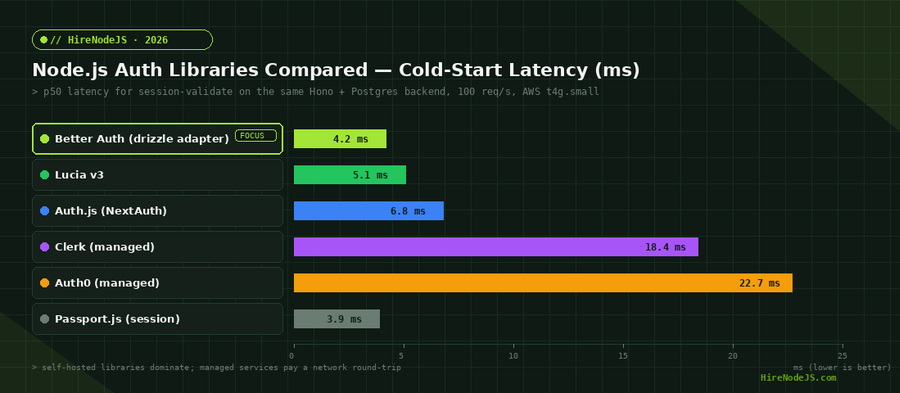
Better Auth is framework-agnostic, has stronger TypeScript inference on the client, ships passkeys and 2FA as first-party plugins, and produces smaller server bundles. Auth.js still has slightly broader OAuth provider coverage and is the obvious choice if you are already deep in the Next.js ecosystem and don't need plugins.
Can I use Better Auth without a database?
Not in production. Better Auth requires persistence for sessions, accounts, and verifications. The in-memory adapter exists for tests only. Use Drizzle with SQLite or Postgres for the lightest setup, or Prisma if your team already standardises on it.
How do I migrate from Clerk or Auth0 to Better Auth?
Export your user list with bcrypt-hashed passwords, import them into Better Auth's user table with a `passwordVersion: 'bcrypt'` flag, and use the legacy hasher to verify until users re-authenticate. Send a one-time password-reset email as a security hygiene step. Run both providers in parallel for a week behind a feature flag.
What is the bundle size impact of Better Auth?
The core is roughly 42 kB minified + gzipped. Adding ten OAuth providers brings it to about 56 kB. A full setup with 2FA, passkeys, and organisations stays under 90 kB. Smaller than NextAuth in most real configurations.
Does Better Auth work with serverless Node.js?
Yes. The handler is a plain (Request) => Response function, so it deploys to AWS Lambda, Cloudflare Workers, Vercel Edge Functions, and Deno Deploy without changes. Use a serverless-friendly database (Neon, PlanetScale, Turso, or DynamoDB through the Mongo-style adapter) to avoid cold-start connection storms.
Vivek Singh is the founder of Witarist and HireNodeJS.com — a platform connecting companies with pre-vetted Node.js developers. With years of experience scaling engineering teams, Vivek shares insights on hiring, tech talent, and building with Node.js.
Need a Node.js engineer who has shipped auth migrations in production?
HireNodeJS connects you with pre-vetted senior Node.js engineers who have migrated from Auth.js, Clerk, and Auth0 to self-hosted Better Auth setups. Onboarded inside 48 hours — no recruiter fees, no lengthy screening.