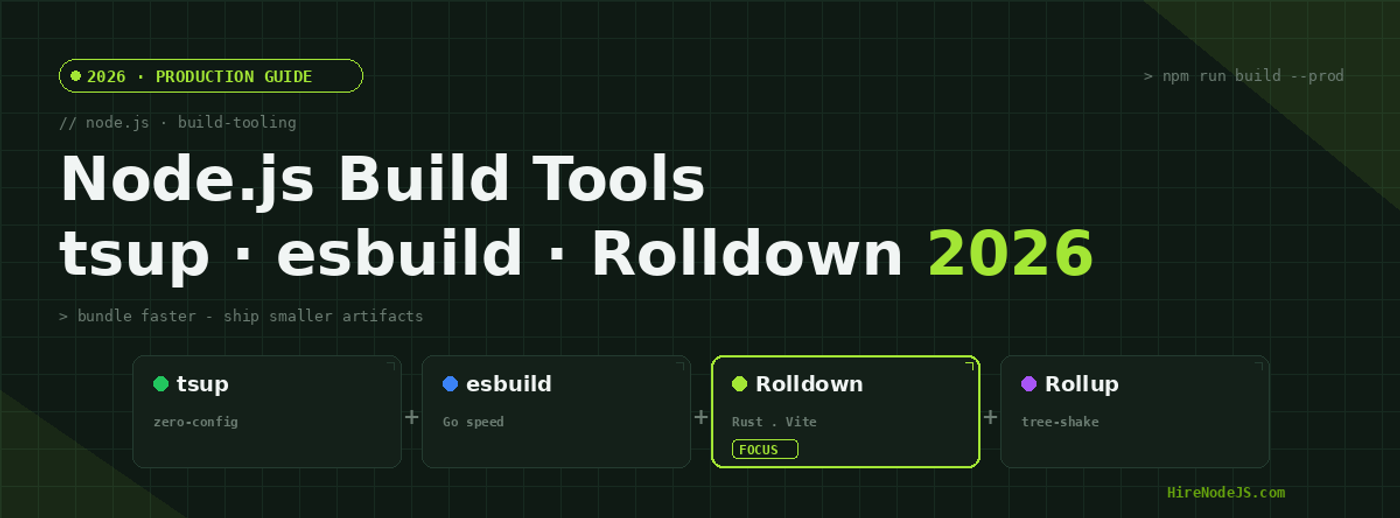
Node.js Build Tools in 2026: tsup vs esbuild vs Rolldown
Every Node.js project eventually hits the same wall: the build step. What starts as a single index.js grows into thousands of TypeScript modules, a publishable package, and a deploy artifact that has to be small, fast, and reproducible. In 2026 the tooling that produces that artifact has changed dramatically — the JavaScript-based bundlers that defined the last decade are being replaced by tools written in Go and Rust, and the difference in build time is no longer measured in percentages but in multiples.
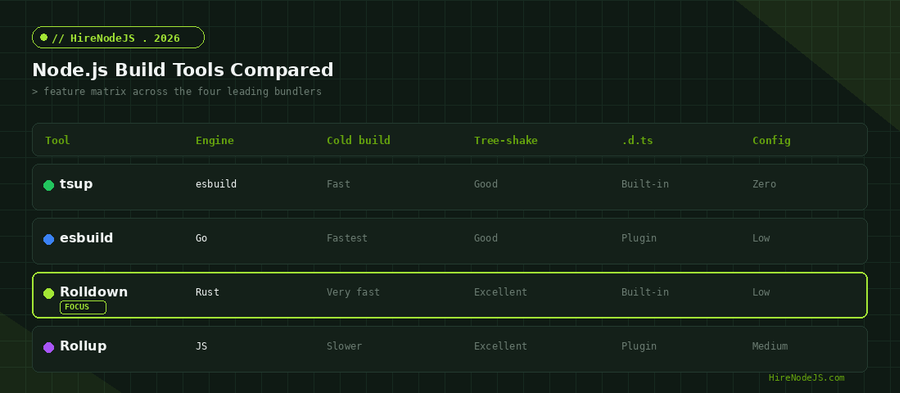
This guide compares the four bundlers that matter most for Node.js work today — tsup, esbuild, Rolldown, and Rollup — across build speed, bundle size, type-definition support, and developer experience. Whether you ship an npm library or a containerized backend service, the right choice can cut your CI time in half. And if you are scaling a team to ship faster, you can always hire vetted Node.js developers who already know these tools cold.
Why Node.js Build Tooling Matters in 2026
The cost of a slow build compounds
A build that takes ten seconds feels harmless until you multiply it. Run it on every save during development, on every commit in CI, and across every member of a ten-person team, and a slow bundler quietly burns hundreds of engineering hours a month. Fast feedback loops are not a luxury — they directly shape how often developers refactor, test, and ship. The shift toward native-speed tooling is fundamentally about reclaiming that lost time.
Bundling is not just for the browser
There is a persistent myth that backend Node.js code does not need bundling. In practice, bundling a service produces a single, tree-shaken entrypoint that starts faster, ships in a smaller Docker layer, and removes dead code paths that bloat your attack surface. Combined with strong TypeScript practices and type-stripping, a modern build pipeline gives you both safety and speed without a heavyweight toolchain.
The Four Bundlers You Should Know
esbuild — the Go-powered speed floor
esbuild, written in Go, set the modern speed baseline. It compiles and bundles TypeScript an order of magnitude faster than the JS-based tools that came before it. Its weaknesses are deliberate: tree-shaking is good but not best-in-class, and it does not emit TypeScript declaration files on its own. It is the engine many higher-level tools build on rather than a complete library-publishing solution by itself.
tsup — zero-config bundling for libraries
tsup wraps esbuild with sensible defaults aimed at package authors. It emits ESM and CommonJS output, generates .d.ts declaration files, and needs almost no configuration to publish a clean dual-format package. For most libraries it is the fastest path from source to a publishable artifact.
Rolldown and Rollup — the tree-shaking lineage
Rollup pioneered ES-module tree-shaking and remains the gold standard for output quality, but its JavaScript core makes it slow on large graphs. Rolldown is its Rust-based successor — a drop-in-style replacement that keeps Rollup's plugin philosophy while delivering build times close to esbuild. It is the engine now powering Vite's bundling path, which is why it has become the most-watched tool in this space.
Benchmarks: Build Speed and Bundle Size
Cold builds versus incremental rebuilds
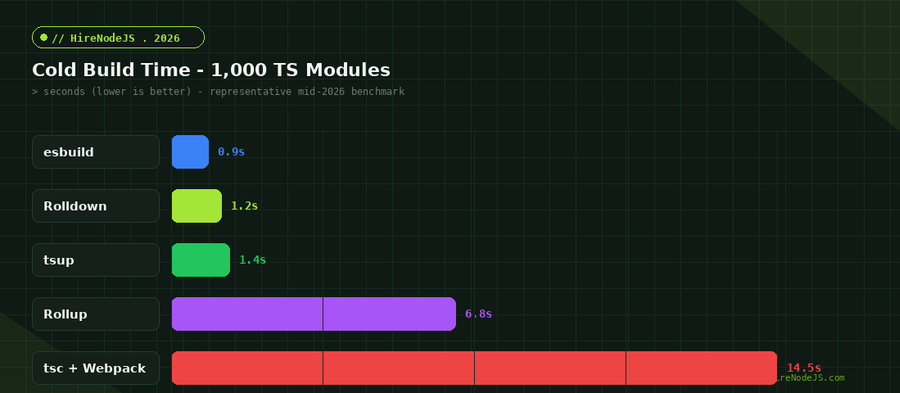
Raw cold-build numbers grab headlines, but incremental rebuild time is what you feel all day during development. The chart below shows both for a synthetic 1,000-module TypeScript project. esbuild and Rolldown lead on cold builds, while the gap on incremental rebuilds is even more pronounced — the Rust and Go tools rebuild in well under a fifth of a second, keeping hot-reload genuinely instant.
Reading benchmarks honestly
tsup in Practice: A Real Build Config
Hire Pre-Vetted Node.js Developers
Skip the months-long search. Our exclusive talent network has senior Node.js experts ready to join your team in 48 hours.
From source to dual-format package
The fastest way to understand tsup is to see a real configuration. The example below bundles a library to both ESM and CommonJS, emits type declarations, generates sourcemaps, and tree-shakes the output — all in a single file with no plugin gymnastics.
import { defineConfig } from 'tsup';

export default defineConfig({
  entry: ['src/index.ts'],
  format: ['esm', 'cjs'],   // dual-format output for broad compatibility
  dts: true,                 // emit .d.ts declaration files
  sourcemap: true,
  treeshake: true,
  clean: true,               // wipe dist/ before each build
  minify: process.env.NODE_ENV === 'production',
  target: 'node20',
  outDir: 'dist',
  onSuccess: async () => {
    console.log('Build complete - artifact ready to publish');
  },
});Rolldown and the Rust Migration Wave
Why everyone is watching Rolldown
Rolldown matters because it sits at the intersection of two trends: the move to Rust-based tooling and the consolidation of the Vite ecosystem. As Vite migrates its production bundling to Rolldown, millions of projects inherit faster builds without changing their own configuration. For library authors, Rolldown promises Rollup-quality tree-shaking at near-esbuild speed — historically a trade-off you could not avoid.
Scoring the trade-offs
No single tool wins on every axis. esbuild dominates raw speed but trails on declaration support; Rollup leads on output quality and ecosystem maturity but lags on speed; tsup offers the best out-of-box developer experience; Rolldown lands in the sweet spot but is still maturing. The radar chart below scores all four across the dimensions that matter for production Node.js builds.
Choosing the Right Tool for Your Project
A simple decision framework
Match the tool to the job. Publishing a library? Reach for tsup — its zero-config dual-format output and built-in declarations are hard to beat. Bundling a backend service or API for a lean Docker image? esbuild or Rolldown give you the fastest path. Need the absolute best tree-shaking for a widely consumed SDK? Rollup or Rolldown earn their keep. The goal is not to chase the newest tool but to pick the one whose strengths line up with your constraints.
Migration without the risk
Migrating a build is low-risk when you treat output as the contract. Pin your current tool, capture the existing bundle's size and a smoke test of its entrypoints, then run the new tool side by side and diff the results. Because all four tools consume standard ES modules, switching is usually a matter of translating config rather than rewriting source.
If you are building a production Node.js system and need engineers who can stand up a fast, reproducible build pipeline from day one, HireNodeJS connects you with pre-vetted senior developers available within 48 hours — without the recruiter overhead. You can also see exactly how the process works before you commit.
Hire Expert Node.js Developers — Ready in 48 Hours
Building the right pipeline is only half the battle — you need the right engineers to maintain it. HireNodeJS.com specialises exclusively in Node.js talent: every developer is pre-vetted on real-world projects, API design, build tooling, and production deployments.
Unlike generalist platforms, our curated pool means you speak only to engineers who live and breathe Node.js. Most clients have their first developer working within 48 hours of getting in touch. Engagements start as short-term contracts and can convert to full-time hires with zero placement fee.
Final Thoughts
The Node.js build landscape in 2026 rewards teams who stop treating the bundler as an afterthought. esbuild reset expectations for speed, tsup made publishing libraries painless, and Rolldown is closing the last gap between fast builds and high-quality output. There is no universal winner — only the tool that fits your project's shape.
Start by measuring your current build, pick the tool whose strengths match your constraints, and migrate behind a smoke test. The payoff is faster CI, smaller artifacts, and a feedback loop tight enough that your team actually enjoys shipping.
Frequently Asked Questions
What is the best Node.js build tool in 2026?
There is no single winner. tsup is best for publishing libraries, esbuild and Rolldown are best for raw build speed, and Rollup or Rolldown deliver the highest output quality. Match the tool to your project's needs.
Is tsup or esbuild better for a Node.js library?
tsup is usually better for libraries because it wraps esbuild and adds dual ESM/CommonJS output plus .d.ts declaration files with almost no configuration. esbuild alone does not emit type declarations.
What is Rolldown and should I use it?
Rolldown is a Rust-based successor to Rollup that offers Rollup-quality tree-shaking at near-esbuild speed. It now powers Vite's bundling path. It is excellent but still maturing, so benchmark it on your repo first.
Do I need to bundle a Node.js backend service?
You do not have to, but bundling produces a single tree-shaken entrypoint that starts faster and ships in a smaller Docker image. For containerized services it is usually worth it.
How much faster are Rust and Go bundlers than JavaScript ones?
On large TypeScript projects, Go-based esbuild and Rust-based Rolldown commonly build several times faster than JavaScript-based Rollup or a tsc + Webpack pipeline, and incremental rebuilds can be ten times faster.
How do I hire a Node.js developer who knows modern build tooling?
HireNodeJS connects you with pre-vetted senior Node.js engineers experienced in tsup, esbuild, Rolldown and CI pipelines, typically available within 48 hours and with no recruiter fees.
Vivek Singh is the founder of Witarist and HireNodeJS.com — a platform connecting companies with pre-vetted Node.js developers. With years of experience scaling engineering teams, Vivek shares insights on hiring, tech talent, and building with Node.js.
Need a Node.js engineer who ships fast, optimised build pipelines?
HireNodeJS connects you with pre-vetted senior Node.js engineers available within 48 hours. No recruiter fees, no lengthy screening - just top talent ready to ship.