Node.js + Cloudflare Workers in 2026: The Edge Runtime Playbook
For most of Node.js history, "the server" meant a single region: a fleet of EC2 boxes in Virginia, a Kubernetes cluster in Frankfurt, or a Heroku dyno on Heroku's shared infrastructure. In 2026, that default no longer holds. Cloudflare Workers, running V8 isolates in 320+ Points of Presence, has matured into a genuine production runtime - one that supports a meaningful subset of the Node.js API and ships your code within milliseconds of every user on Earth.
This guide covers what the edge runtime actually is, how it differs from a traditional Node.js process, when you should migrate (and when you should not), and how to ship a hybrid Workers + origin architecture without burning your team's weekends. If you're scoping out a migration and need engineers who have done it, HireNodeJS has a roster of senior Node.js developers with edge runtime experience.
What Cloudflare Workers Actually Is in 2026
A Worker is not a Node.js process. It is a JavaScript function that runs inside a V8 isolate - a lightweight, single-threaded sandbox that shares its V8 instance with thousands of other isolates on the same machine. Cold starts are measured in single-digit milliseconds because there is no container, no kernel boot, no Node.js initialization - the runtime is already warm; only your code is loaded. This is the fundamental architectural difference, and it dictates everything else: what APIs are available, what limits apply, and what kinds of workloads are a good fit.
V8 Isolates vs Node.js Processes
A traditional Node.js process boots in 200-800ms, eats 40-120MB of memory at idle, and is one of N replicas behind a load balancer. A Worker isolate spins up in under 5ms, has a hard 128MB memory ceiling, and runs in every PoP simultaneously. There is no per-region scaling, no autoscaling group, no warmup. The trade-off: long-running CPU work and large dependency trees that Node.js handles trivially become awkward in a Worker. CPU is metered in milliseconds, not seconds, and the bundle size that ships to the edge is capped (1MB free, 10MB paid).
What Node.js APIs Are Supported
Workers used to mean "browser-like JavaScript with no fs and no net." That is no longer true. Through the nodejs_compat compatibility flag, Workers ship most of node:buffer, node:crypto, node:events, node:stream, node:util, and a growing subset of node:net. node:fs is intentionally absent - the edge has no filesystem - but Workers KV and R2 fill that gap with a different mental model. Most Express middleware works unchanged with the Hono framework; what does not is anything that assumes a single, stateful Node.js process (in-memory caches, setInterval-based schedulers, raw TCP servers).
When the Edge Wins (and When It Loses)
Edge runtimes are not a free upgrade. They win in some workloads, draw in others, and lose badly in a few. Knowing which bucket your app falls into before you migrate saves you from a six-week rollback.
Workloads where Workers wins
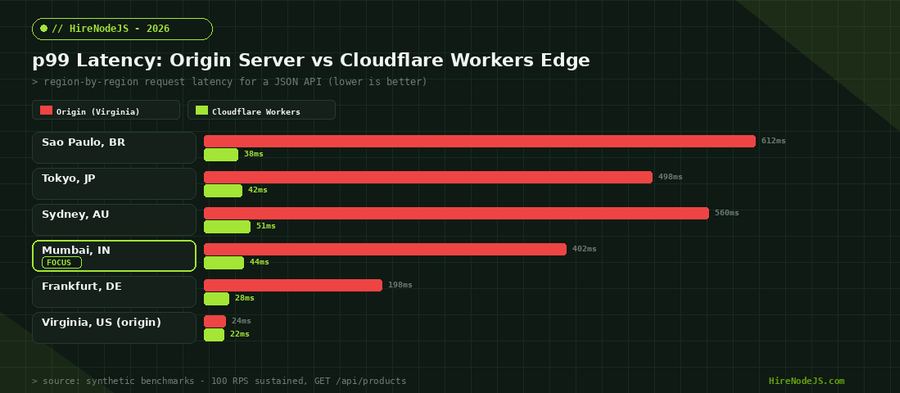
Read-heavy APIs that hit a cache or KV store on most requests. Auth/session validation. Geo-routing and feature flags. Image and HTML transformation pipelines. Webhook fan-out. Anything where the user is far from your origin and the work is small. For these, p99 latency drops 5-20x, infrastructure cost drops 30-70%, and you stop paying egress to AWS for traffic that never needed to leave the user's continent.
Workloads where Node.js still wins
Long-running batch jobs (CPU time limits bite). Chat servers with persistent socket state (Workers are request-scoped; you need Durable Objects, which is a different programming model). ML inference with large model files (bundle limits). Anything with a deep, native-bound npm dependency (e.g., sharp, canvas, headless Chrome). For these, you keep the Node.js origin and put a Worker in front for cache, auth, and routing.
Choosing the Right Framework: Hono vs Express on Workers
Express does not run on Workers. It is built around the Node.js http module and a stateful, blocking model. The community standard for Workers in 2026 is Hono - a tiny, ultrafast router with an Express-like API that compiles to Workers, Bun, Deno, and Node.js from the same source. If you have an existing Express codebase, the migration is mechanical for the routing layer; the work is in your handlers (replace fs with R2, replace pg pool with Hyperdrive, replace setInterval with cron triggers).
Teams already comfortable with the Hono mental model can ship a basic API in an afternoon. For a deeper look at the framework itself, our Node.js + Hono guide walks through routing, middleware, and the streaming response model. If you need help picking a framework or porting an existing Express app, our backend developers have done it.
A Real Hono Worker, End to End
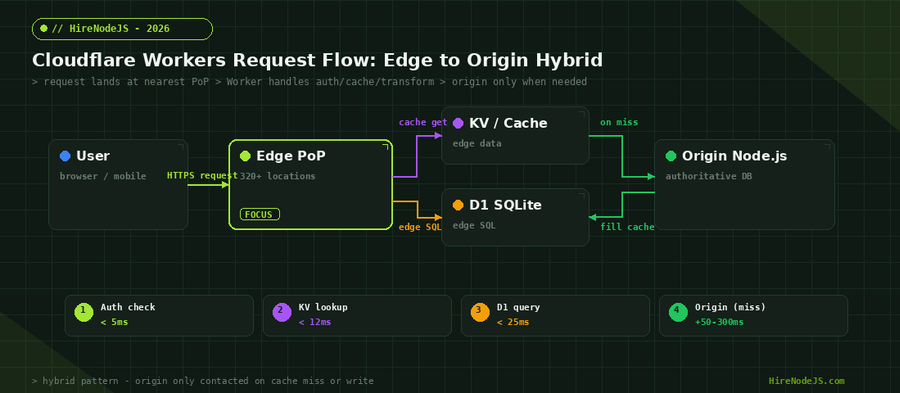
Here is a complete, runnable Worker that handles authenticated reads with KV caching and a Postgres origin fallback. It uses the standard Hono + Cloudflare Workers stack and demonstrates the four moving parts every production Worker has: the router, the auth middleware, the cache layer, and the origin fallback.
import { Hono } from 'hono';
import { jwt } from 'hono/jwt';
import { cors } from 'hono/cors';

type Bindings = {
  PRODUCT_KV: KVNamespace;        // bound in wrangler.toml
  DB: Hyperdrive;                  // Postgres connection via Hyperdrive
  JWT_SECRET: string;
};

const app = new Hono<{ Bindings: Bindings }>();

app.use('*', cors({ origin: ['https://app.example.com'] }));
app.use('/api/*', (c, next) =>
  jwt({ secret: c.env.JWT_SECRET })(c, next)
);

app.get('/api/products/:id', async (c) => {
  const id = c.req.param('id');
  const cacheKey = `product:${id}`;

  // 1. Try edge KV cache (single-digit ms globally)
  const cached = await c.env.PRODUCT_KV.get(cacheKey, 'json');
  if (cached) {
    c.header('x-cache', 'HIT');
    return c.json(cached);
  }

  // 2. Cache miss: query Postgres via Hyperdrive (pooled at the edge)
  const sql = `SELECT id, name, price_cents, currency
               FROM products WHERE id = $1`;
  const { rows } = await c.env.DB.query(sql, [id]);

  if (rows.length === 0) {
    return c.json({ error: 'not found' }, 404);
  }

  const product = rows[0];

  // 3. Backfill cache with 5-minute TTL
  c.executionCtx.waitUntil(
    c.env.PRODUCT_KV.put(cacheKey, JSON.stringify(product), {
      expirationTtl: 300,
    })
  );

  c.header('x-cache', 'MISS');
  return c.json(product);
});

export default app;
A few details are worth highlighting. The bindings (PRODUCT_KV, DB, JWT_SECRET) are injected by Cloudflare from your wrangler.toml - you never ship credentials in code. c.executionCtx.waitUntil lets the cache write happen after the response is sent to the user, so the cache miss path is no slower than it has to be. Hyperdrive is a connection pooler that sits in front of your Postgres origin, keeping warm connections at the edge so each Worker invocation does not pay TCP+TLS+auth handshake costs.
Edge Data: KV, R2, D1, Durable Objects, Hyperdrive
The hardest part of an edge migration is data. Workers are stateless; you cannot keep a Postgres pool open inside a Worker. Cloudflare offers a stack of edge-aware data primitives - each with a different consistency model, cost profile, and latency. Picking the right one for each piece of state is the design decision that determines whether your migration is a 30% cost win or a 200% cost surprise.
Hire Pre-Vetted Node.js Developers
Skip the months-long search. Our exclusive talent network has senior Node.js experts ready to join your team in 48 hours.
KV - eventually consistent, read-optimized
Cloudflare KV is a global key-value store with single-digit-millisecond reads at every PoP. Writes propagate eventually (up to 60 seconds globally). It is the right home for cached fragments, feature flags, session blobs, and small JSON documents that change rarely. It is the wrong home for things that need read-after-write consistency, like a shopping cart.
D1 - edge-first SQLite for relational data
D1 is SQLite that lives at the edge. It is real SQL with foreign keys, transactions, and the same SELECT/INSERT/UPDATE/DELETE you already know. Reads are replicated; writes go through a primary region. It is excellent for small-to-medium relational workloads (multi-tenant SaaS, content sites, internal tools) where you do not need PostgreSQL features like JSONB or full-text search.
For workloads that already live in PostgreSQL or MongoDB, the path is keeping the origin database and using Hyperdrive (Postgres pooling) or your own DB driver from a Worker. If you want a deeper guide to edge data patterns and PostgreSQL tuning, that is a bigger topic - and a place where Node.js engineers experienced with edge architectures earn their fee.
A 4-Week Migration Plan from Express to Workers
A typical migration for a 50-150 endpoint Node.js API takes 3-6 weeks of focused engineering time. The risk is highest in week 1 (when you discover what npm packages you depend on do not work) and lowest by week 4 (when you cut over).
Week 1 - audit and feature flag
Catalogue every endpoint, every npm dependency, and every external integration. Flag anything that uses fs, net.Server, child_process, worker_threads, or a native binding - these need a redesign, not a port. Set up Wrangler, deploy a hello-world Worker, and put it behind your existing API gateway as a no-op route. The goal of week 1 is to know what you are dealing with, not to ship anything.
Week 2 - port the read path
Pick your highest-traffic, simplest read endpoint (typically GET /products or GET /search). Port it to Hono. Wire it to your existing Postgres via Hyperdrive. Add KV caching. Deploy to a 1% traffic split and watch metrics for 48 hours. If p99 drops and error rate stays flat, you are on track.
Week 3 - port writes and auth
Writes are harder than reads because they have side effects (cache invalidation, audit logs, downstream events). Move authentication first (it is read-only and high-value), then mutations one at a time. Use c.executionCtx.waitUntil for all fire-and-forget work. Keep the origin running as a fallback - wrangler routes lets you redirect traffic at the route level.
Week 4 - cut over and decommission
Once 100% of traffic is on Workers and metrics are stable for a week, you can shut down the EC2/Heroku/Lambda fleet. Most teams keep a single small origin instance for batch jobs, cron schedulers, and the inevitable feature that does not fit at the edge. That is fine - the win is moving the request path, not eliminating Node.js.
What an Edge Migration Actually Costs
Workers pricing has two dimensions: requests (per million) and CPU milliseconds (per million). For a typical JSON API doing 100M requests/month at 5ms CPU per request, you pay roughly $5 in requests + $50 in CPU + $5 in KV reads = $60/month, plus any egress that does leave Cloudflare's network. Compare to a 3-instance EC2 fleet (t3.medium x 3 across regions + load balancer) at roughly $200-300/month. The savings get larger as traffic grows; the calculus flips back the other way for very low-traffic apps where the $5 minimum is more than a Hetzner VPS.
If you are evaluating a migration and want a senior engineer to own the design, HireNodeJS connects you with pre-vetted Node.js developers who have shipped Workers in production - typically available within 48 hours, no recruiter fees, and you can start with a short-term contract before deciding on a longer engagement.
Hire Expert Node.js Developers - Ready in 48 Hours
Edge migration is half architecture and half judgement - which endpoints to port, which to leave on origin, where consistency matters and where it does not. HireNodeJS.com specialises exclusively in Node.js talent: every developer is pre-vetted on real-world projects, edge runtime experience, API design, and production deployments.
Unlike generalist platforms, our curated pool means you speak only to engineers who live and breathe Node.js. Most clients have their first developer working within 48 hours of getting in touch. Engagements start as short-term contracts and can convert to full-time hires with zero placement fee.
Summary
Cloudflare Workers in 2026 is no longer an experiment - it is a serious Node.js runtime with a real npm story, real data primitives, and real production scale. The migration is most worth it for read-heavy, latency-sensitive APIs serving a global audience. It is least worth it for CPU-bound batch work or apps with deep native dependencies. Most teams end up running a hybrid: Workers in front, Node.js origin behind, with KV and Hyperdrive bridging the two. That is not a compromise - it is the architecture.
If you are starting a new Node.js project today, build the edge layer in from day one. If you are migrating an existing app, follow the four-week plan: audit, then read path, then writes, then cut over. The hardest part is not Hono or Workers - it is letting go of in-process state.
Frequently Asked Questions
Is Cloudflare Workers a real Node.js runtime in 2026?
Workers ships a V8 isolate runtime with a growing subset of Node.js APIs (node:buffer, node:crypto, node:events, node:stream, much of node:net) behind the nodejs_compat compatibility flag. It is not a full Node.js process - there is no node:fs, no child_process, and no long-lived TCP server - but for most HTTP API workloads, the surface area is large enough to port directly.
Should I migrate my Express API to Cloudflare Workers?
If your app is read-heavy, latency-sensitive, and serves a global audience, yes - the typical p99 wins are 5-20x and infrastructure costs drop 30-70%. If your app is CPU-bound, depends on native npm packages (sharp, canvas, headless Chrome), or holds long-lived socket state, keep the Node.js origin and put a Worker in front for cache and auth.
How long does a typical Workers migration take?
For a 50-150 endpoint Node.js API, plan 3-6 weeks of focused engineering time. Week 1 is audit and dependency triage, weeks 2-3 are porting reads then writes endpoint by endpoint, week 4 is cut-over with traffic splitting. The risk is highest in week 1 when you discover incompatible dependencies.
What replaces my Postgres database when I move to the edge?
You usually do not replace it. Most teams keep PostgreSQL on the origin and use Cloudflare Hyperdrive to pool connections at the edge. For new apps with simple relational schemas, D1 (edge SQLite) is a viable from-scratch choice. KV is for cached blobs and feature flags, not relational data.
How fast is a Cloudflare Workers cold start vs a Node.js Lambda?
A Worker isolate cold-starts in roughly 5ms because the V8 instance is already warm; only your code is loaded. Node.js on Lambda cold-starts in 300-1000ms because the entire container, kernel, and Node.js runtime have to boot. For latency-sensitive APIs, that gap is the entire reason to migrate.
What does Cloudflare Workers cost at scale?
A typical JSON API doing 100M requests/month at 5ms CPU per request costs roughly $60/month on the paid plan ($5 requests + $50 CPU + $5 KV reads). Compare to roughly $200-300/month for a 3-region EC2 fleet plus load balancer. The Workers savings get larger as traffic grows; the calculus flips back for very low-traffic apps where a Hetzner VPS undercuts the $5 minimum.
Vivek Singh is the founder of Witarist and HireNodeJS.com — a platform connecting companies with pre-vetted Node.js developers. With years of experience scaling engineering teams, Vivek shares insights on hiring, tech talent, and building with Node.js.
Need a Node.js Engineer Who Has Shipped on the Edge?
HireNodeJS connects you with pre-vetted senior Node.js engineers experienced with Cloudflare Workers, Hono, and edge data patterns - available within 48 hours, no recruiter fees, no lengthy screening.