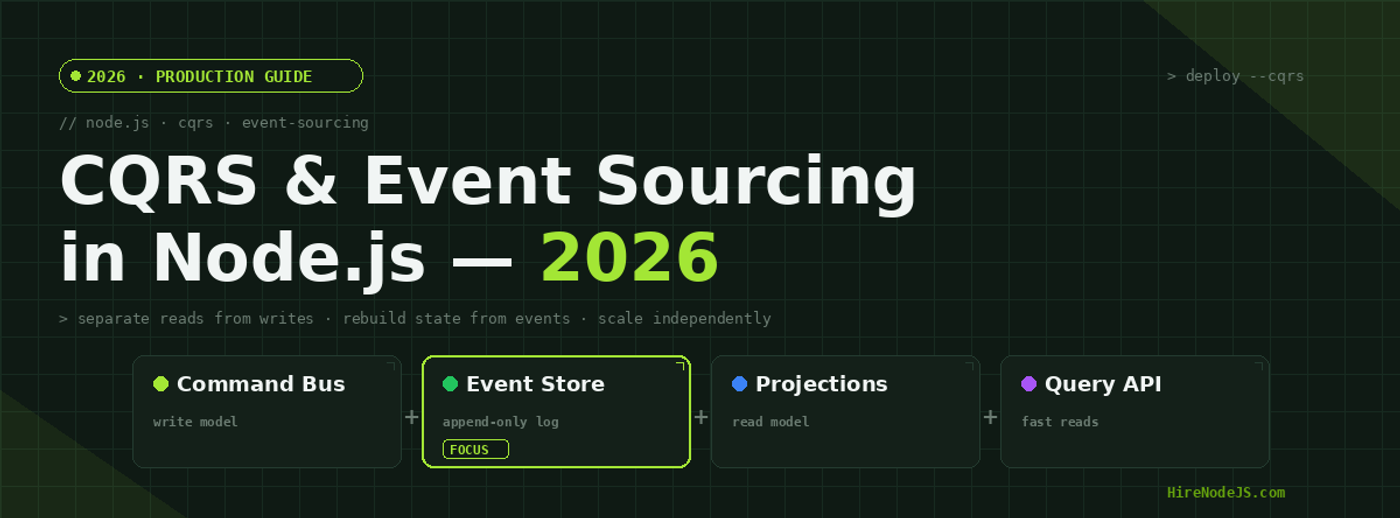
CQRS & Event Sourcing in Node.js: The 2026 Production Guide
The traditional CRUD approach to building backends works well for simple applications, but as systems grow in complexity — handling millions of events, requiring complete audit trails, and needing independent scaling of reads and writes — its limitations become painfully obvious. CQRS (Command Query Responsibility Segregation) paired with Event Sourcing offers a fundamentally different approach: instead of mutating rows in a database, you store every state change as an immutable event, then build optimized read models from that event stream.
In 2026, this pattern has moved from academic exercise to production staple. Companies running Node.js at scale — fintech platforms, e-commerce marketplaces, IoT data pipelines — are adopting CQRS and Event Sourcing to gain complete traceability, horizontal scalability, and the ability to replay history to fix bugs or build new features retroactively. This guide walks you through the architecture, implementation patterns, and production considerations for building CQRS + Event Sourcing systems in Node.js.
What Is CQRS and Why It Matters for Node.js
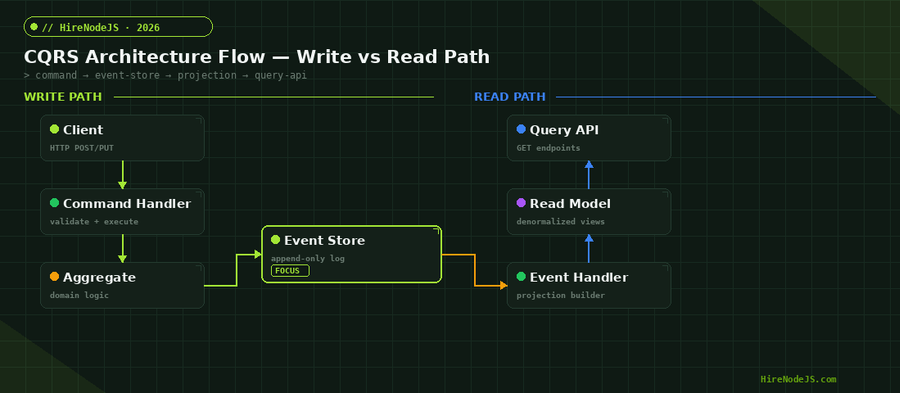
CQRS splits your application into two distinct models: a write model that handles commands (creating orders, updating profiles, processing payments) and a read model optimized for queries (listing products, generating reports, displaying dashboards). In a traditional architecture, the same database table serves both purposes, which forces you to compromise — either your writes are slow because of complex indexing, or your reads are slow because the schema is normalized for writes.
The Command Side
The command side receives intentions to change state. A command handler validates the request against business rules, executes domain logic through aggregates, and emits events describing what happened. Commands are imperative — PlaceOrder, CancelSubscription, UpdateShippingAddress — and they either succeed or fail. The command handler never returns query data; it only confirms that the operation was accepted.
The Query Side
The query side serves read requests from denormalized data stores purpose-built for each view. An order listing might live in Elasticsearch for full-text search, while an analytics dashboard reads from a materialized PostgreSQL view, and a real-time notification feed runs off Redis Streams. Each projection is built and maintained by subscribing to the event stream, giving you the freedom to add new read models without touching the write path.
Event Sourcing Fundamentals — Storing Facts, Not State
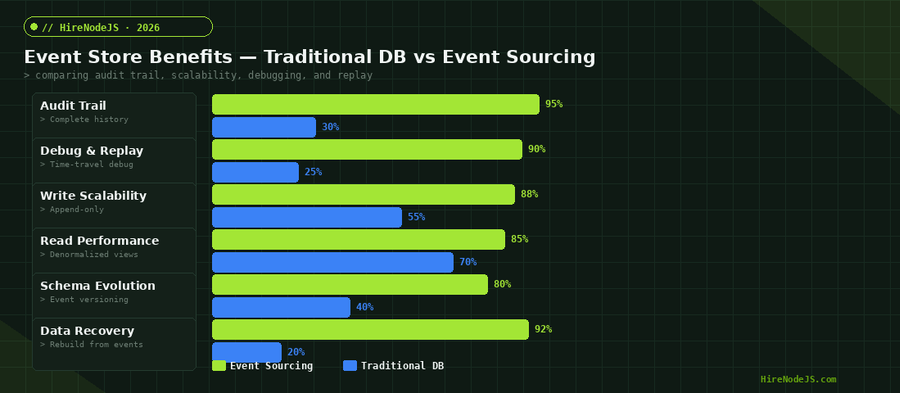
Event Sourcing complements CQRS by changing how you persist data. Instead of storing the current state of an entity (a row with columns like status, total, and updatedAt), you store the sequence of events that led to that state: OrderPlaced, ItemAdded, PaymentProcessed, OrderShipped. The current state is derived by replaying these events in order. Think of it like a Git log for your data — you never lose information, and you can always reconstruct any past state.
The Append-Only Event Store
The event store is the single source of truth. Events are immutable and append-only — you never update or delete them. Each event belongs to a stream (typically identified by aggregate type and ID, like order-abc123) and carries a sequence number for ordering. In Node.js, you can implement this on top of PostgreSQL using a simple events table, or use a dedicated event store like EventStoreDB that provides built-in stream management, subscriptions, and projections.
Event Schema Design
A well-designed event carries all the information needed to understand what happened without requiring additional lookups. Include the aggregate ID, event type, timestamp, version number, and a data payload with the relevant details. Avoid storing derived or computed values in events — store the raw facts and let projections compute what they need.
Building an Event Store in Node.js with PostgreSQL
While dedicated event stores like EventStoreDB offer powerful features out of the box, many teams prefer to start with PostgreSQL — a database their backend developers already know and their infrastructure already supports. PostgreSQL's JSONB columns, advisory locks, and LISTEN/NOTIFY make it a surprisingly capable event store for most workloads.
import { Pool } from 'pg';

interface DomainEvent {
  streamId: string;
  type: string;
  data: Record<string, unknown>;
  metadata?: Record<string, unknown>;
}

class PgEventStore {
  constructor(private pool: Pool) {}

  async append(
    streamId: string,
    events: DomainEvent[],
    expectedVersion: number
  ): Promise<void> {
    const client = await this.pool.connect();
    try {
      await client.query('BEGIN');

      // Optimistic concurrency check
      const { rows } = await client.query(
        `SELECT COALESCE(MAX(version), 0) as version
         FROM events WHERE stream_id = $1`,
        [streamId]
      );
      const currentVersion = rows[0].version;

      if (currentVersion !== expectedVersion) {
        throw new Error(
          `Concurrency conflict: expected v${expectedVersion}, got v${currentVersion}`
        );
      }

      // Append events atomically
      for (let i = 0; i < events.length; i++) {
        const event = events[i];
        await client.query(
          `INSERT INTO events (stream_id, version, type, data, metadata, created_at)
           VALUES ($1, $2, $3, $4, $5, NOW())`,
          [
            streamId,
            expectedVersion + i + 1,
            event.type,
            JSON.stringify(event.data),
            JSON.stringify(event.metadata || {}),
          ]
        );
      }

      await client.query('COMMIT');

      // Notify listeners for real-time projections
      await client.query(
        `SELECT pg_notify('new_events', $1)`,
        [JSON.stringify({ streamId, count: events.length })]
      );
    } catch (err) {
      await client.query('ROLLBACK');
      throw err;
    } finally {
      client.release();
    }
  }

  async readStream(streamId: string, fromVersion = 0): Promise<DomainEvent[]> {
    const { rows } = await this.pool.query(
      `SELECT type, data, metadata, version, created_at
       FROM events
       WHERE stream_id = $1 AND version > $2
       ORDER BY version ASC`,
      [streamId, fromVersion]
    );
    return rows.map(r => ({
      streamId,
      type: r.type,
      data: r.data,
      metadata: r.metadata,
    }));
  }
}
This implementation uses optimistic concurrency control via version checks. When two concurrent commands try to modify the same aggregate, the second one gets a concurrency conflict error and can retry with the updated state. The pg_notify call enables real-time projection updates without polling.
Projections and Read Models — Building Views from Events
Projections are the bridge between your event store and your read models. A projection subscribes to an event stream, processes each event, and updates a denormalized data store optimized for a specific query pattern. You can have multiple projections reading from the same event stream, each building a different view of the data.
Synchronous vs Asynchronous Projections
Synchronous projections update the read model within the same transaction as the event write. This gives you strong consistency — queries always reflect the latest state — but it couples your write and read performance. Asynchronous projections process events in the background, typically using a message broker or PostgreSQL LISTEN/NOTIFY. This introduces eventual consistency but allows independent scaling and fault isolation.
Rebuilding Projections from Scratch
Hire Pre-Vetted Node.js Developers
Skip the months-long search. Our exclusive talent network has senior Node.js experts ready to join your team in 48 hours.
One of the most powerful benefits of Event Sourcing is the ability to rebuild any projection from scratch. Need a new analytics dashboard? Write a new projection, replay the entire event history, and your read model is populated with complete historical data. Want to migrate from MongoDB to Redis for a particular view? Build a new projection targeting Redis, replay events, switch traffic, and decommission the old one — zero data migration scripts required.
Aggregates and Domain Logic in Event-Sourced Systems
Aggregates are the consistency boundaries in your domain. Each aggregate encapsulates a cluster of related entities and enforces business invariants. In an event-sourced system, an aggregate is reconstructed by replaying its event stream, then it processes a command by applying domain logic and emitting new events. The aggregate never reads from the database directly — its entire state comes from events.
Aggregate Design Guidelines
Keep aggregates small and focused. A common mistake is making an aggregate too large — loading thousands of events to reconstruct state before processing a single command. Use snapshots to optimize this: periodically save a snapshot of the aggregate state so you only need to replay events since the last snapshot. In practice, aggregates with fewer than 100 events per stream rarely need snapshots, but high-throughput streams (like a trading account) benefit significantly.
Handling Business Rules
Business rules live inside the aggregate. Before emitting an event, the aggregate validates the command against its current state. For example, an Order aggregate would reject a ShipOrder command if the order status is not Paid. This validation happens in memory after rehydrating the aggregate from events, making it fast and side-effect-free. If the command is valid, the aggregate returns new events to be appended to the store.
Production Considerations and Common Pitfalls
Event Versioning and Schema Evolution
Events are immutable, but your event schemas will evolve. When you add a field to an event, old events in the store will not have it. Use upcasters — functions that transform old event formats to the current version during replay. This keeps your projection code clean (it always handles the latest schema) while preserving backward compatibility with historical events. Version your events explicitly: OrderPlacedV1, OrderPlacedV2, or use a version field in the event metadata.
Idempotency and Exactly-Once Processing
In distributed systems, messages can be delivered more than once. Your event handlers and projections must be idempotent — processing the same event twice should produce the same result. Track the last processed event position per projection and skip duplicates. For command handlers, use a deduplication table keyed by command ID to prevent the same command from being processed twice.
Monitoring and Observability
Event-sourced systems have different observability requirements than traditional apps. Monitor projection lag (how far behind your read models are), event store write latency, stream sizes, and subscription health. A DevOps engineer experienced with Node.js can set up OpenTelemetry traces that follow a command from API entry through event storage to projection update, giving you end-to-end visibility across the entire CQRS pipeline.
When to Use CQRS and Event Sourcing (and When Not To)
CQRS and Event Sourcing add complexity. They introduce eventual consistency, require new infrastructure, and demand a different mental model from your team. This investment pays off when your system needs complete audit trails (financial services, healthcare), when read and write workloads have vastly different scaling requirements, when you need to rebuild historical state (compliance, debugging), or when your domain is inherently event-driven (e-commerce, logistics, IoT).
For simple CRUD applications with straightforward query patterns and modest scale, traditional architectures are perfectly fine. A blog platform, a basic todo app, or an internal tool with a few hundred users rarely needs the overhead of CQRS. Start simple, and introduce CQRS and Event Sourcing into the specific bounded contexts that benefit from it — you do not need to apply it to your entire system.
Hire Expert Node.js Developers — Ready in 48 Hours
Building the right system is only half the battle — you need the right engineers to build it. HireNodeJS.com specialises exclusively in Node.js talent: every developer is pre-vetted on real-world projects, API design, event-driven architecture, and production deployments.
Unlike generalist platforms, our curated pool means you speak only to engineers who live and breathe Node.js. Most clients have their first developer working within 48 hours of getting in touch. Engagements start as short-term contracts and can convert to full-time hires with zero placement fee.
Conclusion — CQRS and Event Sourcing as a Competitive Advantage
CQRS and Event Sourcing are not silver bullets, but for the right use cases they provide capabilities that are nearly impossible to retrofit onto a traditional CRUD system: complete audit trails, time-travel debugging, independently scalable read and write paths, and the ability to build new features on top of historical data. Node.js, with its event-driven runtime and excellent streaming support, is a natural fit for implementing these patterns.
Start with a single bounded context, prove the pattern works for your domain, then expand. Use PostgreSQL as your initial event store to minimize operational overhead, add EventStoreDB when you outgrow it, and invest in solid projection infrastructure from day one. If you need experienced engineers who have built event-sourced systems in production, learn how HireNodeJS works and get matched with the right talent in under 48 hours.
Frequently Asked Questions
What is CQRS in Node.js and how does it work?
CQRS (Command Query Responsibility Segregation) separates your Node.js application into a write model handling commands and a read model optimized for queries. Commands go through handlers that validate business rules and emit events, while queries read from denormalized views built from those events.
Do I need Event Sourcing to use CQRS in Node.js?
No. CQRS can work with a traditional database where the write and read models share the same store but use different schemas. Event Sourcing adds an append-only event log as the source of truth, which gives you audit trails and replay capabilities but is not required for CQRS.
What is the best event store for Node.js in 2026?
For most teams, PostgreSQL with a custom events table is the best starting point — it is familiar, well-supported, and handles moderate workloads easily. For high-throughput or complex subscription needs, EventStoreDB is the leading dedicated event store with excellent Node.js client support.
How do I handle eventual consistency in a CQRS Node.js application?
Use optimistic UI updates on the frontend to show expected state immediately after a command succeeds. On the backend, track projection lag with metrics and set up health checks. For critical reads that must be consistent, query the event store directly or use synchronous projections.
How much does it cost to hire a Node.js developer with CQRS experience?
Senior Node.js developers with production CQRS and Event Sourcing experience typically command rates of $80 to $150 per hour depending on region and engagement type. HireNodeJS connects you with pre-vetted engineers at competitive rates with no recruiter fees.
Can I add Event Sourcing to an existing Node.js application?
Yes. The recommended approach is to introduce Event Sourcing into a single bounded context first — such as the payments or orders module — while keeping the rest of the application on traditional CRUD. Use the Strangler Fig pattern to gradually migrate bounded contexts over time.
Vivek Singh is the founder of Witarist and HireNodeJS.com — a platform connecting companies with pre-vetted Node.js developers. With years of experience scaling engineering teams, Vivek shares insights on hiring, tech talent, and building with Node.js.
Need a Node.js Architect for Event-Driven Systems?
HireNodeJS connects you with pre-vetted senior Node.js engineers experienced in CQRS, Event Sourcing, and event-driven architecture. Get matched within 48 hours — no recruiter fees, no lengthy screening.