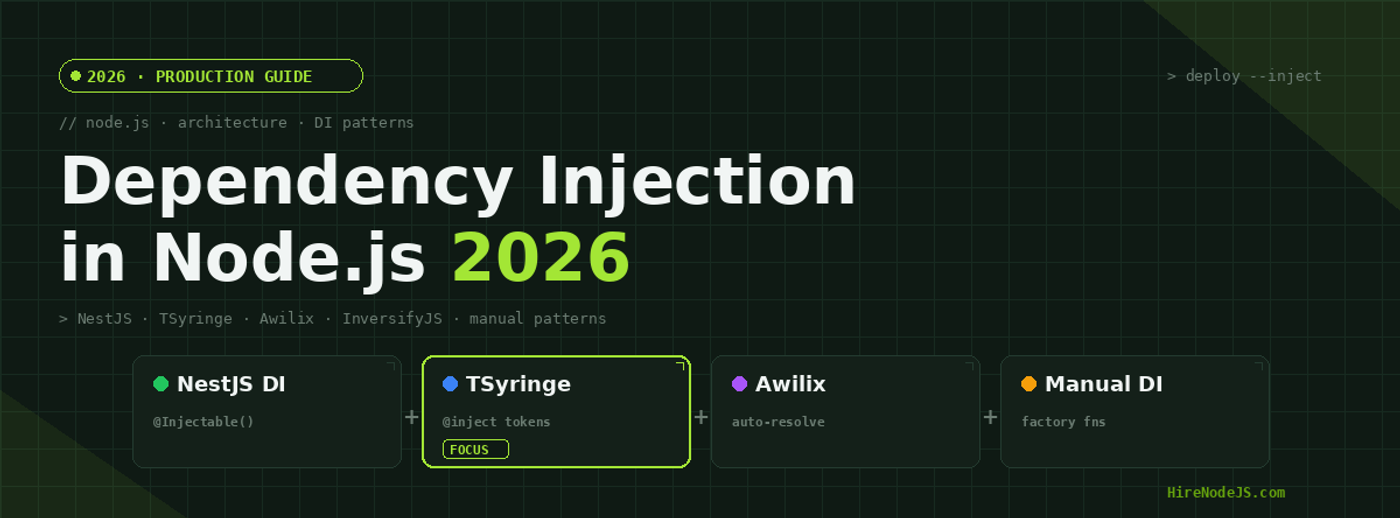
Dependency Injection in Node.js: Complete Guide for 2026
Dependency injection is one of the most important architectural patterns in modern Node.js development. It decouples your application components, makes testing straightforward, and keeps large codebases maintainable. Yet many Node.js teams still wire dependencies manually with require statements scattered across hundreds of files — creating tightly coupled systems that resist change.
In 2026, the Node.js DI ecosystem has matured significantly. Whether you choose NestJS with its built-in container, Microsoft's TSyringe for lightweight TypeScript injection, Awilix for convention-based resolution, or InversifyJS for maximum control, you have production-ready options that rival what Spring and .NET developers have enjoyed for years. This guide compares every major approach, shows real code, and helps you hire Node.js developers who understand DI at a deep level.
What Is Dependency Injection and Why Does It Matter?
Dependency injection is a design pattern where an object receives its dependencies from an external source rather than creating them internally. Instead of a UserService instantiating its own DatabaseConnection, the connection is passed in — injected — at construction time. This inversion of control makes every component independently testable and swappable.
The Three Types of DI
Constructor injection passes dependencies through the class constructor — the most common and recommended approach. Property injection sets dependencies on public properties after construction. Method injection passes dependencies as function parameters at call time. In Node.js, constructor injection dominates because TypeScript decorators and reflection make it clean and type-safe.
DI Without a Framework — The Manual Approach
Before reaching for a library, understand that DI is just a pattern. You can implement it with plain factory functions. The composition root — usually your application entry point — wires everything together. Libraries add automatic resolution, scoping, and decorator-based registration, but the core principle is the same: dependencies flow inward, never outward.
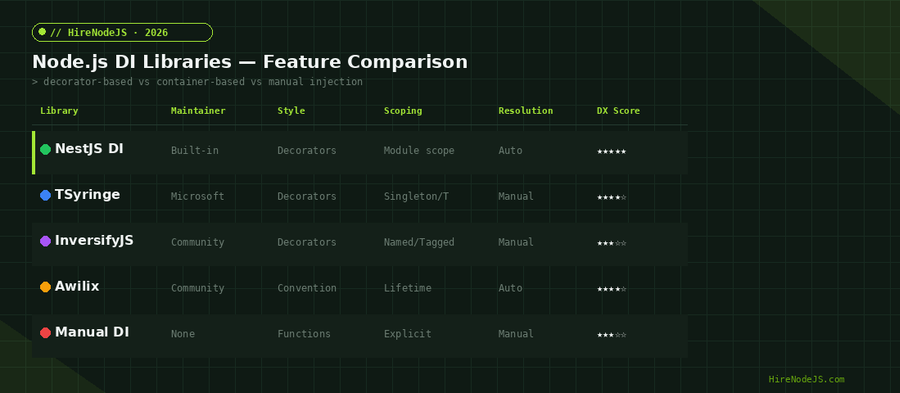
NestJS Built-in Dependency Injection
NestJS ships with the most comprehensive DI system in the Node.js ecosystem. Every provider decorated with @Injectable() is automatically registered in the module's container. The framework handles resolution, lifecycle management, and scope control out of the box. If you are looking to hire a NestJS developer, DI knowledge is non-negotiable — it underpins every service, guard, pipe, and interceptor in the framework.
Module-Scoped Providers
NestJS organizes providers into modules. Each module has its own injection scope, and providers are singleton by default within that module. You can export providers to make them available to other modules, creating a clean dependency graph. The @Global() decorator makes a provider available everywhere — use it sparingly for truly cross-cutting concerns like configuration or logging.
Request-Scoped and Transient Providers
Beyond singletons, NestJS supports REQUEST scope — a new instance per incoming HTTP request — and TRANSIENT scope — a new instance every time the provider is injected. Request scope is essential for multi-tenant applications where each request carries tenant-specific context. Transient scope works well for stateful utilities like loggers that need per-consumer configuration.
import { Injectable, Inject, Scope } from '@nestjs/common';
import { REQUEST } from '@nestjs/core';
import { Request } from 'express';

@Injectable({ scope: Scope.REQUEST })
export class TenantService {
  private tenantId: string;

  constructor(@Inject(REQUEST) private request: Request) {
    this.tenantId = this.request.headers['x-tenant-id'] as string;
  }

  getTenantId(): string {
    return this.tenantId;
  }
}

@Injectable()
export class UserService {
  constructor(
    private readonly tenantService: TenantService,
    private readonly userRepository: UserRepository,
  ) {}

  async findAll(): Promise<User[]> {
    const tenantId = this.tenantService.getTenantId();
    return this.userRepository.findByTenant(tenantId);
  }
}TSyringe — Lightweight TypeScript DI by Microsoft
TSyringe is Microsoft's answer to dependency injection in TypeScript. It uses decorators and the reflect-metadata library to resolve dependencies at runtime. Unlike NestJS, TSyringe is framework-agnostic — you can use it with Express, Fastify, Koa, or any other Node.js framework. This makes it ideal for teams building backend services with Node.js who want DI without adopting an opinionated framework.
Token-Based Registration
TSyringe supports both class-based and token-based injection. Class tokens work automatically with @injectable() — the container resolves the class and all its constructor dependencies. For interfaces, which do not exist at runtime in TypeScript, you use string or symbol tokens with @inject(). This token-based approach gives you the flexibility to swap implementations without changing consumer code.
Container Lifecycle and Child Containers
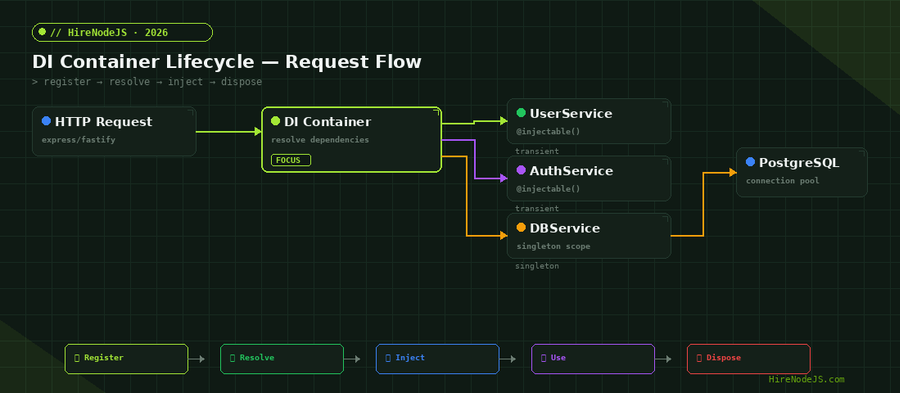
TSyringe supports singleton, transient, and container-scoped lifetimes. You can create child containers that inherit parent registrations but can override specific bindings — perfect for request-scoped isolation in HTTP servers. Each child container gets its own singleton scope while sharing the parent's singletons for cross-cutting services like database pools.
Awilix — Convention-Based DI Without Decorators
Awilix takes a different approach to dependency injection. Instead of decorators, it uses naming conventions and explicit registration to resolve dependencies. You register classes, functions, or values in a container, and Awilix resolves constructor parameters by matching parameter names to registered keys. This works with plain JavaScript — no TypeScript decorators or reflect-metadata required.
Auto-Loading Modules with loadModules
Awilix can automatically scan directories and register every exported class or function. The loadModules function accepts glob patterns and naming conventions (camelCase, CLASSIC, UPPER_CASE). This eliminates manual registration boilerplate — add a new service file to the services directory and it is automatically available for injection throughout your application.
Scoped Containers for HTTP Requests
Hire Pre-Vetted Node.js Developers
Skip the months-long search. Our exclusive talent network has senior Node.js experts ready to join your team in 48 hours.
Awilix provides createScope() for request-level isolation. In Express or Fastify middleware, you create a scoped container per request, register request-specific values like the authenticated user or tenant context, and attach it to the request object. All services resolved from that scope share the request context while inheriting singletons from the root container.
InversifyJS, typedi, and Other DI Libraries
InversifyJS was one of the first decorator-based DI containers for TypeScript. It provides powerful features like named bindings, tagged bindings, and contextual constraints that let you resolve different implementations based on where the dependency is injected. While its API is more verbose than TSyringe, it offers maximum control over complex dependency graphs.
Named and Tagged Bindings
InversifyJS lets you bind multiple implementations to the same interface using names or tags. For example, you might bind ILogger to ConsoleLogger with the name dev and to CloudWatchLogger with the name prod. At injection time, the @named() decorator selects the right implementation. Tagged bindings add metadata-based selection for even more granular control.
typedi — Minimal Decorator-Based DI
typedi offers the simplest decorator-based DI experience. A single @Service() decorator registers a class, and constructor injection works automatically. It lacks the advanced features of InversifyJS but excels at simplicity. For teams building TypeScript applications that need basic DI without complexity, typedi hits the sweet spot.
Testing Strategies with Dependency Injection
The primary benefit of dependency injection is testability. When every dependency is injected rather than hardcoded, you can swap real implementations with mocks, stubs, or fakes in your test suite. This transforms integration-heavy test suites into fast, isolated unit tests that run in milliseconds.
Mocking with DI Containers
NestJS provides Test.createTestingModule() which lets you override any provider with a mock. TSyringe supports container.register() with mock values in your test setup. Awilix lets you register mock functions directly in a test container. The pattern is universal — create a test container, register mocks for external dependencies like databases and APIs, resolve the service under test, and assert behavior.
Integration Testing with Scoped Containers
For integration tests, create a container that uses real implementations but swaps external services like payment gateways or email providers. Scoped containers are perfect here — each test gets its own scope with test-specific overrides while sharing expensive singletons like database connection pools. This approach catches wiring bugs that pure unit tests miss.
Production Best Practices for Node.js DI
Choosing a DI library is just the beginning. How you structure your container, manage lifetimes, and handle errors determines whether DI helps or hurts your application in production. Here are the patterns that senior Node.js engineers follow.
Composition Root Pattern
All dependency registration should happen in one place — the composition root. This is typically your main application file or a dedicated container configuration module. Never register providers inside business logic. The composition root gives you a single location to see every dependency in your system, making debugging and auditing straightforward.
Avoiding Service Locator Anti-Pattern
The service locator pattern — where code directly calls container.resolve() inside business logic — defeats the purpose of DI. It hides dependencies, makes testing harder, and creates implicit coupling to the container itself. Always prefer constructor injection. If you find yourself calling the container outside the composition root, refactor the dependency graph instead.
Graceful Shutdown and Disposal
Production services must clean up resources — close database connections, flush log buffers, stop background jobs. DI containers should manage this lifecycle. NestJS handles it with onModuleDestroy hooks. Awilix supports dispose functions per registration. TSyringe requires manual disposal. Always implement graceful shutdown to prevent resource leaks and data corruption during deployments.
Hire Expert Node.js Developers — Ready in 48 Hours
Building the right system is only half the battle — you need the right engineers to build it. HireNodeJS.com specialises exclusively in Node.js talent: every developer is pre-vetted on real-world projects, API design, event-driven architecture, and production deployments.
Unlike generalist platforms, our curated pool means you speak only to engineers who live and breathe Node.js. Most clients have their first developer working within 48 hours of getting in touch. Engagements start as short-term contracts and can convert to full-time hires with zero placement fee.
Choosing the Right DI Approach for Your Team
Dependency injection is not optional for serious Node.js applications in 2026 — it is foundational. NestJS DI is the clear choice if you are already using or adopting the NestJS framework. TSyringe fits teams that want TypeScript-native DI without framework lock-in. Awilix excels in JavaScript-first or convention-over-configuration environments. Manual DI with factory functions works for smaller services where adding a library is overkill.
The key is to pick one approach and apply it consistently across your codebase. A team that understands DI patterns writes more testable, maintainable, and scalable code. If you need engineers who already think in these terms, explore how HireNodeJS works to connect you with senior Node.js developers who ship production-ready architectures from day one.
Frequently Asked Questions
What is the best dependency injection library for Node.js in 2026?
NestJS DI is the most popular and feature-complete option if you are using the NestJS framework. For framework-agnostic TypeScript projects, TSyringe by Microsoft offers lightweight, decorator-based injection. Awilix is the top choice for JavaScript projects that prefer convention-based resolution without decorators.
Do I need a DI library for a small Node.js project?
Not necessarily. For small services with fewer than 10-15 modules, manual dependency injection using factory functions and a composition root file works well. DI libraries add value when your dependency graph becomes complex enough that manual wiring is error-prone and hard to maintain.
How does dependency injection improve testability in Node.js?
DI lets you swap real implementations with mocks or stubs during testing. Instead of requiring a real database connection, you inject a mock repository that returns test data. This makes unit tests fast, isolated, and deterministic without needing external services running.
What is the difference between singleton and transient scope in DI?
Singleton scope means one instance is created and shared across all consumers for the lifetime of the container. Transient scope creates a new instance every time the dependency is requested. Request scope creates one instance per HTTP request, useful for multi-tenant applications.
Can I use dependency injection with Express.js without NestJS?
Yes. Libraries like TSyringe, Awilix, and InversifyJS are framework-agnostic and work with Express, Fastify, Koa, or any Node.js HTTP framework. Awilix even has dedicated plugins like awilix-express for seamless Express integration with request-scoped containers.
How much does it cost to hire a Node.js developer who knows DI patterns?
Senior Node.js developers with strong architectural knowledge including DI typically range from $60-120 per hour depending on region and experience. Platforms like HireNodeJS.com offer pre-vetted senior developers available within 48 hours without recruiter fees.
Vivek Singh is the founder of Witarist and HireNodeJS.com — a platform connecting companies with pre-vetted Node.js developers. With years of experience scaling engineering teams, Vivek shares insights on hiring, tech talent, and building with Node.js.
Need a Node.js Architect Who Understands DI?
HireNodeJS connects you with pre-vetted senior Node.js engineers who build testable, maintainable architectures from day one. No recruiter fees, no lengthy screening — just top talent ready to ship.