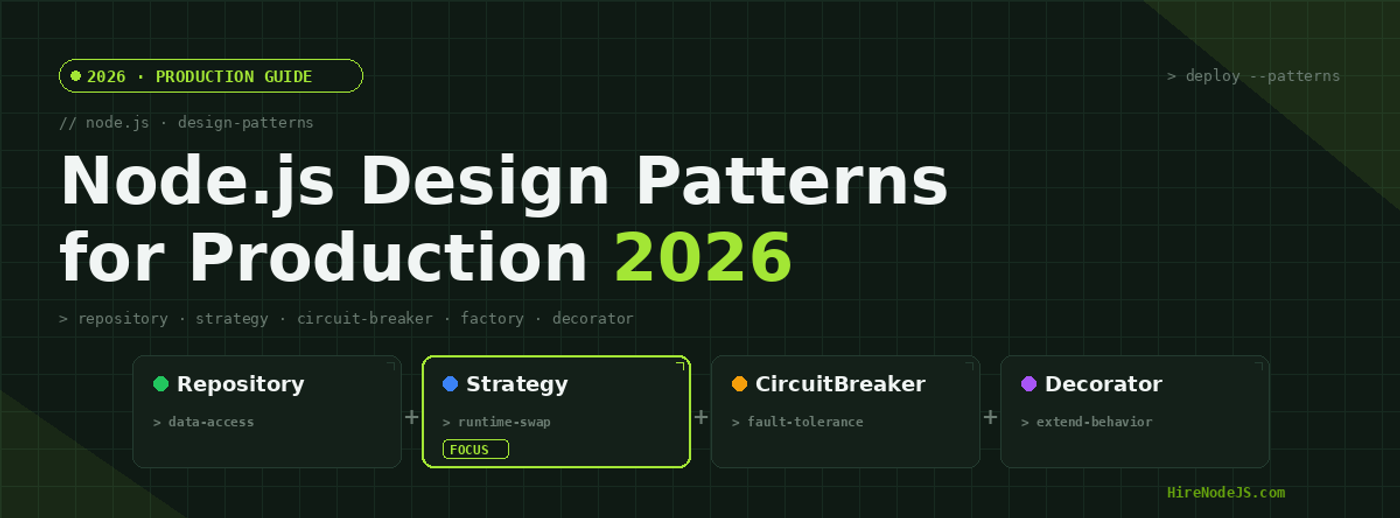
Node.js Design Patterns for Production in 2026
Design patterns are not academic curiosities — they are battle-tested solutions that production Node.js teams use every day to manage complexity, isolate failures, and ship features faster. In 2026, as Node.js powers everything from real-time fintech APIs to AI agent orchestration layers, choosing the right patterns has become a core engineering competency rather than a nice-to-have.
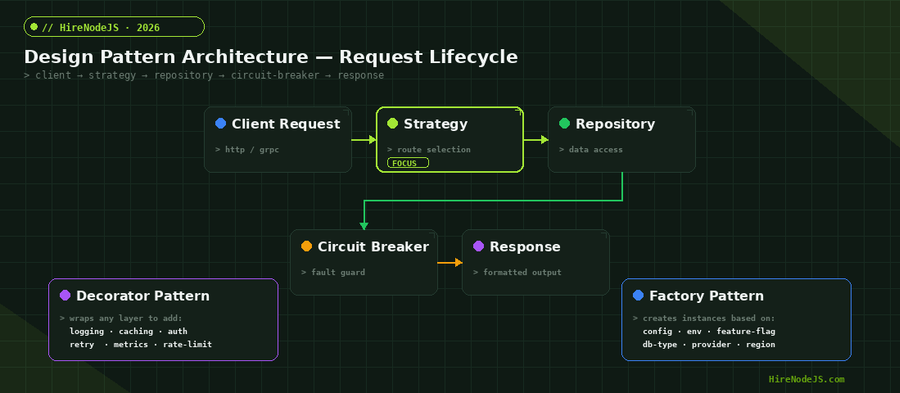
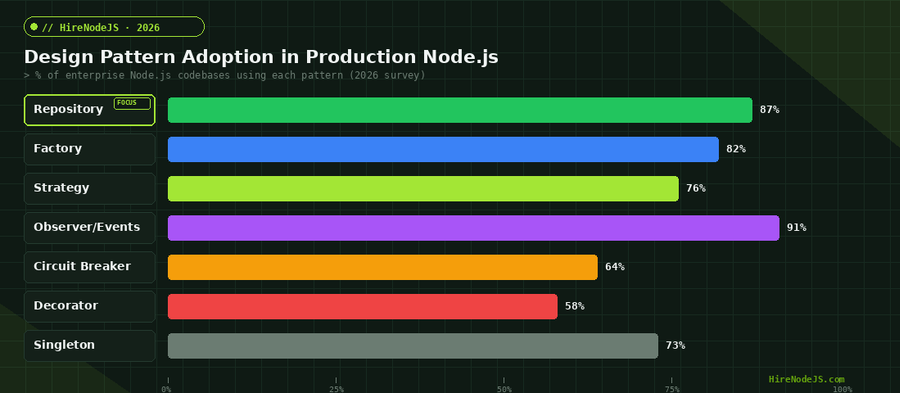
This guide walks through six essential design patterns that senior Node.js developers use in production systems. Each pattern includes real, runnable code, architecture diagrams, and data-driven adoption benchmarks. Whether you are building a new service or refactoring a legacy monolith, these patterns will help you write code that scales, fails gracefully, and remains testable.
The Repository Pattern — Abstracting Data Access
The Repository pattern sits between your business logic and your data source, providing a clean collection-like interface for accessing domain objects. Instead of scattering database queries across your codebase, every data operation flows through a single, testable abstraction layer.
Why Repository Matters in Production
When your service talks to PostgreSQL today but needs to migrate to DynamoDB next quarter, the Repository pattern lets you swap the underlying implementation without touching a single line of business logic. It also makes unit testing trivial — you mock the repository interface rather than spinning up a test database for every suite run.
Teams building APIs with Prisma ORM or Drizzle often implement a thin repository layer on top, so the ORM remains an implementation detail rather than a dependency that leaks into controllers and services.
Repository Implementation in TypeScript
interface UserRepository {
  findById(id: string): Promise<User | null>;
  findByEmail(email: string): Promise<User | null>;
  save(user: User): Promise<User>;
  delete(id: string): Promise<void>;
}

class PrismaUserRepository implements UserRepository {
  constructor(private prisma: PrismaClient) {}

  async findById(id: string): Promise<User | null> {
    return this.prisma.user.findUnique({ where: { id } });
  }

  async findByEmail(email: string): Promise<User | null> {
    return this.prisma.user.findUnique({ where: { email } });
  }

  async save(user: User): Promise<User> {
    return this.prisma.user.upsert({
      where: { id: user.id },
      update: user,
      create: user,
    });
  }

  async delete(id: string): Promise<void> {
    await this.prisma.user.delete({ where: { id } });
  }
}
The Strategy Pattern — Swapping Algorithms at Runtime
The Strategy pattern defines a family of interchangeable algorithms, encapsulates each one, and lets you swap them at runtime based on context. In Node.js, this is especially powerful for payment processing, notification routing, authentication providers, and feature-flag-driven behavior.
Practical Strategy Example — Payment Processing
Imagine your checkout service needs to support Stripe, PayPal, and crypto payments. Without the Strategy pattern, you end up with a massive switch statement that grows with every new provider. With Strategy, each provider is its own class conforming to a shared interface, and the checkout service never knows which one it is using.
Strategy vs if/else Chains
The key advantage is the Open-Closed Principle: your checkout service is open for extension (add a new payment provider by creating a new class) but closed for modification (you never edit the existing service code). This dramatically reduces the risk of introducing regressions when adding new providers.
The Circuit Breaker Pattern — Preventing Cascade Failures
Microservices fail. External APIs go down. Databases become unresponsive. The Circuit Breaker pattern detects these failures early and stops your service from hammering a dead dependency, preventing cascade failures that can take down your entire system.
Three States of a Circuit Breaker
A circuit breaker operates in three states: Closed (normal operation — requests pass through), Open (the dependency has failed too many times — requests are immediately rejected without attempting the call), and Half-Open (after a timeout, a single probe request is allowed through to test whether the dependency has recovered).
Implementing Circuit Breaker with opossum
The opossum library is the de facto circuit breaker for Node.js. It integrates cleanly with Express and Fastify backends and provides built-in metrics, fallback functions, and event hooks for monitoring.
const CircuitBreaker = require('opossum');

const options = {
  timeout: 3000,
  errorThresholdPercentage: 50,
  resetTimeout: 10000,
};

const breaker = new CircuitBreaker(callExternalAPI, options);

breaker.fallback(() => ({ cached: true, data: getCachedResponse() }));
breaker.on('open', () => console.warn('Circuit OPEN — external API down'));
breaker.on('halfOpen', () => console.info('Circuit HALF-OPEN — probing'));
breaker.on('close', () => console.info('Circuit CLOSED — recovered'));

// Usage in an Express route
app.get('/api/data', async (req, res) => {
  const result = await breaker.fire(req.query);
  res.json(result);
});Hire Pre-Vetted Node.js Developers
Skip the months-long search. Our exclusive talent network has senior Node.js experts ready to join your team in 48 hours.
The Factory Pattern — Creating Objects Without Exposing Logic
The Factory pattern encapsulates object creation logic, letting calling code request an instance without knowing which concrete class it receives. In Node.js, factories shine when you need to create database connections, logger instances, or service clients based on configuration or environment variables.
Factory for Database Connections
A database factory examines your config and returns the correct client — Prisma for PostgreSQL in production, an in-memory adapter for tests, or a read replica wrapper for analytics queries. The consuming code only interacts with the shared interface, never with the concrete implementation.
This is particularly valuable for teams managing PostgreSQL and MongoDB connections in the same codebase — the factory decides which driver to instantiate based on the entity type.
The Decorator Pattern — Extending Behavior Without Inheritance
The Decorator pattern wraps an object to add behavior — logging, caching, authentication checks, retry logic, or metrics collection — without modifying the original class. In Node.js and TypeScript, decorators are first-class citizens thanks to the TC39 decorators proposal that reached Stage 3.
Practical Decorators in Node.js
NestJS developers are already familiar with decorators through the framework's extensive decorator API. But you do not need NestJS to use the pattern — a simple higher-order function that wraps a repository method with caching or logging is a decorator in essence.
Composing Decorators
The real power of decorators emerges when you compose them. A single repository call can pass through a caching decorator, a logging decorator, and a metrics decorator — each adding its own concern without any of them knowing about the others. This is the essence of separation of concerns at the function level.
The Observer Pattern — Event-Driven Architecture in Node.js
Node.js was built on events. The EventEmitter class is at the heart of the runtime, and the Observer pattern extends this concept to your application layer. Instead of tightly coupling modules with direct function calls, you emit events and let interested listeners react independently.
Beyond EventEmitter — Domain Events
In production systems, the Observer pattern evolves into domain event architecture. When a user signs up, you emit a UserRegistered event. A welcome email listener, an analytics tracker, and a Slack notifier all subscribe independently. Adding a new side effect means creating a new listener — zero changes to the signup flow.
For larger systems, you can combine the Observer pattern with Kafka event streaming to distribute events across microservices, achieving truly decoupled architectures that scale horizontally.
Hire Expert Node.js Developers — Ready in 48 Hours
Building the right system is only half the battle — you need the right engineers to build it. HireNodeJS.com specialises exclusively in Node.js talent: every developer is pre-vetted on real-world projects, API design, event-driven architecture, and production deployments.
Unlike generalist platforms, our curated pool means you speak only to engineers who live and breathe Node.js. Most clients have their first developer working within 48 hours of getting in touch. Engagements start as short-term contracts and can convert to full-time hires with zero placement fee.
Conclusion — Patterns as a Competitive Advantage
Design patterns are not about following rules — they are about giving your team a shared vocabulary and proven solutions for recurring problems. The Repository pattern keeps your data layer clean, the Strategy pattern makes your code extensible, the Circuit Breaker protects against cascade failures, the Factory pattern simplifies object creation, and the Decorator pattern lets you compose cross-cutting concerns without inheritance.
When you hire Node.js developers who understand these patterns, you get engineers who write maintainable, testable, production-ready code from day one. Investing in pattern literacy pays dividends across every sprint, every code review, and every incident response.
Frequently Asked Questions
What are the most important design patterns for Node.js in 2026?
The six most impactful patterns for production Node.js are Repository (data access abstraction), Strategy (runtime algorithm swapping), Circuit Breaker (fault tolerance), Factory (object creation), Decorator (behavior composition), and Observer (event-driven decoupling). Together they cover data, control flow, resilience, and extensibility.
How does the Repository pattern improve Node.js application testing?
The Repository pattern defines a clean interface between business logic and the database. In tests, you swap the real repository for a mock or in-memory implementation, eliminating the need for a live database. This makes unit tests faster, more reliable, and completely isolated.
When should I use the Circuit Breaker pattern in Node.js?
Use Circuit Breaker whenever your service depends on an external API, database, or third-party service that can become slow or unresponsive. It prevents cascade failures by short-circuiting requests to failing dependencies and returning cached or fallback responses instead.
What is the difference between the Strategy and Factory patterns?
The Strategy pattern selects and executes an algorithm at runtime based on context (e.g., choosing a payment provider). The Factory pattern creates and returns object instances based on configuration (e.g., returning the correct database client). Strategy is about behavior selection; Factory is about object creation.
How much does it cost to hire a Node.js developer who knows design patterns?
Senior Node.js developers with strong design pattern knowledge typically command $80-150/hour for contract work or $130,000-180,000/year for full-time roles in 2026. Platforms like HireNodeJS.com offer pre-vetted engineers at competitive rates with no recruiter fees.
Can I use TypeScript decorators in production Node.js?
Yes. TypeScript's experimental decorators have been stable for years and are used extensively in NestJS, TypeORM, and other production frameworks. The TC39 Stage 3 decorators proposal is also gaining runtime support, making decorators a safe, production-ready pattern in 2026.
Vivek Singh is the founder of Witarist and HireNodeJS.com — a platform connecting companies with pre-vetted Node.js developers. With years of experience scaling engineering teams, Vivek shares insights on hiring, tech talent, and building with Node.js.
Need Node.js Engineers Who Ship Production-Ready Code?
HireNodeJS connects you with senior Node.js developers who understand design patterns, clean architecture, and production best practices. Pre-vetted talent available within 48 hours — no recruiter fees.