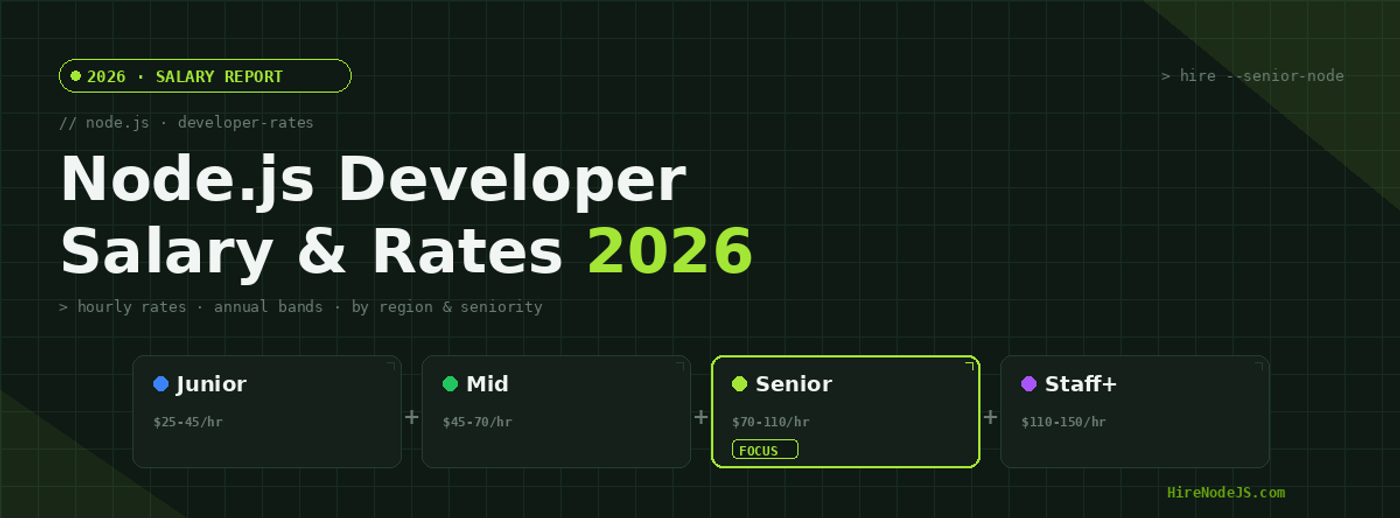
Node.js Developer Salary Guide 2026: Rates by Region & Role
Node.js remains one of the most in-demand backend skills heading into 2026, and that demand has a direct line to compensation. Whether you are a developer benchmarking your own worth, a founder writing a first engineering budget, or a hiring manager defending a req, knowing what a Node.js developer actually costs in 2026 is the difference between a quick, fair offer and months of stalled negotiation.
This guide breaks down Node.js developer salary and contractor rates by region, seniority, and skill premium, using current market data. We will also model the real fully-loaded cost of hiring — the number that includes benefits, overhead, and recruiting — because the sticker salary is rarely what you actually pay. By the end you will have realistic 2026 budget ranges and a framework for deciding between in-house, contract, and staff-augmentation hiring.
Why Node.js Developer Salaries Keep Climbing in 2026
Three forces are pushing Node.js compensation upward. First, Node.js sits at the center of modern full-stack and serverless architectures, so a single engineer who is fluent in it can own APIs, real-time systems, and edge functions at once — that breadth commands a premium. Second, the talent pool grew more slowly than demand: bootcamps produce plenty of junior JavaScript developers, but genuinely senior engineers who can design event-driven systems and tune production performance remain scarce. Third, remote hiring globalized the market, which raised rates in lower-cost regions even as it gave companies more arbitrage options.
The result is a wide band. A junior developer in a low-cost region and a principal engineer in San Francisco can differ by an order of magnitude for the same nominal job title. That spread is exactly why a regional and seniority breakdown matters more than any single 'average salary' headline number.
Node.js Developer Salary by Region
Geography is still the largest single driver of cost. The chart below shows median senior contractor rates by region for 2026. United States developers anchor the top of the market, with the United Kingdom and Western Europe close behind, while Eastern Europe, Latin America, and India offer substantial savings for comparable senior skill.
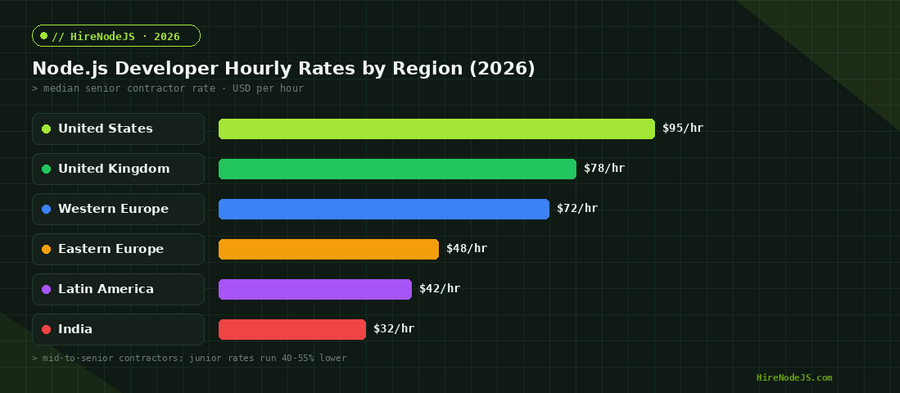
In annual terms, a senior US-based Node.js developer typically lands between $140,000 and $180,000 in base salary, UK developers in the £60,000–£90,000 range, and skilled engineers in Eastern Europe, Latin America, or India often deliver the same output at 40–60% lower cost. Many teams now blend regions deliberately — a US tech lead with a nearshore squad — and platforms like HireNodeJS make that blend practical by pre-vetting talent across regions to one consistent bar.
Cost of living, currency strength, and local demand all feed into these numbers. The key insight for 2026 is that the regional gap narrowed at the senior end — top Eastern European and Latin American engineers now command rates that would have looked North American three years ago — but a meaningful arbitrage still exists for teams willing to work across time zones.
Salary by Seniority and Experience Level
Within any region, seniority is the second great divider. The bands below reflect US full-time base compensation in 2026, from junior developers still building production instincts to principal engineers who set technical direction across teams.
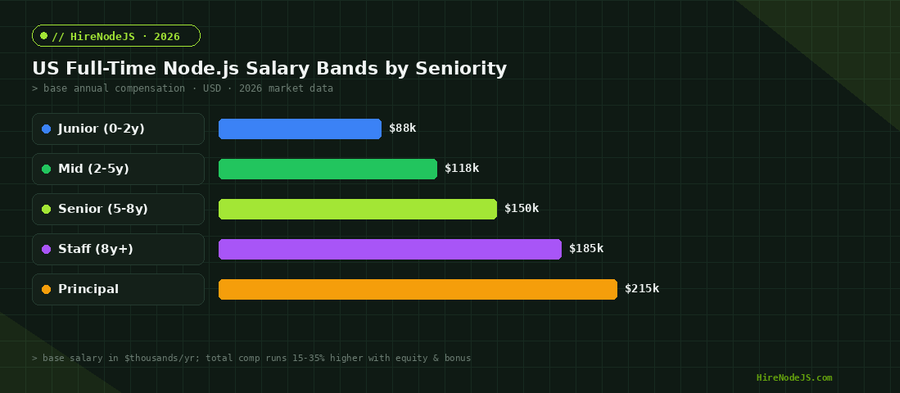
Notice how the curve steepens at the top. The jump from mid to senior is large because senior engineers reduce risk — they prevent the architecture mistakes that cost months later. The jump from staff to principal reflects scope: principals influence systems they do not personally write. When you are budgeting, decide which of these problems you are actually buying a solution to before anchoring on a band.
Sticker salary is only part of the story. Once you load in benefits, payroll taxes, equipment, tooling, and amortized recruiting cost, an in-house full-time hire costs far more than the headline number — often 40–60% more. The interactive chart below models the fully-loaded annual cost of a senior Node.js developer across four common hiring models.
Hourly Contractor and Freelance Rates
Contract and freelance Node.js work is priced by the hour, and the spread is wide. Internationally, experienced Node.js freelancers charge roughly $50–$150 per hour depending on region, specialization, and project complexity. US-based senior contractors cluster around $75–$120, while equally skilled engineers in Eastern Europe and Latin America frequently sit in the $40–$70 range.
Contractors look more expensive per hour but often cost less per year, because you pay only for productive time and carry none of the benefits or overhead load. The trade-off is continuity and institutional knowledge. The radar below compares the major hiring models across the five dimensions that actually decide outcomes — not just price, but speed, vetting depth, flexibility, and time-zone overlap.
Hire Pre-Vetted Node.js Developers
Skip the months-long search. Our exclusive talent network has senior Node.js experts ready to join your team in 48 hours.
The takeaway is that no model wins on every axis. Open marketplaces are cheap and flexible but shift all vetting risk onto you. In-house hiring maximizes control and overlap but is the slowest and most expensive to start. A vetted staff-augmentation partner aims to keep most of the cost advantage while removing the vetting burden and compressing time-to-hire to days instead of months.
What Drives a Node.js Salary Premium
Two engineers with the same years of experience can command very different rates depending on the depth of their adjacent skills. In 2026 the clearest salary multipliers are strong TypeScript fluency, production experience with cloud and serverless platforms, event-driven and microservice architecture, and a track record of performance tuning under real load.
Among these, TypeScript proficiency has effectively become table stakes for senior roles — its absence is now a discount rather than its presence a premium. Database depth (Postgres, Redis, and the query-optimization skills that go with them) and observability experience round out the most-rewarded skill set.
Before you negotiate, model the number honestly. The snippet below computes the fully-loaded annual cost of an in-house hire versus a contractor so you can compare like with like — it is the same logic behind the cost chart above.
// Estimate the fully-loaded annual cost of a Node.js hire.
// Compares an in-house full-time employee against a contractor,
// so you can budget honestly before you start interviewing.

function fullyLoadedFteCost({ baseSalary, benefitsRate = 0.25, overheadRate = 0.18, recruitingFee = 0.20 }) {
  const benefits = baseSalary * benefitsRate;       // health, retirement, payroll tax
  const overhead = baseSalary * overheadRate;       // tooling, office, equipment, mgmt
  const recruiting = baseSalary * recruitingFee;    // amortised first-year hiring cost
  return Math.round(baseSalary + benefits + overhead + recruiting);
}

function contractorCost({ hourlyRate, hoursPerWeek = 40, weeks = 48 }) {
  return Math.round(hourlyRate * hoursPerWeek * weeks); // no benefits/overhead load
}

const seniorFte = fullyLoadedFteCost({ baseSalary: 150000 });
const seniorContractor = contractorCost({ hourlyRate: 75 });

console.log(`In-house senior (fully loaded): $${seniorFte.toLocaleString()}`);
console.log(`Senior contractor (48 wks):     $${seniorContractor.toLocaleString()}`);
console.log(`Annual delta:                   $${(seniorFte - seniorContractor).toLocaleString()}`);
// In-house senior (fully loaded): $244,500
// Senior contractor (48 wks):     $144,000
// Annual delta: $100,500In-House vs Contractor vs Staff Augmentation
The right model depends on the problem. Hire in-house when the work is core, long-term, and benefits from deep institutional knowledge. Use independent contractors for well-scoped, time-boxed projects where you can afford to manage vetting yourself. Choose staff augmentation when you need senior capacity quickly, want the cost profile of a contractor with the reliability of a vetted hire, and would rather not run a three-month recruiting pipeline.
For most growing teams in 2026, the honest answer is a blend. A small in-house core holds the architecture and domain knowledge, while augmented engineers add velocity on well-defined surfaces. The fully-loaded cost gap — often $80,000–$120,000 per senior head per year between in-house US and a vetted nearshore engineer — is large enough that the blend is a budget strategy, not just a staffing one.
How to Budget and Negotiate Node.js Compensation
Start from the fully-loaded number, not the base. Decide the seniority you actually need (re-read your own job description honestly), pick a region or blend, then add the benefits and overhead load on top of base. Build a range with a real ceiling so you can move fast on a strong candidate instead of losing them to a slow approval chain.
On the developer side, the strongest lever is demonstrable production impact: latency you cut, incidents you prevented, systems you scaled. Specialized depth in TypeScript, cloud, and performance moves offers more than another year of generic experience. On both sides, speed matters — the best engineers are off the market in days, so a tight, well-budgeted process wins more often than the highest nominal number.
If you would rather skip the benchmarking and pipeline entirely, HireNodeJS connects you with pre-vetted senior Node.js engineers available within 48 hours — every developer is screened on real-world architecture, API design, and production deployments, so the rate you see maps to talent you can trust.
Hire Expert Node.js Developers — Ready in 48 Hours
Knowing the market rate is only useful if you can act on it. HireNodeJS.com specialises exclusively in Node.js talent: every developer is pre-vetted on real-world projects, API design, event-driven architecture, and production deployments — so you compare engineers, not resumes.
Unlike generalist marketplaces, our curated pool means you speak only to engineers who live and breathe Node.js. Most clients have their first developer working within 48 hours of getting in touch, at rates that reflect the regional and seniority bands in this guide. Engagements start as short-term contracts and can convert to full-time hires with zero placement fee.
Conclusion: Budgeting Node.js Talent in 2026
Node.js compensation in 2026 spans a wide, regionally driven range — from roughly $32/hour for senior talent in India to $95+/hour in the United States, and from $88k to $215k in US full-time base salary across seniority levels. The number that should drive your decisions is not the sticker salary but the fully-loaded cost, and the smartest teams treat region and hiring model as budget levers rather than fixed constraints.
Decide the seniority you truly need, model the real cost, and choose the hiring model that fits the problem. Do that, and you will make faster, fairer offers — and spend your budget on impact instead of overhead.
Frequently Asked Questions
What is the average Node.js developer salary in 2026?
In the United States, full-time Node.js developers average around $120,000–$145,000 per year in 2026, with seniors reaching $150,000–$180,000. Rates vary widely by region, from roughly $88k for juniors to $215k for principal engineers.
How much does it cost to hire a Node.js developer per hour in 2026?
Senior Node.js contractor rates range from about $32/hour in India and $42–$48/hour in Latin America and Eastern Europe to $72–$95/hour in Western Europe, the UK, and the United States. Freelancers internationally average $50–$150/hour depending on expertise.
Is it cheaper to hire a Node.js contractor or a full-time employee?
Per hour, contractors look more expensive, but per year they often cost less because you avoid benefits, payroll taxes, and overhead — which add 40–60% on top of an in-house base salary. Contractors trade some continuity for lower fully-loaded cost and faster onboarding.
Which region offers the best value for hiring Node.js developers?
Eastern Europe and Latin America offer the strongest balance of senior skill and cost in 2026, typically 40–60% below US rates with reasonable time-zone overlap. India remains the lowest-cost option for senior talent at around $32/hour.
What skills increase a Node.js developer's salary the most?
Strong TypeScript fluency, production cloud and serverless experience, event-driven and microservice architecture, database optimization, and proven performance tuning under load command the largest premiums in 2026.
How fast can I hire a vetted Node.js developer?
Through a staff-augmentation platform like HireNodeJS, pre-vetted senior Node.js engineers can typically start within 48 hours, compared with a two-to-three month in-house recruiting cycle.
Vivek Singh is the founder of Witarist and HireNodeJS.com — a platform connecting companies with pre-vetted Node.js developers. With years of experience scaling engineering teams, Vivek shares insights on hiring, tech talent, and building with Node.js.
Skip the search — hire a vetted Node.js developer in 48 hours
HireNodeJS connects you with pre-vetted senior Node.js engineers available within 48 hours. No recruiter fees, no lengthy screening — just rate-fair, production-ready talent.