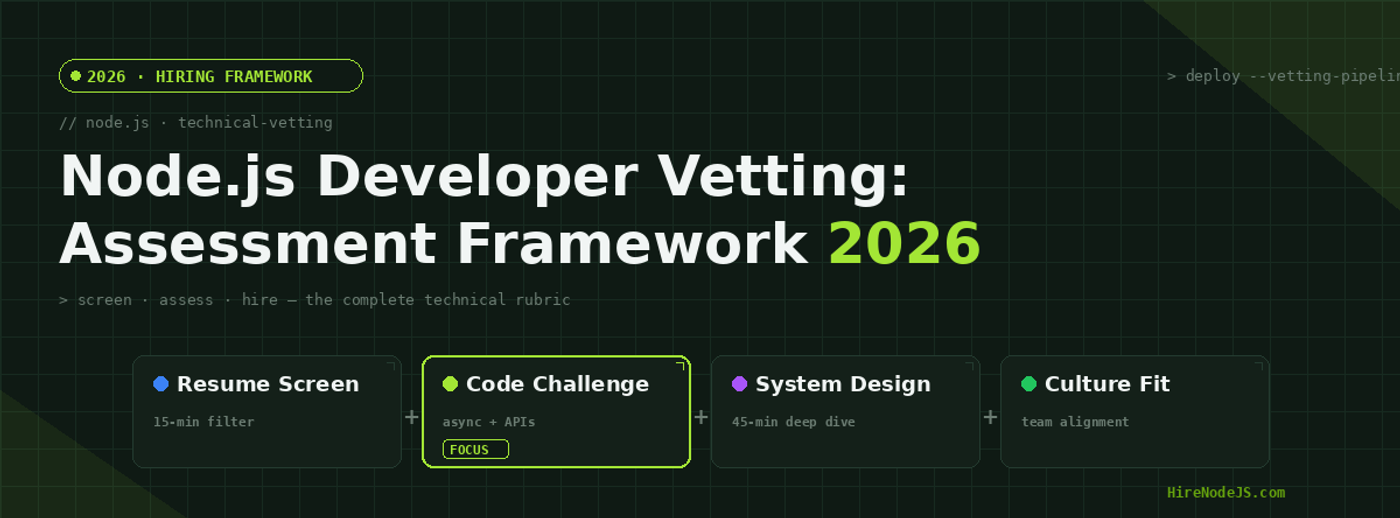
Node.js Developer Vetting: The Complete Technical Assessment Framework for 2026
Hiring the wrong Node.js developer costs more than a bad sprint — it compounds into technical debt, missed deadlines, and team morale erosion. In 2026, with Node.js powering everything from real-time fintech APIs to AI-driven microservices, the gap between a competent developer and a truly production-ready engineer has never been wider. Yet most hiring teams still rely on resume scanning and generic algorithm quizzes that tell you nothing about how a candidate handles backpressure in a streaming pipeline or structures error boundaries across fifty microservices.
This guide presents a complete, battle-tested technical assessment framework for vetting Node.js developers at every seniority level. Whether you are hiring a Node.js developer for a startup MVP or scaling an enterprise platform team, these rubrics, code challenges, and scoring matrices will help you identify engineers who ship production-grade systems — not just pass interview puzzles.
Why Traditional Node.js Interviews Fail in 2026
The standard technical interview — a whiteboard algorithm problem, a few trivia questions about closures, and a behavioral chat — was designed for a different era. Node.js development in 2026 demands fluency in async concurrency patterns, TypeScript generics, container orchestration, and increasingly, integrating LLM APIs and vector databases into backend services. A candidate who can invert a binary tree may still write an Express handler that blocks the event loop with a synchronous JSON parse on a 200 MB payload.
The Event Loop Blind Spot
The number one technical failure mode in Node.js hires is a shallow understanding of the event loop. Developers who learned Node through tutorials often treat async/await as magic syntax without understanding microtask queues, I/O polling phases, or timer resolution. In production, this gap manifests as mysterious latency spikes, unhandled promise rejections that crash the process, and memory leaks from unawaited promises accumulating in the heap.
Resume Inflation in the AI Era
With AI coding assistants generating polished portfolios and GitHub contributions, resumes have become unreliable signals. A 2026 survey of engineering managers found that over sixty percent had encountered candidates whose claimed experience did not match their live coding performance. The solution is not to abandon resumes entirely but to treat them as a coarse filter — the first five minutes of a structured pipeline, not the whole story.
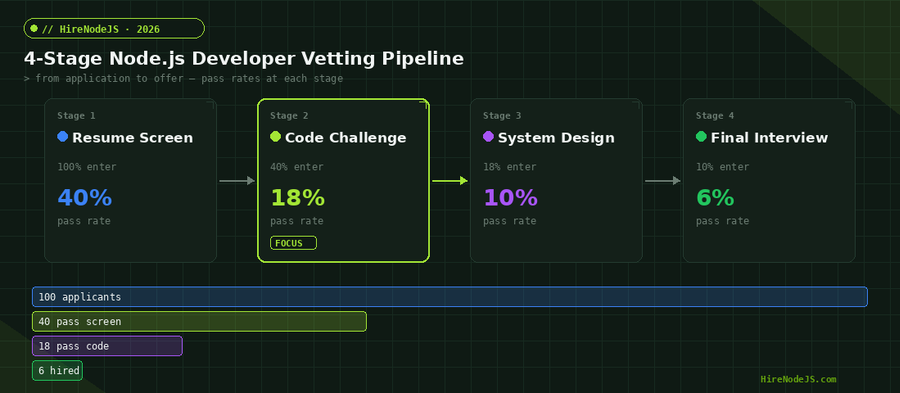
The 4-Stage Node.js Developer Vetting Pipeline
An effective vetting pipeline balances thoroughness with candidate experience. You want to filter decisively at each stage without burning a senior engineer's entire weekend on a take-home project. The framework below typically takes five to seven business days from application to offer, with each stage progressively increasing in depth and time investment.
Stage 1: Resume and Portfolio Screen (15 Minutes)
The goal here is speed: eliminate clearly unqualified candidates without over-investing. Look for evidence of production Node.js deployments, not just tutorial projects. Key signals include contributions to open-source Node.js libraries, experience with TypeScript in production, mentions of observability tools like OpenTelemetry or Datadog, and familiarity with containerized deployments. A candidate who lists Express and MongoDB but has never deployed to anything beyond localhost is a red flag for senior roles.
Stage 2: Asynchronous Code Challenge (60–90 Minutes)
This is where most candidates are filtered. The challenge should test real-world Node.js skills — not algorithmic puzzles. A strong code challenge asks the candidate to build a small REST API with proper error handling, input validation, and at least one async integration (a database call, a third-party API, or a file system operation). The best challenges include a deliberately buggy starter codebase that the candidate must debug before extending.
Stage 3: Live System Design Interview (45 Minutes)
For mid-level and senior roles, the system design round separates engineers who build features from engineers who build systems. Present a realistic scenario — designing a real-time notification service, an event-driven order processing pipeline, or a multi-tenant SaaS API — and assess their ability to reason about backend architecture, database selection, caching strategies, and failure modes. The best candidates will proactively discuss rate limiting, circuit breakers, and graceful degradation.
Stage 4: Culture and Collaboration Fit (30 Minutes)
Technical skill without collaboration skill is a liability. This final stage assesses how the candidate communicates technical tradeoffs, handles disagreements about architecture, and approaches code reviews. Ask them to walk through a production incident they resolved — you will learn more about their engineering maturity from a post-mortem narrative than from any coding exercise.
Building a Weighted Scoring Rubric
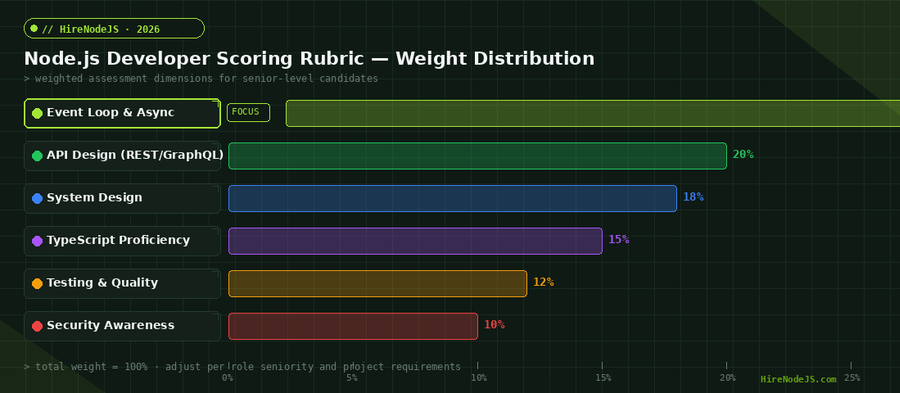
Gut feelings are not a hiring strategy. A structured scoring rubric ensures every interviewer evaluates the same dimensions with the same weight, reducing bias and improving signal-to-noise ratio. The rubric below is calibrated for senior Node.js roles and should be adjusted for mid-level and junior positions by shifting weight from system design toward code quality and fundamental JavaScript fluency.
Core Assessment Dimensions
The six dimensions that matter most for Node.js developers are event loop and async mastery (25 percent weight), API design proficiency covering both REST and GraphQL (20 percent), system design and architectural thinking (18 percent), TypeScript proficiency including generics, utility types, and strict mode patterns (15 percent), testing and quality practices (12 percent), and security awareness including OWASP Top 10 for Node.js (10 percent). Each dimension is scored on a 0 to 100 scale, and the weighted total determines the candidate tier.
Scoring Thresholds by Seniority
A junior developer should score at least 40 on event loop fundamentals and 35 on API design. Mid-level candidates need a 60+ weighted average across all dimensions. Senior candidates — the ones you would trust to architect a new microservice or lead a TypeScript migration — should score 75 or above on every dimension. If a senior candidate scores below 65 on system design, that is a disqualifying signal regardless of how well they performed on the code challenge.
Hire Pre-Vetted Node.js Developers
Skip the months-long search. Our exclusive talent network has senior Node.js experts ready to join your team in 48 hours.
Designing Effective Node.js Code Challenges
The best code challenges simulate real production work. They should take 60 to 90 minutes, include a clear specification document, provide a starter codebase with deliberate issues, and test multiple competencies simultaneously. Avoid algorithm-heavy puzzles that reward competitive programming practice over practical engineering skill.
The Bug Hunt Starter Pattern
One of the most effective challenge formats is the Bug Hunt Starter. You provide a small Express or Fastify application with four to six real-world bugs hidden in the codebase: a synchronous file read blocking the event loop, a promise chain with swallowed errors, missing input validation on a critical endpoint, hardcoded credentials in the source, an N+1 database query, and a race condition in a concurrent update handler. The candidate's task is to find and fix the bugs, then add a new feature on top of the cleaned codebase.
Sample Challenge: Build a Rate-Limited API Gateway
const express = require('express');
const { createClient } = require('redis');
const crypto = require('crypto');

const app = express();
const redis = createClient({ url: process.env.REDIS_URL });

// Sliding window rate limiter using Redis sorted sets
const slidingWindowLimiter = async (req, res, next) => {
  const key = `rate:${req.ip}`;
  const now = Date.now();
  const windowMs = 60_000; // 1-minute window

  const multi = redis.multi();
  multi.zRemRangeByScore(key, 0, now - windowMs);
  multi.zAdd(key, { score: now, value: `${now}:${crypto.randomUUID()}` });
  multi.zCard(key);
  multi.expire(key, 60);

  const results = await multi.exec();
  const requestCount = results[2];

  if (requestCount > 100) {
    return res.status(429).json({
      error: 'Rate limit exceeded',
      retryAfter: Math.ceil(windowMs / 1000),
    });
  }

  res.set('X-RateLimit-Remaining', Math.max(0, 100 - requestCount));
  next();
};

app.use(express.json());
app.use(slidingWindowLimiter);

app.get('/api/health', (req, res) => {
  res.json({ status: 'ok', timestamp: new Date().toISOString() });
});

app.listen(3000, () => console.log('Gateway listening on :3000'));System Design Interview Questions for Node.js Developers
The system design round is the most informative stage for senior hires. Unlike coding challenges that test implementation speed, system design interviews reveal how a candidate thinks about trade-offs, failure modes, and scalability constraints. The conversation should feel collaborative, not adversarial — you are assessing whether you would trust this person to make architectural decisions on your team.
Recommended Prompts by Domain
For candidates working on real-time systems, ask them to design a WebSocket-based notification service that handles 100,000 concurrent connections with message persistence and delivery guarantees. For API-focused roles, have them architect a GraphQL gateway that federates across five microservices with field-level authorization. For data-intensive roles, ask them to design a clickstream analytics pipeline using Node.js streams, Kafka, and ClickHouse.
What to Listen For
Strong candidates will proactively address single points of failure and propose redundancy strategies. They will discuss caching at multiple layers — CDN, application-level with Redis, and database query caching. They will mention observability from the start, suggesting structured logging with Pino, distributed tracing with OpenTelemetry, and health check endpoints. Weak candidates jump straight to code without clarifying requirements, ignore error handling entirely, or propose architectures that cannot scale beyond a single instance.
Remote Node.js Hiring: Rates, Regions, and Red Flags
The global market for Node.js talent in 2026 offers significant cost variation by region without a proportional quality gap. North American senior developers command 72 to 86 dollars per hour on remote contracts, while equally skilled engineers in Eastern Europe and South Asia range from 36 to 48 dollars per hour. The key is rigorous vetting — which this framework provides — rather than defaulting to the most expensive talent pool. If you need a full-stack developer who can ship both React frontends and Node.js APIs, consider talent pools in Poland, Ukraine, Romania, and India where full-stack fluency is common.
Red Flags in Remote Candidates
Watch for candidates who cannot explain their own portfolio projects in a live call — a strong indicator of AI-generated or outsourced work. Be cautious of developers who have never worked asynchronously with a distributed team, as the collaboration patterns differ significantly from co-located work. And always verify timezone overlap: a brilliant engineer who is never online during your team's core hours will create more coordination overhead than they save in salary.
Contract-to-Hire as a Risk Mitigation Strategy
The most effective risk mitigation for remote Node.js hires is a contract-to-hire arrangement. Start with a two to four week paid trial project that mirrors your actual codebase and workflow. Evaluate not just code quality but communication patterns, PR review thoroughness, and how they handle ambiguous requirements. This trial period catches culture mismatches that no interview can detect and costs far less than a bad full-time hire.
Hire Expert Node.js Developers — Ready in 48 Hours
Building the right system is only half the battle — you need the right engineers to build it. HireNodeJS.com specialises exclusively in Node.js talent: every developer is pre-vetted on real-world projects, API design, event-driven architecture, and production deployments.
Unlike generalist platforms, our curated pool means you speak only to engineers who live and breathe Node.js. Most clients have their first developer working within 48 hours of getting in touch. Engagements start as short-term contracts and can convert to full-time hires with zero placement fee.
Conclusion: Hire for Production, Not for Puzzles
A structured, four-stage vetting pipeline with weighted scoring rubrics transforms Node.js hiring from a gamble into a repeatable process. By testing event loop mastery, API design proficiency, system design thinking, and real-world debugging skills, you filter for engineers who deliver production-grade systems — not just candidates who memorize interview answers. Invest the time to build your assessment framework once, calibrate it against your existing team, and refine it quarterly. The compounding returns in hire quality will pay for themselves within the first sprint.
If building and maintaining an assessment pipeline sounds like more overhead than your team can absorb, HireNodeJS handles the vetting for you — every developer on the platform has already passed a rigorous technical assessment covering all six dimensions in this framework.
Frequently Asked Questions
What is the best way to vet Node.js developers in 2026?
Use a structured 4-stage pipeline: resume screen, asynchronous code challenge testing real-world async patterns, live system design interview, and a culture fit conversation. Score each stage against a weighted rubric covering event loop mastery, API design, system architecture, TypeScript, testing, and security.
How much does it cost to hire a Node.js developer in 2026?
Remote contract rates range from $12-28/hr for junior developers in Southeast Asia to $72-86/hr for senior engineers in North America. Eastern European senior developers typically cost $36-48/hr with comparable quality, making the region a popular choice for cost-optimized hiring.
What should a Node.js technical assessment include?
An effective assessment includes a timed code challenge with a buggy starter codebase, a live system design discussion about a realistic architecture scenario, and evaluation of the candidate's testing approach. Avoid pure algorithm puzzles — test production-relevant skills like error handling, async patterns, and database integration.
How long should the Node.js hiring process take?
A well-structured pipeline takes 5-7 business days from application to offer. The resume screen takes 15 minutes, the code challenge 60-90 minutes, the system design interview 45 minutes, and the culture fit discussion 30 minutes.
What are the red flags when hiring remote Node.js developers?
Key red flags include inability to explain their own portfolio projects live (suggesting AI-generated work), no experience with async team collaboration tools, poor timezone overlap with your core team, and candidates who cannot discuss production debugging or incident response from real experience.
Should I use contract-to-hire for Node.js developers?
Yes, contract-to-hire is the most effective risk mitigation strategy for remote Node.js hires. A 2-4 week paid trial project lets you evaluate code quality, communication patterns, and cultural fit in a real work context — catching mismatches that no interview can detect.
Vivek Singh is the founder of Witarist and HireNodeJS.com — a platform connecting companies with pre-vetted Node.js developers. With years of experience scaling engineering teams, Vivek shares insights on hiring, tech talent, and building with Node.js.
Skip the Screening — Hire Pre-Vetted Node.js Developers in 48 Hours
HireNodeJS has already applied this assessment framework for you. Every developer on our platform has passed a rigorous 4-stage vetting process covering event loop mastery, API design, system architecture, and production deployment experience.