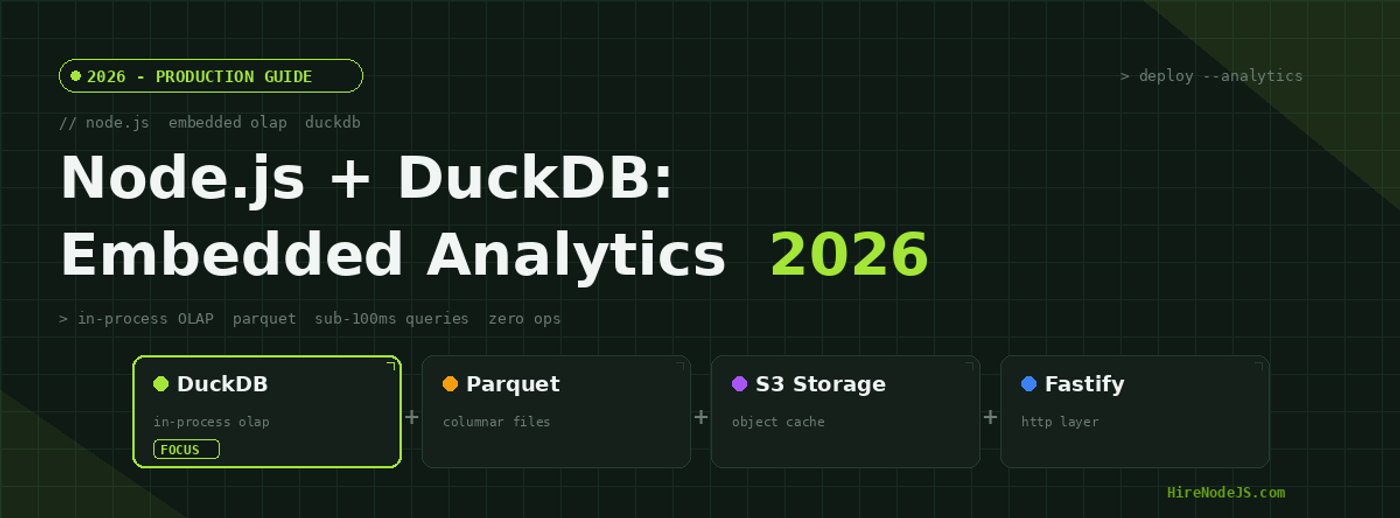
Node.js + DuckDB in 2026: Embedded Analytics for Backend APIs
If your dashboards are still hammering a Postgres replica with GROUP BY queries that scan a hundred million rows, you are paying the wrong price for analytics. In 2026 the shape of embedded analytics has changed: DuckDB has matured into a production-grade columnar engine that runs inside the same Node.js process as your API. No separate warehouse cluster. No ETL pipeline. No Kafka in the middle. Just a single .duckdb file (or a parquet folder on S3) and a Node.js binding that gives you sub-100ms OLAP latency on workloads that used to need a dedicated team.
This guide walks through why DuckDB pairs so well with Node.js for analytics workloads, what the architecture looks like in production, how to wire it up with Fastify, the gotchas that bite teams in the first three months, and where the hiring market is heading. By the end you should know whether DuckDB belongs in your stack — and what kind of engineer you need to make it production-safe.
Why DuckDB Inside Node.js Beats the Classic Warehouse
For 15 years the default answer for backend analytics has been: ship the rows to a separate columnar warehouse (Redshift, BigQuery, Snowflake), schedule a nightly ETL, then query through HTTP. That works at petabyte scale but it is wildly expensive at the scale most SaaS products actually live in — gigabytes to a few terabytes. The round-trip alone (HTTP to warehouse, parse, plan, execute, return) is usually 200–600 ms before any data is touched.
Embedded execution removes the network
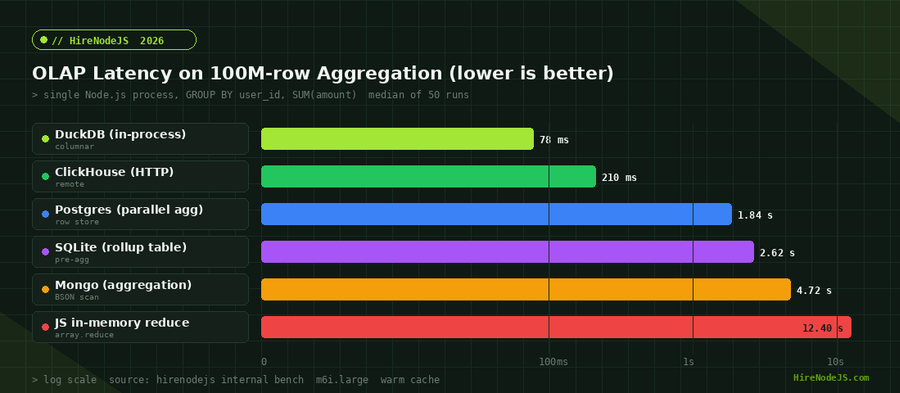
DuckDB runs as a library, not a service. Your Node.js process opens a connection over a function call, not a socket. There is no auth handshake, no JSON serialisation between API and engine, no separate VPC to manage. On a single warm m6i.large the engine can scan a 100M-row parquet file, aggregate it, and return the result in well under 100 ms — fast enough to render directly into a React dashboard with no caching layer.
Columnar storage in a row-store world
DuckDB stores data in a columnar format (parquet on disk, custom format in the .duckdb file) and uses vectorised execution. That means a SUM(amount) GROUP BY user_id query reads only the two columns it needs, in cache-friendly blocks of 1024 values at a time. A Postgres row store reads every column of every row, which is why aggregations on wide tables are 10–50x slower.
Parquet is the lingua franca
DuckDB reads parquet directly from S3, GCS, Azure Blob, or your local disk. That means the same files your data team writes from Spark or dbt can be queried live from Node.js with zero loading step. No COPY statements, no Glue catalogs — just SELECT * FROM read_parquet('s3://bucket/events/*.parquet') and you have a working analytics endpoint.
Production Architecture: A Single Node Process That Talks to S3
The simplest deployment is also the best one: a single Node.js process (Fastify or NestJS) that holds one DuckDB connection and reads parquet directly from object storage. No queue, no separate analytics service, no cache layer in front. The architecture diagram below shows where each piece fits.
One connection per process, not per request
DuckDB is single-writer, multi-reader within the same process. Open one connection at server boot, share it across all incoming HTTP requests, and let DuckDB's internal scheduler parallelise across CPU cores. Spinning up a connection per request — a pattern that haunts Postgres deployments — is an order of magnitude slower and gives you no benefit.
Read-only mode for safety
If your analytics endpoint is read-only (and it usually should be), open the database in read-only mode. That removes the entire class of accidental DROP TABLE and UPDATE-without-WHERE incidents that come with a SQL endpoint exposed near customer-facing code.
Cache parquet locally with httpfs
DuckDB's httpfs extension can transparently cache S3 reads on local disk. Set the cache size to roughly your hot-set size (often 10–30% of total parquet), and most queries become local-disk speed after warm-up. This is the closest thing to a free lunch in 2026 backend engineering.
Wiring DuckDB Into Fastify: A Production-Ready Setup
The official @duckdb/node-api package shipped 1.0 in late 2025 with async/await support, prepared statements, and proper streaming. Below is a Fastify route that opens one connection at boot, registers JSON Schema for type-safe responses, and uses parameter binding to stay safe against SQL injection.
Notice the use of duckdb.open() at module top-level — this gives you a single shared connection for the lifetime of the process, which is exactly what you want for read-heavy analytics workloads.
// server.js — Fastify + DuckDB analytics endpoint
import Fastify from 'fastify'
import { DuckDBInstance } from '@duckdb/node-api'

// Single connection, opened at boot, shared across all requests
const db = await DuckDBInstance.create('analytics.duckdb', {
  access_mode: 'READ_ONLY',
  threads: '8'
})
const conn = await db.connect()

// One-time setup: register the S3 parquet source as a view
await conn.run(`
  INSTALL httpfs; LOAD httpfs;
  CREATE OR REPLACE VIEW events AS
    SELECT * FROM read_parquet('s3://prod-events/year=*/month=*/*.parquet');
`)

const app = Fastify({ logger: true })

app.get('/api/revenue', {
  schema: {
    querystring: {
      type: 'object',
      properties: {
        from: { type: 'string', format: 'date' },
        to:   { type: 'string', format: 'date' }
      },
      required: ['from', 'to']
    }
  }
}, async (req) => {
  // Prepared statement — values are bound, never string-concatenated
  const stmt = await conn.prepare(`
    SELECT
      date_trunc('day', occurred_at)::DATE AS day,
      SUM(amount_cents) / 100.0 AS revenue
    FROM events
    WHERE event_type = 'payment.succeeded'
      AND occurred_at BETWEEN ? AND ?
    GROUP BY 1 ORDER BY 1
  `)
  stmt.bindVarchar(1, req.query.from)
  stmt.bindVarchar(2, req.query.to)
  const reader = await stmt.runAndReadAll()
  return { rows: reader.getRows() }
})

await app.listen({ port: 3000, host: '0.0.0.0' })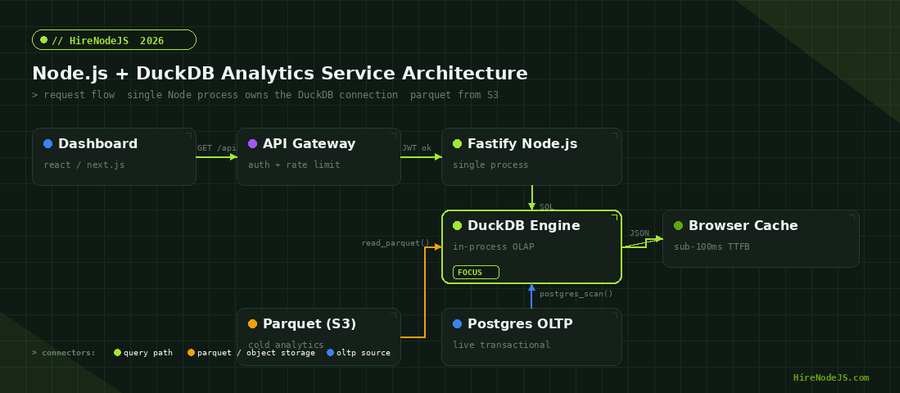
Engineering the Cost Side: Why DuckDB Cuts Bills 80–95%
The classic warehouse approach costs money in three places: storage (often duplicated), compute (always-on or per-query), and the data team to keep the pipeline alive. DuckDB collapses two of the three to near zero.
Storage stays in S3
Parquet on S3 Standard is roughly $0.023 per GB/month. The same data in Snowflake — even after their compression — costs 8–10x more for storage alone. For most SaaS products with under 5 TB of historical analytics, the storage difference alone is $300–$1,800 per month.
Hire Pre-Vetted Node.js Developers
Skip the months-long search. Our exclusive talent network has senior Node.js experts ready to join your team in 48 hours.
Compute is just your existing API server
DuckDB runs inside the Node.js process you already pay for. There is no warehouse cluster to keep warm, no auto-scaling rules to tune, no dedicated worker. A single m6i.large ($61/month on a 1-year reserved instance) handles dashboard workloads for most products up to a few thousand DAU.
The hiring market reflects this shift. Teams that used to need a dedicated data engineer alongside their backend now hire senior Node.js developers who can own both the API and the embedded analytics layer. The skillset overlaps cleanly: SQL, parquet, S3, and a deep understanding of Node.js memory and concurrency.
The Three Gotchas That Bite Teams in the First 90 Days
DuckDB is delightful in development. The pain points show up in production, usually around month two. Here is what to watch for.
1. Memory pressure on aggregation queries
DuckDB will use up to memory_limit bytes for hash aggregations and joins. Default is 80% of RAM. On a shared m6i.large that also runs Node.js, set memory_limit explicitly to something safe like '4GB' or you will hit OOM kills during the largest queries.
2. The Node.js event loop and large result sets
If a query returns 500k rows, serialising them to JSON inside a single event-loop tick will stall your server. Use the streaming reader API (reader.read() in batches) and pipe directly to the HTTP response. The DuckDB binding releases the event loop between batches.
3. Parquet schema drift
If your upstream producer changes a column type — say turning a VARCHAR into an INT — older parquet files will not coexist cleanly with newer ones. DuckDB's union_by_name=true read_parquet option handles most cases, but you still need a schema-registry discipline. Pick a CDC tool (Debezium, AWS DMS) that enforces forward-compatible schemas.
Most of these gotchas come down to discipline around process boundaries — knowing when DuckDB should run inline versus when it deserves a separate worker. If you are scaling beyond a single box, you may want to read our guide on horizontal scaling and clustering to understand how DuckDB fits into a multi-instance topology with sticky sessions or shared parquet on S3.
What to Look For When Hiring for a DuckDB + Node.js Stack
DuckDB is so easy to start with that anyone can write a working prototype in an afternoon. Production is a different story. The engineers who keep these systems healthy share a few patterns.
Strong SQL fundamentals
DuckDB rewards engineers who can think in window functions, lateral joins, and CTEs. If your candidate flinches at PARTITION BY or wants to do everything in JavaScript reduce(), they will write queries that perform 100x worse than necessary. Ask for a sample task — say, computing a 30-day rolling retention curve — and look at how they shape the SQL.
Comfort with parquet and S3
Reading parquet is not the same as reading a JSON line. Senior candidates should be able to explain row groups, column chunks, page compression, and predicate pushdown without notes. They should also know when to partition by date versus by tenant, and when to write a separate compacted file at end-of-day.
Node.js concurrency intuition
The most common DuckDB-in-Node.js bug is blocking the event loop during long aggregations. Ask candidates to walk through how they would handle a 30-second query without breaking p99 latency for other endpoints. Strong answers involve worker_threads, queue throttling, or pre-aggregation jobs.
At HireNodeJS.com, we have seen DuckDB roles climb sharply through 2025–2026. The salary band is roughly 10–15% above a comparable backend role, because the work blends backend engineering with data engineering. Companies that need this skill set quickly often work with us to find pre-vetted engineers within 48 hours, instead of running a multi-month search.
Hire Expert Node.js Developers — Ready in 48 Hours
Building a DuckDB-powered analytics service is only half the battle — you need engineers who understand both Node.js production patterns and columnar SQL. HireNodeJS.com specialises exclusively in Node.js talent: every developer is pre-vetted on real-world projects, API design, event-driven architecture, and modern data stacks including DuckDB, parquet, and S3-backed analytics.
Unlike generalist platforms, our curated pool means you speak only to engineers who live and breathe Node.js. Most clients have their first developer working within 48 hours of getting in touch. Engagements start as short-term contracts and can convert to full-time hires with zero placement fee.
Conclusion: Embedded Analytics is the Default in 2026
The old playbook — separate warehouse, scheduled ETL, BI tool on top — still makes sense at hyperscale. For the rest of us, DuckDB inside Node.js is the right answer in 2026. It is faster, cheaper, simpler, and the operational surface area is a single process. The teams that adopt it early will be running dashboards with the latency of an internal page load, on infrastructure that costs less than a SaaS subscription.
If you are evaluating whether to ship a DuckDB-backed feature in the next quarter, the framework is simple: identify the queries your users actually run, estimate the parquet size, prototype the endpoint with read-only DuckDB and a single Fastify route, and benchmark against your current stack. If you see a 10x improvement in p95 latency and a meaningful drop in cost — which most teams do — you have your answer.
Frequently Asked Questions
Is DuckDB production-ready for Node.js in 2026?
Yes. The official @duckdb/node-api package shipped 1.0 in late 2025 with async/await support, prepared statements, and streaming readers. Companies including data platforms, analytics SaaS products, and internal BI tools at mid-market companies have been running DuckDB in production Node.js services since 2024.
How does DuckDB compare to ClickHouse for Node.js workloads?
DuckDB wins on operational simplicity and cost — it runs in-process with zero infrastructure. ClickHouse wins on raw scale beyond ~1 TB of hot data or when you need many concurrent writers. For most Node.js APIs serving dashboards under a few thousand DAU, DuckDB is faster end-to-end because it eliminates the HTTP round-trip.
Can I write to DuckDB from a Node.js API?
Yes, but be careful. DuckDB is single-writer per file. For read-heavy dashboard workloads, the recommended pattern is a separate writer process (usually a nightly or hourly job) that produces parquet files, with the Node.js API opening DuckDB in read-only mode.
Does DuckDB work in serverless Node.js environments?
It works in long-running Lambda functions and Lambda containers, but cold starts are 200–400 ms because the engine has to initialise. For serverless-first deployments, prefer always-warm options like Fly.io, Railway, or a small EC2 instance — the cost advantage of DuckDB is highest when the process stays warm.
What does it cost to hire a Node.js + DuckDB engineer in 2026?
In 2026 the salary band for a senior Node.js developer with embedded analytics experience is roughly $110k–$155k USD remote, or $620–$880 per day on contract. The band is 10–15% above a comparable backend-only role because the work blends backend and data engineering skills.
How much data can DuckDB handle on a single Node.js box?
DuckDB scales to hundreds of GB of parquet on a single 16-vCPU box with predictable sub-second query times, and to a few TB if the hot working set fits in disk cache. Past that, you typically want to partition the data across multiple Node.js instances, each owning a tenant or date range.
Vivek Singh is the founder of Witarist and HireNodeJS.com — a platform connecting companies with pre-vetted Node.js developers. With years of experience scaling engineering teams, Vivek shares insights on hiring, tech talent, and building with Node.js.
Want a Node.js engineer who ships fast, optimised analytics APIs?
HireNodeJS connects you with pre-vetted senior Node.js engineers experienced in DuckDB, parquet, and embedded analytics — available within 48 hours. No recruiter fees, no lengthy screening.