Effect-TS for Node.js: The Complete Production Guide 2026
Effect-TS has quietly become the most significant shift in how production Node.js applications handle errors, concurrency, and dependency injection since TypeScript itself arrived. In 2026, teams building mission-critical APIs, event-driven pipelines, and AI orchestration layers are discovering that traditional try-catch error handling and ad-hoc dependency injection simply cannot keep up with the complexity of modern backend systems.
This guide walks you through everything you need to adopt Effect-TS in a production Node.js codebase — from the core primitives and typed error channels to structured concurrency with fibers and the Layer-based dependency injection system. Whether you are scaling an existing Node.js backend or starting a greenfield project, you will learn patterns that eliminate entire categories of runtime bugs at compile time.
What Is Effect-TS and Why Does It Matter in 2026
Effect-TS is a TypeScript library that introduces a typed effect system to the language. At its core, every operation is represented as an Effect<Success, Error, Requirements> value — a lazy description of a computation that declares its return type, its possible failure modes, and the services it needs to run. Unlike promises, effects are referentially transparent: they describe what to do without actually doing it until you explicitly run the program.
The library has matured rapidly through 2025 and into 2026, reaching version 3.x with a stable API surface. Companies ranging from fintech startups to enterprise SaaS platforms have adopted it for critical paths where untyped error handling was causing production incidents. The npm download numbers tell the story — Effect has crossed 2 million weekly downloads as of early 2026, a fourfold increase from the previous year.
The Problem with Traditional Error Handling
In standard TypeScript, when you write an async function that might fail, the type signature tells you nothing about what can go wrong. A function returning Promise<User> could throw a database connection error, a validation error, a timeout, or anything else — and the compiler is completely silent about it. You rely on documentation, tribal knowledge, or runtime crashes to discover failure modes.
Effect-TS changes this fundamentally. A function returning Effect<User, DatabaseError | ValidationError, UserRepo> makes every failure path visible in the type system. If you forget to handle a DatabaseError, the compiler catches it — before your code ever reaches production. This is why teams building TypeScript backends are increasingly reaching for Effect.
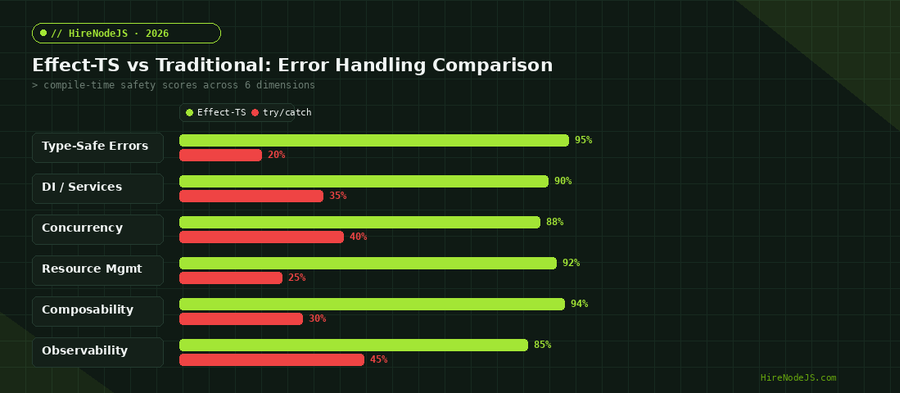
Core Primitives: Effect, Either, and Option
The foundation of Effect-TS rests on three key primitives. The Effect type itself represents a computation that may succeed with a value of type A, fail with an error of type E, or require services described by type R. The Either type represents a synchronous result that is either a Left (error) or Right (success). The Option type represents a value that may or may not exist — a type-safe replacement for null checks.
Creating and Composing Effects
Effects are created using constructor functions like Effect.succeed, Effect.fail, and Effect.tryPromise. The real power comes from composition — you chain effects with pipe, flatMap, and map to build complex workflows from small, testable pieces. Each step in the chain preserves full type information about what can go wrong.
import { Effect, pipe } from "effect"

// Define typed error classes
class UserNotFound extends Error {
  readonly _tag = "UserNotFound"
  constructor(readonly userId: string) {
    super(`User ${userId} not found`)
  }
}

class DatabaseError extends Error {
  readonly _tag = "DatabaseError"
  constructor(readonly cause: unknown) {
    super("Database operation failed")
  }
}

// A function with typed errors in the signature
const getUser = (id: string): Effect.Effect<User, UserNotFound | DatabaseError> =>
  pipe(
    Effect.tryPromise({
      try: () => db.query("SELECT * FROM users WHERE id = $1", [id]),
      catch: (err) => new DatabaseError(err)
    }),
    Effect.flatMap((rows) =>
      rows.length === 0
        ? Effect.fail(new UserNotFound(id))
        : Effect.succeed(rows[0] as User)
    )
  )

// The caller MUST handle both error types — compiler enforces it
const program = pipe(
  getUser("usr_123"),
  Effect.catchTag("UserNotFound", (err) =>
    Effect.succeed({ id: err.userId, name: "Guest", fallback: true })
  ),
  Effect.catchTag("DatabaseError", (err) =>
    Effect.logError("DB failed", err).pipe(Effect.flatMap(() => Effect.fail(err)))
  )
)Dependency Injection with the Layer System
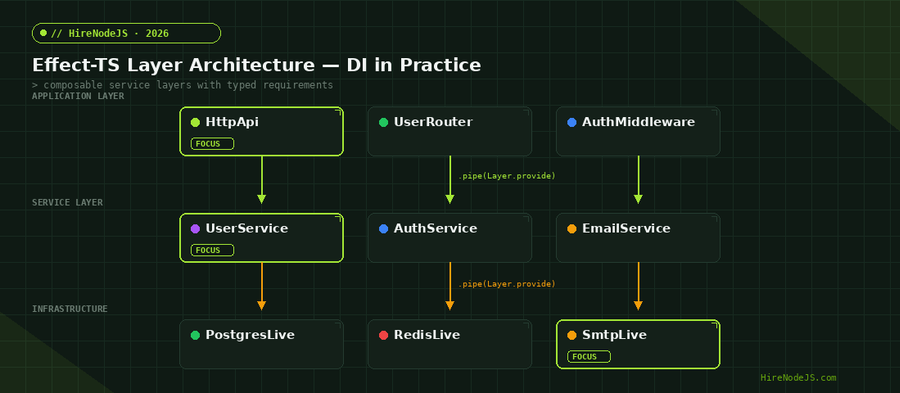
One of Effect-TS's most compelling features for production applications is its built-in dependency injection system. Unlike NestJS's decorator-based DI or manual constructor injection, Effect uses a concept called Layers to define how services are constructed and composed. The type system tracks which services each effect requires, and the compiler ensures you provide all dependencies before running the program.
Defining Services and Layers
A Service in Effect-TS is defined using Context.Tag, which creates a typed token that identifies a service interface. A Layer is a recipe for constructing that service, potentially depending on other services. Layers compose vertically — you can build a UserService layer that depends on a DatabaseService layer, and Effect will wire everything together at the composition root.
Why This Beats Traditional DI
Traditional dependency injection containers in Node.js — whether through NestJS, tsyringe, or manual wiring — operate at runtime. You discover missing dependencies when the application crashes, not when you compile. Effect's Layer system catches missing or misconfigured dependencies at compile time. For teams managing complex backend architectures, this eliminates an entire category of deployment failures.
Structured Concurrency with Fibers
Hire Pre-Vetted Node.js Developers
Skip the months-long search. Our exclusive talent network has senior Node.js experts ready to join your team in 48 hours.
JavaScript's concurrency model has a fundamental problem: when you fire off multiple promises with Promise.all or Promise.race, there is no built-in mechanism to cancel the losers, propagate errors cleanly, or ensure resource cleanup. Effect-TS introduces fibers — lightweight virtual threads that support structured concurrency, where child computations are always tied to their parent's lifecycle.
Fiber Lifecycle and Cancellation
When you fork a fiber in Effect-TS, it runs concurrently with the parent. If the parent is interrupted — due to a timeout, an error, or explicit cancellation — all child fibers are automatically interrupted as well. This prevents the common Node.js problem of orphaned promises that continue executing after the request they belonged to has already failed or timed out.
Practical Concurrency Patterns
Effect provides high-level combinators like Effect.all (parallel execution with configurable concurrency), Effect.race (first to complete wins, others are cancelled), and Effect.timeout (automatic cancellation after a deadline). These patterns replace fragile hand-rolled promise orchestration with type-safe, cancellation-aware alternatives.
Schema Validation and Serialization
Effect-TS includes a built-in schema library (@effect/schema) that unifies runtime validation with static types. Unlike Zod, which requires you to infer types from schemas, Effect Schema works bidirectionally — you define a schema once and get both the TypeScript type and the runtime validator. Schemas also support encoding (serialization) out of the box, making them ideal for API boundaries.
Defining Schemas for API Boundaries
In production Node.js APIs, you need to validate incoming requests, serialize outgoing responses, and transform data between your domain model and external representations. Effect Schema handles all three concerns with a single definition. Schemas compose — you build complex types from simpler ones using combinators like Schema.Struct, Schema.Array, and Schema.Union.
For teams already using Node.js with PostgreSQL or MongoDB, Effect Schema integrates naturally with your data access layer, providing typed validation at every boundary without duplicating type definitions.
Testing Effect-TS Applications
One of the most practical benefits of Effect-TS in production is testability. Because every dependency is declared in the type signature and provided through Layers, swapping real services for test doubles is trivial — and the compiler ensures your test setup is complete. You never discover a missing mock at runtime.
Layer-Based Test Setup
To test a service, you create a test Layer that provides mock implementations of its dependencies. The Effect.provide function wires the test layer into your effect, and the compiler verifies that all required services are satisfied. This approach eliminates the need for DI container hacks, jest.mock gymnastics, or reflection-based mocking libraries.
Property-Based Testing with Effect
Effect-TS pairs naturally with property-based testing libraries. Because schemas define both types and validators, you can generate arbitrary valid inputs from a schema definition and verify that your effects handle them correctly. Combined with the typed error channel, this catches edge cases that example-based tests miss.
Hire Expert Node.js Developers — Ready in 48 Hours
Building the right system is only half the battle — you need the right engineers to build it. HireNodeJS.com specialises exclusively in Node.js talent: every developer is pre-vetted on real-world projects, API design, event-driven architecture, and production deployments.
Unlike generalist platforms, our curated pool means you speak only to engineers who live and breathe Node.js. Most clients have their first developer working within 48 hours of getting in touch. Engagements start as short-term contracts and can convert to full-time hires with zero placement fee.
Conclusion: Should You Adopt Effect-TS in 2026
Effect-TS represents a genuine paradigm shift for Node.js development. By making errors, dependencies, and concurrency explicit in the type system, it eliminates categories of bugs that traditional TypeScript patterns simply cannot catch. The learning curve is real — Effect introduces new abstractions and a functional programming style that takes time to internalise — but the payoff in production reliability and developer confidence is substantial.
If your team is building complex backend systems, processing event streams, orchestrating AI pipelines, or managing microservice architectures, Effect-TS deserves serious evaluation. Start with a single service boundary, prove the value in a contained scope, and expand from there. And if you need experienced engineers who already know Effect-TS and modern Node.js patterns, HireNodeJS can connect you with pre-vetted talent ready to ship production code within 48 hours.
Frequently Asked Questions
What is Effect-TS and how does it differ from fp-ts?
Effect-TS is a comprehensive typed effect system for TypeScript that provides typed errors, dependency injection via Layers, structured concurrency with fibers, and built-in schema validation. Unlike fp-ts which focuses on functional data types, Effect-TS is a complete application framework designed for production use.
Is Effect-TS production-ready in 2026?
Yes. Effect-TS reached version 3.x with a stable API and is used in production by fintech companies, SaaS platforms, and AI startups. It has over 2 million weekly npm downloads as of early 2026.
How steep is the Effect-TS learning curve for Node.js developers?
The learning curve is moderate to steep, especially for developers unfamiliar with functional programming concepts. Most teams report 2-4 weeks to become productive with core patterns and 2-3 months to fully leverage advanced features like Layers and fibers.
Can I adopt Effect-TS incrementally in an existing Node.js project?
Absolutely. Effect-TS is designed for incremental adoption. You can wrap existing async functions with Effect.tryPromise, introduce typed errors at a single service boundary, and gradually expand coverage as your team gains confidence.
How does Effect-TS handle dependency injection compared to NestJS?
Effect-TS uses a compile-time Layer system where missing dependencies cause type errors, not runtime crashes. NestJS uses runtime decorator-based DI. Effect's approach catches misconfiguration during development rather than in production.
Does Effect-TS work with existing Node.js frameworks like Express or Fastify?
Yes. Effect-TS integrates with any Node.js framework. You can use Effect inside route handlers, wrap middleware as Layers, and gradually replace promise-based code with typed effects while keeping your existing HTTP framework.
Vivek Singh is the founder of Witarist and HireNodeJS.com — a platform connecting companies with pre-vetted Node.js developers. With years of experience scaling engineering teams, Vivek shares insights on hiring, tech talent, and building with Node.js.
Want a TypeScript + Node.js Expert on Your Team?
HireNodeJS connects you with pre-vetted senior Node.js and TypeScript engineers who understand Effect-TS, typed architectures, and production-grade patterns. Get your first developer within 48 hours — no recruiter fees, no lengthy screening.