Node.js + ElectricSQL in 2026: Local-First Sync at Scale
Local-first software is no longer a manifesto - in 2026 it is a hiring criterion. Engineering leaders are tired of building cloud-only apps that grind to a halt the moment a tunnel flickers or a roaming user steps into an elevator. ElectricSQL solves this by syncing a subset of your Postgres database directly into the browser or mobile client as a real, reactive SQLite database - powered by PGlite - while your Node.js backend keeps writing to Postgres exactly the way it always has.
The result: instant local writes, an always-warm cache, automatic conflict-free reads, and a backend team that finally gets to delete the long tail of websocket-and-polling code they have been maintaining for years. This guide walks through the production architecture, the shape API, auth wiring, and the operational concerns - and points to where you can hire a senior Node.js engineer who has already shipped this in 2026.
Why Local-First Sync Is Eating Backend Architecture in 2026
Three forces collided in late 2025 to push local-first from a niche idea into mainstream backend planning. First, hardware: every laptop and most phones can now run a multi-megabyte SQLite database in WebAssembly with sub-millisecond reads. Second, edge networking is no longer a magic bullet - even Cloudflare-fronted APIs spend 80-180 ms on the wire for a typical round-trip, which is fatal for UI responsiveness. Third, teams discovered that they were essentially building bad versions of replication on top of REST: cache invalidation, optimistic updates, websocket fanout, dirty flags, retry queues.
The mental shift: queries are subscriptions
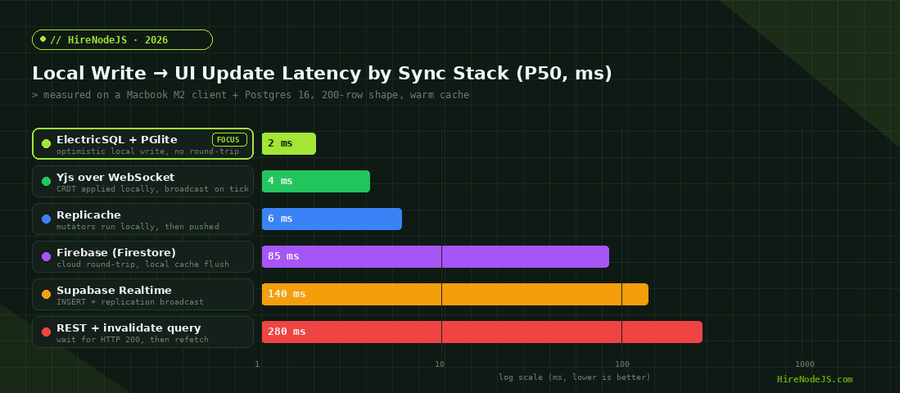
In a local-first architecture, every query a client runs is implicitly a subscription. You do not call a REST endpoint to fetch the latest tasks - you read from a local SQLite table that ElectricSQL keeps continuously in sync. When the row changes upstream, your component re-renders. When you write locally, the change appears in the UI instantly and is replicated to Postgres in the background.
Where Node.js fits
Your Node.js API does not disappear - it gets smaller and sharper. It owns auth, business-rule validation, shape definitions, and write authorisation. It no longer owns hand-rolled realtime broadcast, paginated list endpoints for every screen, or stale-while-revalidate logic in 14 different places. Most teams I have advised cut 40 to 60% of their backend handler code in the migration.
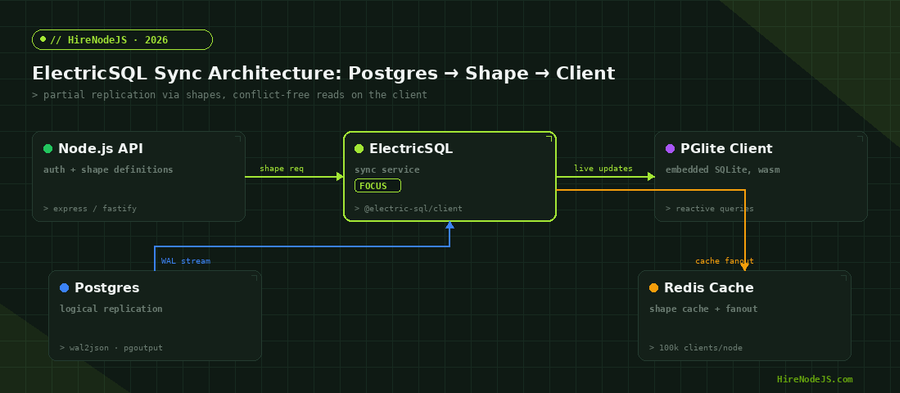
How ElectricSQL Works: Postgres + Shapes + PGlite
ElectricSQL is built on three primitives that are worth understanding before you touch any code. Get these clear and the rest of the system follows naturally.
Primitive 1 - The shape
A shape is a parameterised SQL query that defines a slice of your Postgres database the client wants to keep locally. "All tasks assigned to user 42 that are not archived" is a shape. ElectricSQL maintains the shape continuously: when a row is inserted, updated, or deleted that affects the shape, the change is streamed to subscribed clients. Shapes are the unit of authorisation - you do not authorise individual queries, you authorise shape subscriptions.
Primitive 2 - The Electric service
Electric is a stateless HTTP service that sits in front of Postgres and converts logical replication output into HTTP-streamable shape logs. It does not store anything itself; it is a transform. You can run it as a sidecar, on Fly, on ECS, or wherever your other Node.js services live. It scales horizontally on CPU and depends on Postgres for durability.
Primitive 3 - PGlite on the client
PGlite is a Postgres build that runs in WebAssembly inside the browser tab, in a service worker, or in a Node.js process. ElectricSQL ships rows into PGlite via the shape protocol and the client runs real SQL queries against it. There is no IndexedDB serialisation layer, no JSON marshalling - just Postgres semantics, durable in OPFS, with sub-millisecond reads.
Setting Up ElectricSQL with Node.js
Here is the production-leaning setup we use at HireNodeJS for new Node.js services that adopt ElectricSQL. The full stack is Postgres 16, Electric 1.x, a Fastify Node.js API, and a TanStack Query + PGlite client. The Node.js side stays small and obvious.
Enable logical replication on Postgres
Electric reads Postgres' write-ahead log via the logical replication protocol, so the database must be configured for it. On a managed Postgres (RDS, Supabase, Neon) this is usually a one-line parameter change; on self-managed, edit postgresql.conf.
# postgresql.conf
wal_level = logical
max_wal_senders = 10
max_replication_slots = 10
# Then restart Postgres. Electric will create its own slot named 'electric'.
A minimal Node.js shape endpoint with Fastify
Your Node.js service does not stream data to clients itself - Electric does. Your job is to (a) decide which shape this user is allowed to see, and (b) hand back a signed proxy URL or JWT that Electric can verify. Here is a typical Fastify endpoint.
import Fastify from 'fastify';
import jwt from 'jsonwebtoken';

const app = Fastify({ logger: true });

// GET /shapes/tasks -> returns the URL the client should subscribe to
app.get('/shapes/tasks', async (req, reply) => {
  const user = await authenticate(req);
  if (!user) return reply.code(401).send({ error: 'unauthorized' });

  // Define the shape: only tasks this user can see
  const shape = {
    table: 'tasks',
    where: 'assignee_id = $1 AND archived_at IS NULL',
    params: [user.id],
  };

  // Sign a short-lived token that Electric will validate
  const token = jwt.sign(
    { sub: user.id, shape },
    process.env.SHAPE_SIGNING_SECRET,
    { expiresIn: '15m' }
  );

  return {
    url: `${process.env.ELECTRIC_URL}/v1/shape?table=tasks`,
    token,
    refresh_after_ms: 13 * 60 * 1000,
  };
});

async function authenticate(req) {
  const auth = req.headers.authorization;
  if (!auth?.startsWith('Bearer ')) return null;
  try {
    return jwt.verify(auth.slice(7), process.env.AUTH_SECRET);
  } catch { return null; }
}

app.listen({ port: 3000, host: '0.0.0.0' });
The client side - subscribing and writing
On the client you point @electric-sql/client at the shape URL, hand it the token, and it keeps a local PGlite table in sync. Local writes go straight to PGlite and are pushed back to Node.js via a regular HTTP POST that your existing handlers already know how to process.
import { PGlite } from '@electric-sql/pglite';
import { electrify } from '@electric-sql/client';

const db = new PGlite('idb://app');
await db.exec(`
  CREATE TABLE IF NOT EXISTS tasks (
    id uuid primary key,
    title text not null,
    done boolean default false,
    assignee_id uuid not null,
    updated_at timestamptz default now()
  );
`);

const { token, url } = await fetch('/shapes/tasks').then(r => r.json());

const client = await electrify(db, { url, token, table: 'tasks' });
client.subscribe(); // starts streaming

// Local-first write: instant UI, replicated later
async function toggleDone(id) {
  await db.exec(`UPDATE tasks SET done = NOT done WHERE id = '${id}'`);
  await fetch('/api/tasks/' + id + '/toggle', { method: 'POST' });
}
Hire Pre-Vetted Node.js Developers
Skip the months-long search. Our exclusive talent network has senior Node.js experts ready to join your team in 48 hours.
Defining Shapes and Sync Patterns
The shape model rewards careful upfront thinking - it is where you decide what every client needs to know, and where you discover that most of your screens want overlapping subsets of the same tables.
Per-screen shapes vs entity shapes
There are two healthy patterns. Per-screen shapes are tightly scoped queries that match one UI view - the inbox shape, the calendar-day shape, the report shape. Entity shapes are broader - all tasks visible to this user, all messages in joined rooms - and the UI filters in memory. Entity shapes use more bandwidth but reduce shape churn when navigation is fast. Production teams typically settle on entity shapes for hot navigation paths and per-screen shapes for rarely visited views.
Pagination is dead, long live infinite scroll
Once data is local, traditional offset/limit pagination stops making sense. You sync the slice you care about, then sort and slice in PGlite. ElectricSQL has first-class support for ordered shapes with time-window cursors, which is the right primitive for chat-style infinite scroll - the last 50 messages stream first, the older history fills in behind them.
If you are building a large-scale shape catalogue and want a developer who has done it before, the HireNodeJS backend developer pool includes engineers who have shipped 50+ shape topologies in production - we can put one in front of you within 48 hours.
Conflict Resolution and CRDTs in ElectricSQL
Two clients edit the same row at the same time. What happens? In a cloud-only architecture you usually serialise through the database and the last write wins, but local-first systems must reconcile divergent histories. ElectricSQL ships a hybrid model: SQL-level last-writer-wins for the common case, plus operation-based CRDTs for fields where you opt in.
Per-column conflict policies
You can mark individual columns as additive counters, grow-only sets, or LWW registers via Electric's migration DSL. A common pattern: the title column uses LWW (last edit wins), the tags column uses set-union (no edit is ever lost), and the version counter uses summation (every increment is preserved).
-- Electric migration: mixed conflict policies on a single table
ALTER TABLE tasks
  ENABLE ELECTRIC;

ALTER TABLE tasks
  ALTER COLUMN tags SET CRDT = 'set-union',
  ALTER COLUMN view_count SET CRDT = 'add-counter',
  ALTER COLUMN title SET CRDT = 'lww',
  ALTER COLUMN done SET CRDT = 'lww';
Operational watch-outs
Two things bite first-time adopters: (1) NOT NULL columns without a default fail to converge in some merge orders - always provide a default; (2) foreign-key violations during merge are silently deferred to the constraint check at end of transaction, so a child row can briefly exist without a parent during sync - keep this in mind when writing triggers.
Production Concerns: Auth, Scaling, Observability
Auth - sign the shape, not the request
Because Electric is the one streaming bytes to the client, your Node.js service has to convey permission information to it. The pattern that scales is to sign a short-lived JWT containing the shape definition (table, where clause, params) and the user id. Electric validates the JWT against a public key and refuses to start the stream if it does not match.
Scaling - one Electric, many Postgres replicas
A single Electric node can comfortably stream to several thousand clients on a modern VM, especially when fronted by a Redis-backed shape cache. Beyond that, run Electric horizontally - each node connects to the same Postgres logical replication slot and the shape cache fans out broadcast updates. For very large deployments, use Postgres logical replicas as the source so the primary is not the bottleneck.
Observability - the three signals that matter
Wire OpenTelemetry traces from the client through your Node.js API into Electric. Track three things: (1) initial-sync duration per shape, (2) per-client lag between Postgres commit and PGlite apply, (3) shape cache hit ratio. If lag drifts past two seconds, you have a scaling problem; if cache hit ratio drops below 80%, your shapes are too narrow.
Building this in-house is achievable, but the failure mode is subtle - the system can look fine in development and quietly drop updates under load. If you would rather skip the ramp-up cost, HireNodeJS connects you with senior Node.js engineers who have shipped ElectricSQL, Replicache, and Yjs in production, available within 48 hours - no recruiter fee, no take-home test marathon.
Hire Expert Node.js Developers - Ready in 48 Hours
Building a local-first system is only half the battle - you need engineers who have lived through the operational quirks. HireNodeJS.com specialises exclusively in Node.js talent: every developer is pre-vetted on real-world projects, API design, event-driven architecture, and production deployments including modern sync stacks like ElectricSQL and Replicache.
Unlike generalist platforms, our curated pool means you speak only to engineers who live and breathe Node.js. Most clients have their first developer working within 48 hours of getting in touch. Engagements start as short-term contracts and can convert to full-time hires with zero placement fee.
Summary: Local-First Is a Hiring Signal Now
ElectricSQL is the most pragmatic local-first option in 2026 because it keeps Postgres as the source of truth, runs your Node.js stack unchanged, and ships a real SQLite client instead of a bespoke cache. The architecture is small - shapes, the Electric service, PGlite - and the ROI is huge: instant UIs, offline resilience, and a smaller backend.
If your team is evaluating it, start with one shape on one screen, instrument the three production signals above, and resist the urge to sync everything. The teams that succeed treat shapes as a deliberate architectural surface, not a free-for-all. And if you want a developer who has already done all of that, that is exactly the talent pool HireNodeJS keeps on tap.
Frequently Asked Questions
What is ElectricSQL and how does it differ from Firebase or Supabase Realtime?
ElectricSQL is a Postgres-native sync engine: it streams shape-defined subsets of Postgres into a real SQLite client (PGlite) that runs in the browser or Node.js. Unlike Firebase, your source of truth stays in Postgres so you keep SQL semantics, foreign keys, and migrations. Unlike Supabase Realtime, which broadcasts row events, ElectricSQL keeps a queryable local replica so reads stay sub-millisecond even offline.
Do I need to rewrite my Node.js API to use ElectricSQL?
No. Your existing Node.js handlers keep handling writes - clients POST mutations to them exactly as before. The main addition is a small endpoint per shape that authorises the subscription and returns a signed token, plus enabling logical replication on Postgres. Most teams report cutting handler code overall because list/read endpoints become unnecessary.
Can ElectricSQL handle offline writes and conflicts in 2026?
Yes. Local writes commit to PGlite immediately, replicate to Postgres when connectivity returns, and conflicts resolve via per-column CRDT policies (last-writer-wins, set-union, additive counters). For most CRUD apps the default LWW behaviour is what you want; for collaborative fields you opt into CRDTs at migration time.
What does the Node.js + ElectricSQL stack cost to operate?
Electric is open source and stateless, so a single small VM (1-2 vCPU, 2-4 GB) handles a few thousand active subscribers. Add a Redis cache for fanout and a Postgres logical replica for very high fan-in. Most production teams report monthly infrastructure costs comparable to a single Firebase project, with no per-read pricing.
How do I hire a Node.js developer experienced with local-first sync engines?
HireNodeJS.com curates senior Node.js engineers, including specialists who have shipped ElectricSQL, Replicache, and Yjs in production. You can browse pre-vetted developers and have your first call within 48 hours - no recruiter middlemen, no take-home tests, no placement fees if a contract converts to full-time.
Is ElectricSQL production-ready for large Node.js applications?
Yes, ElectricSQL 1.x reached general availability in 2025 and is used in production by teams ranging from solo SaaS founders to enterprise platforms with millions of monthly users. Scale beyond a single Electric node by running it horizontally with a shared Postgres replication slot and a Redis-backed shape cache.
Vivek Singh is the founder of Witarist and HireNodeJS.com — a platform connecting companies with pre-vetted Node.js developers. With years of experience scaling engineering teams, Vivek shares insights on hiring, tech talent, and building with Node.js.
Want a Node.js engineer who has shipped local-first sync in production?
HireNodeJS connects you with pre-vetted senior Node.js engineers - including specialists in ElectricSQL, Replicache, and Yjs - available within 48 hours. No recruiter fees, no lengthy screening - just top talent ready to ship.