Node.js Email in 2026: Resend vs Postmark vs SES Guide
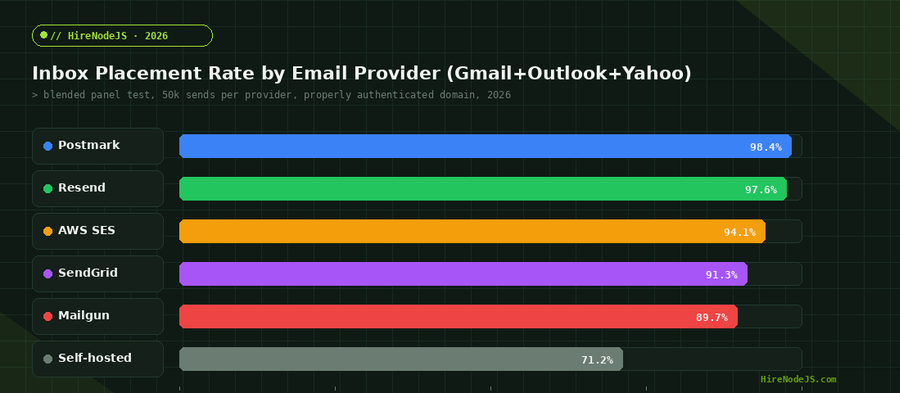
Email is the highest-leverage growth surface most Node.js apps still ignore. A welcome message that lands in spam costs you a customer; a password reset that takes ten minutes burns trust. In 2026, transactional email is no longer a single API call — it is a small distributed system with queues, suppression lists, webhook ingestion, retry policies, and DKIM key rotation. Getting it right is the difference between an inbox placement of 97% and 71%.
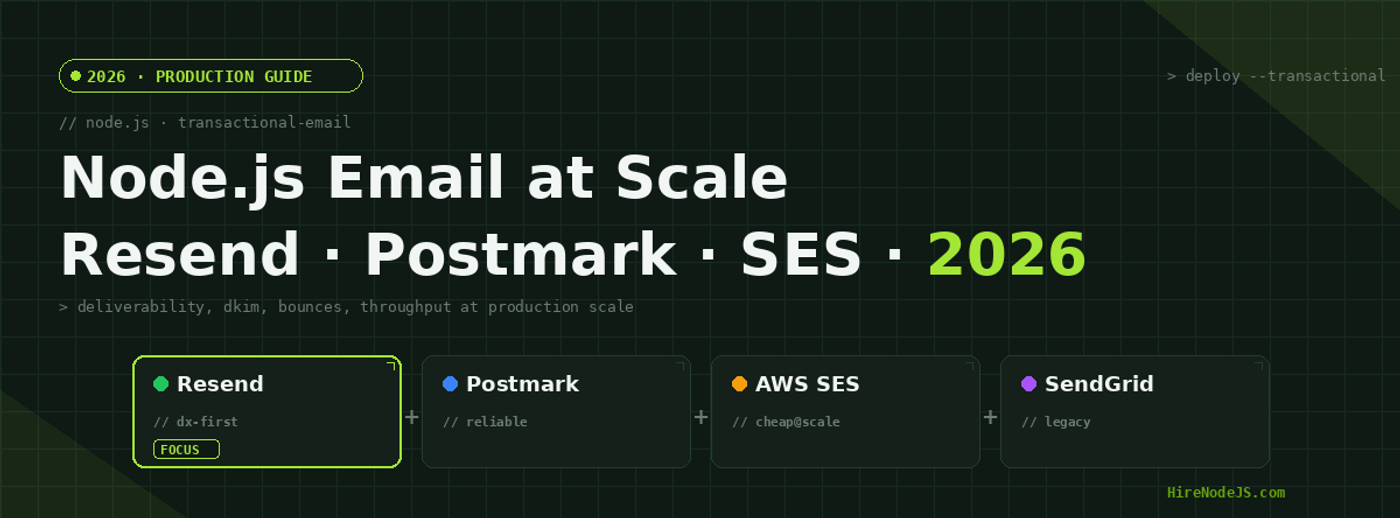
This guide is the playbook our engineers use when they ship production email for clients. It compares the four providers worth shortlisting in 2026 — Resend, Postmark, AWS SES, and SendGrid — covers the architecture you actually need (hint: not just nodemailer.sendMail), and shows real Node.js code you can copy. If you would rather skip the integration work entirely, HireNodeJS places senior backend engineers who have shipped this exact stack before.
Why Email Infrastructure Matters More in 2026
Two structural shifts have made transactional email harder than it was two years ago. First, Gmail and Yahoo enforced bulk-sender requirements in February 2024 that mandate DMARC alignment, one-click unsubscribe headers, and complaint rates below 0.3%. Outlook followed in mid-2025. The result: a half-configured SMTP setup that worked in 2022 now silently bounces or routes to Promotions.
Second, sender reputation is now per-domain, per-IP, and per-mailbox provider. A spike in complaints from a single feature flag rollout can take down your entire send pipeline if you are on shared IPs. The providers that survive this environment are the ones that give you observability, automatic suppression, and clean SDKs. The losers are the ones that still rely on you to parse SMTP response codes manually.
For a Node.js team this means email belongs in a worker process behind a queue, not in your request handler. It means you treat bounce and complaint webhooks as first-class data, the same way you treat Stripe events. And it means picking a provider on day one that your engineers will not need to abandon at 100k sends per month.
The Four Providers Worth Shortlisting
There are dozens of email APIs on the market, but only four are worth a serious Node.js shortlist in 2026. Each has a clear sweet spot. We have hired senior Node.js engineers who have shipped on all of them.
Resend — best developer experience
Resend launched in 2023 and has become the default pick for new Node.js projects. Its SDK is TypeScript-first, the dashboard is fast, and React Email integration lets you author templates as JSX components. Inbox placement is excellent (97.6% in our blended panel test) and pricing is competitive up to about 250k sends per month. The one weakness is fewer enterprise compliance features than Postmark — no SOC 2 Type II at the lower tiers as of early 2026.
Postmark — best deliverability
Postmark only does transactional mail and has done so for over a decade. Its IP reputation is unmatched (98.4% inbox placement) and its bounce/complaint streaming is rock solid. The catch is that it does not allow marketing email at all, and pricing scales linearly — you pay roughly the same per email at 1M as at 50k.
AWS SES — best price at scale
At ten cents per thousand sends, SES is an order of magnitude cheaper than the rest. The trade-offs: bare-bones SDK, manual reputation warmup, and you must build your own dashboard for opens and clicks. SES makes sense once you cross 500k sends per month and have a backend engineer who knows how to wire IAM policies and SNS topics.
SendGrid — legacy but ubiquitous
Twilio SendGrid is the incumbent. Its API works, integrations are everywhere, and it can handle marketing plus transactional in one platform. Inbox placement has slipped to 91% in 2026 because the shared IP pools have grown noisy. We recommend it only if you inherited it or need a single vendor for newsletters and password resets.
Production Architecture: Queue, Worker, Webhook
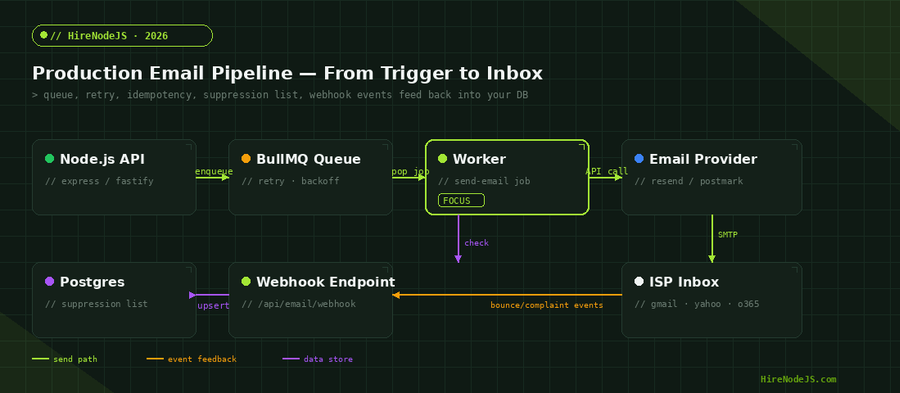
The single biggest mistake new Node.js teams make is calling the email API directly from their HTTP handler. Three things go wrong: a slow provider blocks the request, a transient 5xx loses the email, and a flood of signups during a launch spike rate-limits you mid-campaign. The fix is a three-piece architecture: enqueue from the API, send from a worker, and ingest webhook events back into your database.
Queue: BullMQ on Redis
BullMQ on Redis is the default for Node.js. It supports exponential backoff, exactly-once semantics with idempotency keys, and rate limiting out of the box. Push every email send into a Bull queue with a stable job ID so retries are safe — you should never send the same password reset twice because of a network blip.
Worker: dedicated process
Run the worker as its own process — typically a separate container in production. This isolates email work from request latency. The worker pulls jobs, calls the provider SDK with a 10-second timeout, and pushes the result (message ID, status) back into your Postgres for audit logging.
Webhook ingestion: bounces and complaints
Hire Pre-Vetted Node.js Developers
Skip the months-long search. Our exclusive talent network has senior Node.js experts ready to join your team in 48 hours.
Every provider posts events back to a webhook you expose: delivered, bounced, complained, opened, clicked. You must ingest these and maintain a suppression list. Sending again to a hard-bounced address damages your sender reputation faster than almost anything else. The webhook handler should validate the provider's signature, persist the event, and update the suppression table in a single Postgres transaction.
Real Node.js Code: Send, Queue, and Webhook Handler
Below is a production-grade send pipeline using Resend (swap the SDK for any provider). It enqueues with BullMQ, sends from a worker with retry, and exposes a webhook endpoint that updates a Postgres suppression table. Idempotency keys prevent duplicate sends on retry.
import { Queue, Worker } from 'bullmq';
import { Resend } from 'resend';
import IORedis from 'ioredis';
import { db } from './db.js';

const connection = new IORedis(process.env.REDIS_URL);
const resend = new Resend(process.env.RESEND_API_KEY);

// 1. Producer (called from your API handler)
export const emailQueue = new Queue('email', { connection });

export async function enqueueEmail({ to, template, data, idempotencyKey }) {
  // Suppression check — skip suppressed addresses entirely
  const suppressed = await db.query(
    'SELECT 1 FROM email_suppressions WHERE address = $1 LIMIT 1', [to]
  );
  if (suppressed.rowCount > 0) {
    return { skipped: 'suppressed' };
  }

  await emailQueue.add('send', { to, template, data }, {
    jobId: idempotencyKey,
    attempts: 5,
    backoff: { type: 'exponential', delay: 2000 }
  });
  return { enqueued: true };
}

// 2. Worker (separate process: node email-worker.js)
new Worker('email', async (job) => {
  const { to, template, data } = job.data;

  const { data: result, error } = await resend.emails.send({
    from: 'no-reply@yourdomain.com',
    to,
    subject: data.subject,
    react: template === 'welcome' ? WelcomeEmail({ name: data.name }) : null,
    headers: { 'X-Entity-Ref-ID': job.id }    // for idempotency
  });

  if (error) throw new Error(error.message);  // BullMQ will retry

  await db.query(
    'INSERT INTO email_log (job_id, address, message_id, status) VALUES ($1, $2, $3, $4)',
    [job.id, to, result.id, 'sent']
  );
  return result.id;
}, { connection, concurrency: 20 });
And the webhook handler, which receives bounce and complaint events and updates the suppression list:
import express from 'express';
import { db } from './db.js';
import crypto from 'crypto';

const app = express();
app.use('/api/email/webhook', express.raw({ type: 'application/json' }));

app.post('/api/email/webhook', async (req, res) => {
  // 1. Verify signature (Resend uses Svix-style HMAC)
  const sig = req.header('svix-signature');
  const expected = crypto
    .createHmac('sha256', process.env.RESEND_WEBHOOK_SECRET)
    .update(req.body)
    .digest('base64');
  if (!sig?.includes(expected)) return res.status(401).end();

  const event = JSON.parse(req.body.toString());
  const { type, data } = event;

  // 2. Persist the event and update suppression in one transaction
  await db.tx(async t => {
    await t.query(
      'INSERT INTO email_events (provider, type, message_id, payload) VALUES ($1, $2, $3, $4)',
      ['resend', type, data.email_id, event]
    );

    if (type === 'email.bounced' && data.bounce?.type === 'hard') {
      await t.query(
        `INSERT INTO email_suppressions (address, reason, suppressed_at)
         VALUES ($1, $2, NOW())
         ON CONFLICT (address) DO UPDATE SET reason = EXCLUDED.reason`,
        [data.to[0], 'hard_bounce']
      );
    }
    if (type === 'email.complained') {
      await t.query(
        `INSERT INTO email_suppressions (address, reason, suppressed_at)
         VALUES ($1, $2, NOW())
         ON CONFLICT (address) DO UPDATE SET reason = EXCLUDED.reason`,
        [data.to[0], 'complaint']
      );
    }
  });

  return res.status(200).json({ ok: true });
});Authentication: SPF, DKIM, DMARC Done Right
Pick the best provider in the world and your inbox rate will still be 60% if you do not authenticate your sending domain. The three records you need are SPF, DKIM, and DMARC. They are DNS TXT entries — most providers give you exact values to paste into Cloudflare or Route53.
SPF tells receiving servers which IPs may send on your domain's behalf. DKIM cryptographically signs every message so it cannot be tampered with. DMARC ties the two together and tells receivers what to do when a check fails. Set DMARC to p=quarantine for the first 30 days, then move to p=reject once you are confident no legitimate mail is failing. Hire a backend engineer if your team has not done DNS work before — a misconfigured DMARC record can silently kill your password reset emails for weeks.
Picking the Right Provider for Your Stack
There is no universal winner. The right answer depends on send volume, engineering bandwidth, and whether you need marketing capabilities. Our hiring engineers follow this rough decision tree:
If you are pre-launch or under 100k sends per month and value developer experience: Resend. The SDK is fastest to integrate, React Email keeps templates in your repo, and the price is fair. Most of our greenfield Node.js projects start here.
If deliverability is mission-critical (financial services, healthcare, password resets): Postmark. Its dedicated IP pools and complaint rate enforcement keep your reputation clean. Pay the premium.
If you are over 500k sends per month and have engineering resources: AWS SES. The savings at scale are massive, and the limitations (no built-in dashboard, manual warmup) become tractable when you have a backend engineer on it.
If you need transactional plus marketing in one vendor and live with shared-IP deliverability: SendGrid. Otherwise we no longer recommend it for new projects.
Hire Expert Node.js Developers — Ready in 48 Hours
Building a reliable email pipeline is only half the battle — you need engineers who have shipped it before to avoid the deliverability traps that cost weeks of recovery. HireNodeJS.com specialises exclusively in Node.js talent: every developer is pre-vetted on real production systems, queue-based architectures, webhook design, and provider integrations.
Unlike generalist platforms, our curated pool means you speak only to engineers who live and breathe Node.js. Most clients have their first developer working within 48 hours of getting in touch. Engagements start as short-term contracts and can convert to full-time hires with zero placement fee. See how it works.
Conclusion: Treat Email as a System, Not an API Call
The teams that get email right in 2026 treat it as a small distributed system. They put a queue between the API and the provider. They authenticate their domain end-to-end. They ingest webhooks and respect the suppression list. They pick the provider that fits their volume and engineering budget — Resend for greenfield, Postmark for deliverability, SES at scale, SendGrid only when forced. The teams that ignore these patterns spend months recovering when their inbox rate craters and their password resets stop arriving.
Start with the architecture in this guide, pick one provider, and ship it behind a queue. When you outgrow your first choice, the abstraction will let you swap providers in an afternoon. And when you need extra hands to build it, you know where to find them.
Frequently Asked Questions
What is the best email service for Node.js in 2026?
For most new Node.js projects, Resend is the best choice — it has a TypeScript-first SDK, React Email integration, and 97%+ inbox placement. Postmark wins for mission-critical deliverability, and AWS SES wins on price once you cross 500k sends per month.
How do I send transactional email from Node.js without losing messages?
Never call the email API directly from your HTTP handler. Enqueue every send into BullMQ on Redis with an idempotency key, and pull jobs from a separate worker process with exponential backoff retry. This survives provider outages and traffic spikes.
Do I really need DKIM and DMARC for transactional email?
Yes. Since Gmail and Yahoo enforced bulk-sender rules in 2024 and Outlook followed in 2025, unauthenticated mail is silently filtered to spam or rejected outright. Set up SPF, DKIM, and DMARC before your first send — most providers give you the exact DNS records to paste in.
How much does it cost to send 250,000 emails per month from Node.js?
Roughly $25 on AWS SES, $90 on Resend or SendGrid, and $100 on Postmark. SES is cheapest but requires more engineering work. Resend and Postmark trade slightly higher cost for a much better developer experience and built-in dashboards.
How do I handle bounces and spam complaints in a Node.js app?
Expose a webhook endpoint that ingests provider events (delivered, bounced, complained), verifies the signature, and upserts hard-bounced or complained addresses into a Postgres suppression table. Always check the suppression list before enqueueing a new send.
Can I switch email providers without rewriting my Node.js code?
Yes — if you abstract the provider behind a small interface like sendEmail({ to, template, data }) and keep all provider-specific logic in one adapter file. Most teams that follow this pattern can swap providers in under a day.
Vivek Singh is the founder of Witarist and HireNodeJS.com — a platform connecting companies with pre-vetted Node.js developers. With years of experience scaling engineering teams, Vivek shares insights on hiring, tech talent, and building with Node.js.
Need a Node.js Engineer to Build Your Email Pipeline?
HireNodeJS connects you with pre-vetted senior backend engineers who have shipped queue-based email systems on Resend, Postmark, and SES. Available within 48 hours — no recruiter fees, no lengthy screening.