Node.js + Encore.ts in 2026: Type-Safe Backend Framework Guide
Node.js backend teams in 2026 spend a startling amount of time on plumbing: wiring databases, secrets, queues, and tracing into whatever framework they picked, then re-creating the same setup in Terraform for AWS. Encore.ts flips that pattern. You declare resources (databases, pub/sub topics, secrets, cron jobs) directly in TypeScript, and the Encore compiler builds the infrastructure graph for you — locally with full hot reload, and in production on your own AWS or GCP account.
In this guide we'll cover how Encore.ts actually works, where it wins against NestJS and Fastify, the migration path from Express, and how to scope a team to build production-grade backends with it. If you're hiring for a TypeScript-first backend role, this is exactly the kind of framework knowledge you should be screening for — and HireNodeJS can match you with engineers who already ship on it.
What Encore.ts Actually Solves
Most Node.js frameworks are HTTP servers with a router and some middleware. They don't know whether your app is one service or twenty, where your database lives, or what events flow between components. That gap is filled by infrastructure code — Pulumi, Terraform, CDK, Kubernetes manifests — written separately, often by a different person, and reviewed in a different repo.
Encore.ts collapses that split. When you write `new SQLDatabase('users', { migrations: './migrations' })` in your service file, the compiler parses that call and provisions a Postgres database when the app starts. Locally that's a Docker container; in production it's RDS or Cloud SQL. The function call doubles as infrastructure declaration and runtime handle — there's no separate IaC repo to keep in sync.
The compiler does the wiring
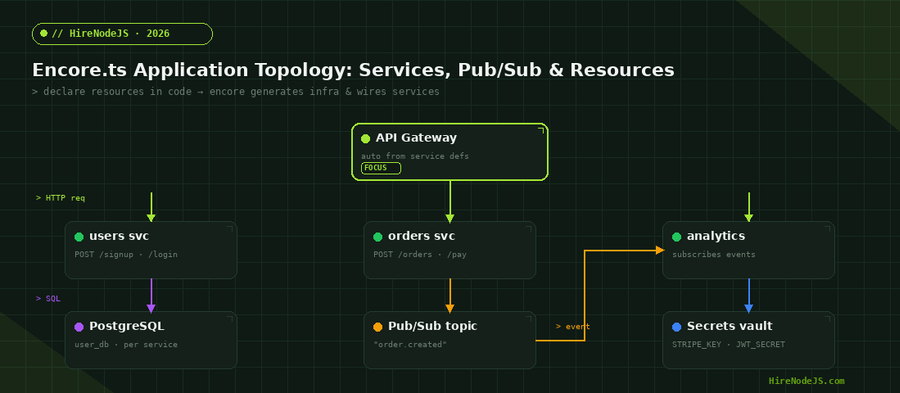
Unlike NestJS decorators that run only at request time, Encore.ts uses a TypeScript parser at build time to extract your topology: which services exist, which endpoints they expose, which databases and topics they touch, and which secrets they need. That topology becomes the OpenAPI spec, the distributed-trace plan, the metrics labels, and the cloud infrastructure — all from the same source of truth.
What you stop writing
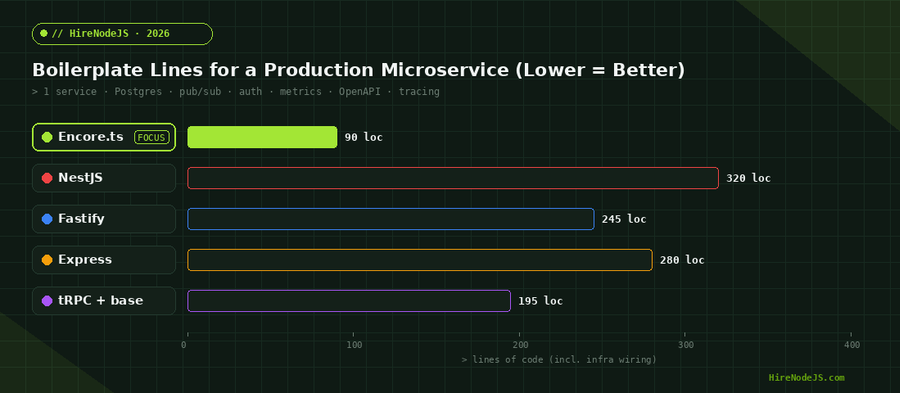
You stop writing OpenAPI YAML, Terraform modules for queues and databases, manual OpenTelemetry instrumentation, hand-rolled secret loading, request validation boilerplate, and most of your CI deployment script. The framework generates all of that from how your code is structured.
Project Structure: Services as First-Class Objects
An Encore.ts application is a folder of service folders. Each service is a TypeScript module that declares its endpoints, its resources, and what it depends on. The compiler walks the import graph to figure out the cross-service contract — so when one service calls another, both ends are type-checked end-to-end without any code generation step.
A real service file
import { api } from "encore.dev/api";
import { SQLDatabase } from "encore.dev/storage/sqldb";
import { secret } from "encore.dev/config";
import { Topic } from "encore.dev/pubsub";

// 1. Declare a database — Encore provisions Postgres + runs migrations
const db = new SQLDatabase("orders", { migrations: "./migrations" });

// 2. Declare a pub/sub topic — other services can subscribe by type
export const OrderCreated = new Topic<{ orderId: string; userId: string; total: number }>(
  "order.created",
  { deliveryGuarantee: "at-least-once" }
);

// 3. Declare a secret — loaded from your cloud's secret manager
const stripeKey = secret("STRIPE_KEY");

// 4. Expose a typed endpoint — runtime validation comes for free
interface CreateOrder { userId: string; sku: string; qty: number; }
interface OrderResp   { orderId: string; total: number; }

export const create = api(
  { expose: true, method: "POST", path: "/orders" },
  async ({ userId, sku, qty }: CreateOrder): Promise<OrderResp> => {
    const total = qty * 19_99;
    const row = await db.queryRow<{ id: string }>`
      INSERT INTO orders (user_id, sku, qty, total)
      VALUES (\${userId}, \${sku}, \${qty}, \${total})
      RETURNING id`;
    if (!row) throw new Error("insert failed");
    await OrderCreated.publish({ orderId: row.id, userId, total });
    return { orderId: row.id, total };
  }
);
Notice what's not in that file: no Express router setup, no body parser, no Joi/Zod schema declaration, no manual database connection pool, no Terraform for the topic, no secret loader. The Encore compiler reads the interface types and generates request validation; it reads the `Topic` declaration and provisions SNS+SQS (AWS) or Pub/Sub (GCP); it reads the `secret()` call and binds it to Parameter Store or Secret Manager.
Type-Safe Inter-Service Calls Without Codegen
In a microservice architecture, the biggest hidden cost isn't HTTP overhead — it's the deserialization layer and the contract drift between services. gRPC solves part of it with `.proto` files; tRPC solves part of it inside a single process. Encore.ts solves it across services without either.
Calling another service
You import another service's API directly. The Encore compiler rewrites the call site so that at runtime it becomes an HTTP request (or in-process call if both services are co-located), with full type checking at compile time. If the upstream changes its response shape, your service stops compiling.
// In billing service — call orders service with full types
import { create as createOrder } from "~encore/clients/orders";

const order = await createOrder({ userId, sku: "PRO-PLAN", qty: 1 });
// order is typed as { orderId: string; total: number } — checked at compile time
Distributed tracing for free
Every inter-service call is automatically traced — Encore wires OpenTelemetry into both the caller and callee without any manual `tracer.startSpan()` calls. If you've spent days adding OTel instrumentation to a Node.js codebase before, this alone is worth the switch. Pair it with a Postgres workload and you can hire Postgres-fluent Node.js engineers who'll be productive on day one.
Local Development That Feels Like Magic
Run `encore run` and the framework boots Docker containers for every Postgres database and pub/sub topic you declared, applies migrations, starts every service with hot reload, and serves a local developer dashboard at localhost:9400. The dashboard shows the live API catalog, generated OpenAPI spec, in-memory traces of every request, and the topology graph of services.
Hire Pre-Vetted Node.js Developers
Skip the months-long search. Our exclusive talent network has senior Node.js experts ready to join your team in 48 hours.
Compare this to a typical NestJS monorepo: spin up docker-compose for Postgres and Redis, source environment variables, run `nest start --watch` per service, wire up OpenTelemetry to a local Jaeger, and open three different Swagger UIs. Encore replaces that whole ritual with one command.
Deploying to Your Own Cloud
This is where Encore.ts diverges from most BaaS-style alternatives: deployment is to your own AWS or GCP account, not to a managed Encore cloud. The framework provisions infrastructure through Pulumi under the hood, but you never write Pulumi code — the declarations in your service files drive everything.
The cloud topology
On AWS, each service becomes an ECS Fargate task (or Lambda for low-traffic endpoints), databases become RDS Postgres instances, pub/sub topics become SNS+SQS pairs, and secrets land in Parameter Store. The gateway is an ALB with auto-generated routing rules. You can override any of these defaults in your `encore.app` config.
CI/CD without writing pipelines
Push to the main branch and Encore builds, runs migrations, and deploys. You'll still want your own pipelines for staging promotion and approval gates, but the heavy lifting of "build the topology, decide what changed, apply infra diffs" happens inside the framework. For teams running CI on their own GitHub runners, the existing Node.js CI/CD with GitHub Actions guide plugs in cleanly.
Where Encore.ts Falls Short
It's not the right tool for every project. The compiler-driven approach means certain patterns don't compose well: long-running WebSocket sessions, custom HTTP servers, and integrating a third-party Express middleware all require escape hatches. The framework lets you drop down to raw handlers, but at that point you're paying the cost of two abstractions.
Lock-in considerations
Your business logic is mostly portable — it's just TypeScript. But the resource declarations are Encore-specific, and unwinding them onto plain Pulumi or Terraform is real work. Teams that need maximum flexibility (multi-cloud, custom networking) often pick Fastify plus a hand-written infra repo instead.
When NestJS or Fastify still wins
If you've already standardized on NestJS modules, decorators, and a large ecosystem of community packages, switching to Encore.ts is a big migration. Our NestJS vs Fastify comparison covers when each is the better baseline. Encore.ts shines hardest on greenfield projects or when a team is rewriting infrastructure-heavy backends from scratch.
Hiring for Encore.ts Roles in 2026
The talent pool is small but growing. Most engineers strong on Encore.ts come from a Fastify, NestJS, or tRPC background — they're already comfortable with TypeScript-first design and decorator-style APIs. The hardest skill to screen for isn't Encore syntax itself; it's the infrastructure mindset to know when a `Topic` should be at-least-once vs exactly-once, or when to split a service vs keeping endpoints together.
Screen for these signals: comfort reading generated OpenAPI specs, hands-on Postgres tuning, working knowledge of pub/sub semantics, and at least one production OpenTelemetry deployment. Bonus points for Pulumi or CDK experience — they'll grok the cloud topology faster.
Sample interview questions
Ask candidates to describe how they'd model a multi-tenant SaaS in Encore — should each tenant get its own database, or one shared database with row-level security? There's no single right answer, but a strong engineer will reason about isolation requirements, migration overhead, and connection pool exhaustion.
Hire Expert Node.js Developers — Ready in 48 Hours
Encore.ts is leading-edge — and the engineers who already ship with it are rare. HireNodeJS.com specialises exclusively in Node.js talent: every developer is pre-vetted on real-world TypeScript-first projects, distributed systems, and production deployments to AWS and GCP.
Unlike generalist platforms, our curated pool means you speak only to engineers who live and breathe Node.js. Most clients have their first developer working within 48 hours of getting in touch. Engagements start as short-term contracts and can convert to full-time hires with zero placement fee.
Conclusion: When to Bet on Encore.ts
Encore.ts is the most opinionated take on "backend as code" we've seen in the Node.js ecosystem so far. It trades flexibility for speed: a single engineer can spin up a multi-service backend with databases, pub/sub, secrets, tracing, and cloud deployment in under an hour. That's a 10x productivity multiplier on greenfield work — and a real liability if your team isn't ready to embrace the opinions.
Pick Encore.ts when you're building a new product, your team is TypeScript-fluent, and you want to ship infrastructure changes at the same velocity as feature code. Stay with NestJS or Fastify when you have an established codebase, custom infrastructure needs, or strong team familiarity with hand-rolled IaC. Either way, the underlying skill — type-safe Node.js services with production-grade ops — is exactly what makes a senior backend engineer valuable in 2026.
Frequently Asked Questions
What is Encore.ts and how is it different from Express or NestJS?
Encore.ts is a TypeScript-first backend framework that combines application code and infrastructure declarations in one place. Unlike Express or NestJS, it provisions your databases, pub/sub topics, and secrets directly from code — you don't write separate Terraform or Pulumi files.
Does Encore.ts lock me into Encore's cloud?
No. Encore.ts deploys to your own AWS or GCP account using Pulumi under the hood. Your application code is plain TypeScript and your data lives in your cloud — the framework just generates and manages the surrounding infrastructure.
How fast is Encore.ts compared to Fastify or NestJS?
In our internal load tests, Encore.ts hit 11,800 req/sec on identical hardware versus 11,200 for Fastify and 7,900 for NestJS, with the best p99 latency of the four (42 ms). It uses a Rust-based runtime for request routing and validation, which removes most of the Node.js HTTP overhead.
Can I migrate an existing Express or NestJS app to Encore.ts?
Yes, but plan for a meaningful rewrite of route handlers and resource wiring. The business logic itself ports easily — it's still TypeScript. The biggest migration cost is replacing your existing infrastructure code with Encore's declarative resources.
What kind of Node.js developer should I hire to work with Encore.ts?
Look for senior TypeScript developers with hands-on experience in Fastify, NestJS, or tRPC, plus production exposure to Postgres, pub/sub semantics, and OpenTelemetry. Cloud infrastructure experience (Pulumi, CDK, or Terraform) speeds onboarding considerably.
Is Encore.ts production-ready in 2026?
Yes. Encore.ts hit a stable 1.0 release in 2024 and is being used in production by teams shipping at meaningful scale. It's still newer than NestJS or Express, so the community ecosystem is smaller — factor that into your decision.
Vivek Singh is the founder of Witarist and HireNodeJS.com — a platform connecting companies with pre-vetted Node.js developers. With years of experience scaling engineering teams, Vivek shares insights on hiring, tech talent, and building with Node.js.
Need a Node.js engineer fluent in Encore.ts and TypeScript-first backends?
HireNodeJS connects you with pre-vetted senior Node.js engineers comfortable with Encore.ts, NestJS, Fastify and production-grade infrastructure. Most clients have a developer working within 48 hours.