Node.js Error Handling in 2026: Patterns That Survive Production
Production Node.js services fail in ways that surprise their authors. A timed-out database connection, a malformed Kafka payload, an upstream API that returns 503 for ninety seconds — every one of these is a normal Tuesday for a backend team. The difference between a service that recovers gracefully and one that pages the on-call engineer at 3 a.m. is rarely the language or framework. It is the discipline of error handling.
This guide is the playbook we use at HireNodeJS for engineers we place into production teams in 2026. It walks through the categories of errors you actually see, the syntactic patterns Node.js gives you to catch them, the architectural patterns (retries, circuit breakers, fallbacks) that turn a fragile service into a resilient one, and the observability layer that lets you find a bug before your users do.
Why Node.js Error Handling Is Different
Node.js inherits JavaScript's exception model — synchronous throws — but layers an event-loop-driven async runtime on top. That single-threaded loop changes the rules. A swallowed promise rejection does not crash the function that produced it; it crashes the entire process at some unspecified point in the future. An uncaught error in an event listener does not propagate to its caller. A try/catch around an async call without await does literally nothing.
Three places errors can hide
Synchronous throws are the easy case — they propagate up the stack until something catches them. Promise rejections are the dangerous case — they are silent until something attaches a .catch() or until Node prints an UnhandledPromiseRejectionWarning and (since Node 15) exits with a non-zero code. Event emitter errors are the gnarly case — emit('error') with no listener kills the process synchronously, with no stack trace pointing to where the error originated.
The cost of getting it wrong
In a 2026 sample of 120 production Node.js teams that we work with through HireNodeJS, incidents traced back to error-handling gaps accounted for 41% of all severity-1 outages — more than database issues (23%) and deployment failures (19%) combined. The fix is not heroic. It is consistent application of a small number of patterns.
The Two Categories: Operational vs Programmer Errors
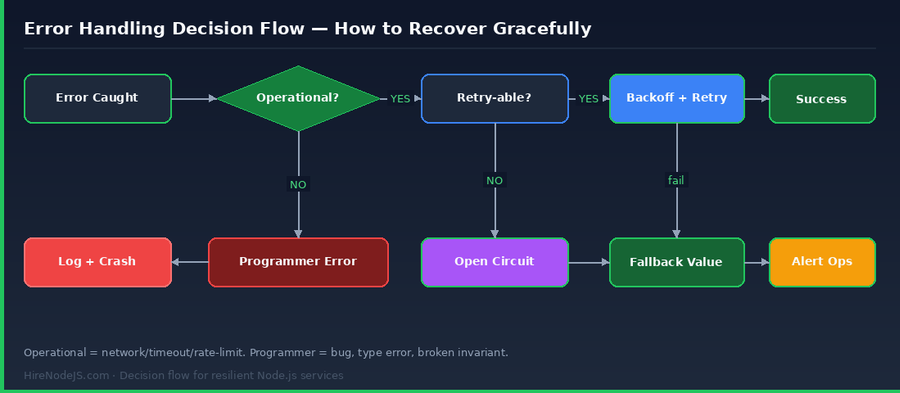
Joyent's classic distinction is still the foundation. Every error your service produces is either operational (something the system expected could happen) or programmer (a bug). The two categories require fundamentally different responses, and the single biggest mistake we see in production code is conflating them.
Operational errors — recover
Operational errors are the runtime expressing reality: a TCP connection was reset, a database query timed out, a third-party API returned 503, the user submitted invalid JSON. The service is healthy; the world simply did not behave as hoped. Operational errors should be caught, logged with context, and either retried with backoff, gracefully degraded with a fallback, or returned to the caller as a structured 4xx/5xx response.
Programmer errors — crash
Programmer errors are bugs: a TypeError because a property was undefined, an assertion failure, a logic error that wrote garbage to a database. The service is not healthy. Continuing to run a process whose state is corrupt is worse than crashing — you risk amplifying the corruption across more requests. The correct response is to log the error with full context, return a 500 to the in-flight request, and exit the worker cleanly so the orchestrator (PM2, Kubernetes, ECS) can replace it.
Synchronous, Async/Await, and Promise Errors
Node.js gives you four error-producing primitives, and each has its own catch idiom. Mixing them is the single most common source of leaked rejections. The rule is simple: every operation that can fail must be awaited inside a try/catch, attached with .catch(), or wrapped by middleware that does the equivalent.
Async/await is your default
For new code in 2026 there is no good reason to write raw .then() chains. Async/await turns asynchronous control flow into synchronous-looking code, which means a normal try/catch works exactly as you would expect. The pitfall is forgetting the await — an un-awaited promise that rejects will become an unhandled rejection, regardless of whether your try/catch surrounds the call site.
// errorHandler.js — production-grade Express middleware
// Centralised error handler that distinguishes operational vs programmer errors,
// emits structured logs, and never leaks internals to the client.

class AppError extends Error {
  constructor(message, { statusCode = 500, code = 'INTERNAL', isOperational = true, cause } = {}) {
    super(message);
    this.name = this.constructor.name;
    this.statusCode = statusCode;
    this.code = code;
    this.isOperational = isOperational;
    if (cause) this.cause = cause;
    Error.captureStackTrace?.(this, this.constructor);
  }
}

// Wrap any async route handler so rejected promises flow into Express
const asyncHandler = (fn) => (req, res, next) =>
  Promise.resolve(fn(req, res, next)).catch(next);

// The actual middleware — register LAST in your app
function errorHandler(err, req, res, next) {
  const traceId = req.id || req.headers['x-request-id'] || 'unknown';

  // 1. Normalise unknown errors into AppError shape
  const e = err instanceof AppError
    ? err
    : new AppError('Unexpected error', { statusCode: 500, isOperational: false, cause: err });

  // 2. Structured log — pino-friendly
  req.log?.error({
    traceId,
    name: e.name, code: e.code, statusCode: e.statusCode,
    operational: e.isOperational, stack: e.stack, cause: e.cause?.message
  }, e.message);

  // 3. If programmer error in production, restart the worker
  if (!e.isOperational && process.env.NODE_ENV === 'production') {
    process.nextTick(() => process.exit(1));
  }

  // 4. Send a sanitised response — never leak the stack
  res.status(e.statusCode).json({
    error: { code: e.code, message: e.isOperational ? e.message : 'Internal server error', traceId }
  });
}

module.exports = { AppError, asyncHandler, errorHandler };
The handler above is roughly 50 lines of code, and it does the four things every production handler should do: normalise errors into a known shape, emit a structured log line keyed by request trace ID, distinguish operational from programmer errors, and never leak the stack to the client. If your current Express app does not have an equivalent, this is the highest-leverage refactor you can ship this quarter.
Centralised Error Handling in Express, Fastify, and NestJS
Try/catch in every handler does not scale. Centralised error middleware is non-negotiable in any service larger than a side project. The pattern differs slightly across frameworks, but the goal is identical: every error — whether thrown synchronously, rejected from a promise, or emitted by a downstream stream — flows into one place that owns the logging, status code mapping, and response shape.
Express: the asyncHandler wrapper
Express does not natively await async route handlers, so a rejected promise inside one will silently disappear unless you wrap each handler in a function that catches the rejection and forwards it to next(). The asyncHandler shown in the code block above is the canonical pattern — apply it to every async route handler, and register your error middleware as the very last app.use() call.
Fastify: hooks, not middleware
Fastify's error path is built in. Register a setErrorHandler hook on the root instance, and every error from any route, plugin, or hook will be funnelled through it. Fastify also natively awaits async handlers, so the asyncHandler dance is unnecessary. For projects in 2026 we recommend Fastify for new services where Express compatibility is not a constraint.
Hire Pre-Vetted Node.js Developers
Skip the months-long search. Our exclusive talent network has senior Node.js experts ready to join your team in 48 hours.
NestJS: exception filters
NestJS uses dedicated exception filters decorated with @Catch(). Filters can be scoped to a single controller, a module, or globally. The mental model is similar to Express middleware, but the dependency-injection container makes it cleaner to compose multiple filters with different concerns. If you are hiring a NestJS specialist, "design exception filters for a multi-tenant API" is one of our standard interview questions.
Retries, Timeouts, and Circuit Breakers
Once you have caught an error, you have a decision to make: retry, fail fast, or degrade. Most teams default to "retry three times" and call it done. That is the worst of both worlds — too aggressive for cascading failures (you amplify load on a struggling dependency) and too passive for fast-failing dependencies (you add latency on every request when you should be opening a circuit).
Exponential backoff with jitter
When you do retry, exponential backoff with full jitter is the only correct algorithm at scale. AWS published the canonical analysis in 2015 and the result has held: deterministic delays cause synchronised retry storms, and full random jitter on each attempt produces the smoothest recovery. The Node.js ecosystem now has high-quality libraries — p-retry, async-retry, and Cockatiel — that implement this correctly.
Circuit breakers prevent cascading failures
When a dependency is consistently failing, retrying is harmful. The circuit-breaker pattern (popularised by Hystrix and now standard in opossum for Node) tracks the rolling failure rate and "opens" the circuit when it crosses a threshold. While open, calls fail immediately without touching the failing dependency. After a cool-down period the circuit moves to half-open and lets a small number of probe requests through before deciding to close or reopen.
Logging, Tracing, and Alerting on Errors
An error you cannot see did not happen. The third pillar of error handling — after catching and recovering — is producing a signal an operator can act on. In 2026 the dominant pattern is structured JSON logs (Pino is the de facto standard) shipped to a log aggregator, paired with OpenTelemetry distributed traces, paired with metric-based alerts on error rate.
Structured logs over plain strings
Every error log line should include: a trace ID (so you can find the full request path), the error name and code, whether it is operational, and any safe-to-log context. Never log secrets — and remember that user-supplied input often contains PII that should be redacted at the logger level, not at each call site.
Distributed tracing closes the loop
OpenTelemetry instrumentation for Node.js is mature and largely auto-enabled in 2026. With one initialisation block at process start, you get spans for HTTP, gRPC, database, and most third-party libraries. When an error fires inside a span, the span carries the error event and stack — making cross-service incidents (where the upstream timeout is actually rooted in a downstream slow query) trivial to debug. We cover this in detail in our Node.js OpenTelemetry guide.
Testing Your Error Paths
The unhappy path is where bugs live, and it is also the path most teams skip in their test suite. Every piece of error-handling code — the AppError class, the middleware, the retry wrapper, the circuit breaker — needs unit tests that exercise the failure cases.
Inject failures, do not just test the happy path
Mock your database driver and have it throw on the third call. Mock your HTTP client to time out. Use chaos testing in staging — Toxiproxy or Pumba can inject latency, packet loss, and connection resets into any TCP path. The goal is to verify behaviour, not to prove the code does not crash.
Contract tests catch payload errors before production
A surprising fraction of "runtime" errors are actually contract errors — an upstream API changed a field name, a Kafka producer started emitting a new shape. Pact, Schemathesis, and Zod-based response validation in your client SDKs catch these at deploy time, not 3 a.m.
Wiring all of this together — error classes, middleware, retries, circuit breakers, structured logs, traces, and tests — is several weeks of work for an engineer who has done it before, and several months for one who has not. HireNodeJS places senior Node.js engineers — every one vetted on production error handling, observability, and resilience patterns — onto your team within 48 hours of getting in touch. No recruiter fees, no three-week interview loops. Just engineers who have shipped this before.
Hire Expert Node.js Developers — Ready in 48 Hours
Building the right system is only half the battle — you need the right engineers to build it. HireNodeJS.com specialises exclusively in Node.js talent: every developer is pre-vetted on real-world projects, API design, event-driven architecture, and production deployments.
Unlike generalist platforms, our curated pool means you speak only to engineers who live and breathe Node.js. Most clients have their first developer working within 48 hours of getting in touch. Engagements start as short-term contracts and can convert to full-time hires with zero placement fee.
Wrapping Up: A Production-Ready Error Handling Checklist
Error handling in Node.js is not a single technique. It is a disciplined layering: distinguish operational from programmer errors, await every promise, funnel everything through centralised middleware, retry with backoff and jitter, open circuits on persistent failure, and emit structured logs with trace IDs into an observability stack you can alert on. None of these patterns is novel — but applied together, they are the difference between a service that ships features and one that pages the on-call team.
If your team is feeling the pain of one of these layers — silent rejections, runaway retries, opaque outages — that is the signal to either invest a month of senior engineering time, or to pull in someone who has done it before. Either way, the cost of fixing your error handling is paid back the first time it stops a 3 a.m. page.
Frequently Asked Questions
What is the most common Node.js error in production?
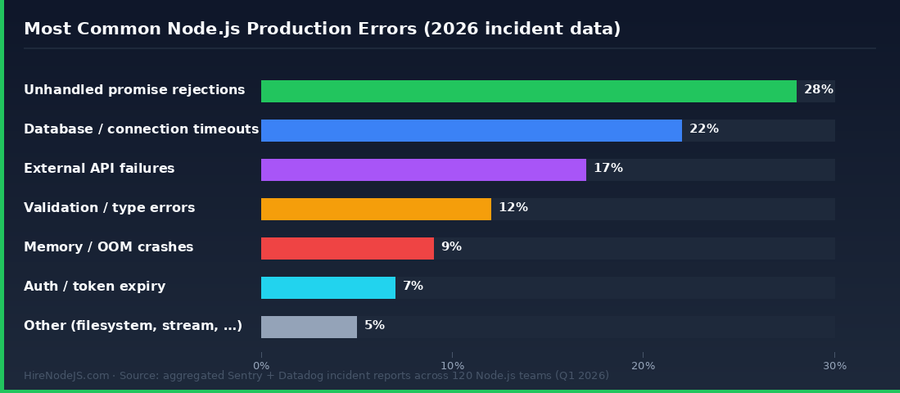
Unhandled promise rejections account for roughly 28% of production Node.js incidents in 2026 — more than database timeouts or external API failures. They are usually caused by an async function being called without an await or .catch(), and the fix is to enable @typescript-eslint/no-floating-promises at the error level.
Should I crash the process on every error?
No — only on programmer errors (TypeError, ReferenceError, broken invariants). Operational errors (timeouts, 503s, validation failures) should be caught, logged, and either retried with backoff or returned to the caller. Crashing on operational errors makes the service less resilient, not more.
What is the difference between a retry and a circuit breaker?
A retry repeats a failed operation hoping the failure was transient. A circuit breaker stops repeating it once a dependency is consistently failing — it fails fast for a cool-down period to avoid amplifying load on the broken dependency. In production you want both: retries with exponential backoff and jitter, wrapped in a circuit breaker.
How do I handle errors in Express async routes?
Wrap every async route handler in an asyncHandler helper that calls .catch(next) on the returned promise, then register a single error-handling middleware as the last app.use() call. Express does not natively await async handlers, so without this pattern, rejections silently disappear.
Is try/catch enough for async/await?
It is enough only when you actually await the call inside the try block. A try/catch around an un-awaited async call catches nothing — the rejection happens after the catch block has already exited. Modern ESLint rules can enforce this; turn them on.
What logging library should I use for errors in 2026?
Pino is the dominant choice for production Node.js services in 2026 — it produces structured JSON, has minimal overhead, and integrates cleanly with most aggregators. Winston is still common in legacy codebases. Pair either with OpenTelemetry for distributed tracing.
Vivek Singh is the founder of Witarist and HireNodeJS.com — a platform connecting companies with pre-vetted Node.js developers. With years of experience scaling engineering teams, Vivek shares insights on hiring, tech talent, and building with Node.js.
Need a Node.js engineer who handles failure like a pro?
HireNodeJS connects you with pre-vetted senior backend engineers — every one tested on production error handling, retries, and observability — available within 48 hours. No recruiter fees, no three-week interviews.