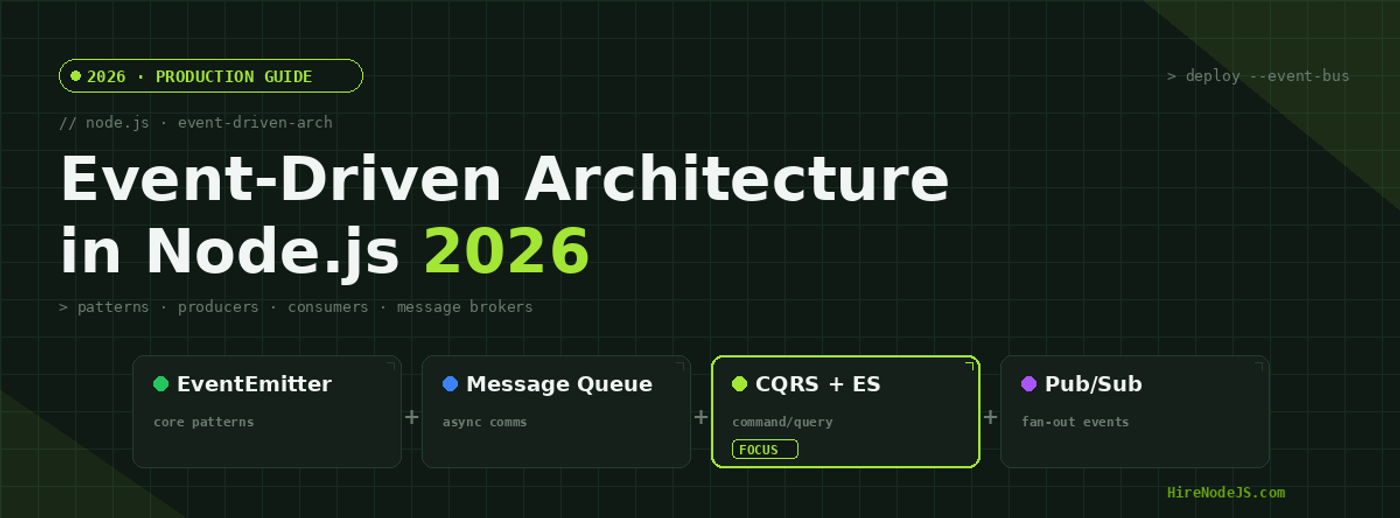
Event-Driven Architecture in Node.js: The 2026 Production Guide
Event-driven architecture (EDA) has become the backbone of modern, scalable Node.js applications. As distributed systems grow more complex and real-time user experiences become the baseline expectation, the traditional request-response model falls short. EDA decouples producers from consumers, enabling services to communicate asynchronously through events — resulting in systems that scale horizontally, recover gracefully from failures, and evolve independently.
In 2026, the Node.js ecosystem offers mature tooling for building event-driven systems — from native EventEmitter patterns to full-blown message brokers like Kafka and RabbitMQ. Whether you are building a real-time fintech platform or scaling an e-commerce backend, understanding EDA is no longer optional. This guide covers everything you need to build robust Node.js systems that stand the test of scale.
What Is Event-Driven Architecture?
Event-driven architecture is a software design paradigm where the flow of the program is determined by events — meaningful changes in state. Instead of services directly calling each other through synchronous HTTP requests, they emit events that other services react to asynchronously. This fundamental shift in communication patterns unlocks loose coupling, independent deployability, and horizontal scalability.
In the Node.js world, EDA feels natural. Node.js was built from the ground up around an event loop and non-blocking I/O — the EventEmitter class is one of the most used primitives in the entire runtime. Event-driven architecture extends this single-process concept to distributed systems, where events flow between microservices through message brokers, event buses, and streaming platforms.
Core Components of EDA
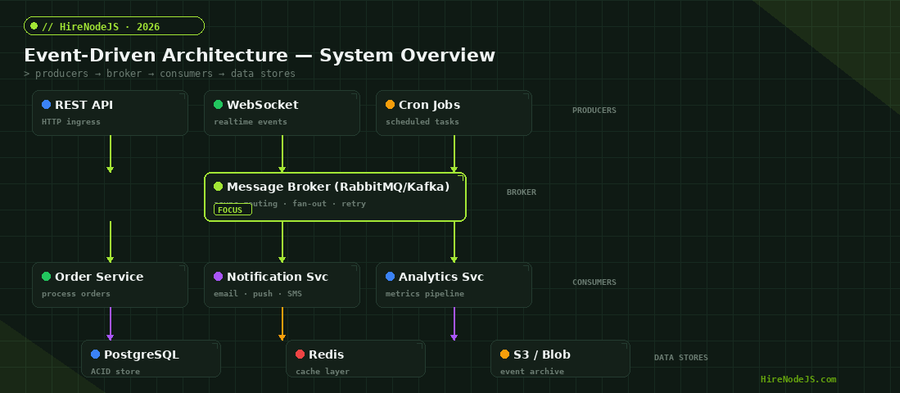
Every event-driven system consists of three core components: producers (services that emit events when state changes), a message broker or event bus (the infrastructure that routes events), and consumers (services that subscribe to and process events). The broker acts as an intermediary that decouples producers from consumers — neither side needs to know about the other, which is what gives EDA its flexibility.
Foundational EDA Patterns in Node.js
Before reaching for external message brokers, Node.js provides powerful in-process event-driven patterns through the built-in EventEmitter class. Understanding these foundational patterns is critical because they form the conceptual basis for distributed event systems and remain useful for intra-service communication.
The EventEmitter Pattern
The EventEmitter class in Node.js allows you to create objects that emit named events and register listener functions. This is the simplest form of event-driven communication — a publisher emits an event, and any number of subscribers react to it without the publisher needing to know who they are.
import { EventEmitter } from 'node:events';

// Create a typed event bus for your application
class AppEventBus extends EventEmitter {
  emitOrderPlaced(order) {
    this.emit('order:placed', {
      orderId: order.id,
      userId: order.userId,
      total: order.total,
      items: order.items,
      timestamp: new Date().toISOString(),
    });
  }

  onOrderPlaced(handler) {
    this.on('order:placed', handler);
    return () => this.off('order:placed', handler); // cleanup
  }
}

const bus = new AppEventBus();

// Consumer 1: Inventory service
bus.onOrderPlaced(({ orderId, items }) => {
  console.log(`[Inventory] Reserving stock for order ${orderId}`);
  items.forEach(item => reserveStock(item.sku, item.qty));
});

// Consumer 2: Notification service
bus.onOrderPlaced(({ orderId, userId }) => {
  console.log(`[Notifications] Sending confirmation to user ${userId}`);
  sendOrderConfirmation(userId, orderId);
});

// Consumer 3: Analytics
bus.onOrderPlaced(({ total, timestamp }) => {
  console.log(`[Analytics] Recording sale: $${total} at ${timestamp}`);
  trackRevenue(total, timestamp);
});

// Producer: Order service
async function placeOrder(orderData) {
  const order = await db.orders.create(orderData);
  bus.emitOrderPlaced(order); // fire and forget
  return order;
}
Pub/Sub vs Point-to-Point
Two fundamental messaging patterns underpin all EDA systems. In the publish-subscribe (pub/sub) pattern, an event is broadcast to all interested subscribers — every consumer gets a copy. In the point-to-point (queue) pattern, each message is consumed by exactly one consumer, enabling load distribution. Most production systems use both patterns: pub/sub for notifications and analytics, and queues for task processing and work distribution.
Choosing the Right Message Broker for Node.js
The message broker is the heart of any distributed event-driven system. Your choice of broker affects throughput, latency, durability, and operational complexity. In 2026, Node.js developers have several battle-tested options, each with distinct strengths.
Kafka — The Throughput King
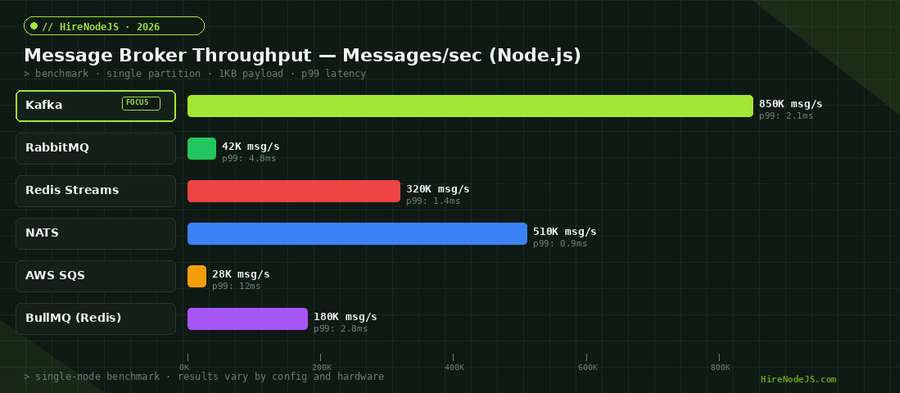
Apache Kafka excels at high-throughput, ordered event streaming. With its partitioned log architecture, Kafka can handle millions of events per second while maintaining strict ordering within partitions. The kafkajs library provides a mature Node.js client with support for consumer groups, exactly-once semantics, and schema registry integration. Kafka is the go-to choice for event sourcing, real-time analytics pipelines, and any system where event replay is a requirement.
RabbitMQ — The Flexible Router
RabbitMQ offers sophisticated routing capabilities through its exchange and binding model. It supports direct, topic, fanout, and header-based routing — giving you fine-grained control over which consumers receive which events. The amqplib package is the standard Node.js client. RabbitMQ shines in systems that need complex routing logic, dead-letter queues, and priority-based message processing.
Redis Streams and BullMQ
For teams already running Redis in their stack, Redis Streams provide a lightweight alternative to dedicated message brokers. Combined with BullMQ for job queue semantics, Redis can serve as both a cache layer and an event transport — reducing infrastructure complexity. This combination works well for medium-scale systems processing up to 300K messages per second on a single node.
CQRS and Event Sourcing with Node.js
Command Query Responsibility Segregation (CQRS) and Event Sourcing (ES) are advanced EDA patterns that separate read and write models, storing every state change as an immutable event. Together, they provide a complete audit trail, enable temporal queries, and allow you to rebuild state from scratch by replaying events.
When CQRS Makes Sense
CQRS is not a universal pattern — it adds complexity that only pays off in specific scenarios. Consider CQRS when your read and write workloads have vastly different scaling requirements, when you need to optimise read models for specific query patterns, when audit trails are a regulatory requirement (fintech, healthcare), or when you need to support event replay for debugging and analytics. For simple CRUD applications, CQRS is over-engineering.
Hire Pre-Vetted Node.js Developers
Skip the months-long search. Our exclusive talent network has senior Node.js experts ready to join your team in 48 hours.
Implementing Event Sourcing in Node.js
A practical event sourcing implementation in Node.js typically uses PostgreSQL as the event store (leveraging its ACID guarantees and JSONB support) and projects read models into optimised query tables or a search engine like Elasticsearch. Libraries like @eventstore/db-client or custom implementations built on top of pg provide the foundation.
Production Patterns for Event-Driven Node.js
Moving from a proof-of-concept to a production-grade event-driven system requires addressing several cross-cutting concerns: idempotency, ordering, dead-letter handling, monitoring, and schema evolution. These patterns separate hobby projects from systems that handle real traffic reliably.
Idempotent Event Handlers
In distributed systems, events can be delivered more than once — network retries, broker redeliveries, and consumer restarts all contribute to duplicate processing. Every event handler must be idempotent, meaning processing the same event multiple times produces the same result. The standard approach is to store a hash or ID of each processed event and skip duplicates. In Node.js, you can implement this with a simple Redis set or a PostgreSQL unique constraint on the event ID.
Dead-Letter Queues and Retry Strategies
Not every event will be processed successfully on the first attempt. A robust retry strategy with exponential backoff prevents cascading failures, while dead-letter queues (DLQs) capture events that exhaust their retry budget. Monitor your DLQ depth as a key operational metric — a growing DLQ signals either a bug in your consumer logic or a downstream dependency failure that needs attention.
Schema Evolution and Versioning
As your system evolves, event schemas will change. Without a schema evolution strategy, you risk breaking consumers when producers update their event format. Use schema registries (Confluent Schema Registry for Kafka, or a simple JSON Schema validator) and follow the rule of additive-only changes: add new fields, never remove or rename existing ones. Version your event types explicitly (OrderPlacedV2) when breaking changes are unavoidable.
Testing Event-Driven Node.js Systems
Testing event-driven systems requires a different approach than testing synchronous REST APIs. You need to verify that events are emitted correctly, consumed reliably, and that the eventual consistency model produces correct results. A comprehensive testing strategy combines unit tests for individual handlers, integration tests with embedded brokers, and contract tests to verify event schema compatibility between producers and consumers.
Unit Testing Event Handlers
Test each event handler in isolation by providing a known event payload and asserting on the side effects. Mock external dependencies (databases, APIs, other event emitters) and verify that the handler processes the event correctly, handles edge cases gracefully, and is idempotent when given the same event twice.
Integration Testing with Testcontainers
For integration tests, use Testcontainers to spin up real instances of your message broker (Kafka, RabbitMQ, Redis) in Docker containers. This ensures your tests exercise the actual broker protocol and configuration rather than relying on mocks that may diverge from production behaviour. The testcontainers-node library makes this straightforward — each test suite gets a fresh broker instance that is automatically cleaned up after the tests complete.
Monitoring and Observability for EDA
Event-driven systems are inherently harder to observe than synchronous systems. A request does not follow a single code path — it fans out across multiple services through asynchronous events. Investing in observability tooling from day one is essential. Focus on three pillars: distributed tracing (OpenTelemetry), structured logging (Pino), and metrics (Prometheus/Grafana).
Key Metrics to Track
Monitor event throughput (events produced and consumed per second), consumer lag (how far behind consumers are from the latest event), processing latency (time from event emission to handler completion), error rates per handler, and dead-letter queue depth. Set alerts on consumer lag and DLQ depth — these are the earliest indicators of production issues in event-driven systems.
Distributed Tracing with OpenTelemetry
OpenTelemetry provides a vendor-neutral standard for propagating trace context through event-driven systems. Inject trace headers into event metadata at the producer and extract them at the consumer. This creates end-to-end traces that span asynchronous boundaries, allowing you to visualise the complete lifecycle of a business operation across multiple services and event hops.
Hire Expert Node.js Developers — Ready in 48 Hours
Building the right event-driven system is only half the battle — you need the right engineers to build it. HireNodeJS.com specialises exclusively in Node.js talent: every developer is pre-vetted on real-world projects, API design, event-driven architecture, and production deployments.
Unlike generalist platforms, our curated pool means you speak only to engineers who live and breathe Node.js. Most clients have their first developer working within 48 hours of getting in touch. Engagements start as short-term contracts and can convert to full-time hires with zero placement fee.
Conclusion
Event-driven architecture is a powerful paradigm that aligns naturally with Node.js and its non-blocking, event-loop-based runtime. By decoupling services through asynchronous events, you gain horizontal scalability, fault tolerance, and the flexibility to evolve your system incrementally. The patterns covered in this guide — from foundational EventEmitter usage to production-grade CQRS, idempotency, and observability — provide a roadmap for building event-driven Node.js systems that perform reliably at scale.
Start with the simplest pattern that solves your immediate problem. Use in-process EventEmitter for intra-service communication, graduate to Redis Streams or BullMQ for moderate scale, and adopt Kafka or RabbitMQ when you need the full power of a distributed event platform. Whatever your scale, the principles remain the same: design for idempotency, trace everything, and let events — not direct calls — be the connective tissue of your architecture.
Frequently Asked Questions
What is event-driven architecture in Node.js?
Event-driven architecture (EDA) is a design paradigm where services communicate through asynchronous events rather than direct synchronous calls. Node.js is naturally suited for EDA because its runtime is built around an event loop and non-blocking I/O, making it efficient at handling high volumes of concurrent events.
Which message broker is best for Node.js in 2026?
The best broker depends on your requirements. Kafka excels at high-throughput ordered event streaming (850K+ msg/sec). RabbitMQ offers flexible routing with exchanges and bindings. Redis Streams with BullMQ is ideal for teams already using Redis who need moderate throughput. NATS provides the lowest latency at 0.9ms p99.
When should I use CQRS with Node.js?
Use CQRS when your read and write workloads have different scaling needs, when you need optimised read models for specific query patterns, when regulatory compliance requires full audit trails, or when event replay is needed for analytics. Avoid CQRS for simple CRUD applications — the added complexity is not justified.
How do I handle duplicate events in Node.js event-driven systems?
Implement idempotent event handlers by storing a unique ID for each processed event (in Redis or PostgreSQL) and skipping duplicates. Every handler should produce the same result whether the event is processed once or multiple times, since network retries and broker redeliveries make duplicate delivery inevitable.
How much does it cost to hire a Node.js developer experienced in event-driven architecture?
Senior Node.js developers with event-driven architecture expertise typically command rates of $80-150/hour depending on region and specialisation. HireNodeJS.com connects you with pre-vetted engineers at competitive rates, with most clients having their first developer working within 48 hours.
What are the best testing strategies for event-driven Node.js applications?
Combine unit tests for individual event handlers (mock dependencies, verify idempotency), integration tests using Testcontainers with real broker instances, and contract tests to verify event schema compatibility between producers and consumers. Focus on testing eventual consistency outcomes rather than synchronous assertions.
Vivek Singh is the founder of Witarist and HireNodeJS.com — a platform connecting companies with pre-vetted Node.js developers. With years of experience scaling engineering teams, Vivek shares insights on hiring, tech talent, and building with Node.js.
Need Node.js Engineers Who Build Event-Driven Systems at Scale?
HireNodeJS connects you with pre-vetted senior Node.js engineers experienced in Kafka, RabbitMQ, CQRS, and event sourcing — available within 48 hours. No recruiter fees, no lengthy screening.