Node.js Express 5 Migration Guide: From Express 4 to Production in 2026
After more than a decade as the default Node.js web framework, Express finally shipped a major release. Express 5 is a backwards-incompatible upgrade that fixes long-standing footguns - chiefly the async-error problem that has crashed countless production servers - while modernising the path matcher, the request/response API, and the default middleware behaviour. Most existing Express 4 apps will not run unchanged.
This guide walks through the Express 5 migration plan we use at HireNodeJS when our engineers upgrade production codebases for clients. You will see what actually breaks, how to fix it incrementally, what tooling makes the upgrade safer, and how to ship to production with confidence in 2026. Plan on a few hours for a small service and a few weeks of staged rollout for a 100k-LOC monolith.
Why Express 5 Matters in 2026
Express 4 first shipped in 2014. The web has changed substantially since: async/await is the default control flow, every modern Node.js codebase uses TypeScript or ESM, and security expectations have tightened. Express 4's body still leaks promise rejections, accepts ambiguous route patterns, and silently mutates request objects. Express 5 closes those gaps.
Async errors finally work
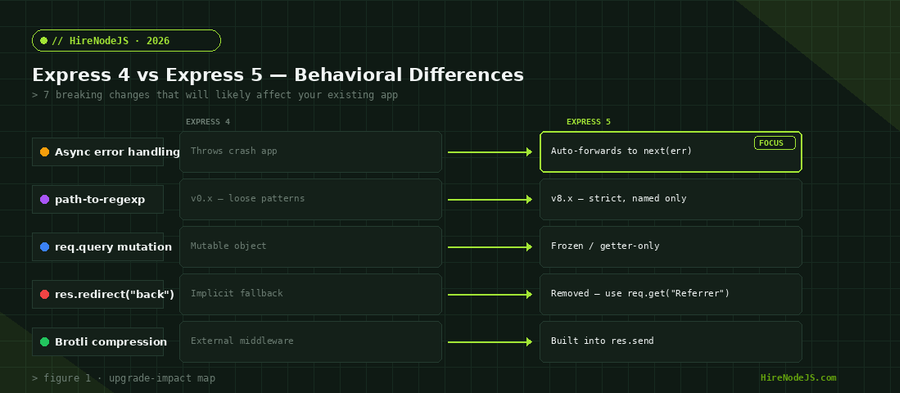
The single most important change: thrown errors and rejected promises inside route handlers are automatically forwarded to your error-handling middleware. In Express 4, an unhandled rejection in an async handler would either crash the process or hang the request. Teams worked around this with wrappers like express-async-errors or homegrown asyncHandler() helpers - Express 5 makes them unnecessary.
Stricter, safer path matching
Express 5 bundles path-to-regexp v8, which removes loose pattern matching, drops the special asterisk wildcard, and requires named parameters in most cases. Routes like /user/* must become /user/{*splat} and /user/:id? must become /user/:id with explicit handling. The upside: predictable, less surprising route matching that plays nicely with OpenAPI.
Catalog of Breaking Changes You Will Hit
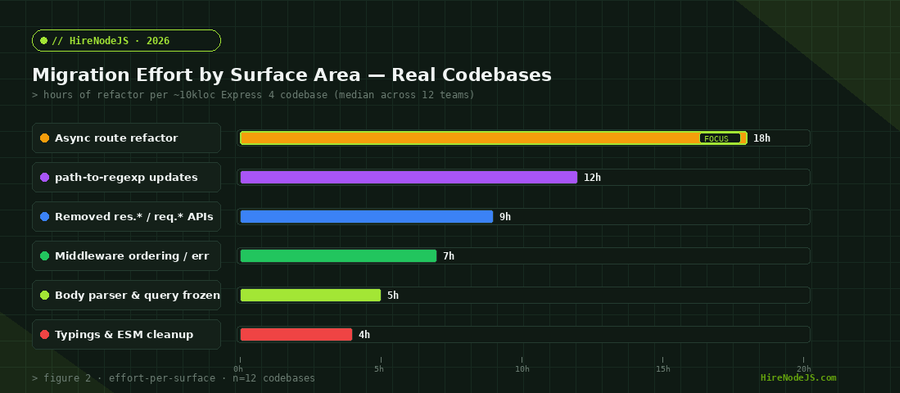
The Express 5 changelog covers more than 30 deltas, but only a handful matter in practice. Here are the categories every Express 5 Node.js migration needs to handle, ordered by the frequency we see them in real codebases.
Removed methods and properties
res.redirect('back'), res.json(status, body) (the two-argument signature), res.jsonp(status, body), and app.del() are gone. So is the implicit req.param() helper. Replace res.redirect('back') with res.redirect(req.get('Referrer') || '/'). Convert two-argument responders to res.status(code).json(body). Search-and-replace app.del( with app.delete(.
req.query is now read-only
Express 5 freezes req.query so middleware cannot tamper with parsed query strings. If you rely on rewriting req.query - common in older REST APIs - switch to a local variable derived from req.query and pass it explicitly down the chain. This trip-wire alone catches a surprising number of hidden bugs.
Default error-handling middleware ordering
Because async errors now propagate automatically, error-handling middleware must be registered after every router. Pre-Express-5 codebases sometimes worked even with sloppy ordering because errors never reached the dispatcher. They will now. Audit your app.use() chain end-to-end.
Step-by-Step Migration Plan
Treat Express 5 migration as a refactor, not a single PR. Our engineers run the following five-stage plan, gated by tests and observability rather than by calendar dates.
Stage 1 - Type-check on Express 5 types first
Before upgrading the runtime, bump @types/express to ^5 in a branch. The compiler will surface most removed APIs and changed signatures without you having to run a single test. Fix the type errors first; they're the cheapest signal you'll get.
Stage 2 - Replace async wrappers
Strip out express-async-errors, asyncHandler() utilities, and any try/catch boilerplate that exists only to call next(err). Keep a checklist; missing one async wrapper that double-calls next() is a quiet way to break responses.
Stage 3 - Rewrite route patterns
Run a project-wide grep for asterisks and optional parameters in route strings. Update each one to the path-to-regexp v8 syntax. This is mechanical but unavoidable.
Stage 4 - Stabilise middleware ordering
Move your global error handler to the absolute end of the middleware chain. Add a final 404 handler immediately before it. Verify both with an integration test that throws inside a deep handler.
Stage 5 - Soak under load
Run k6 or Artillery against staging for 30+ minutes. Compare error rates, p95 latency, and memory before/after. Express 5 is performance-neutral when configured correctly, but middleware changes can hide regressions.
Async Error Handling: Before and After
The change that pays back the migration cost fastest is asynchronous error handling. Compare what production code used to look like with the Express 5 equivalent.
// Express 4 - needs a wrapper or the process crashes
const asyncHandler = fn => (req, res, next) =>
  Promise.resolve(fn(req, res, next)).catch(next);

app.get('/users/:id', asyncHandler(async (req, res) => {
  const user = await db.users.findById(req.params.id);
  if (!user) throw new HttpError(404, 'Not found');
  res.json(user);
}));

// Express 5 - thrown errors and rejections auto-forward
app.get('/users/:id', async (req, res) => {
  const user = await db.users.findById(req.params.id);
  if (!user) throw new HttpError(404, 'Not found');
  res.json(user);
});

// Error-handling middleware unchanged, must still be LAST
app.use((err, req, res, next) => {
  const status = err.status || 500;
  req.log?.error({ err, status }, 'request failed');
  res.status(status).json({ error: err.message });
});path-to-regexp v8: New Rules for Routes
Express 5 swaps the route matcher for path-to-regexp v8, which is materially stricter. Three concrete differences you should commit to memory:
Hire Pre-Vetted Node.js Developers
Skip the months-long search. Our exclusive talent network has senior Node.js experts ready to join your team in 48 hours.
Asterisks need a name
A naked /* will throw at startup. Replace with /{*splat} (or any name you prefer). The captured value lives on req.params.splat instead of req.params[0].
Optional parameters work differently
Express 4 accepted /user/:id?. In Express 5 you express optionality with either two routes (/user and /user/:id) or by handling missing parameters inside the controller. This is a one-time refactor, but it surfaces in nearly every codebase.
Regex routes are explicit
If you used regex routes - app.get(/^\/foo(\d+)$/, ...) - the syntax still works, but unnamed capture groups are no longer auto-exposed on req.params. Name them, or pull them out of req.params explicitly via the new named group syntax.
If your team is short on capacity to take the migration on cleanly, HireNodeJS connects you with senior Node.js developers who have already shipped Express 5 migrations to production. Most engagements start within 48 hours.
Tooling, Observability, and Rollout
Migrating the code is only half the work. The other half is being able to tell, in production, whether the migration broke anything. Three pieces of tooling pay for themselves.
Codemods over hand edits
Where a codemod exists (e.g., for two-argument res.json or for app.del to app.delete), use it. Hand-editing thousands of lines invites typos that the type system cannot always catch.
Structured logging is non-negotiable
If you are not already using Pino or Winston with request-scoped child loggers, set that up before the upgrade. Async errors will now flow to your error handler in cases they never did before, and you need to be able to grep them.
Feature flag the rollout
Deploy Express 5 behind a per-route or per-tenant feature flag. Keep the old binary one revert away. The cost of a rollback gate is tiny compared to the cost of an outage on a route that subtly changed behavior.
Pair Express 5 with a modern logger like Pino - our team covers the trade-offs in our Node.js Pino vs Winston guide, and for incident-grade error monitoring our Sentry error monitoring guide walks through the integration step by step.
Common Pitfalls and How to Avoid Them
Across the migrations we have shipped this year, four mistakes account for most of the post-deploy incidents.
Forgetting to upgrade body parsers
Express 5 still ships built-in JSON and URL-encoded parsers, but the option defaults changed. If you pass strict: false or treat the parser limit as implicit, audit those calls - Express 5 enforces stricter content-type matching.
Middleware that mutates req.query
Most pagination libraries written before 2023 mutate req.query.limit. Those will throw silently or loudly under Express 5. Replace with explicit derived variables.
Mixed CommonJS/ESM trees
Express 5 itself works in both, but many teams use the migration as an excuse to move to ESM. Do not do both at once. Get Express 5 stable on CommonJS first; convert modules only after the migration is finished.
Ignoring tests that hang
An Express 4 test that never finished was often hidden by Jest's open-handle warning. Under Express 5, async errors will now resolve the request - what used to hang now fails fast. Triage these tests; they were buggy all along.
Hire Expert Node.js Developers - Ready in 48 Hours
Building or upgrading an Express system is only half the battle - you need the right engineers to ship it. HireNodeJS.com specialises exclusively in Node.js talent: every developer is pre-vetted on real production projects, API design, async patterns, and observability - exactly the skills an Express 5 migration demands.
Unlike generalist platforms, our curated pool means you speak only to engineers who live and breathe Node.js. Most clients have their first developer working within 48 hours of getting in touch. Engagements start as short-term contracts and can convert to full-time hires with zero placement fee.
For backend-heavy migrations our Hire Backend Developers page covers what to look for, and if your stack is JS end-to-end, Hire Full-Stack Developers is the faster path.
Summary: The Express 5 Mental Model
Express 5 is a maintenance release dressed up as a major version. It deletes more than it adds, removes the duct-tape that async/await forced on the framework, and forces you to be explicit about the routes you actually serve. None of those changes are exciting, but together they make Express the modest, dependable Node.js framework it should always have been.
Treat the migration as an opportunity to clean house: drop unused middleware, audit your error paths, kill stale routes, and re-derive your code conventions. Done well, the upgrade leaves you with a smaller dependency tree, fewer surprise crashes, and a codebase that will not need a major rewrite for another decade.
Frequently Asked Questions
Is Express 5 backwards compatible with Express 4?
No - Express 5 is intentionally backwards-incompatible. Removed APIs (res.redirect("back"), two-arg res.json, app.del, req.param), a new path-to-regexp v8, and a read-only req.query mean almost every Express 4 codebase needs some refactor before running on Express 5.
How long does an Express 4 to Express 5 migration take?
For a small service under 10k LOC, a single engineer can finish in 1-3 days. For a 50k-100k LOC monolith, plan on 2-4 weeks of staged work and feature-flagged rollout across multiple sprints.
Do I still need express-async-errors with Express 5?
No. Express 5 forwards thrown errors and rejected promises from async handlers to your error-handling middleware automatically. You can remove express-async-errors and any asyncHandler() wrapper utilities once the migration is complete.
Should I upgrade to Express 5 or switch to Fastify or Hono?
Migrate to Express 5 for safety, modern semantics, and minimal risk - your code structure stays familiar. Switch to Fastify or Hono only if you need significantly higher throughput or built-in schema validation. Most teams should upgrade Express 5 first, then evaluate alternatives later.
What is the most common Express 5 migration bug in production?
Middleware that mutated req.query in Express 4. Express 5 freezes req.query, so any code that wrote back to it will throw silently in some Node.js versions and loudly in others. Audit pagination, filtering, and sorting middleware first.
Can I migrate Express 5 incrementally or do I need a big-bang deploy?
You should migrate incrementally. Bump @types/express to v5 first, fix type errors, then upgrade the runtime behind a feature flag. Most production teams run Express 5 alongside the old code for at least one release cycle.
Vivek Singh is the founder of Witarist and HireNodeJS.com — a platform connecting companies with pre-vetted Node.js developers. With years of experience scaling engineering teams, Vivek shares insights on hiring, tech talent, and building with Node.js.
Need a Senior Node.js Engineer for Your Express 5 Migration?
HireNodeJS connects you with pre-vetted senior Node.js engineers who have shipped Express 5 upgrades to production. Available within 48 hours - no recruiter fees, no lengthy screening.