Fastify in Production: The Complete Node.js Guide 2026
Fastify has emerged as the performance leader among Node.js web frameworks, consistently outperforming Express by two to three times in raw throughput benchmarks. Built from the ground up with an asynchronous plugin system, JSON Schema-based validation, and a highly optimised request lifecycle, Fastify v5 is the framework of choice for teams building production APIs that need to handle serious traffic in 2026.
Whether you are migrating from Express or starting a greenfield project, this guide covers everything you need to deploy Fastify confidently in production. If you are looking to hire Node.js developers with Fastify expertise, understanding these patterns will help you evaluate candidates effectively.
Why Fastify for Production in 2026
Fastify was created by Matteo Collina and Tomas Della Vedova with a singular focus: developer experience without sacrificing runtime performance. The framework achieves this through several architectural decisions that set it apart from older alternatives like Express and Koa.
First, Fastify uses a radix-tree router (find-my-way) that resolves routes in constant time regardless of how many routes are registered. Second, its serialisation layer uses fast-json-stringify, which pre-compiles JSON Schema definitions into optimised serialisation functions — eliminating the overhead of JSON.stringify on every response. Third, the plugin encapsulation model ensures that decorators, hooks, and dependencies are scoped correctly, preventing the leaky abstractions that plague large Express applications.
Performance That Scales
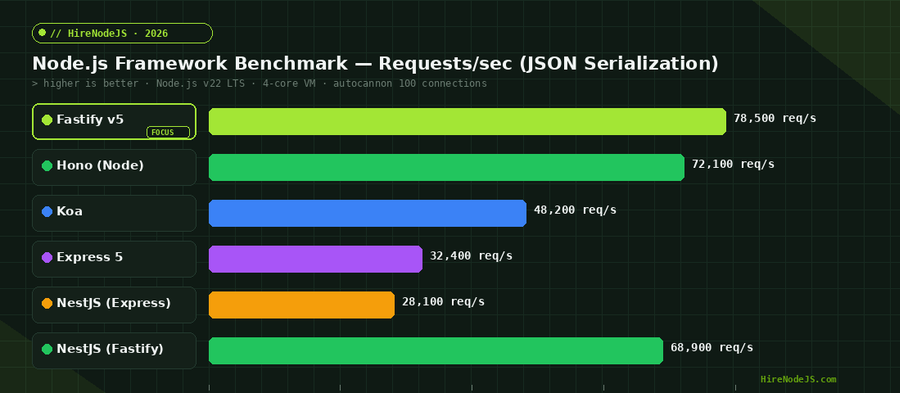
In controlled benchmarks on Node.js v22 LTS with a 4-core VM and 100 concurrent connections, Fastify v5 handles approximately 78,500 requests per second for simple JSON serialisation — compared to 32,400 for Express 5 and 48,200 for Koa. These numbers are not theoretical; they translate directly to lower infrastructure costs and better user experience under load.
Project Setup and Configuration
Getting a production-ready Fastify project off the ground requires more than just installing the package. You need TypeScript support, environment-based configuration, structured logging, and a sensible project layout that scales as your team grows.
TypeScript-First Configuration
Fastify has excellent TypeScript support out of the box. The framework ships its own type definitions, and the plugin system is fully typed through declaration merging. This means your decorators, request properties, and reply methods all get proper IntelliSense without any extra work.
import Fastify, { FastifyInstance } from 'fastify';
import { TypeBoxTypeProvider } from '@fastify/type-provider-typebox';
import { Type } from '@sinclair/typebox';

const app: FastifyInstance = Fastify({
  logger: {
    level: process.env.LOG_LEVEL || 'info',
    transport: process.env.NODE_ENV === 'development'
      ? { target: 'pino-pretty', options: { colorize: true } }
      : undefined,
  },
  trustProxy: true,
  requestIdHeader: 'x-request-id',
}).withTypeProvider<TypeBoxTypeProvider>();

// Register a typed route with JSON Schema validation
app.get('/api/users/:id', {
  schema: {
    params: Type.Object({ id: Type.String({ format: 'uuid' }) }),
    response: {
      200: Type.Object({
        id: Type.String(),
        name: Type.String(),
        email: Type.String({ format: 'email' }),
      }),
    },
  },
}, async (request, reply) => {
  const { id } = request.params;
  const user = await app.db.findUser(id);
  if (!user) return reply.code(404).send({ error: 'User not found' });
  return user;
});

await app.listen({ port: 3000, host: '0.0.0.0' });
console.log('Server running on port 3000');Mastering the Plugin Architecture
The plugin system is what makes Fastify fundamentally different from Express middleware. In Express, every middleware shares a single global scope — any middleware can modify the request object, and there is no isolation between unrelated concerns. Fastify flips this model on its head with encapsulated plugins.
Encapsulation and Scope
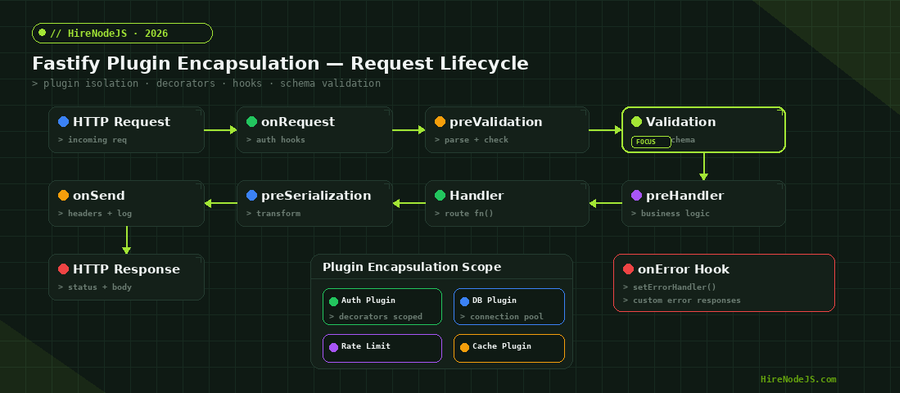
Every Fastify plugin runs inside its own encapsulation context. Decorators added inside a plugin are only visible to that plugin and its children — not to sibling plugins or the parent scope. This means your authentication plugin cannot accidentally interfere with your caching plugin, and vice versa.
The only exception is when you explicitly use fastify-plugin to break encapsulation, which you should do sparingly and only for truly shared utilities like database connections or configuration objects.
Hook Lifecycle
Fastify provides a rich set of lifecycle hooks that let you intercept requests at every stage: onRequest, preParsing, preValidation, preHandler, preSerialization, onSend, and onResponse. Each hook can be scoped to specific plugins, giving you fine-grained control over which middleware runs on which routes.
Schema Validation and Serialization
One of Fastify's most powerful features is its built-in JSON Schema validation. Unlike Express, where you need to install and configure a separate validation library like Joi or Zod, Fastify validates request params, query strings, headers, and bodies automatically when you define a schema on your route.
Why JSON Schema Matters
JSON Schema validation in Fastify is not just a convenience — it is a performance optimisation. When you define a response schema, Fastify uses fast-json-stringify to pre-compile a serialisation function specific to that shape. This avoids the overhead of JSON.stringify inspecting every property at runtime, resulting in two to three times faster serialisation for complex objects.
Teams building backend APIs at scale should always define response schemas. The upfront investment in schema definitions pays for itself through better validation, automatic documentation, and measurably faster response times.
Hire Pre-Vetted Node.js Developers
Skip the months-long search. Our exclusive talent network has senior Node.js experts ready to join your team in 48 hours.
Error Handling and Observability
Production applications need robust error handling that does not leak internal details to clients while still providing enough information for debugging. Fastify's error handling model is built around setErrorHandler and structured error responses.
Custom Error Handlers
Fastify lets you register error handlers at any level of the plugin tree. A global error handler catches unhandled errors across all routes, while plugin-scoped error handlers can provide domain-specific error formatting. This is particularly useful for microservices where different API sections may have different error response formats.
Structured Logging with Pino
Fastify ships with Pino as its built-in logger — the fastest JSON logger for Node.js. Every request automatically gets a unique request ID, and the logger is available on both the Fastify instance and individual request objects. For production observability, pipe Pino output to your log aggregator (Datadog, Elastic, Grafana Loki) and correlate traces using the request ID header.
Deployment and Scaling
Deploying Fastify in production requires attention to graceful shutdown, health checks, Docker optimisation, and horizontal scaling. The framework provides built-in support for graceful shutdown via the close hook, but there are several additional patterns you need to implement.
Docker Best Practices
Use a multi-stage Dockerfile to keep your production image lean. The build stage installs devDependencies and compiles TypeScript, while the production stage copies only the compiled output and production node_modules. A well-optimised Fastify Docker image typically weighs under 150MB with the Alpine base.
Graceful Shutdown
Always implement graceful shutdown to prevent dropped connections during deployments. Fastify's app.close() method drains active connections and runs all onClose hooks, giving your database pools, message queue consumers, and cache connections time to clean up properly.
Horizontal Scaling with Kubernetes
For high-traffic APIs, run Fastify behind a Kubernetes deployment with horizontal pod autoscaling. Set your readiness probe to hit a dedicated /health route that checks database connectivity and downstream service availability. The liveness probe should be a simpler /alive endpoint that only confirms the process is responsive.
Security Hardening for Production
Security in Fastify goes beyond installing helmet. The framework's plugin architecture actually makes security easier to implement because you can scope security middleware to specific route groups rather than applying everything globally.
Essential Security Plugins
Install @fastify/helmet for HTTP security headers, @fastify/cors for cross-origin configuration, and @fastify/rate-limit for API throttling. Each of these can be registered at the plugin level, so your public API routes can have different CORS settings than your internal admin routes.
For authentication, @fastify/jwt provides a clean integration with Fastify's decorator system. Register it once, and every request gets a verifyJWT method that you can call in preHandler hooks. Combine this with role-based access control to build a robust authorisation layer.
Hire Expert Node.js Developers — Ready in 48 Hours
Building the right system is only half the battle — you need the right engineers to build it. HireNodeJS.com specialises exclusively in Node.js talent: every developer is pre-vetted on real-world projects, API design, event-driven architecture, and production deployments.
Unlike generalist platforms, our curated pool means you speak only to engineers who live and breathe Node.js. Most clients have their first developer working within 48 hours of getting in touch. Engagements start as short-term contracts and can convert to full-time hires with zero placement fee.
Conclusion — Fastify Is Production-Ready
Fastify v5 delivers the rare combination of raw performance, developer ergonomics, and production-grade features that modern Node.js APIs demand. Its plugin encapsulation model prevents the architectural decay that plagues large Express applications, while JSON Schema validation provides both runtime safety and serialisation speed that no other framework matches.
Whether you are building a high-throughput microservice, a real-time API gateway, or a full-featured REST API, Fastify gives you the tools to ship fast without cutting corners on reliability. The investment in learning its plugin model and schema system pays dividends as your codebase scales from a handful of routes to hundreds.
Frequently Asked Questions
Is Fastify faster than Express in production?
Yes. In benchmarks on Node.js v22 LTS, Fastify v5 handles approximately 78,500 requests per second compared to 32,400 for Express 5 — roughly 2.4 times faster for JSON serialization workloads. The gap widens further when response schemas are used.
Should I use Fastify or NestJS for a new Node.js API?
It depends on your team size and preferences. Fastify is ideal if you want maximum performance and a lightweight framework you can extend with plugins. NestJS is better if your team prefers an opinionated, Angular-style architecture with dependency injection. NestJS can also use Fastify as its HTTP adapter for better performance.
How do I migrate from Express to Fastify?
Start by running both frameworks side by side behind a reverse proxy, migrating routes incrementally. Fastify provides a compatibility layer via @fastify/express that lets you use existing Express middleware during the transition. Focus on migrating route handlers first, then replace middleware with Fastify plugins.
Does Fastify support TypeScript natively?
Yes. Fastify ships its own TypeScript type definitions and supports declaration merging for plugins. When combined with a type provider like TypeBox, you get end-to-end type safety from schema definitions to route handlers without any code generation step.
How much does it cost to hire a Fastify developer in 2026?
Senior Fastify developers typically charge between $60 and $120 per hour depending on location and experience. Platforms like HireNodeJS.com offer pre-vetted developers available within 48 hours at competitive rates without recruiter fees.
Can Fastify handle WebSocket connections?
Yes. The @fastify/websocket plugin integrates WebSocket support directly into Fastify's routing system. You define WebSocket routes alongside HTTP routes, and they benefit from the same plugin encapsulation and hook system.
Vivek Singh is the founder of Witarist and HireNodeJS.com — a platform connecting companies with pre-vetted Node.js developers. With years of experience scaling engineering teams, Vivek shares insights on hiring, tech talent, and building with Node.js.
Need a Fastify Expert for Your Next Project?
HireNodeJS connects you with pre-vetted senior Fastify and Node.js engineers available within 48 hours. No recruiter fees, no lengthy screening — just top talent who ship production APIs.