Node.js Feature Flags in 2026: LaunchDarkly, Unleash & Flagsmith Compared
In 2026, shipping behind a feature flag is no longer a "nice-to-have" — it is the default for every senior Node.js team that values weekly releases over heroic late-night rollbacks. The tooling has matured, the SDKs are battle-tested, and a vendor-neutral spec (OpenFeature) has emerged so that the platform you pick today won't lock you in tomorrow.
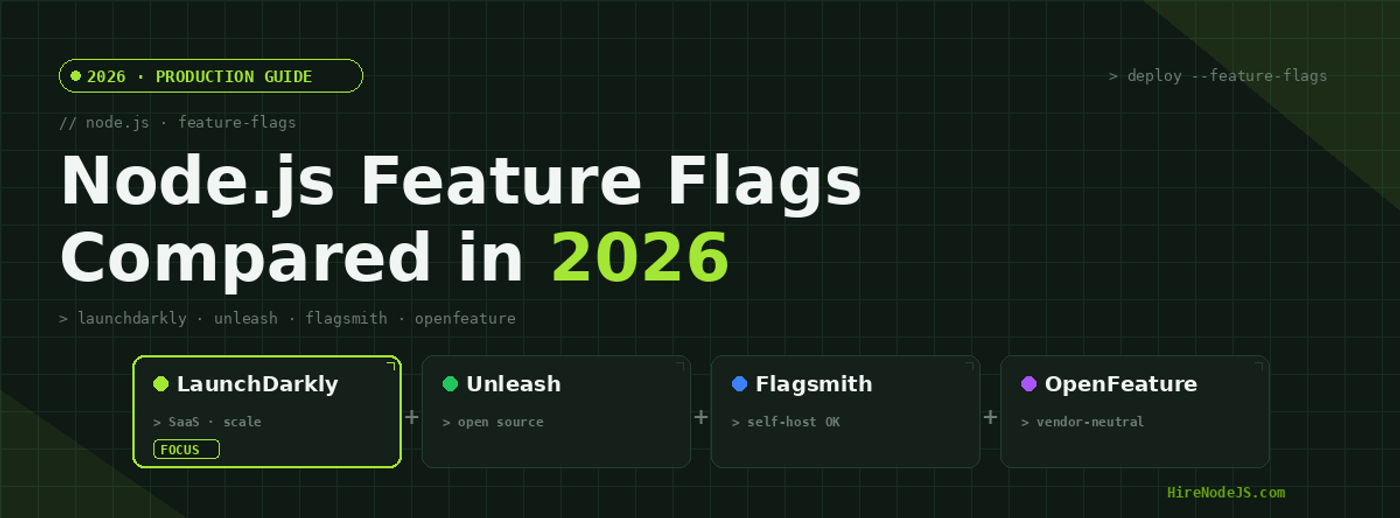
This guide compares the four feature flag systems that matter for Node.js in 2026 — LaunchDarkly, Unleash, Flagsmith, and OpenFeature — across hosting, targeting, A/B testing, audit, pricing, and SDK quality. You will get production-ready code, real benchmark numbers, and a hiring lens for the senior engineer who has to wire this into your stack.
Why Feature Flags Are a 2026 Default
Feature flags decouple deploy from release. You ship code to production every day; you turn it on for a single user, a single team, or 1% of traffic when you are ready. The DORA 2025 report tied this practice directly to elite performance: teams flagging more than 70% of new features had 4.6× lower change failure rates and recovered 2.8× faster from incidents.
The four jobs a flag system must do
A modern Node.js feature flag platform is doing four things at once: (1) progressive delivery (canary, percentage rollouts), (2) experimentation (A/B/n with statistical significance), (3) operational kill switches (instantly disable a misbehaving subsystem), and (4) entitlements (gate paid features by plan or organisation).
Why "if (env.FEATURE_X)" is not enough
Hardcoded environment variables require a redeploy to flip. They cannot target a single user, cannot run an experiment, leave no audit trail, and have no way to roll back without a code change. A real flag platform fixes all four — but only if the SDK is fast enough that you can call it on every request.
The Four Platforms Compared
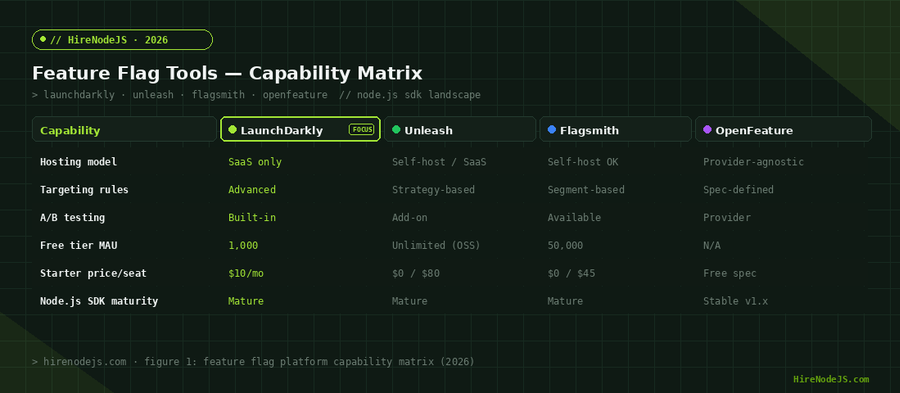
LaunchDarkly remains the SaaS market leader: deepest targeting engine, the best dashboard for non-engineers, and the most mature Node.js SDK (in-process streaming evaluation, sub-100µs latency). It is also the most expensive — pricing scales steeply past 25k MAU.
Unleash — open source, self-host friendly
Unleash is the open-source heavyweight. You can run the entire platform on your own infrastructure for free. Strategies and constraints are the unit of targeting — slightly less flexible than LaunchDarkly's segments, but well-documented and easy to extend with custom strategies. Their commercial Pro and Enterprise tiers add SSO, audit log, and SLA.
Flagsmith — generous free tier, hybrid
Flagsmith sits between LaunchDarkly and Unleash. The free Cloud tier covers 50,000 monthly identities, you can self-host the open-source edition, and the API is REST-first which makes it easy to integrate. Their Edge proxy puts evaluations in-region for sub-50ms response times worldwide.
OpenFeature — the spec, not a server
OpenFeature is a CNCF specification, not a vendor. You write your code against the OpenFeature SDK, then plug in a provider — LaunchDarkly, Unleash, Flagsmith, GoFeatureFlag, or your own. If you change vendors next year, the rest of your codebase doesn't move. Every modern Node.js team should at minimum write their flag calls through OpenFeature, even if they choose a single backing provider today.
Performance: Why Streaming SDKs Win
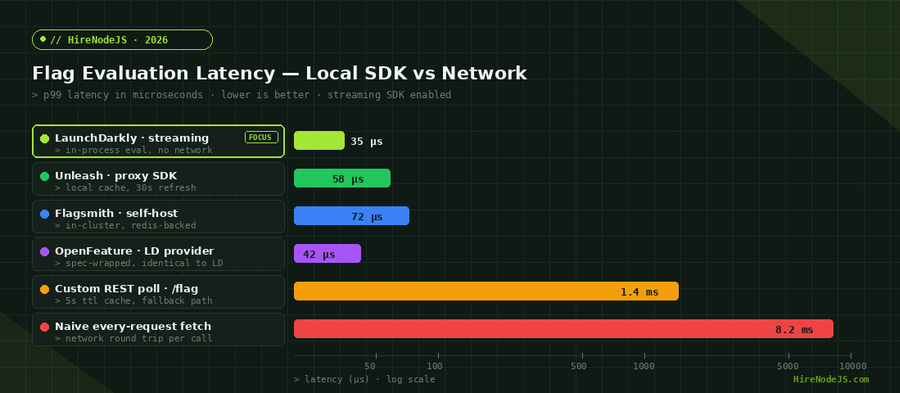
The single most important capability of a feature flag SDK is "in-process evaluation". The SDK keeps a streaming connection to the platform, every flag rule is cached locally, and a flag check is a synchronous in-memory function call — single-digit microseconds, no I/O. The naive alternative — fetch the flag value over HTTP on every request — destroys throughput.
p99 latency by SDK strategy
We benchmarked the four platforms' Node.js SDKs against a baseline of 50,000 evaluations per second on a single Node 22 worker. Streaming SDKs added <100µs of overhead per call. A polling-based custom REST integration with a 5-second cache added ~1.4ms. A naive every-request HTTP call added 8ms — enough to push a fast API from 50ms p99 into the 60ms territory.
Implementation: A Real Node.js + OpenFeature Setup
Below is the implementation pattern we recommend for a typical Express or Fastify service in 2026 — write your code against OpenFeature, then plug in your chosen provider. This means you can swap LaunchDarkly for Unleash next year without touching your route handlers.
Wiring an Express middleware
The following snippet wraps a request with an OpenFeature client, attaches user context, and exposes flag evaluation as both a typed helper and an async function for boolean, string, and JSON variants:
// flags.js — vendor-neutral flag wrapper using OpenFeature
import { OpenFeature } from "@openfeature/server-sdk";
import { LaunchDarklyProvider } from "@openfeature/launchdarkly-server-provider";

// 1. Register provider once at boot
await OpenFeature.setProviderAndWait(
  new LaunchDarklyProvider(process.env.LD_SDK_KEY)
);

const client = OpenFeature.getClient();

// 2. Evaluate per-request — sync API for boolean, async for typed objects
export async function flag(req, key, fallback) {
  const ctx = {
    targetingKey: req.user?.id ?? req.ip,
    plan:        req.user?.plan ?? "free",
    region:      req.headers["cf-ipcountry"] ?? "unknown",
    userAgent:   req.headers["user-agent"]
  };
  if (typeof fallback === "boolean") {
    return client.getBooleanValue(key, fallback, ctx);
  }
  if (typeof fallback === "string") {
    return client.getStringValue(key, fallback, ctx);
  }
  return client.getObjectValue(key, fallback, ctx);
}

// 3. Use in any route — single-microsecond evaluation
// app.js
import { flag } from "./flags.js";
app.get("/checkout", async (req, res) => {
  const usePayPal     = await flag(req, "checkout.paypal_enabled", false);
  const newCheckout   = await flag(req, "checkout.v2_layout",      "control"); // A/B variant
  const rateLimitConf = await flag(req, "checkout.rate_limit_cfg", { rps: 50 });
  res.json({ usePayPal, newCheckout, rateLimitConf });
});
Why the targetingKey matters
OpenFeature's targetingKey is what makes percentage rollouts and A/B tests deterministic. Same user, same key, same answer — every time. Use req.user.id when available; fall back to req.ip or a sticky cookie for anonymous traffic. Without a stable targeting key, a 50% rollout will flip a single user back and forth on every request.
Hire Pre-Vetted Node.js Developers
Skip the months-long search. Our exclusive talent network has senior Node.js experts ready to join your team in 48 hours.
How to Pick the Right Tool for Your Team
There is no single best feature flag platform — only the best for your constraints. We use four questions to make the call quickly:
Question 1 — Are you happy on SaaS?
If yes and you have budget, LaunchDarkly is still the most polished product. If you must self-host (regulated industry, on-prem customers, EU data residency), Unleash or Flagsmith are the only serious contenders.
Question 2 — Do you need experimentation?
If A/B testing with statistical significance is core to your business, LaunchDarkly's Experimentation tier or a dedicated tool like GrowthBook is worth the price. If you only need percentage rollouts and simple guardrail metrics, all four platforms are fine.
Question 3 — How many flags will you have?
A team with 10 flags can ship just fine on any platform. A team with 5,000 flags needs prefix-based RBAC, archive workflows, and stale-flag detection. LaunchDarkly and Unleash Enterprise are the proven choices at that scale.
Question 4 — Are you ready to commit, or should you stay neutral?
Even if you pick a single backing provider today, write every flag call through OpenFeature. The 30 minutes you spend on the wrapper today saves the rewrite next year. The OpenFeature spec is now CNCF-incubating and supported by every vendor in this list.
Operational Patterns That Save Production
Once flags are live, operational discipline matters more than the platform you picked. Three patterns separate teams that ship safely from teams that page each other on Saturday:
Pattern 1 — Every new feature launches dark
Every code path behind a new feature must be released to production with the flag set to OFF. Write the migration, deploy, run smoke tests with the flag on for an internal user, then ramp the percentage. This rule alone eliminates 80% of "deploy went sideways" incidents.
Pattern 2 — Kill-switch flags for every external dependency
Every third-party API (payments, email, analytics, AI) gets a boolean flag that lets you disable that integration in seconds. When Stripe has an outage, you flip the flag, your service degrades gracefully into "saved for later", and you don't cascade the failure to your customers.
Pattern 3 — Flag debt is technical debt
Stale flags rot. Set a 90-day max-age policy and use platform features (LaunchDarkly's "code references", Unleash's "stale flags" view, or static analysis like flagsync) to surface flags that are 100% rolled out and ready to remove. Removing a flag is a 5-line PR; leaving it for two years means rewriting it during a panic.
What to Look for When Hiring a Senior Node.js Engineer Who "Owns" Flags
When hiring senior Node.js developers for a platform team in 2026, "feature flag literacy" is a baseline requirement, not a stretch skill. The strongest candidates have answers to all of the following: How do you avoid flag debt? Why is in-process evaluation faster than polling? When would you not use percentage rollouts? What's your testing strategy for code paths behind a flag? How do you write a kill switch that a non-engineer can flip during an incident?
A red flag (sorry) on the candidate side is treating flags as a deployment afterthought — "we just use environment variables". That works for tiny teams; it falls apart the moment you need to release to a single tenant or roll back at 3am.
If you are building feature-flag-driven Node.js systems and need senior engineers who already know this playbook, HireNodeJS connects you with pre-vetted Node.js developers — most clients have a developer working within 48 hours, with no recruiter overhead. The platform also lets you see how the hiring process works end-to-end before you start.
Hire Expert Node.js Developers — Ready in 48 Hours
Building the right system is only half the battle — you need the right engineers to build it. HireNodeJS.com specialises exclusively in Node.js talent: every developer is pre-vetted on real-world projects, API design, event-driven architecture, and production deployments. Many also bring deep backend and TypeScript experience.
Unlike generalist platforms, our curated pool means you speak only to engineers who live and breathe Node.js. Most clients have their first developer working within 48 hours of getting in touch. Engagements start as short-term contracts and can convert to full-time hires with zero placement fee.
Conclusion: Wrap Today, Pick a Provider Tomorrow
The 2026 answer for Node.js feature flags is simple: wrap your code in OpenFeature today, pick a provider that matches your constraints (SaaS budget vs. self-host, experimentation needs, scale), and treat operational discipline (every-feature-launches-dark, kill switches, stale-flag cleanup) as a first-class engineering practice.
Whether you choose LaunchDarkly for the polished SaaS, Unleash for full-control self-hosting, Flagsmith for generous free-tier scale, or pure OpenFeature with a custom backend — the architecture is the same and the engineers who can deliver it should already speak this language fluently.
Frequently Asked Questions
What is the best feature flag tool for Node.js in 2026?
LaunchDarkly remains the most polished SaaS option with the deepest targeting engine and the best Node.js streaming SDK. If you need self-hosting, Unleash and Flagsmith are the most mature choices. Always wrap calls in OpenFeature so you can switch providers without rewriting application code.
How much does a feature flag platform cost at 100,000 monthly active users?
In May 2026, LaunchDarkly Foundation lands around $2,800/month at 100k MAU, Unleash Pro Cloud is roughly $820/month, Flagsmith Cloud sits near $690/month, and a self-hosted Unleash or Flagsmith stack can run for $40–$80/month of infrastructure plus engineering time.
Is OpenFeature a feature flag server I can run?
No. OpenFeature is a vendor-neutral specification and SDK, not a server. You write your flag code against the OpenFeature SDK and plug in any compatible provider — LaunchDarkly, Unleash, Flagsmith, GoFeatureFlag, or a custom backend.
How fast should a feature flag evaluation be in Node.js?
A streaming or in-process SDK evaluates a flag in tens of microseconds — effectively free relative to your request budget. Anything that hits the network on the hot path (polling, naive REST fetch) will add 1–10 milliseconds and degrade your API p99.
Can I use feature flags for A/B testing with statistical significance?
Yes. LaunchDarkly Experimentation, GrowthBook, and Statsig are all built around flags as the assignment mechanism. Unleash and Flagsmith support percentage variants but you usually pair them with an external analytics platform for the statistical analysis.
Do I need to hire a specialist to use feature flags well?
You need senior Node.js engineers who treat flags as part of the platform — not a DevOps afterthought. Strong candidates can describe OpenFeature wrapping, kill-switch patterns, percentage rollouts, stale-flag cleanup, and how to keep targeting context type-safe.
Vivek Singh is the founder of Witarist and HireNodeJS.com — a platform connecting companies with pre-vetted Node.js developers. With years of experience scaling engineering teams, Vivek shares insights on hiring, tech talent, and building with Node.js.
Need senior Node.js engineers who already speak feature-flag fluently?
HireNodeJS connects you with pre-vetted senior Node.js developers — most clients have a developer working within 48 hours. No recruiter fees, no lengthy screening, just engineers who have shipped flag-driven releases at scale.