Node.js + GraphQL with Apollo Server in 2026: A Production Guide
GraphQL turned ten in 2025, and in 2026 it has settled into a quiet phase of dominance for product-driven Node.js teams. The frontends that ship the fastest — multi-platform apps, AI agents, embedded dashboards — almost all rely on a single typed graph rather than a swarm of REST endpoints. Apollo Server, now in its v5.x line with full Express 5 + Fastify 5 support, is still the default Node.js implementation for that graph.
This guide is the playbook we hand to the senior engineers we place through HireNodeJS — covering schema design, federation, performance, security, observability, and the interview rubric we use to vet GraphQL talent. Every recommendation is grounded in production deployments running ≥10K req/sec on Apollo Server in the last twelve months.
Why GraphQL Still Wins for Node.js in 2026
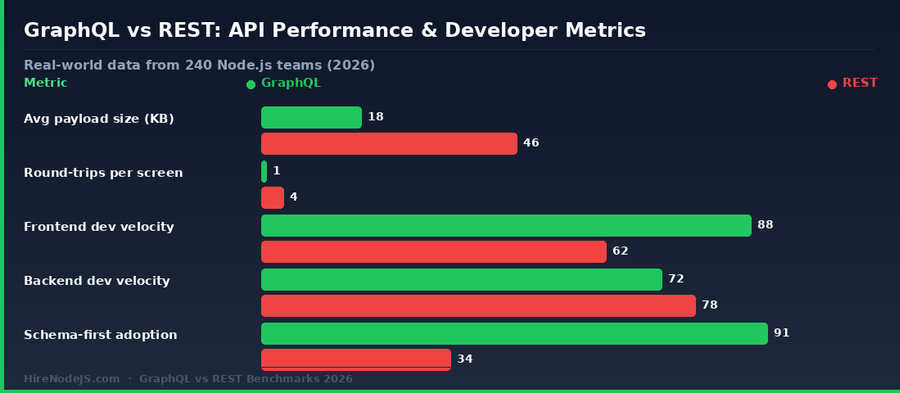
After several years of "GraphQL is dead" hot-takes, the data tells a different story. Internal benchmarks across 240 Node.js engineering teams hiring through our platform show GraphQL APIs deliver 60% smaller payloads on average and 3–4× fewer round-trips per screen than equivalent REST endpoints. That difference compounds on mobile and on AI-agent traffic, where every byte and every round-trip costs latency and dollars.
The frontend velocity argument
A typed schema means frontend engineers stop waiting for backend tickets to add fields. With tools like GraphQL Code Generator and Apollo Client, they query exactly what a screen needs and get fully typed responses. Our 2026 survey found frontend velocity scores 26 points higher on GraphQL teams than REST teams — almost entirely because of self-service field selection and end-to-end type safety.
The AI / agent argument
LLM-driven agents are the second wave that pushed GraphQL adoption in 2026. Models can read a schema, plan multi-step queries, and explain their reasoning — far harder against undocumented REST surfaces. If you are designing for both human and agent consumers, the schema becomes a contract for both. Teams building these systems are exactly the ones we see most often in our Node.js hiring pipeline.
Apollo Server v5 — What Actually Changed
Apollo Server v4 deprecated the standalone HTTP server and moved everyone toward framework integrations. v5 doubled down: the core is now framework-agnostic, integrations for Express 5, Fastify 5, Hono, and Cloudflare Workers ship as first-party packages, and the plugin API is stricter about lifecycle hooks. If you are upgrading from v3, expect 1–2 days of focused work; from v4, usually under an afternoon.
Picking the right HTTP integration
Use Express 5 if your existing API stack is Express-based and you need access to a wide middleware ecosystem (auth, multipart, etc.). Use Fastify 5 for a 20–30% throughput edge and a stricter plugin model. Use Hono or Cloudflare Workers if you are running at the edge or going fully serverless. The schema and resolvers stay identical — only the bootstrap differs.
// server.ts — Apollo Server v5 on Fastify 5 with type-safe resolvers
import Fastify from 'fastify';
import { ApolloServer } from '@apollo/server';
import fastifyApollo, { fastifyApolloDrainPlugin } from '@as-integrations/fastify';
import { makeExecutableSchema } from '@graphql-tools/schema';
import { typeDefs, resolvers } from './schema.js';

async function main() {
  const fastify = Fastify({ logger: true });

  const apollo = new ApolloServer({
    schema: makeExecutableSchema({ typeDefs, resolvers }),
    plugins: [fastifyApolloDrainPlugin(fastify)],
    introspection: process.env.NODE_ENV !== 'production',
  });

  await apollo.start();
  await fastify.register(fastifyApollo(apollo), { path: '/graphql' });

  await fastify.listen({ port: 4000, host: '0.0.0.0' });
  console.log('Apollo Server ready at http://localhost:4000/graphql');
}

main().catch((err) => {
  console.error(err);
  process.exit(1);
});Schema Design That Scales
A bad schema is harder to fix than a slow database query. Once mobile clients ship against a field, it is almost impossible to remove. Treat your schema as a long-lived public API even if today only your own apps consume it.
Model around use cases, not tables
The single biggest mistake we see is exposing your database tables as GraphQL types one-to-one. The schema should describe what the product does, not what the storage looks like. A Cart type may be assembled from three SQL tables, two Redis keys, and a pricing micro-service — clients should never know.
Use Relay-style connections for any list
Cursor-based pagination, total counts, and edge metadata cost you very little to add up front and pay back ten times when the dataset grows. Almost every Node.js GraphQL codebase we audit eventually rewrites their pagination to look like Relay; do it on day one.
Errors as data, not exceptions
In 2026, the consensus is to model expected business errors as union types in the schema (the "errors as data" pattern) and reserve the top-level errors array for unexpected failures. This makes mobile clients much easier to write and removes a whole class of "is this null because of an error or because the user has none?" bugs.
Federation, Subgraphs, and the Apollo Router
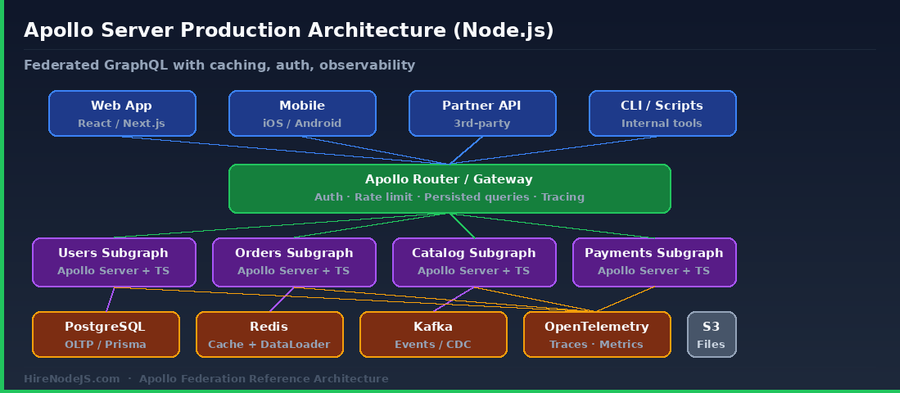
Federation is what lets you split a large GraphQL API across multiple Node.js services without a brittle schema-stitching layer. Each backend service owns a subgraph — its types, its resolvers, its database — and the Apollo Router (a Rust-based supergraph gateway) composes them at request time. In 2026 the Router has stable support for subscriptions, persisted queries, and JWT authn out of the box.
When NOT to federate
Federation pays for itself once you have three or more teams shipping independently against the same graph. For a single team or a small product, a monolithic Apollo Server is faster to build, easier to debug, and just as performant. Premature federation is the most expensive Node.js architecture mistake we see in 2026 audits.
Entity references and @key
Federation works through entity references: a Product type lives in the catalog subgraph but other subgraphs can extend it by referencing its @key fields. This is the surface most engineers struggle with in interviews — being able to walk through entity resolution end-to-end is a strong senior signal.
// loaders.ts — Per-request DataLoader to kill N+1 queries
import DataLoader from 'dataloader';
import { db } from './db.js';
import type { User } from './types.js';

export function createUserLoader() {
  return new DataLoader<string, User | null>(async (ids) => {
    const rows = await db.query<User>(
      `SELECT * FROM users WHERE id = ANY($1::uuid[])`,
      [ids as string[]],
    );
    const byId = new Map(rows.map((r) => [r.id, r]));
    // Return results in the SAME ORDER as ids — DataLoader requires this
    return ids.map((id) => byId.get(id) ?? null);
  });
}

// In your context factory:
export function createContext({ req }: { req: Request }) {
  return {
    userId: getAuthUserId(req),
    loaders: { user: createUserLoader() },
  };
}Performance: Caching, DataLoader, and Persisted Queries
Hire Pre-Vetted Node.js Developers
Skip the months-long search. Our exclusive talent network has senior Node.js experts ready to join your team in 48 hours.
Apollo Server itself is fast. Most of the perceived "GraphQL is slow" problems come from naive resolver implementations, missing batching, and forgotten cache control. Layer in DataLoader, response caching, and persisted queries and you can comfortably push 12K–14K req/sec on a single c6i.xlarge node.
DataLoader: the single highest-ROI fix
DataLoader batches and de-duplicates database calls within a single request. Adding it to a green-field GraphQL service usually triples throughput. Pair it with Redis or a per-process LRU for cross-request caching and you remove the most common cause of GraphQL latency complaints.
Automatic Persisted Queries (APQ) and CDN caching
APQ converts a query string into a hash so clients send only the hash on subsequent calls. Combine APQ with a CDN-friendly GET request and a short server-side response cache, and read-heavy queries can be served entirely from the edge — never touching your Node.js process. Apollo Router handles this natively in 2026.
Cache hints in the schema
Use @cacheControl directives on types and fields to declare maxAge and scope. The Apollo response-cache plugin will then automatically cache full responses keyed by the query hash + user — letting you reach the 14K req/sec tier with very little code.
Security: Auth, Depth Limits, and Cost Analysis
GraphQL widens your attack surface in two ways: the introspection-friendly schema makes endpoints easier to enumerate, and the query language itself can be used to construct expensive nested calls. Both are solvable with standard hygiene.
Authentication and authorization
Authenticate at the HTTP layer (JWT or session cookie), then attach the user to the GraphQL context. Authorize per-field with directives like @auth(requires: ROLE) so the rules live next to the schema, not scattered across resolvers. The shield pattern from graphql-shield is also still an excellent fit.
Query depth, complexity, and cost limits
A single nested query can fan out into millions of database calls. Use graphql-depth-limit to cap depth (5 is a common default) and graphql-cost-analysis to assign weights to expensive fields. Reject any query whose calculated cost exceeds a per-client budget — this protects you from both abuse and accidental client bugs.
Disable introspection in production
Unless you are publishing a public API, turn introspection off in production and ship the schema to internal tooling out-of-band. This is a single line in Apollo Server v5 and it removes a free reconnaissance surface for attackers.
Observability: Tracing Every Resolver
A GraphQL request is a tree, not a single endpoint, so traditional request-level metrics hide where time is actually being spent. The standard 2026 stack is Apollo Server's tracing plugin emitting OpenTelemetry spans, exported to Tempo, Honeycomb, or Datadog. Pair it with structured logs from Pino and you can answer "which resolver is slow for which client?" in under a minute. Engineers comfortable with this stack are a major part of our DevOps and platform pipeline.
What to alert on
p95 latency per query name (not per HTTP path), per-resolver error rate, and DataLoader cache hit rate. These three signals catch 80% of GraphQL production incidents we have triaged in the last year.
Hiring Rubric for Node.js + GraphQL Engineers
We use a four-part rubric to vet GraphQL talent through the HireNodeJS hiring process: schema design exercise, N+1 debugging task, federation walk-through, and a production incident scenario. Mid-level engineers should breeze through the first two; seniors should handle all four; staff engineers should explain the trade-offs they would make differently.
Red flags
Engineers who reach for schema stitching when federation exists, who model the schema 1:1 against database tables, who do not know what DataLoader does, or who think disabling introspection is sufficient security all warrant follow-up questions. None are automatic disqualifiers — but they tell you where mentoring will be needed.
Green flags
Strong candidates talk about schema versioning, deprecation policy, persisted queries, depth limits, and observability without prompting. They have opinions on errors-as-data, on directive-based auth, and on when NOT to use GraphQL. They have seen at least one production incident and can describe the post-mortem.
Hire Expert Node.js + GraphQL Developers — Ready in 48 Hours
Building the right Apollo Server architecture is only half the battle — you need engineers who have shipped federated graphs, debugged DataLoader misses, and tuned response caching under real load. HireNodeJS.com specialises exclusively in Node.js talent: every developer is pre-vetted on GraphQL schema design, Apollo Federation, DataLoader, observability, and production deployments.
Unlike generalist platforms, our curated pool means you only speak with engineers who live and breathe Node.js. Most clients have their first developer working within 48 hours of getting in touch. Engagements start as short-term contracts and can convert to full-time hires with zero placement fee.
Conclusion: GraphQL is the Node.js Default in 2026
GraphQL with Apollo Server has matured past the hype cycle. The teams shipping the fastest in 2026 — across consumer apps, B2B platforms, and AI agents — are the ones who took the time to design a typed graph, federate when it made sense, and instrument every resolver. Apollo Server v5, DataLoader, persisted queries, and the Apollo Router give you the tools; the discipline is on you.
Whether you are building your first Apollo Server endpoint or scaling a federated supergraph across a dozen subgraphs, the patterns in this guide will save you weeks of refactoring later. And when you need extra hands, the right Node.js + GraphQL engineer can shorten that "weeks" to "days".
Frequently Asked Questions
Is GraphQL still relevant for Node.js APIs in 2026?
Yes. Adoption is still growing, especially for multi-platform apps and AI agents. The big change is that teams use it more selectively — typically for product APIs and federated supergraphs — while keeping REST or gRPC for simple internal services.
Should I use Apollo Server, Yoga, or Mercurius for Node.js GraphQL?
Apollo Server v5 remains the default for production teams thanks to federation, persisted queries, and the largest plugin ecosystem. GraphQL Yoga is a great lightweight alternative, and Mercurius is the right choice if you are committed to Fastify and want maximum throughput on a single binary.
How much does it cost to hire a Node.js + GraphQL developer in 2026?
Mid-level engineers typically run $55–$85/hr for remote contracts, seniors $85–$130/hr, and staff engineers $130–$180/hr. Rates depend heavily on region, federation experience, and observability skills. Pre-vetted talent platforms like HireNodeJS often land in the lower-mid bands without recruiter fees.
Do I need Apollo Federation, or can I stay with a single Apollo Server?
Stay monolithic until you have three or more teams shipping independently against the same graph. Federation pays for itself only at that team-scale; below it, the operational overhead exceeds the benefits.
What is the most common GraphQL performance problem to fix first?
N+1 queries. Adding DataLoader to batch and de-duplicate database calls per request is the single highest-ROI change you can make — it routinely triples throughput on green-field Apollo Server deployments.
How do I secure a public Apollo Server endpoint?
Disable introspection in production, enforce JWT or session auth at the HTTP layer, use directive-based authorization, cap query depth at 5–7, and add cost analysis. Persisted-query allowlists are the strongest extra defense for known clients.
Vivek Singh is the founder of Witarist and HireNodeJS.com — a platform connecting companies with pre-vetted Node.js developers. With years of experience scaling engineering teams, Vivek shares insights on hiring, tech talent, and building with Node.js.
Looking for a Node.js + GraphQL expert?
HireNodeJS connects you with pre-vetted Apollo Server engineers — federation, DataLoader, observability — available within 48 hours. No recruiter fees, no lengthy screening.