GraphQL Yoga on Node.js: The Production Guide for 2026
If you have shipped a GraphQL API on Node.js in the last few years, you have almost certainly reached for Apollo Server. But in 2026 the centre of gravity has shifted. GraphQL Yoga — the batteries-included server from The Guild, built on top of the Envelop plugin system and the GraphQL-over-HTTP spec — has become the default choice for teams that want a fast, standards-compliant server without wiring a dozen libraries together themselves.
This guide walks through running GraphQL Yoga in production on Node.js: how the Envelop plugin pipeline works, how to add caching and rate limiting without forking your schema, how subscriptions and file uploads behave, and where Yoga fits relative to Apollo Server and Mercurius. Every recommendation here is the kind of thing we look for when vetting senior Node.js engineers, so it doubles as a checklist for the patterns that hold up under real traffic.
Why GraphQL Yoga won the Node.js GraphQL race
The original GraphQL servers on Node.js were either too bare (express-graphql, now deprecated) or too opinionated and heavy. GraphQL Yoga lands in the middle: it ships sensible defaults — CORS, GraphiQL, error masking, subscriptions, file uploads, and persisted operations — while staying a thin layer you can fully reconfigure.
Crucially, Yoga is server-agnostic. The same schema runs on Node's native HTTP server, on Bun, on Deno, on AWS Lambda, and on Cloudflare Workers, because Yoga is built on the WHATWG Fetch API rather than Express-specific request objects. That portability is the single biggest reason teams migrate to it.
Standards compliance is the second reason. Yoga implements the GraphQL-over-HTTP specification, so clients, gateways, and tooling behave predictably. Apollo Server is also compliant today, but Yoga made it the default earlier and exposes fewer footguns around content negotiation and status codes.
Migrating from Apollo Server is usually a half-day job rather than a rewrite. Your schema and resolvers are plain GraphQL, so they move across untouched; what changes is the server bootstrap and the middleware. Apollo plugins become Envelop plugins, Apollo's context function maps almost one-to-one onto Yoga's, and the GraphiQL playground is built in. The most common surprise is error handling: Yoga masks internal errors by default in production, which is safer but means you must opt in to surface custom error codes to clients.
The third reason is bundle weight and cold starts. Because Yoga avoids the Express dependency chain and leans on the platform's native primitives, it produces smaller deployments and faster cold starts on serverless — a real cost difference once you are running thousands of Lambda invocations a day. For teams on AWS Lambda or Cloudflare Workers, that alone can justify the switch, and it is one of the first things we probe for when assessing a candidate's serverless instincts.
The Envelop plugin pipeline explained
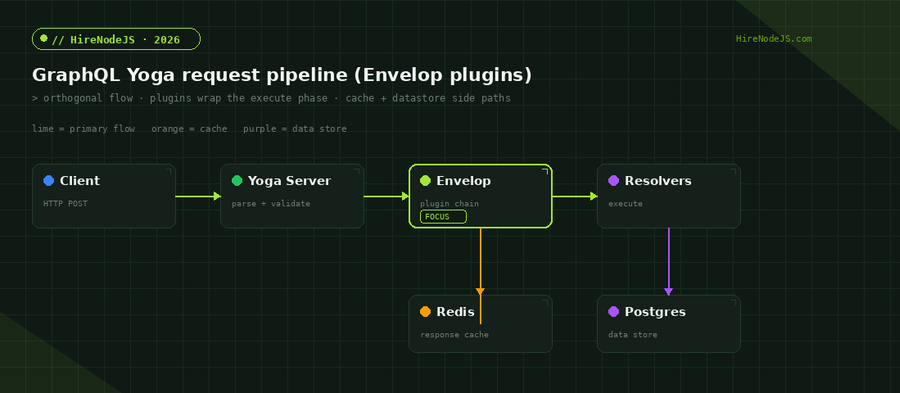
Yoga's power comes from Envelop, a plugin system that wraps every phase of GraphQL execution: schema building, parsing, validation, context creation, and execute/subscribe. Instead of monkey-patching the schema, you register plugins that hook into these phases. This is what makes cross-cutting concerns — caching, auth, tracing, rate limiting — composable rather than tangled.
A plugin is just an object with lifecycle hooks. Order matters: plugins registered first wrap those registered later, so a parser cache should sit before a validation cache, and observability should usually wrap everything.
import { createYoga } from 'graphql-yoga'
import { useResponseCache } from '@graphql-yoga/plugin-response-cache'
import { createServer } from 'node:http'
import { schema } from './schema.js'

const yoga = createYoga({
  schema,
  // Envelop plugins run as a pipeline around execution
  plugins: [
    useResponseCache({
      session: (request) => request.headers.get('authorization') ?? null,
      ttl: 5_000, // cache identical queries for 5s
    }),
  ],
  // mask internal errors in production, keep them in dev
  maskedErrors: process.env.NODE_ENV === 'production',
})

const server = createServer(yoga)
server.listen(4000, () => {
  console.log('GraphQL Yoga ready at http://localhost:4000/graphql')
})Caching, rate limiting, and protecting the hot path
Most GraphQL performance problems are not raw execution speed — they are unbounded queries and repeated work. Envelop gives you three layers of defence that you can add without touching resolver code.
Parser and validation caches eliminate repeated work for identical query documents. Response caching serves identical results from memory or Redis. Depth and cost limits reject abusive queries before they ever reach your database.
Persisted operations are the strongest protection of all. Instead of accepting arbitrary query strings, the server only executes a pre-approved allowlist keyed by hash; the client sends the hash, not the document. This eliminates an entire class of malicious or accidentally expensive queries, shrinks request payloads, and gives you a stable catalogue of exactly which operations your clients run. For public-facing APIs, treat persisted operations as the production default and reserve free-form queries for internal tools.
Rate limiting in Yoga happens at the field level through the Envelop rate-limiter plugin, which is more precise than a blunt per-IP gateway rule. You can throttle an expensive search field to a handful of calls per minute while leaving cheap lookups untouched, and you can key limits on the authenticated user rather than the IP. Combine field-level limits with global query-cost analysis so a single request cannot smuggle thousands of cheap-looking fields past your defences.
If your resolvers fan out to a relational database, pair response caching with a connection-pooling strategy and consider a dedicated cache tier — our Redis hiring guide and PostgreSQL skill page cover the engineers who specialise in exactly this layer.
Hire Pre-Vetted Node.js Developers
Skip the months-long search. Our exclusive talent network has senior Node.js experts ready to join your team in 48 hours.
Subscriptions and real-time with Yoga
Yoga ships subscriptions over Server-Sent Events by default rather than WebSockets. SSE is simpler to operate, works through most proxies, and survives HTTP/2 multiplexing — for the majority of dashboards and notification feeds it is the right default. WebSocket transport is still available when you need bidirectional channels.
Because subscriptions are just async iterators, you can back them with any pub/sub source: Postgres LISTEN/NOTIFY, Redis pub/sub, or a managed broker. Keep the resolver thin and push fan-out to the broker.
Authentication for subscriptions deserves special care. Unlike a stateless query, a subscription is a long-lived connection, so you authenticate once when the stream opens and then re-check authorization on every payload you push. The safest pattern is to filter inside the subscribe iterator — never publish an event to a subscriber who has lost access mid-stream. With SSE this is straightforward because each event passes back through your resolver; with raw WebSockets you have to wire the check yourself.
import { createPubSub } from 'graphql-yoga'

const pubSub = createPubSub()

export const resolvers = {
  Subscription: {
    orderUpdated: {
      subscribe: (_p, { id }) => pubSub.subscribe(`order:${id}`),
      resolve: (payload) => payload,
    },
  },
  Mutation: {
    updateOrder: async (_p, { id, status }) => {
      const order = await db.orders.update(id, { status })
      pubSub.publish(`order:${id}`, order) // fan out to subscribers
      return order
    },
  },
}
Measuring plugin overhead before you ship
Every plugin adds latency. Most are negligible, but response caching with a remote store and full distributed tracing are not free. Measure the marginal cost of each plugin under load before enabling it globally, and scope expensive plugins to the operations that actually need them.
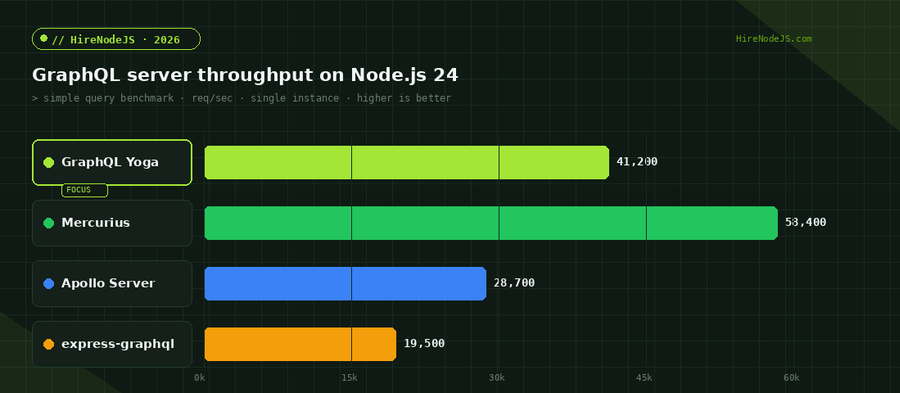
The chart below shows representative per-request overhead for common Envelop plugins on Node.js 24. Use it to reason about defaults, then confirm with your own load test — k6 or Artillery against your real schema beats any generic benchmark.
Federation, gateways, and scaling out
As your graph grows past a single team, you will want to split it. Yoga subgraphs work behind Apollo Gateway or GraphQL Mesh, and Yoga can act as the gateway itself. The portability story pays off here: the same subgraph runs unchanged whether you scale it horizontally behind Nginx or deploy it to the edge.
Designing a federated graph is an architecture decision as much as a coding one. If you are standing up subgraphs across teams, it helps to have engineers who have done it before — you can hire backend developers with federation experience, or browse our GraphQL skill page for specialists.
Operationally, GraphQL is stateless apart from subscriptions, so it scales horizontally like any Node.js service: run multiple instances, put a load balancer in front, and externalise the response cache to Redis so every instance shares it. Keep subscription transport sticky or move fan-out entirely to the broker.
Getting a GraphQL Yoga setup right — Envelop ordering, caching, depth limits, federation — is the difference between an API that scales and one that falls over at launch. If you need that expertise on your team, HireNodeJS connects you with pre-vetted senior Node.js engineers available within 48 hours, without the recruiter overhead.
Hire Expert Node.js Developers — Ready in 48 Hours
Building the right system is only half the battle — you need the right engineers to build it. HireNodeJS.com specialises exclusively in Node.js talent: every developer is pre-vetted on real-world projects, API design, GraphQL schema work, and production deployments.
Unlike generalist platforms, our curated pool means you speak only to engineers who live and breathe Node.js. Most clients have their first developer working within 48 hours of getting in touch. Engagements start as short-term contracts and can convert to full-time hires with zero placement fee.
Conclusion: betting on Yoga in 2026
GraphQL Yoga has become the pragmatic default for Node.js GraphQL servers because it is fast, standards-compliant, portable across runtimes, and extensible through Envelop without schema surgery. Start with the batteries-included defaults, add caching and query-cost protection before you go public, measure plugin overhead under realistic load, and externalise state when you scale out.
Do those things and Yoga will comfortably carry a production graph. The remaining variable is people: the patterns above are exactly what separates a senior Node.js engineer from someone who has only built demos. Hire for that judgement and the rest follows.
Frequently Asked Questions
Is GraphQL Yoga better than Apollo Server in 2026?
For most new Node.js projects, yes. Yoga is faster to set up, runtime-portable across Node, Bun, Deno, Lambda, and Workers, and built on the Envelop plugin system. Apollo Server remains a solid choice, especially if you are already invested in Apollo Studio and federation tooling.
Does GraphQL Yoga support subscriptions?
Yes. Yoga ships subscriptions over Server-Sent Events by default, which is simpler to operate than WebSockets and works through most proxies. WebSocket transport is also available when you need bidirectional communication.
What is Envelop in GraphQL Yoga?
Envelop is the plugin system Yoga is built on. It lets you hook into every phase of GraphQL execution — parse, validate, context, execute — so you can add caching, auth, rate limiting, and tracing without modifying your schema or resolvers.
Can GraphQL Yoga be used with Apollo Federation?
Yes. Yoga can build federation-compatible subgraphs that run behind Apollo Gateway or GraphQL Mesh, and Yoga can also act as the gateway itself. The same subgraph code runs unchanged across runtimes.
How do you cache responses in GraphQL Yoga?
Use the @graphql-yoga/plugin-response-cache Envelop plugin. It can cache in memory or in Redis, supports per-session cache keys, and invalidates by TTL or by entity. Pair it with parser and validation caches for the biggest wins.
How much does it cost to hire a Node.js GraphQL developer in 2026?
Rates vary by region and seniority, typically ranging from $40-$90 per hour for vetted senior engineers through staff-augmentation platforms. HireNodeJS connects you with pre-vetted Node.js developers, often within 48 hours and with no recruiter fees.
Vivek Singh is the founder of Witarist and HireNodeJS.com — a platform connecting companies with pre-vetted Node.js developers. With years of experience scaling engineering teams, Vivek shares insights on hiring, tech talent, and building with Node.js.
Looking for a Node.js + GraphQL expert?
HireNodeJS connects you with pre-vetted senior Node.js engineers who ship GraphQL APIs with Yoga, Apollo, and federation — available within 48 hours. No recruiter fees, no lengthy screening.