Node.js + Hono in 2026: The Edge-First Framework Guide
Hono spent 2024 quietly becoming one of the fastest-growing web frameworks on npm, and by 2026 it has gone from "interesting Cloudflare experiment" to a serious default for new Node.js services. The reason is simple: it runs the same codebase across Node.js, Bun, Deno, Cloudflare Workers, and AWS Lambda - with a routing core that benchmarks faster than Fastify and a bundle measured in kilobytes, not megabytes.
This guide is for engineering leads choosing a framework for a new service in 2026, and for hiring managers trying to understand what "Hono experience" actually means on a candidate's CV. We'll cover routing internals, middleware, validation with Zod, deploying to multiple runtimes from one codebase, performance tuning, and the patterns we look for when vetting senior Node.js engineers building on Hono.
Why Hono Matters for Node.js in 2026
Express has powered Node.js for over 15 years, but it carries its age. Express 5 finally landed in 2024 with native async/await - yet it still leans on a callback-shaped middleware contract, lacks first-class TypeScript types, and has no concept of edge runtimes. Hono was designed for the post-Express world: built around the Web Standard Request and Response objects, written in TypeScript from line one, and small enough to run on Cloudflare Workers' 1 MB script limit.
The router that makes Hono fast
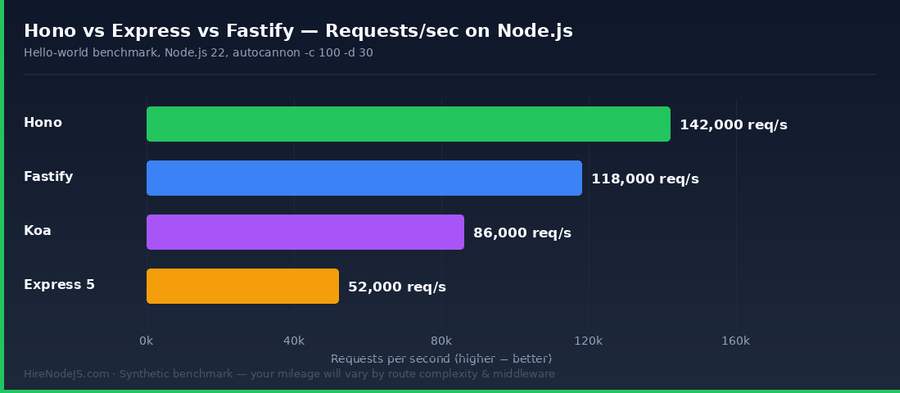
Hono uses a routing engine called RegExpRouter that pre-compiles every route into a single regular expression. The result: route matching is O(1) regardless of how many routes you register, and lookups are 2-3x faster than the radix tries powering Fastify and find-my-way. For an API with 200+ endpoints this difference shows up clearly in p99 latency under load.
One framework, many runtimes
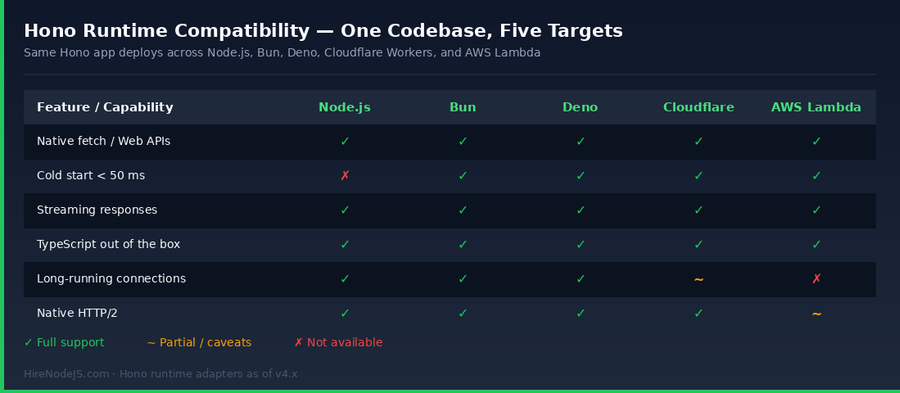
Hono ships official adapters for Node.js, Bun, Deno, AWS Lambda, Cloudflare Workers, and Vercel Edge. The same Hono app instance - your routes, middleware, and types - boots on every one of these without changes. That makes it easier to start on Node.js for development, deploy to AWS Lambda for production, and migrate hot paths to Cloudflare Workers later, without rewriting your handlers. If you need engineers who can architect this kind of multi-runtime system, hire Node.js developers from HireNodeJS - every developer is pre-vetted on real-world Node.js projects.
Setting Up Your First Hono App on Node.js
Spinning up a Hono server on Node.js takes three lines of installation and about ten lines of code. The two packages you need are hono itself and @hono/node-server, which adapts Web Standard Request/Response to Node's http module.
Install and bootstrap
import { Hono } from 'hono'
import { serve } from '@hono/node-server'
import { logger } from 'hono/logger'
import { cors } from 'hono/cors'
import { secureHeaders } from 'hono/secure-headers'

const app = new Hono()

app.use('*', logger())
app.use('*', secureHeaders())
app.use('/api/*', cors({ origin: ['https://app.example.com'] }))

app.get('/health', (c) => c.json({ status: 'ok', uptime: process.uptime() }))

app.get('/api/users/:id', (c) => {
  const id = c.req.param('id')
  return c.json({ id, name: 'Ada Lovelace' })
})

app.post('/api/users', async (c) => {
  const body = await c.req.json<{ name: string; email: string }>()
  // ... persist user, get id back
  return c.json({ id: 'usr_42', ...body }, 201)
})

app.onError((err, c) => {
  console.error('Unhandled error', err)
  return c.json({ error: 'internal_error' }, 500)
})

const port = Number(process.env.PORT) || 3000
serve({ fetch: app.fetch, port }, (info) => {
  console.log(`Hono listening on :${info.port}`)
})Routing, Middleware, and Type-Safe Handlers
Hono's routing API will feel familiar to anyone coming from Express or Koa, but the type inference is on another level. Path parameters, query strings, JSON body shapes, and response types are all carried through the type system - when you change a route, every consumer that uses Hono's RPC client gets a type error immediately.
Middleware composition
Middleware in Hono is async-first and runs as a chain - every handler is just (c, next) returning a Promise of Response or void. This composes cleanly with logging, auth, rate limiting, and validation. For TypeScript on Node.js specifically, Hono's generics let you attach typed values to the context object, so once your auth middleware sets c.set('user', user), every downstream handler sees user as the right type without any casts.
Validation with @hono/zod-validator
Hono's official Zod integration validates and types the request body, params, query, and headers in one line. If a request fails the schema, Zod's error map is returned automatically as JSON - no boilerplate, no drift between schema and handler signature. Combined with hono/client (the type-safe RPC client), this gives you end-to-end type safety from frontend to API without code generation.
Hono vs Express vs Fastify - When to Pick Which
Choosing a framework is about more than benchmarks. Express is still the safest pick if you're inheriting an old codebase, training junior developers, or relying on a wide ecosystem of middleware that hasn't been ported to Web Standards. Fastify shines for traditional Node.js APIs that need plugin encapsulation and built-in JSON-Schema validation. Hono wins when you want raw speed, a tiny bundle, edge deployment, or first-class TypeScript inference. For most backend developer projects started in 2026, Hono is the new default unless you have a concrete reason to pick something else.
Migration patterns from Express
Hire Pre-Vetted Node.js Developers
Skip the months-long search. Our exclusive talent network has senior Node.js experts ready to join your team in 48 hours.
Most teams don't rewrite - they migrate route by route. The cleanest pattern is to mount Hono as a sub-app inside Express using a thin adapter, move new endpoints into Hono, and gradually port existing routes. Once the Express portion is empty, you swap the listen call for serve from @hono/node-server and ship the migration. Expect to gain 30-50% throughput and lose 60-70% of your TypeScript any casts.
Production Patterns: Errors, Observability, and Caching
A framework benchmark looks pretty in a README; production looks different. The four things that determine whether your Hono service survives the first traffic spike are structured error handling, request-scoped context, observability, and caching strategy.
Error handling done right
Use HTTPException from hono/http-exception for known errors and a single app.onError() handler for the unknown ones. Pair this with a typed error response shape so frontend clients can distinguish validation, auth, rate limit, and server errors without parsing free-text strings.
Tracing and metrics
OpenTelemetry has a stable Node.js auto-instrumentation that picks up Hono routes when you wrap the fetch handler. For caching, the standard pattern is an in-process LRU for hot lookups plus Redis for shared, multi-instance state. Hono's tiny footprint means you can usually fit both your app and a co-located Redis client well within Lambda's memory budget.
Deploying One Hono Codebase to Multiple Targets
The clearest demonstration of Hono's value is a build pipeline that produces three deploy artifacts from a single source tree: a Node.js Docker image, a Cloudflare Workers script, and an AWS Lambda zip. Each entrypoint is six to ten lines that import the same app instance and wire it up to the runtime's adapter.
Cloudflare Workers entrypoint
For Workers you export an object with a fetch property that delegates to app.fetch - no listen, no http server. Wrangler picks it up automatically. The same trick works for Vercel Edge and Deno Deploy.
AWS Lambda with @hono/aws-lambda
On AWS Lambda, the handle helper from @hono/aws-lambda translates API Gateway events to Web Requests and back. Pair this with esbuild bundling and a 256 MB memory setting and you get sub-30 ms warm starts for typical CRUD endpoints. If you need help wiring this kind of multi-target pipeline, hire DevOps engineers with deep AWS and serverless experience.
What to Look for When Hiring a Hono Node.js Engineer
Hono experience is still a leading indicator that a candidate has been writing modern Node.js - the people building on it tend to also know TypeScript inside-out, understand Web Standard APIs, and have shipped at least one edge or serverless workload. When we vet for Hono roles at HireNodeJS, we check four areas:
First, can the candidate explain why fetch-style Request/Response objects are different from req/res in Express, and what that buys you on the edge. Second, can they design a middleware that sets typed context values without breaking inference. Third, do they know when not to use Hono - for example, a long-lived WebSocket gateway is still better as a dedicated Fastify or uWebSockets.js process. Fourth, can they articulate a deploy pipeline that ships the same code to Node.js and to Workers without divergence.
Hire Expert Node.js Developers - Ready in 48 Hours
Building the right system is only half the battle - you need the right engineers to build it. HireNodeJS.com specialises exclusively in Node.js talent: every developer is pre-vetted on real-world projects, modern frameworks like Hono and NestJS, edge runtimes, and production deployments.
Unlike generalist platforms, our curated pool means you speak only to engineers who live and breathe Node.js. Most clients have their first developer working within 48 hours of getting in touch. Engagements start as short-term contracts and can convert to full-time hires with zero placement fee.
Conclusion: Hono Is the New Default for New Node.js Services
In 2026, picking Hono for a green-field Node.js service is the safe, productive choice. You get the throughput of Fastify, the API ergonomics of Koa, the type inference of tRPC, and the edge portability of nothing else in the Node.js world - all in a 14 KB framework. Existing Express services can migrate route by route with low risk. Engineers who have shipped Hono in production tend to be the same engineers who get the rest of modern Node.js right.
If your team is starting a new service, evaluating a migration, or hiring engineers who can move comfortably between Node.js, edge runtimes, and serverless, Hono should be on the shortlist - and so should HireNodeJS.com when you need the people to build it.
Frequently Asked Questions
Is Hono ready for production Node.js use in 2026?
Yes. Hono v4 is stable, used by companies including Cloudflare, the creator Yusuke Wada maintains it actively, and major SaaS products run it on Node.js, Bun, and Workers in production. It is no longer an early-adopter choice.
How does Hono compare to Express on Node.js?
Hono is roughly 2-3x faster than Express 5 on hello-world benchmarks, has first-class TypeScript inference, ships in 14 KB versus Express's 200+ KB, and runs on edge runtimes Express cannot reach. Express is still safer when you need legacy middleware compatibility.
Can I run the same Hono code on Node.js and Cloudflare Workers?
Yes - that is Hono's core value proposition. You write your app once and add a 5-10 line entrypoint per runtime (using @hono/node-server, @hono/aws-lambda, or the default Workers fetch handler). Routes, middleware, and types are shared.
Should I migrate an existing Express app to Hono?
Migrate if you need edge deployment, much higher throughput, or strict TypeScript inference. Don't migrate if your Express app depends on legacy middleware that hasn't been ported to Web Standards or if your team isn't ready for the API change. A route-by-route migration is the safest path.
How much does it cost to hire a Node.js developer experienced with Hono in 2026?
Senior Node.js engineers with Hono and edge-runtime experience typically cost USD 60-110 per hour or 9k-16k USD per month for full-time engagements, depending on region. HireNodeJS connects you with pre-vetted senior developers within 48 hours, with no recruiter fees.
Does Hono support WebSockets and long-running connections on Node.js?
Yes on Node.js, Bun, and Deno via the @hono/node-ws and equivalent adapters. WebSockets need Durable Objects on Cloudflare Workers and are not supported on AWS Lambda - for those, use a dedicated long-lived Node.js process.
Vivek Singh is the founder of Witarist and HireNodeJS.com — a platform connecting companies with pre-vetted Node.js developers. With years of experience scaling engineering teams, Vivek shares insights on hiring, tech talent, and building with Node.js.
Need a Node.js engineer who ships fast, edge-ready APIs?
HireNodeJS connects you with pre-vetted senior Node.js engineers experienced in Hono, NestJS, edge runtimes, and serverless deployments - available within 48 hours. No recruiter fees, no lengthy screening.