Node.js HTTP/2 & HTTP/3 in 2026: The Production Guide
For most of the last decade, the transport layer under your Node.js API was something you never had to think about. TCP just worked, TLS was a checkbox, and HTTP/1.1 keep-alive carried the load. That assumption quietly stopped being true. In 2026, HTTP/3 carries the majority of real-world web traffic, every major browser negotiates it by default, and the gap between an HTTP/2 origin and an HTTP/3 edge is now measurable in your tail latency and your error budgets.
This guide walks through where HTTP/2 and HTTP/3 actually differ, how to run each from Node.js, what the performance numbers look like on imperfect networks, and the migration path that gets you the benefits without rebuilding your stack. The short version: HTTP/2 is your stable origin protocol, and HTTP/3 is the edge upgrade that pays off most for mobile and high-latency clients.
Why HTTP/3 Matters for Node.js APIs in 2026
Adoption crossed the tipping point
HTTP/3 is no longer experimental. By 2025 it accounted for over 60% of all web traffic, and among the top 1,000 sites by traffic, adoption is already past 50% — Google, Meta, Netflix, Cloudflare, and Amazon all deploy it widely. When more than half of your users' other tabs are already on HTTP/3, an origin stuck on HTTP/1.1 is the slow outlier, not the safe default.
The win is tail latency, not headline throughput
HTTP/3's advantage shows up where it hurts users most: lossy mobile networks and high-latency connections. On a clean wired link the difference is modest — often around 12% faster time-to-first-byte. On a 4G connection with intermittent packet loss, the gap widens dramatically because QUIC eliminates the TCP head-of-line blocking that stalls every stream when a single packet is lost. If you are designing APIs that need to feel fast on real devices, that resilience is exactly the kind of work a strong backend engineer should be reasoning about.
HTTP/2 in Node.js: Multiplexing, Server Push, and Its Limits
One connection, many streams
Node.js has shipped a stable, built-in node:http2 module since Node 8.4 and it is production-ready today. HTTP/2 multiplexes many logical request/response streams over a single TCP connection, so you stop paying the per-request connection tax that plagued HTTP/1.1. Headers are compressed with HPACK, and the binary framing layer is far cheaper to parse than HTTP/1.1's text protocol.
Here is a minimal but realistic HTTP/2 server. Note that browsers only speak HTTP/2 over TLS, and allowHTTP1 lets older clients fall back cleanly during a migration:
import http2 from 'node:http2';
import { readFileSync } from 'node:fs';

// HTTP/2 runs over TLS in every real browser, so wire up your cert + key.
const server = http2.createSecureServer({
  key: readFileSync('./certs/key.pem'),
  cert: readFileSync('./certs/cert.pem'),
  // Allow HTTP/1.1 fallback for older clients during migration.
  allowHTTP1: true,
});

server.on('stream', (stream, headers) => {
  // Each request is an independent, multiplexed stream on one connection.
  if (headers[':path'] === '/health') {
    stream.respond({ ':status': 200, 'content-type': 'application/json' });
    stream.end(JSON.stringify({ status: 'ok', protocol: 'h2' }));
    return;
  }
  stream.respond({ ':status': 200, 'content-type': 'text/plain' });
  stream.end('Hello over HTTP/2');
});

server.listen(8443, () => console.log('HTTP/2 server on https://localhost:8443'));
What HTTP/2 cannot fix
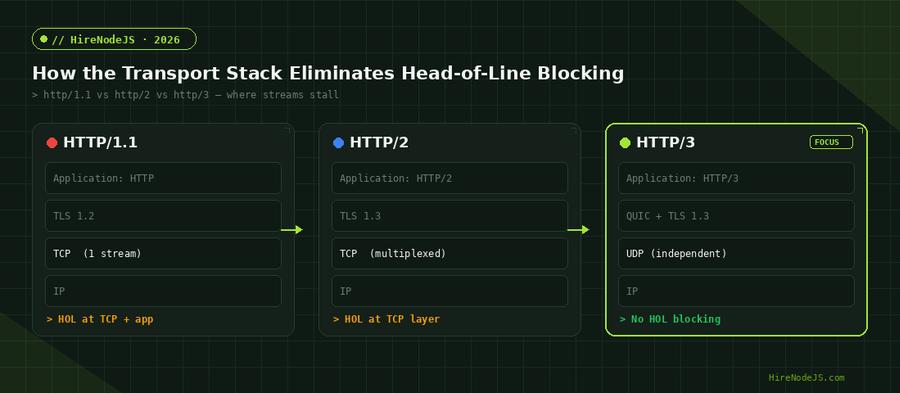
Multiplexing solves application-level blocking, but every HTTP/2 stream still rides one TCP connection. When a single TCP segment is lost, the kernel withholds all subsequent bytes — including bytes belonging to unrelated streams — until the retransmission arrives. That is TCP head-of-line blocking, and no amount of HTTP/2 cleverness removes it. Server Push, once HTTP/2's headline feature, has been effectively deprecated by browsers and should not be part of new designs.
HTTP/3 and QUIC: How the Transport Changed
QUIC moves reliability into user space
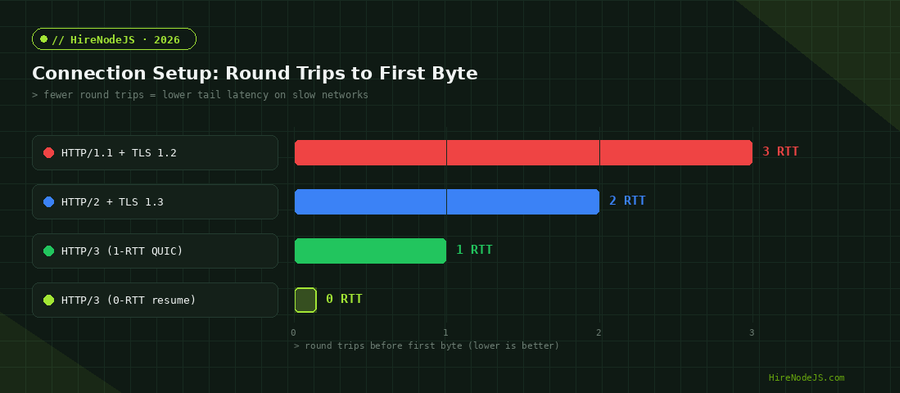
HTTP/3 replaces TCP with QUIC, a transport built on UDP that implements its own reliability, ordering, and congestion control in user space. Because streams are independent at the transport layer, a lost packet only stalls the one stream it belongs to — the other streams keep flowing. TLS 1.3 is baked directly into the QUIC handshake rather than layered on top, which is how HTTP/3 collapses connection setup down to a single round trip, or zero round trips when resuming a known server.
Connection migration and 0-RTT
QUIC connections are identified by a connection ID rather than the classic IP-and-port four-tuple. That means a phone switching from Wi-Fi to cellular keeps the same QUIC connection alive instead of renegotiating from scratch — a genuine UX win on mobile. The trade-off to respect is 0-RTT early data: it is replayable under certain threat models, so you must limit it to idempotent, replay-safe requests and never to operations that mutate state.
Running HTTP/3 in Production with Node.js
The edge-termination pattern
Hire Pre-Vetted Node.js Developers
Skip the months-long search. Our exclusive talent network has senior Node.js experts ready to join your team in 48 hours.
Node.js v24+ ships stable QUIC primitives in the node:quic module, but the pragmatic 2026 pattern for most teams is still to terminate HTTP/3 at the edge — a CDN, Cloudflare, or an nginx 1.25+ build with QUIC enabled — and speak HTTP/2 from that proxy back to your Node origin. You get HTTP/3's client-facing benefits without putting an experimental UDP stack on your critical request path. The key is the Alt-Svc header, which advertises HTTP/3 availability so compatible browsers upgrade on their next visit.
// HTTP/3 termination is usually done at the edge today. A common, battle-tested
// pattern is to terminate QUIC at a reverse proxy and speak HTTP/2 (or h2c) to Node.
//
// nginx (1.25+) example — terminate HTTP/3, forward to the Node upstream:
//
//   server {
//     listen 443 quic reuseport;   # HTTP/3 over QUIC/UDP
//     listen 443 ssl;              # HTTP/2 + HTTP/1.1 fallback over TCP
//     http3 on;
//     ssl_certificate     /etc/ssl/site.pem;
//     ssl_certificate_key /etc/ssl/site.key;
//     add_header Alt-Svc 'h3=":443"; ma=86400';  # advertise HTTP/3 to clients
//     location / { proxy_pass http://127.0.0.1:8443; }
//   }

// In Node itself you keep an ordinary HTTP/2 origin. The Alt-Svc header is what
// tells browsers "you may upgrade to HTTP/3 next time":
import http2 from 'node:http2';
import { readFileSync } from 'node:fs';

const origin = http2.createSecureServer({
  key: readFileSync('./certs/key.pem'),
  cert: readFileSync('./certs/cert.pem'),
});

origin.on('stream', (stream) => {
  stream.respond({
    ':status': 200,
    'alt-svc': 'h3=":443"; ma=86400',
    'content-type': 'application/json',
  });
  stream.end(JSON.stringify({ upgraded: true }));
});

origin.listen(8443);
UDP is a first-class operational concern now
HTTP/3 runs on UDP port 443, which means firewalls, security groups, and load balancers that only ever forwarded TCP need explicit UDP rules. Many corporate networks still throttle or block UDP, so HTTP/3 must always degrade gracefully to HTTP/2. This is squarely DevOps territory — getting QUIC, Alt-Svc, and fallback behaviour right across your edge is infrastructure work, not just application code.
Performance: What the Numbers Actually Show
Read the benchmarks honestly
On a fast, stable connection, swapping HTTP/2 for HTTP/3 buys you a small single-digit-percentage improvement — real, but not transformative. The story changes on degraded networks. As packet loss climbs, HTTP/2 page loads inflate sharply because of TCP head-of-line blocking, while HTTP/3 stays comparatively flat. The interactive charts above model exactly this divergence. The honest takeaway is that HTTP/3 is a tail-latency and reliability investment, not a throughput silver bullet.
Where it pays off most
If your traffic skews mobile, international, or otherwise high-latency, HTTP/3 is one of the highest-leverage performance changes available in 2026. For internal service-to-service traffic on a reliable data-center network, HTTP/2 remains the sensible default and gRPC over HTTP/2 is still the workhorse. Knowing which protocol belongs where is core Node.js performance judgment.
Migration Strategy and Operational Gotchas
A staged rollout that can't hurt you
The safe migration order is: stabilise an HTTP/2 origin first, enable HTTP/3 at the edge with an Alt-Svc advertisement, verify fallback to HTTP/2 works when UDP is blocked, then watch your tail-latency metrics by network type. Because Alt-Svc is opt-in per client and degrades to HTTP/2 automatically, you can roll HTTP/3 out to a fraction of traffic and expand with confidence. Nothing about the upgrade requires touching your application handlers.
Observability has to follow the protocol
Once HTTP/3 is live, your logs and dashboards need to record the negotiated protocol per request, or you will be blind to which clients actually upgraded. Tag metrics with h1/h2/h3 and segment latency by network type. Without that, a regression that only affects HTTP/3 on cellular can hide inside a healthy-looking aggregate for weeks.
If you are rolling out HTTP/3 or tuning a high-throughput Node.js API and need engineers who have done it in production, HireNodeJS connects you with pre-vetted senior developers available within 48 hours — people who understand QUIC, edge termination, and the observability work that has to come with it, without the recruiter overhead.
Hire Expert Node.js Developers — Ready in 48 Hours
Building fast, resilient APIs is only half the battle — you need the right engineers to ship and operate them. HireNodeJS.com specialises exclusively in Node.js talent: every developer is pre-vetted on real-world projects, API design, transport-layer performance, and production deployments.
Unlike generalist platforms, our curated pool means you speak only to engineers who live and breathe Node.js. Most clients have their first developer working within 48 hours of getting in touch. Engagements start as short-term contracts and can convert to full-time hires with zero placement fee.
Conclusion: Where to Place Your Bets
HTTP/2 is your stable, built-in Node.js origin protocol and the correct default for internal and service-to-service traffic. HTTP/3 is the edge upgrade that delivers real, measurable wins for mobile and high-latency users by killing TCP head-of-line blocking and shrinking connection setup to one round trip or zero. In 2026 the migration is low-risk: terminate HTTP/3 at the edge, advertise it with Alt-Svc, keep HTTP/2 fallback, and let your tail-latency metrics tell you it worked.
The teams that get the most from this are the ones who treat the transport layer as a first-class engineering surface — measuring p99 by network type, guarding 0-RTT replay safety, and instrumenting the negotiated protocol. Do that, and HTTP/3 stops being a buzzword and becomes a quiet, durable advantage for everyone who uses your API on a less-than-perfect network.
Frequently Asked Questions
Does Node.js support HTTP/3 natively in 2026?
Node.js v24+ ships stable QUIC primitives in the node:quic module, but most teams still terminate HTTP/3 at the edge (CDN or nginx 1.25+) and run an HTTP/2 origin in Node. That gives you HTTP/3's client benefits without an experimental UDP stack on the critical path.
Is HTTP/3 actually faster than HTTP/2 for a Node.js API?
On a clean, fast network the difference is small — often around 12% faster time-to-first-byte. The real gains appear on lossy or high-latency mobile networks, where HTTP/3 avoids the TCP head-of-line blocking that inflates HTTP/2 tail latency.
Should I use HTTP/2 or HTTP/3 for service-to-service traffic?
For internal traffic on a reliable data-center network, HTTP/2 remains the sensible default, and gRPC over HTTP/2 is still the standard. Reserve HTTP/3 for client-facing edges where mobile and high-latency users dominate.
How do I enable HTTP/3 without rewriting my application?
Keep your existing HTTP/2 origin, terminate HTTP/3 at the edge, and add an Alt-Svc response header advertising h3. Browsers upgrade automatically on their next visit and fall back to HTTP/2 when UDP is blocked, so no handler code changes.
Is 0-RTT early data safe to use?
Only for idempotent, replay-safe requests. 0-RTT data can be replayed by an attacker, so restrict it to safe GETs and reject it for anything that writes, charges, or mutates state. Treat replay protection as a hard requirement.
What operational changes does HTTP/3 require?
HTTP/3 runs over UDP port 443, so firewalls, security groups, and load balancers need explicit UDP rules and a guaranteed HTTP/2 fallback. You should also tag logs and metrics with the negotiated protocol so you can segment latency by h1, h2, and h3.
Vivek Singh is the founder of Witarist and HireNodeJS.com — a platform connecting companies with pre-vetted Node.js developers. With years of experience scaling engineering teams, Vivek shares insights on hiring, tech talent, and building with Node.js.
Want a Node.js engineer who ships fast, optimised APIs?
HireNodeJS connects you with pre-vetted senior Node.js engineers who understand HTTP/3, QUIC, and transport-layer performance — available within 48 hours, no recruiter fees, no lengthy screening.