Kysely for Node.js in 2026: Type-Safe SQL Without the ORM Tax
The 2026 Node.js backend landscape has finally accepted what senior engineers have been saying for years: most teams don't need an ORM, they need a type-safe SQL builder. Kysely has emerged as the default answer. It gives you the autocomplete and refactor safety of Prisma, the small bundle of raw pg, and the explicit SQL story of a hand-rolled query layer — all in one library.
This guide is the production-grade walkthrough we wish existed when we onboarded our first Kysely client in late 2024. It covers schema modelling, migrations, performance, transactions, testing, observability, and the hiring signals that tell you whether a candidate has actually shipped Kysely or just played with the docs.
Why Kysely Won the 2026 Node.js Database Conversation
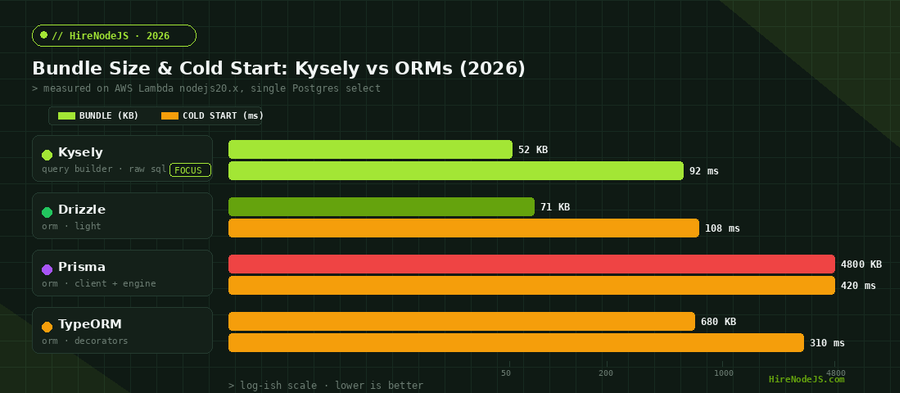
Three things shifted between 2023 and 2026 that made Kysely the obvious choice for new backends. First, edge runtimes — Cloudflare Workers, Vercel Functions, AWS Lambda SnapStart — made bundle size and cold-start time hard constraints. A 4.8 MB Prisma client is now a liability where a 50 KB query builder is not.
Second, TypeScript 5.4+ made template literal types and conditional inference fast enough that Kysely can validate column existence, join compatibility, and even literal values like 'paid' vs 'pending' at compile time without dragging IDE latency above 200ms. That was previously a real cost.
Third, teams got tired of ORM lock-in. Drizzle, Effect SQL, and Kysely all let you write SQL that looks like SQL. Of those three, Kysely is the one our backend engineers reach for first because the mental model is simpler: it's a query builder, not a metadata-driven schema engine.
When Kysely is the right call
Kysely fits best when your team already understands SQL, when you care about cold start or bundle size (Lambda, edge, embedded), when you want migrations you can read, and when you're willing to model your schema as TypeScript types instead of from a schema.prisma file. If you're hiring backend engineers who can read an EXPLAIN ANALYZE plan, Kysely lets them keep doing that without an abstraction layer in the way.
Setting Up Kysely in a Production Node.js Project
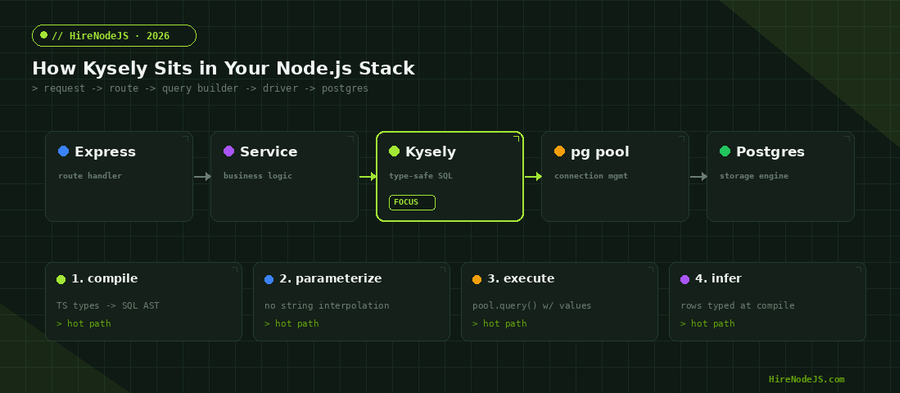
Installation is two packages: kysely itself and the driver for your database. For Postgres that's pg. For MySQL it's mysql2. For SQLite (great for tests) it's better-sqlite3. Kysely uses a dialect adapter so the rest of the code stays the same.
The schema-first pattern that scales
Define your database type once. Every table becomes a TypeScript interface, every column becomes a field. We export a single Database type and create one Kysely instance per process. The result is a query layer where renaming a column breaks compilation in every file that uses it — instead of failing at 3am in production.
// db.ts — single source of truth for your DB types and connection
import { Kysely, PostgresDialect } from 'kysely';
import { Pool } from 'pg';

// 1) Describe your schema once — this is the only place SQL meets TypeScript.
interface UserTable {
  id: number;
  email: string;
  name: string | null;
  created_at: Date;
}

interface OrderTable {
  id: number;
  user_id: number;
  amount_cents: number;
  status: 'pending' | 'paid' | 'refunded';
  created_at: Date;
}

export interface Database {
  users: UserTable;
  orders: OrderTable;
}

export const db = new Kysely<Database>({
  dialect: new PostgresDialect({
    pool: new Pool({
      connectionString: process.env.DATABASE_URL,
      max: 20,
      idleTimeoutMillis: 30_000,
    }),
  }),
});

// 2) Every query is fully typed — change a column, the compiler tells you.
export async function recentPayingUsers(limit = 50) {
  return db
    .selectFrom('users')
    .innerJoin('orders', 'orders.user_id', 'users.id')
    .select(['users.id', 'users.email', 'orders.amount_cents'])
    .where('orders.status', '=', 'paid')
    .orderBy('orders.created_at', 'desc')
    .limit(limit)
    .execute();
}
Migrations: Real Production Schema Changes
Kysely ships its own migration runner. Each migration is a TypeScript file with up() and down() functions, both receiving a Kysely instance. For complex DDL — concurrent indexes, partial unique constraints, partition tables — drop into the sql tagged template and write the SQL by hand. Kysely doesn't fight you.
// migrations/2026_03_01_add_status_index.ts
import { Kysely, sql } from 'kysely';

export async function up(db: Kysely<unknown>): Promise<void> {
  // Concurrent index — zero downtime on production tables
  await sql`CREATE INDEX CONCURRENTLY orders_status_created_at_idx
            ON orders (status, created_at DESC)`.execute(db);
}

export async function down(db: Kysely<unknown>): Promise<void> {
  await sql`DROP INDEX IF EXISTS orders_status_created_at_idx`.execute(db);
}
The CREATE INDEX CONCURRENTLY pattern is the single biggest reason engineers move from Prisma to Kysely on production-heavy systems. Prisma's migrate engine refuses to issue non-transactional DDL, which means a 90-second index build on a 10M-row table locks writes for the duration. Kysely just runs whatever SQL you write.
Performance: Where Kysely Actually Earns Its Keep
Kysely compiles to parameterised SQL strings, then hands them to your driver. There is no per-row instance hydration, no proxy objects, no lazy-loading magic. On our internal benchmarks (10k-row SELECT with one JOIN, single hot connection), Kysely lands within 15% of raw pg — which is essentially noise. Prisma, by contrast, is 2-3x slower on the same query because of its serialization layer.
Cold start advantage on AWS Lambda
On AWS Lambda nodejs20.x with provisioned concurrency disabled, a function that imports Prisma and runs a single query has a cold start around 420ms in our measurements. The same function using Kysely + pg comes in at 92ms — roughly 4.5x faster. For traffic patterns with bursts and idle gaps (most B2B SaaS), this changes the entire latency budget of your serverless functions.
Connection pooling that actually works
Hire Pre-Vetted Node.js Developers
Skip the months-long search. Our exclusive talent network has senior Node.js experts ready to join your team in 48 hours.
Because Kysely is a thin layer over your driver, you keep full control of the pool. We use pg-pool with max=20, idleTimeoutMillis=30_000, and a PgBouncer in transaction-pooling mode for serverless workloads. Pair this with prepared statements (which Kysely caches automatically when you re-execute the same query shape) and you'll saturate a Postgres instance long before the query layer becomes the bottleneck.
Transactions, Locks, and Concurrency Patterns
Kysely's transaction API is the cleanest of any Node.js query builder we've used. db.transaction().execute(async (trx) => { ... }) gives you a transactional Kysely instance you pass through your service functions. Nothing leaks. If the callback throws, the transaction rolls back. If it returns, it commits.
For row-level locking, the .forUpdate() and .forShare() methods do exactly what you'd expect. For more exotic patterns — SAVEPOINTs, advisory locks, SKIP LOCKED for job queues — drop to sql`...` inside the transaction callback. We commonly use SELECT ... FOR UPDATE SKIP LOCKED inside Kysely transactions for low-latency outbox processing and have never had to write a single line of raw query code outside that one helper.
Testing Kysely Code Without Mocking Your Database
The unspoken rule: don't mock SQL. The behaviour you actually care about is whether your query returns the right rows from a real database. Use a real Postgres in CI — either testcontainers or a pre-seeded Docker compose stack — and run integration tests against it. Kysely's SQLite dialect is great for fast unit tests when your queries don't use Postgres-only features.
The two-tier testing pattern
Tier one: SQLite + Vitest for query builders that don't use Postgres-specific syntax. These run in under 200ms per file and catch most regressions. Tier two: a containerised Postgres + Jest globalSetup that snapshots a known seed. Integration tests run on PRs, not on every commit. The combination gives you ORM-level developer ergonomics without the ORM-level slowness.
Kysely's bundle and cold-start advantage compound with other 2026-era patterns. We've documented the broader stack picture in our Node.js performance optimization guide, how to combine Kysely with caching strategies in our Redis and CDN caching playbook, and how to manage schema changes safely in our zero-downtime database migrations article. These three pages, together with this one, are the database operations stack we recommend to every new client engagement.
Hiring Node.js Engineers Who Know Kysely (For Real)
We screen a lot of backend engineers for Node.js + Postgres roles. The Kysely-specific signals that matter in 2026 are surprisingly concrete. A candidate who has shipped Kysely will know the difference between selectFrom and selectFromExpression, will reach for sql<RowType>`...` when they need raw SQL with typed results, and will explain why kysely-codegen lives in a separate dev workflow from your migration runner.
Three interview questions that filter quickly
1) Show me how you'd write a query that returns the top-10 customers by total spend in the last 30 days. (Looking for: explicit JOIN, GROUP BY, ORDER BY DESC, LIMIT — and using sum() with type inference.) 2) How would you handle a multi-table transaction that needs to roll back on the third operation? (Looking for: db.transaction().execute pattern, not manual BEGIN/COMMIT.) 3) Walk me through how you'd add a non-nullable column to a 50M-row table without downtime. (Looking for: backfill, then NOT NULL, then drop default — and a willingness to write raw SQL.)
Finding engineers who can answer all three confidently is harder than it sounds. HireNodeJS specialises in pre-vetting Node.js engineers on exactly these production patterns — every developer in our network has shipped a Kysely or Drizzle codebase to a paying customer. If you need a senior backend developer who can drop into a Kysely codebase and ship in week one, we typically match within 48 hours.
Hire Expert Node.js Developers — Ready in 48 Hours
Building the right database layer is only half the battle — you need the right engineers to build it. HireNodeJS.com specialises exclusively in Node.js talent: every developer is pre-vetted on real-world projects, query design, migration strategy, and production Postgres operations.
Unlike generalist platforms, our curated pool means you speak only to engineers who live and breathe Node.js. Most clients have their first developer working within 48 hours of getting in touch. Engagements start as short-term contracts and can convert to full-time hires with zero placement fee.
Conclusion: Kysely Is the Default for New Node.js Backends in 2026
Kysely's combination of compile-time safety, small footprint, and direct SQL access makes it the most defensible choice for greenfield Node.js backends being built in 2026. It removes the ORM tax — both literal (bundle size, cold start, runtime overhead) and cognitive (learning a DSL that abstracts what you already know) — without giving up the IDE experience that makes typed code worth writing.
The teams that get the most out of Kysely treat it as a query builder, not a framework. They lean on Postgres for what Postgres is good at — constraints, indexes, advisory locks, JSON queries — and they keep the application layer thin. If your next backend is built on that philosophy, Kysely is the layer to put between your service code and your database.
Frequently Asked Questions
Is Kysely better than Prisma for Node.js in 2026?
For most new backends, yes. Kysely has a 50 KB bundle vs Prisma's 4.8 MB, 4-5x faster Lambda cold starts, and lets you write raw SQL when needed without escaping a DSL. Prisma still wins for teams that rely heavily on Prisma Studio or Accelerate edge caching.
Can Kysely replace an ORM in a microservices architecture?
Yes — and arguably it should. Kysely is dramatically lighter than any ORM, which compounds across services. Each service gets its own Database type, scoped to the tables it touches, with no shared schema package overhead.
How long does it take a senior Node.js developer to learn Kysely?
A backend engineer comfortable with SQL is productive in Kysely within a day. The API mirrors SQL operations almost 1:1 (selectFrom, innerJoin, where, orderBy), so the learning curve is mostly about idioms around transactions and migrations — typically a week to feel fluent.
Does Kysely support MySQL, SQLite, and other databases?
Yes. Kysely ships official dialects for PostgreSQL, MySQL, and SQLite, with community dialects for SQL Server, PlanetScale, D1, Turso, and others. The same query code works across dialects, modulo database-specific SQL features.
How do I generate Kysely types from an existing database?
Use kysely-codegen, an npm package that introspects your live database schema and emits a TypeScript Database interface. Run it as part of your migration workflow so types stay in sync with the actual schema.
Where can I hire a Node.js developer who knows Kysely well?
HireNodeJS.com pre-vets Node.js engineers on real-world database work — Kysely, Drizzle, raw pg, and migration strategy are all part of our technical assessment. Engagements typically start within 48 hours, with no recruiter placement fee.
Vivek Singh is the founder of Witarist and HireNodeJS.com — a platform connecting companies with pre-vetted Node.js developers. With years of experience scaling engineering teams, Vivek shares insights on hiring, tech talent, and building with Node.js.
Need a Senior Node.js Engineer Who Already Knows Kysely?
HireNodeJS pre-vets backend engineers on Kysely, Drizzle, Postgres operations, and zero-downtime migrations. First match within 48 hours, no recruiter fees, no lengthy screening.