Node.js + LangChain: Building Production RAG Apps in 2026
In 2026, retrieval-augmented generation (RAG) is no longer a research toy — it's the most-shipped pattern for production LLM features. From customer-support assistants and internal knowledge bots to AI-powered search and code copilots, almost every company adding generative AI to their product is wrapping it around their own private data. And for a huge chunk of those teams, the runtime doing the orchestration is Node.js.
Node.js has become the default home for RAG for one obvious reason: most product backends already speak it. LangChain.js gives you a TypeScript-native way to chain embeddings, vector retrieval, prompt templates and LLM calls without dropping into Python — and the gap between the JS and Python ecosystems has all but closed. This guide is a practical, end-to-end playbook for building production RAG with Node.js and LangChain in 2026: the architecture, the code, the vector database choice, the cost math, and the operational gotchas teams keep hitting in real deployments.
What RAG Actually Solves (and Why Node.js Is the Right Runtime)
Out of the box, large language models hallucinate confidently about anything outside their training data — your product docs, your customer's order history, the contract your legal team wrote last week. Fine-tuning fixes a slice of that, but it's slow, expensive, and stale the moment your data changes. Retrieval-augmented generation takes a different route: keep the model frozen, look up the most relevant chunks of your data at query time, and stuff them into the prompt. The model becomes a fluent summariser of facts you control.
Where Node.js fits
RAG isn't a model-training problem — it's a backend integration problem. You're building an HTTP service that talks to a vector database, an embedding API, and an LLM, then streams tokens back over Server-Sent Events or WebSockets. That's a workload Node.js was designed for: high-concurrency, I/O-bound, JSON-everywhere. If your product backend is already Node, adding RAG without introducing a Python service is a real win for ops and hiring. If you're starting fresh, the same skills your team needs to ship a normal API — TypeScript, a framework like Fastify or NestJS, a job queue — are exactly the ones you need for RAG. Need that talent? hire experienced Node.js backend developers who already know the pattern.
When to use RAG vs. fine-tuning vs. just bigger context
Use RAG when your knowledge base changes often, when citations matter, or when the answer depends on per-tenant data. Use fine-tuning when you need style or format control, or to teach the model a domain language. Use a long-context call (200k+ tokens) only when the relevant data is small, static, and you can afford the per-call cost — in production it's almost always cheaper to retrieve.
Production RAG Architecture: The Two Pipelines
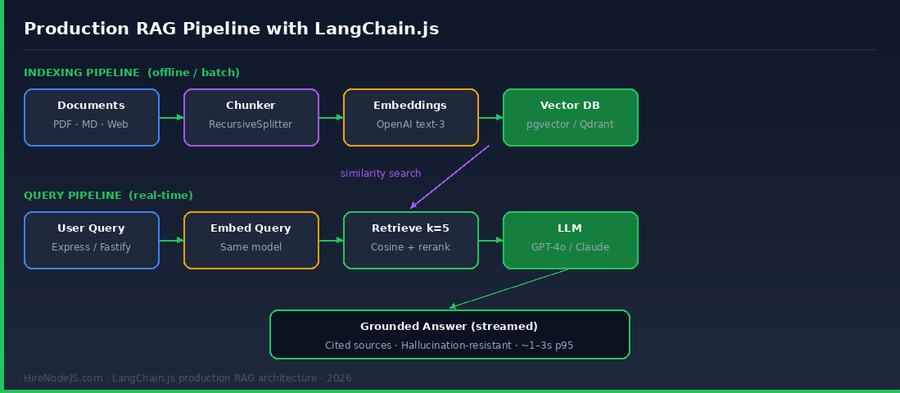
Every serious RAG system has the same two-pipeline shape. Indexing happens offline, on a schedule or triggered by document changes. Query happens in real time, behind your API. Mixing the two is the most common architectural mistake and the source of most latency complaints.
Indexing pipeline (offline)
Documents land in object storage or a CMS. A worker job — typically a BullMQ worker in Node.js — picks them up, splits them into chunks of roughly 800–1,200 tokens with overlap, calls the embedding API in batches of 100 inputs, and upserts the resulting vectors with metadata into your vector database. Make this idempotent on document hash: if a doc hasn't changed, skip the embedding spend.
Query pipeline (real-time)
A request hits your Fastify or Express endpoint. You embed the user query with the same model you used for the corpus, run a similarity search for the top-k chunks (k=4–10 in most apps), optionally rerank with a small cross-encoder, build a prompt that pins the LLM to those chunks, and stream the response back. End-to-end p95 in a healthy system is 1.5–3 seconds.
Choosing a Vector Database for Node.js in 2026
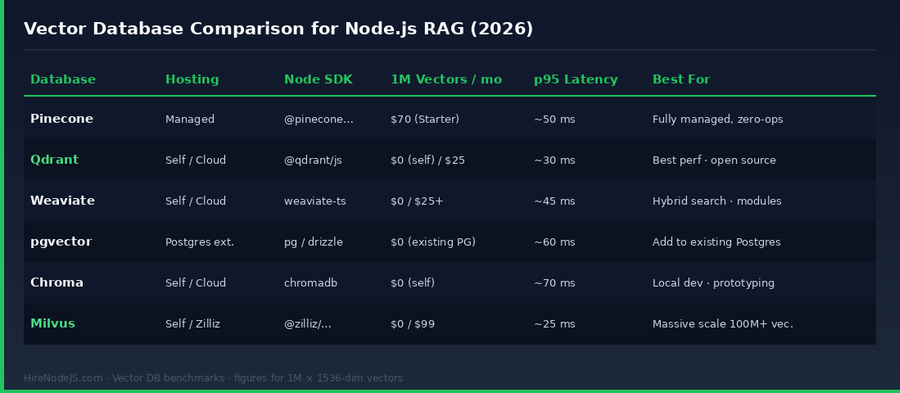
The vector DB market consolidated hard between 2024 and 2026. There are now five choices that matter for Node.js teams, and the right one depends on scale, hosting model, and what you already run. If you're already on Postgres — and you should be looking at engineers who can run Postgres at scale — pgvector is almost always the right starting point: zero new infrastructure, transactional consistency with the rest of your data, and 'good enough' performance up to roughly 5 million vectors.
When to graduate beyond pgvector
Move to Qdrant or Milvus when you cross ~10M vectors, when retrieval latency starts dominating your p95, or when you need advanced features like multi-vector documents, payload filtering at scale, or hybrid sparse/dense search. Both have first-class TypeScript SDKs and run cleanly in Kubernetes — Qdrant's footprint is smaller, Milvus scales further but takes more ops effort.
Managed services worth paying for
Pinecone remains the default for teams who want zero infrastructure overhead and are happy paying $70+/month for the convenience. Weaviate Cloud is a strong runner-up with stronger hybrid-search semantics. Avoid running any of these on a single VM in production — vector DBs need either a managed service or a real Kubernetes setup with proper persistent volumes and replication.
Building the Pipeline with LangChain.js
LangChain.js gets criticised for being heavy, but in 2026 the core RAG primitives — document loaders, splitters, vector store adapters, retrievers, and the LCEL expression language — are actually the cleanest part. The trick is to not import the kitchen sink: pull only the modules you need, keep prompts in your own files, and resist the urge to wrap everything in 'agents' for a workload that's really just retrieve-then-generate.
Hire Pre-Vetted Node.js Developers
Skip the months-long search. Our exclusive talent network has senior Node.js experts ready to join your team in 48 hours.
A minimal but production-shaped example
Below is a complete TypeScript implementation of the query side of a RAG pipeline using LangChain.js, pgvector, and OpenAI. It streams tokens, includes retrieval reranking via metadata filters, and pins the model to the retrieved context with a strict system prompt. This is the pattern we see in real production codebases at HireNodeJS clients.
import { ChatOpenAI } from "@langchain/openai";
import { OpenAIEmbeddings } from "@langchain/openai";
import { PGVectorStore } from "@langchain/community/vectorstores/pgvector";
import { ChatPromptTemplate } from "@langchain/core/prompts";
import { RunnableSequence } from "@langchain/core/runnables";
import { StringOutputParser } from "@langchain/core/output_parsers";
import { formatDocumentsAsString } from "langchain/util/document";

const embeddings = new OpenAIEmbeddings({
  model: "text-embedding-3-small", // 1536 dim, $0.02 / 1M tokens
});

const vectorStore = await PGVectorStore.initialize(embeddings, {
  postgresConnectionOptions: { connectionString: process.env.DATABASE_URL! },
  tableName: "doc_chunks",
  columns: { idColumnName: "id", vectorColumnName: "embedding",
             contentColumnName: "content", metadataColumnName: "metadata" },
});

const retriever = vectorStore.asRetriever({
  k: 6,
  // tenant isolation — always filter by org in multi-tenant RAG
  filter: { org_id: "org_abc" },
});

const prompt = ChatPromptTemplate.fromTemplate(`
You are a helpful assistant. Answer ONLY using the context below.
If the answer is not in the context, say "I don't know based on the
provided documents." Cite source IDs in [brackets].

Context:
{context}

Question: {question}
`);

const llm = new ChatOpenAI({
  model: "gpt-4o-mini",
  temperature: 0,
  streaming: true,
});

export const ragChain = RunnableSequence.from([
  {
    context: async (input: { question: string }) => {
      const docs = await retriever.invoke(input.question);
      return formatDocumentsAsString(docs);
    },
    question: (input: { question: string }) => input.question,
  },
  prompt,
  llm,
  new StringOutputParser(),
]);

// Use it from a Fastify route — stream tokens to the client
// for await (const chunk of await ragChain.stream({ question })) {
//   reply.raw.write(`data: ${JSON.stringify({ chunk })}\n\n`);
// }
Chunking and Embedding: The 80% That Decides Quality
RAG quality is decided more by your chunking and embedding choices than by the LLM you pick. Most failed RAG demos are not failures of the model — they're failures to retrieve the right chunk. Get this layer right and a smaller, cheaper model often beats a flagship one with bad retrieval.
Chunk sizing rules of thumb
Aim for 800–1,200 tokens per chunk with 100–200 tokens of overlap. Smaller chunks (200–400 tokens) work better for dense FAQ-style data; larger chunks (1,500–2,000 tokens) work better for long-form documentation where context matters. Always split on semantic boundaries — paragraphs, headings, code blocks — not raw character counts. RecursiveCharacterTextSplitter from LangChain.js handles this well if you give it a sensible separators list.
Embedding model selection
In 2026 the default for English content is OpenAI text-embedding-3-small at 1536 dimensions — cheap, fast, and good enough for almost everything. Step up to text-embedding-3-large only when retrieval recall is genuinely hurting. For multilingual content, Cohere embed-v4 is the strongest open choice. For private deployments, BGE-M3 self-hosted on a GPU pod is now production-grade.
Cost, Latency, and the Operational Gotchas Nobody Warns You About
Cost is dominated by output tokens, not embeddings
New teams worry about embedding costs. They shouldn't — at $0.02 per million tokens, embedding a million-document corpus costs about $20. The real bill is on the LLM call: an answer that streams 400 tokens through GPT-4o costs roughly $0.008 per query, which means 1,000 queries is $8, and a million queries is $8,000. Pick your model carefully and consider GPT-4o-mini or Claude Haiku 4.5 for any answer where you don't strictly need the flagship.
Latency is dominated by the LLM, not retrieval
In a healthy RAG system, retrieval is 30–80 ms and embedding the query is another 50–100 ms. The LLM call is 800–2,500 ms. Optimising your vector DB to shave 10 ms while you're using GPT-4o is rearranging deck chairs. Streaming first tokens to the client immediately, and caching repeated queries with a Redis layer keyed on the embedding hash, are the highest-ROI latency wins.
Multi-tenancy is a first-class concern
Every multi-tenant RAG system needs strict per-tenant filtering at the vector DB layer. Never assume the LLM will respect 'don't reveal data from other customers' in the prompt — it won't. Store an org_id in metadata on every chunk and make it a required filter in your retriever. A leak here is a P0 incident.
Hire Expert Node.js Developers — Ready in 48 Hours
Building production RAG is half the battle — you also need engineers who've shipped Node.js backends, vector databases, and LLM pipelines under real production load. HireNodeJS.com specialises exclusively in Node.js talent: every developer is pre-vetted on real-world projects covering API design, event-driven architecture, vector search, and LangChain.js / LlamaIndex production deployments.
Unlike generalist platforms, our curated pool means you speak only to engineers who live and breathe Node.js. Most clients have their first developer working within 48 hours of getting in touch. Engagements start as short-term contracts and can convert to full-time hires with zero placement fee.
Summary: Ship RAG That Actually Works in Production
Production RAG with Node.js and LangChain.js comes down to a small number of high-leverage decisions: a clean two-pipeline architecture, the right vector database for your scale, disciplined chunking, the cheapest model that meets your quality bar, and strict per-tenant isolation. Get those right and you have a system that costs cents per user, answers in under three seconds, and stops hallucinating because the answer is grounded in your own data.
The teams shipping the most successful AI features in 2026 aren't the ones using the most exotic frameworks — they're the ones treating RAG as a backend engineering problem. Solid HTTP plumbing, good observability, idempotent indexing jobs, and ruthless cost discipline. None of that requires Python, a research lab, or a six-month migration. It requires the kind of senior Node.js engineer who has shipped real services at real scale — and that's exactly the talent pool HireNodeJS exists to give you instant access to.
Frequently Asked Questions
Can I build production RAG with Node.js or do I need Python?
Node.js is fully production-ready for RAG in 2026. LangChain.js, LlamaIndex.TS, and first-class TypeScript SDKs from every major vector database and LLM provider mean you can ship the entire pipeline — indexing, retrieval, and streaming generation — without a Python service. For most product backends, staying in Node.js is simpler operationally and easier to hire for.
Which vector database should I use with Node.js in 2026?
If you already run Postgres, start with pgvector — zero new infrastructure and good enough to about 5M vectors. For higher scale or lower latency, Qdrant is the strongest open-source pick with an excellent TypeScript SDK. Pinecone remains the default for teams who want a fully managed service with no ops overhead.
How much does a typical RAG system cost to run?
Embedding a 1-million-chunk corpus costs roughly $20 with text-embedding-3-small. The recurring cost is the LLM: about $0.008 per query with GPT-4o-mini and around $0.08 with GPT-4o. For most consumer-scale apps, total monthly RAG cost lands between $200 and $2,000.
How do I handle multi-tenant isolation in RAG?
Store an org_id (or tenant_id) in the metadata of every embedded chunk and make it a required filter on every retriever call. Never rely on the LLM prompt alone to enforce tenant boundaries — the filter must happen at the vector database layer before the model ever sees the context.
Should I use LangChain.js or build the pipeline from scratch?
For most teams, LangChain.js is worth the dependency. The retriever, splitter, and vector-store adapters save real time and the LCEL composition model is clean. Build from scratch only if you have unusual requirements (custom retrieval algorithms, specialized rerankers) or want to keep the dependency footprint minimal.
How do I hire Node.js engineers who have shipped RAG in production?
Look for engineers with hands-on experience across the full stack — Node.js backend, a vector database, an embedding model, and an LLM provider. HireNodeJS pre-vets developers specifically for these production AI workloads and can place a senior engineer on your project within 48 hours.
Vivek Singh is the founder of Witarist and HireNodeJS.com — a platform connecting companies with pre-vetted Node.js developers. With years of experience scaling engineering teams, Vivek shares insights on hiring, tech talent, and building with Node.js.
Need a Node.js engineer who's shipped RAG in production?
HireNodeJS connects you with pre-vetted senior Node.js engineers who have built real LangChain.js pipelines, vector search, and LLM-powered features. Available within 48 hours — no recruiter fees.