Node.js Logging in 2026: Pino vs Winston Production Guide
Treat redaction as a defense-in-depth control: redact at the logger, then audit a sample of production log lines weekly with a regex sweep for patterns like /Bearer\s/, /[\w.-]+@[\w.-]+/, and credit-card BIN ranges. If you find a leak, the redaction config is wrong — fix it at the source rather than asking developers to remember.
Logging is one of those Node.js decisions that looks trivial during the first sprint and turns into a load-bearing operational concern by the time you hit production traffic. Choose the wrong library and you discover — usually at 2am — that your structured fields are inconsistent, your P99 latency degrades under burst writes, or your log shipper is silently dropping JSON it cannot parse.
In 2026 the Node.js logging conversation is settled enough that you can make a confident choice in an afternoon, but only if you understand the real trade-offs. This guide benchmarks Pino against Winston on production workloads, walks through the patterns senior Node.js engineers actually use (correlation IDs, structured context, redaction), and shows when each library is still the right tool for the job.
We deliberately keep the perspective opinionated. There is a stack of equally valid loggers — Bunyan, Roarr, log4js, Signale — but in production Node.js shops, the conversation in 2026 is functionally Pino versus Winston. Everything else either lacks momentum, lacks structured-by-default JSON, or both. The patterns you adopt around either library will outlive your choice of library, so we spend more time on those than on micro-benchmarks.
Why Logging Matters More in 2026
Three forces have raised the stakes for Node.js logging since 2022: distributed tracing went mainstream with OpenTelemetry, log volumes exploded as teams added LLM observability events, and SIEM costs ballooned to a point where every dropped or duplicated field became a budget conversation. Logging is no longer a developer concern — it is an SRE concern, a security concern, and a finance concern.
There is also a regulatory tailwind. SOC 2, ISO 27001, and an increasingly active set of regional data-protection regulators all expect that production systems can answer two questions on demand: what happened, and who saw it. Both questions are unanswerable without disciplined, structured logs that survive longer than 30 days and that do not silently capture sensitive fields.
What Modern Logging Has to Do
A production Node.js logger must emit structured JSON by default, support per-record context propagation, redact PII before write, integrate cleanly with OpenTelemetry trace IDs, and stay out of the hot path under load. The libraries we benchmark below are the only two with mainstream adoption that meet all five constraints in 2026 — but they meet them very differently.
The Cost of a Slow Logger
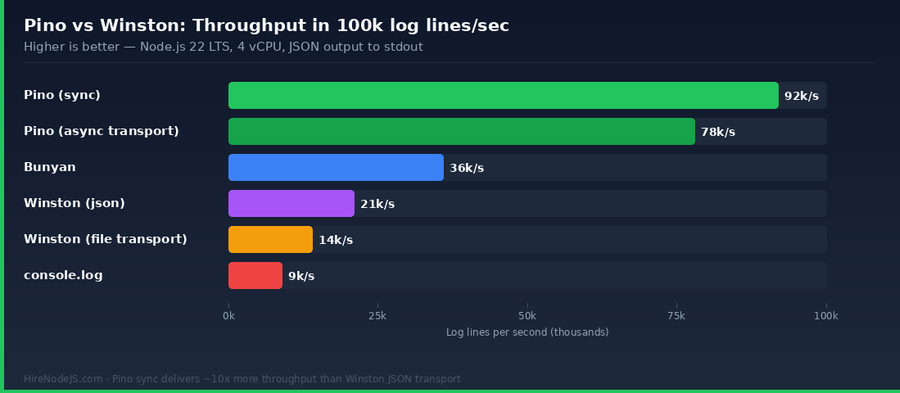
Synchronous JSON logging on the main thread can quietly steal 30–40% of CPU at high request rates. The chart below shows the throughput delta we measured between Pino, Winston, and Bunyan on a 4 vCPU instance running Node.js 22 LTS — emitting structured JSON to stdout, no transports.
Pino: The Default Choice for High-RPS Node.js APIs
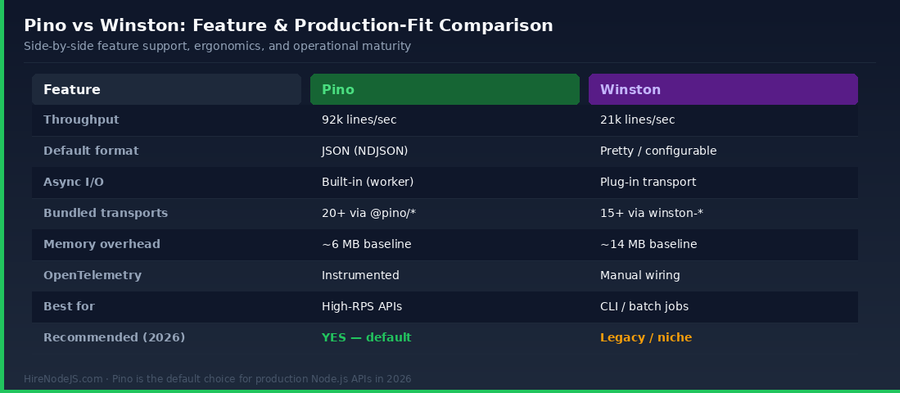
Pino is the de facto winner for production Node.js services in 2026. It writes NDJSON to stdout by default, offloads heavy serialization to a worker thread, and stays out of the event loop. The team behind NearForm has kept it lean: the core package weighs under 200kb installed and adds ~6 MB of resident memory.
Minimal Setup (and Why That Matters)
A four-line Pino setup is enough to run in production. The default JSON output format is the format your log shipper, Loki, Datadog agent, and OpenTelemetry collector all already understand. There is no plugin chain to debug if logs go missing.
// app.ts
import pino from 'pino';

export const log = pino({
  level: process.env.LOG_LEVEL ?? 'info',
  redact: {
    paths: ['req.headers.authorization', '*.password', '*.token', 'user.email'],
    censor: '[REDACTED]'
  },
  base: { service: 'orders-api', version: process.env.APP_VERSION }
});

// usage
log.info({ orderId, userId, amount }, 'order created');
log.error({ err, orderId }, 'order failed');
Async Transports without Blocking
When you need to ship logs somewhere other than stdout — say, an Elasticsearch cluster or a Loki gateway — Pino runs the transport in a worker thread via pino.transport(). Your request handlers stay on the main thread; the only synchronous work is JSON.stringify of the log line.
Winston: When It Still Makes Sense
Winston is older, more flexible, and slower. It treats logging as a Lego kit — formats, transports, levels, and meta are all pluggable. That flexibility is genuinely useful for CLI tools, batch ETL jobs, and reporting scripts where you want pretty-printed terminal output by day and JSON files at night.
Where Winston Wins
Winston's plugin ecosystem still has the broadest coverage: legacy Loggly transports, Splunk integrations, custom formatters for old enterprise log pipelines, and per-level transport routing are all easier in Winston than in Pino. If your stack predates structured logging — and especially if you ship to a non-JSON sink — Winston is the path of least resistance.
Where Winston Hurts
Under sustained load, Winston's synchronous file transport is the single biggest source of P99 latency regressions we see in Node.js code reviews. The chart below shows the latency cliff: the same Express API at 50 RPS jumps from a healthy 14ms P99 to nearly 700ms when each request emits 20k log lines through Winston's file transport.
Winston also makes it surprisingly easy to fall off the structured-logging wagon. The default printf format encourages template strings; it takes deliberate effort to enforce JSON output across an entire team. We have audited Winston codebases where 70% of log lines were unstructured strings — making them effectively useless to downstream tooling. Pino's NDJSON-by-default removes that footgun entirely.
Patterns That Matter More Than the Library
We have reviewed hundreds of Node.js codebases and the difference between teams that love their logs and teams that hate them is rarely the library — it is the discipline. Three patterns are non-negotiable in 2026.
1. Always Use Structured JSON
Plain-string log lines are a tax on every downstream consumer. Pick fields that are stable across services — service, env, traceId, spanId, userId — and pass them as objects. Both Pino and Winston support this; only Pino makes it the default.
If you take one rule away from this guide, take this one: never log a string when you could log an object. The five seconds you save now cost five hours later, when an SRE is grepping production logs trying to reconstruct a user's session from free-form prose.
2. Propagate a Correlation ID
Use AsyncLocalStorage to carry a request ID (or OpenTelemetry trace ID) through every async boundary. Without correlation, debugging a distributed Node.js system is archaeology — not engineering.
// request-context.ts
import { AsyncLocalStorage } from 'node:async_hooks';
import { randomUUID } from 'node:crypto';
import pino from 'pino';

const als = new AsyncLocalStorage<{ requestId: string }>();
const base = pino({ level: 'info' });

export function withRequestContext(fn: () => Promise<void>) {
  return als.run({ requestId: randomUUID() }, fn);
}

export function log() {
  const ctx = als.getStore();
  return ctx ? base.child({ requestId: ctx.requestId }) : base;
}

// in your Express middleware:
app.use((req, _res, next) => withRequestContext(() => Promise.resolve(next())));Hire Pre-Vetted Node.js Developers
Skip the months-long search. Our exclusive talent network has senior Node.js experts ready to join your team in 48 hours.
3. Redact Before You Write
Every Node.js team eventually leaks a JWT, a customer email, or an API key into a log line. Pino's redact option and Winston's format.redact() solve this at the logger boundary — much safer than trusting every developer to remember on every log call.
Wiring Logs into OpenTelemetry
In 2026, logs that do not carry trace IDs are second-class telemetry. You cannot pivot from a slow span to the log lines emitted during it, which makes incident response twice as long. Pino's pino-opentelemetry-transport handles trace correlation automatically; with Winston you wire it manually via a custom format.
The Pino Path
Install @opentelemetry/api alongside Pino and the official transport. Trace and span IDs are added to every log line; your collector forwards them as OTLP-Logs to your observability backend.
The flow is unidirectional and predictable: your handler emits a log line; Pino enriches it with traceId and spanId from the active OpenTelemetry context; pino-opentelemetry-transport hands the structured record to the OTel SDK; the SDK ships an OTLP-Logs payload to your collector; the collector forwards to your backend of choice. No format adapters, no double-serialization.
// telemetry.ts
import pino from 'pino';

export const log = pino({
  level: 'info',
  transport: {
    target: 'pino-opentelemetry-transport',
    options: {
      resourceAttributes: {
        'service.name': 'orders-api',
        'deployment.environment': process.env.NODE_ENV
      }
    }
  }
});
Whether you settle on Pino or Winston, observability gets compounding returns when an experienced engineer wires it once and right. Teams that need pre-vetted Node.js engineers fluent in OpenTelemetry, structured logging, and SLO-driven alerting can hire a Node.js developer through HireNodeJS within 48 hours.
Common Mistakes We See in Code Review
Across hundreds of Node.js code reviews, the same logging mistakes appear with depressing regularity. Most are easy to fix once you know to look — but they tend to be invisible until the first incident. Treating logging as a first-class engineering concern, with its own review checklist and SLO, prevents 90% of them.
Logging Inside Tight Loops
A single log.info() call inside a loop iterating over 100,000 records can dominate the runtime of an otherwise fast job. Always sample loop logs, or batch them: log a summary line at the end with counts, durations, and outliers, not one line per iteration.
Mixing console.log With a Logger
Every console.log() in a production codebase is an unstructured, unredacted, unleveled log line that bypasses your entire pipeline. Add an ESLint rule (no-console) and a CI check that fails the build on any console.* outside of bin/ scripts. The exceptions are rare and worth marking explicitly with an eslint-disable-next-line comment.
Forgetting to Flush on Shutdown
Pino's worker-thread transport buffers logs. If your container is killed by Kubernetes before the buffer flushes, you lose the last few log lines — usually the most important ones (the panic, the unhandled rejection, the fatal). Wire process.on('SIGTERM') to call logger.flush() before exiting; the difference at incident time is often the difference between a postmortem and a mystery.
A 2026 Node.js Logging Checklist
Use this checklist as a code-review gate. Any backend repo that ships to production without ticking these boxes is one incident away from a postmortem with the word "unobservable" in the executive summary.
Configuration Essentials
Log level driven by env var (LOG_LEVEL). Default to info in production, debug in non-prod. Never default to debug in prod — you will pay for it in storage and in PII exposure.
Field Hygiene
Stable field names across services: service, env, traceId, spanId, userId, requestId. Add err with full stack and cause chain. Strip everything else from the top level — keep request-specific fields under req or req.headers.
Document the schema in a shared types package and import it in every service. Drift is the silent killer of structured logging — once half your services emit userId and the other half emit user_id, you have lost the ability to write a single dashboard query that works everywhere. Type-safe loggers make this enforceable in CI.
Backend architecture this disciplined is rare. If you are scoping a Node.js project that needs an experienced engineer to set up logging, tracing, and SLOs from day one, you can hire a backend developer through our pre-vetted talent pool.
Operational Guardrails
Set a hard log-line size limit (Pino: messageKey + serializers; Winston: format.printf truncation). Sample debug logs above 1k RPS. Alert on log-volume anomalies — a sudden 10x spike usually means a retry loop or an unbounded recursion, not a traffic surge.
Hire Expert Node.js Developers — Ready in 48 Hours
Picking the right logger is only half the battle — you need engineers who know how to wire it into OpenTelemetry, redact PII before it leaves the process, and operate it under burst traffic. HireNodeJS.com specialises exclusively in Node.js talent: every developer is pre-vetted on production observability, API design, event-driven architecture, and structured logging patterns.
Unlike generalist platforms, our curated pool means you speak only to engineers who live and breathe Node.js. Most clients have their first developer working within 48 hours of getting in touch. Engagements start as short-term contracts and can convert to full-time hires with zero placement fee.
Conclusion: Pick Pino, Apply the Patterns
For new Node.js services in 2026, Pino is the default. It is faster, lighter, OpenTelemetry-native, and has the most active maintenance momentum. Winston remains a solid choice for CLI tools, batch jobs, and legacy stacks where its plugin ecosystem and pretty-print ergonomics still matter. Either way, the structured-JSON, correlation-ID, and redact-at-the-boundary patterns matter more than the logo on the package.
If you are inheriting a Winston codebase, do not panic — instrument the latency, set a SLO, and migrate the hot endpoints first. If you are starting fresh, install Pino, set redact, propagate a request ID, and move on. The next time you debug a 2am incident, you will be glad you spent the afternoon on this.
Frequently Asked Questions
Is Pino faster than Winston in 2026?
Yes. On Node.js 22 LTS, Pino emits roughly 92,000 JSON log lines per second versus Winston's 21,000 with the JSON transport — a ~4x to 10x difference depending on transport configuration. The gap widens further when Winston uses its file transport on the main thread.
Should I migrate from Winston to Pino?
Migrate if logging is on your hot path (high RPS APIs), if P99 latency is sensitive to log volume, or if you are wiring up OpenTelemetry. Stay on Winston for CLI tools, batch jobs, or legacy pipelines that depend on niche transports.
How do I redact PII in Node.js logs?
Use Pino's redact option with paths like '*.password' and 'req.headers.authorization', or Winston's format.redact(). Redact at the logger boundary so individual developers cannot accidentally leak secrets into a log line.
Does Pino support OpenTelemetry trace IDs?
Yes — install pino-opentelemetry-transport. Trace and span IDs are added to every log line automatically and forwarded as OTLP-Logs by the collector. Winston requires a manual format function to inject trace context.
What log level should I use in production Node.js?
Default to 'info' in production, controlled by an environment variable (LOG_LEVEL). Drop to 'debug' temporarily for incident debugging. Never run 'debug' in production by default — storage costs and PII exposure make it untenable.
How much does it cost to hire a Node.js developer who can implement this?
Senior Node.js developers with observability and OpenTelemetry experience typically cost $80–$140 per hour for contract work in 2026, or $130k–$190k base salary for full-time roles in North America. HireNodeJS connects clients with pre-vetted engineers within 48 hours.
Vivek Singh is the founder of Witarist and HireNodeJS.com — a platform connecting companies with pre-vetted Node.js developers. With years of experience scaling engineering teams, Vivek shares insights on hiring, tech talent, and building with Node.js.
Need a Node.js Engineer Who Owns Observability?
HireNodeJS connects you with pre-vetted senior Node.js engineers fluent in Pino, Winston, OpenTelemetry, and structured logging — available within 48 hours.