Node.js + MCP Servers in 2026: Build AI Tools That Scale
The Model Context Protocol (MCP) went from "interesting Anthropic experiment" in late 2024 to the de-facto integration standard for AI tools by 2026. If you build with Node.js, you are sitting on the most fertile runtime for shipping MCP servers — TypeScript-first SDK support, the largest ecosystem of API clients on npm, and first-class streaming via Node 22. Every host that matters (Claude Desktop, Claude Code, Cursor, VS Code Copilot, Zed, JetBrains AI Assistant) speaks MCP today.
This guide is a practical walkthrough of how MCP works under the hood, how to scaffold a production-grade Node.js MCP server, how to choose between stdio and HTTP/SSE transports, and how to ship something that handles auth, observability, and rate limits without falling over. If you eventually decide you need help, HireNodeJS connects you with senior Node.js engineers who have already shipped MCP servers in production.
What MCP Is — and What It Replaces
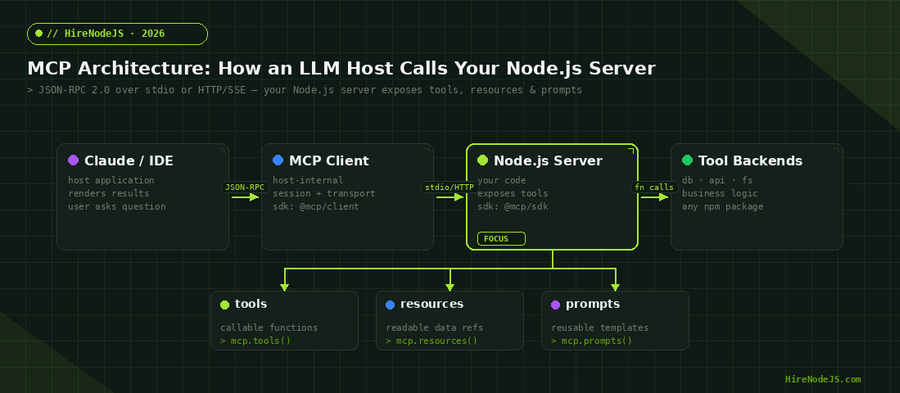
MCP is a JSON-RPC 2.0 specification that lets a host application (an AI assistant like Claude or an IDE like Cursor) connect to one or more servers that expose tools, resources, and prompts. The host's underlying LLM never talks to your code directly — instead, the host's MCP client mediates every call, parsing JSON-RPC messages, enforcing schemas, and rendering results.
Three primitives, one protocol
Tools are functions the model can decide to call ("search the database", "create a Linear issue"). Resources are read-only data the host can subscribe to ("the contents of this file", "this Postgres schema"). Prompts are reusable templates the user can invoke ("summarise this PR"). The whole surface is described in JSON Schema, so the model knows exactly what to send.
What MCP is not
MCP is not RAG, not a function-calling DSL specific to one model, and not a competitor to OpenAPI. It is closer in spirit to the Language Server Protocol — a uniform contract between a host and any number of pluggable backends. Build one MCP server, plug it into Claude Desktop today, Cursor tomorrow, and a custom enterprise host next quarter, with zero code changes.
Scaffold a Production Node.js MCP Server
The official @modelcontextprotocol/sdk package ships with TypeScript types, a stdio transport, an HTTP/SSE transport, and helpers for tool registration. You can have a working server in under 30 lines.
Install the SDK
Initialise a fresh package, install the SDK and Zod (for validating tool inputs), and enable strict TypeScript. Node 22 is the recommended runtime — earlier versions miss the WHATWG streams and structuredClone fixes the SDK relies on.
// 1. scaffold
mkdir nodejs-mcp-server && cd nodejs-mcp-server
npm init -y
npm install @modelcontextprotocol/sdk zod
npm install -D typescript tsx @types/node

// 2. tsconfig with NodeNext + strict
npx tsc --init --module nodenext --moduleResolution nodenext \
  --target es2022 --strict --esModuleInterop \
  --outDir dist --declaration true
A minimal but real server
The server below registers a single tool, search_docs, with a Zod-validated input schema. The host (Claude, Cursor, etc.) discovers it automatically the first time it connects.
import { Server } from "@modelcontextprotocol/sdk/server/index.js";
import { StdioServerTransport } from "@modelcontextprotocol/sdk/server/stdio.js";
import { CallToolRequestSchema, ListToolsRequestSchema } from "@modelcontextprotocol/sdk/types.js";
import { z } from "zod";

const SearchInput = z.object({
  query: z.string().min(1).max(500),
  limit: z.number().int().min(1).max(50).default(10),
});

const server = new Server(
  { name: "hirenodejs-docs", version: "1.0.0" },
  { capabilities: { tools: {} } }
);

server.setRequestHandler(ListToolsRequestSchema, async () => ({
  tools: [{
    name: "search_docs",
    description: "Search HireNodeJS documentation by query string.",
    inputSchema: {
      type: "object",
      properties: {
        query: { type: "string", description: "Free-text search query" },
        limit: { type: "integer", default: 10, minimum: 1, maximum: 50 },
      },
      required: ["query"],
    },
  }],
}));

server.setRequestHandler(CallToolRequestSchema, async (req) => {
  if (req.params.name !== "search_docs") throw new Error("unknown tool");
  const args = SearchInput.parse(req.params.arguments);
  const hits = await runSearch(args.query, args.limit); // your business logic
  return {
    content: [{ type: "text", text: JSON.stringify(hits, null, 2) }],
  };
});

const transport = new StdioServerTransport();
await server.connect(transport);
Choosing a Transport: stdio vs HTTP/SSE vs WebSocket
MCP's spec is transport-agnostic — the same JSON-RPC frames travel across whichever channel you pick. In practice the choice is binary: are you shipping a local CLI tool that the host spawns as a subprocess, or a hosted multi-tenant service that thousands of users connect to over the network?
stdio: zero config, single tenant
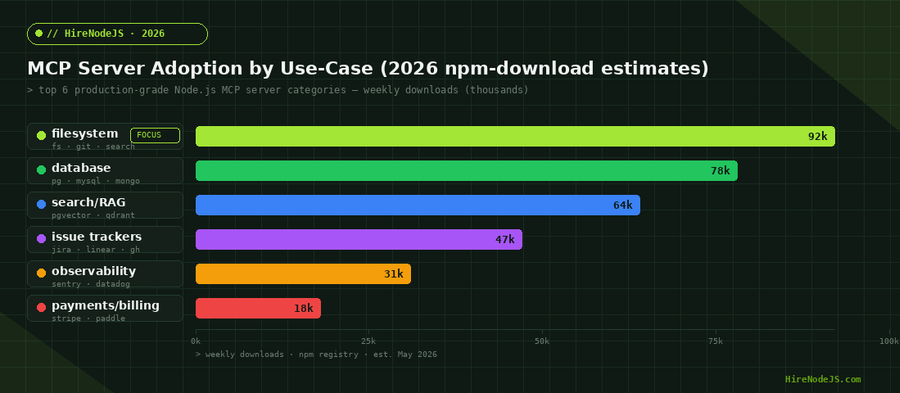
stdio is dead simple — the host launches your Node binary, you read JSON-RPC frames from stdin and write replies to stdout. No ports, no auth, no HTTPS to manage. This is the right transport for desktop integrations: filesystem servers, git wrappers, local Postgres clients. It is also single-tenant by definition — every user gets their own Node process.
HTTP/SSE: multi-tenant, hosted
When you want to centrally host an MCP server (think "a Stripe MCP server we operate so customers do not have to install anything"), HTTP with Server-Sent Events for streaming is the answer. Auth maps cleanly to OAuth 2.1 bearer tokens; you can put the server behind a CDN, terminate TLS at the edge, and scale horizontally.
Hire Pre-Vetted Node.js Developers
Skip the months-long search. Our exclusive talent network has senior Node.js experts ready to join your team in 48 hours.
WebSocket: niche but useful
A handful of hosts also support WebSocket transports for low-latency bidirectional streaming. Use it when the model genuinely needs progress notifications or partial results from long-running tools (e.g., a code-execution sandbox). Otherwise HTTP/SSE is simpler to operate.
Auth, Rate Limiting & Security
Hosted MCP servers are a fresh attack surface. The 2025 OWASP Top 10 for LLM Applications added "insecure tool execution" as one of the top risks — and MCP servers are precisely tool executors. Treat them like any other public API: bearer-token auth, per-tenant rate limits, structured logging, and a strict allowlist of side effects. The patterns from our Node.js security guide carry over almost unchanged.
OAuth 2.1 with bearer tokens
MCP's HTTP transport spec recommends OAuth 2.1 with PKCE. The host obtains an access token through the user-agent flow, then sends Authorization: Bearer <token> on every JSON-RPC call. Validate the token, hydrate a tenant context, and enforce row-level scoping on every database read.
Rate-limiting tools individually
Different tools have different cost profiles — a search tool might tolerate 100 calls/minute, a payments-creation tool should be locked down to 5/minute per tenant. Use Redis-backed token buckets (the same pattern from our API rate limiting guide) and key the bucket on tenant_id + tool_name. Surface 429s as MCP errors so the host can back off cleanly.
Observability — Tracing Every Tool Call
Every tool call should generate a span. We instrument with OpenTelemetry — wrap each handler, tag the span with tool.name, tenant.id, and the JSON-RPC request id, then export to Jaeger or Tempo. Without traces you cannot answer "why did the model call refund_payment three times in a row?". The detailed setup is in our Node.js + OpenTelemetry guide.
Structured logging — Pino + redaction
Use Pino with a redactPaths config that scrubs Authorization headers, API keys, and any field named token, secret, or password. MCP servers love to log inputs, and inputs love to contain secrets that downstream tools require.
import pino from "pino";

export const log = pino({
  level: process.env.LOG_LEVEL ?? "info",
  redact: {
    paths: [
      "req.headers.authorization",
      "req.headers.cookie",
      "*.password",
      "*.apiKey",
      "*.token",
    ],
    censor: "[REDACTED]",
  },
});Testing & CI for MCP Servers
Treat the JSON-RPC surface like any other API: write integration tests that boot the server, send list_tools and call_tool requests, and assert on the responses. Vitest plus the SDK's test transport gives you a tight inner loop without spinning up a real host.
Contract tests against the schema
Snapshot the JSON Schema your server advertises and assert that it never breaks backwards compatibility. Adding a new tool is a minor version bump; removing a field from an existing tool is a breaking change. We cover the broader testing rig in our Jest vs Vitest guide.
Hire Expert Node.js Developers — Ready in 48 Hours
Building an MCP server is the easy part. Operating one in production — with auth, observability, multi-tenancy, and the inevitable schema migrations — is where teams stall. HireNodeJS.com specialises exclusively in Node.js talent: every developer is pre-vetted on real-world API design, event-driven architecture, and production deployments — including AI-tool servers built on the Model Context Protocol.
Unlike generalist platforms, our curated pool means you speak only to engineers who live and breathe Node.js. Most clients have their first developer working within 48 hours of getting in touch. Engagements start as short-term contracts and can convert to full-time hires with zero placement fee.
Conclusion: MCP is the Quiet Standard of 2026
MCP is not glamorous, but it is the standard every major AI host has converged on — and Node.js is the runtime where most servers actually get built. A 30-line stdio server gets you onto Claude Desktop today; a hardened HTTP/SSE deployment with OAuth 2.1, OpenTelemetry, and per-tool rate limiting gets you onto thousands of customer machines tomorrow. The runtime, the SDK, and the npm ecosystem are all aligned in your favour.
Start small — pick one painful internal API, wrap it as an MCP server, ship it to your team. The patterns in this guide will scale from that first prototype all the way to a multi-tenant production deployment without a rewrite.
Frequently Asked Questions
What is the Model Context Protocol (MCP)?
MCP is an open JSON-RPC 2.0 specification that lets AI hosts (Claude, Cursor, IDEs) connect to external servers exposing tools, resources, and prompts. It is transport-agnostic and works over stdio, HTTP/SSE, or WebSockets.
Why use Node.js for MCP servers in 2026?
Node.js has the most mature MCP SDK, the largest npm ecosystem of API clients, and excellent streaming primitives in Node 22. Most production MCP servers shipped in 2025–2026 are TypeScript-on-Node.
Should I pick stdio or HTTP/SSE for my MCP server?
Use stdio for local, single-tenant tools the host launches as a subprocess (filesystem, git, local Postgres). Use HTTP/SSE when you want a hosted multi-tenant service with OAuth 2.1 auth and horizontal scaling.
How do I authenticate an MCP server?
For HTTP transports the spec recommends OAuth 2.1 with PKCE. The host obtains a bearer token via the user-agent flow and sends it on every JSON-RPC request. stdio servers run as the user, so they typically delegate auth to whatever credentials are already on disk.
Is MCP a replacement for OpenAPI or function calling?
No. MCP is closer to the Language Server Protocol — a uniform contract between AI hosts and tool providers. OpenAPI describes HTTP APIs, function-calling is model-specific. MCP unifies the AI-tool surface across hosts.
How do I hire a Node.js developer who has shipped MCP servers?
HireNodeJS.com vets engineers on production Node.js work, including AI-tool servers built on MCP. You can browse pre-vetted candidates and have a developer onboarded within 48 hours.
Vivek Singh is the founder of Witarist and HireNodeJS.com — a platform connecting companies with pre-vetted Node.js developers. With years of experience scaling engineering teams, Vivek shares insights on hiring, tech talent, and building with Node.js.
Need a Node.js engineer who has shipped MCP servers?
HireNodeJS connects you with pre-vetted senior Node.js developers — most have already shipped production AI-tool servers on the Model Context Protocol. Onboarded in 48 hours, no recruiter fees.