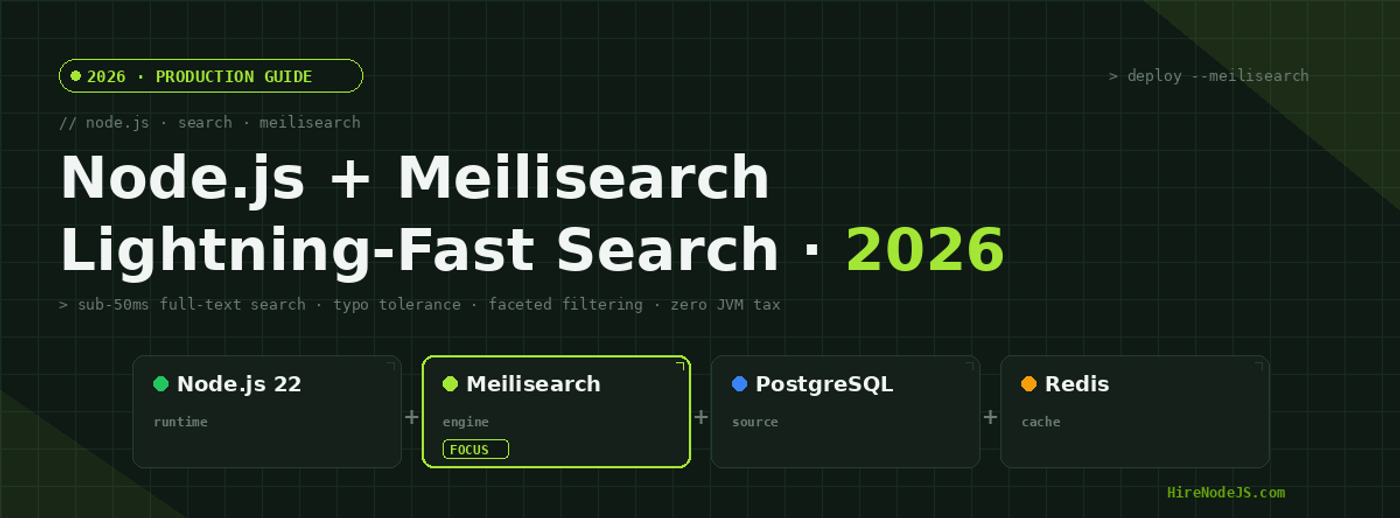
Node.js + Meilisearch in 2026: Lightning-Fast Search Guide
Search is one of those features that looks simple on the surface and then quietly eats engineering quarters. In 2026, Node.js teams have a clear winner for almost every use case under tens of millions of documents: Meilisearch. It is small, fast, written in Rust, and the JavaScript SDK is the kind that you fully understand in an afternoon.
This guide walks through everything a Node.js engineer needs to ship Meilisearch into production in 2026 — architecture, the SDK, syncing from Postgres or MongoDB, indexing strategy, typo tolerance, faceting, multi-tenant API keys, and the moments where you genuinely should reach for Elasticsearch instead. If you are scoping a project and would rather hire a Node.js developer with search experience than learn this yourself, that is fine too — but you will want to know the shape of what you are paying for.
Why Meilisearch Is Winning Search in 2026
Three things shifted between 2022 and 2026. First, Meilisearch crossed the 1.0 line and the API stopped breaking between minor versions. Second, Elasticsearch's licensing drama pushed teams to look at alternatives, and OpenSearch — while a valid fork — still drags around the JVM and the operational weight that goes with it. Third, the Meilisearch team shipped scoped tenant tokens, geo-search, vector search, federated multi-index search, and a competent Web Components UI in roughly that order. The feature gap that used to justify Elasticsearch has largely closed for app-search workloads.
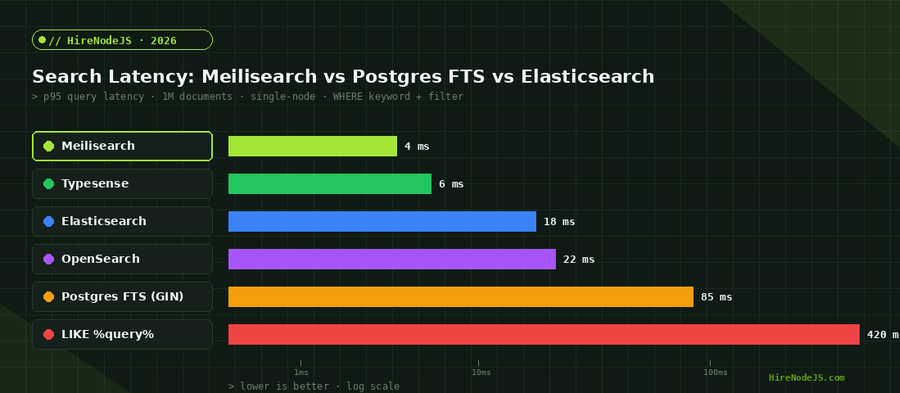
The practical effect: a single Meilisearch process on a $20/month VPS happily serves sub-10ms p95 latency for 5–10 million documents with one developer in charge. That is a different universe from running a 3-node Elasticsearch cluster with dedicated masters, hot/warm tiers, and a JVM heap that you tune until your eyes bleed.
The four traits that matter for app search
Meilisearch optimises for the boring 90% of search use cases: keyword queries with typo tolerance, faceted filtering, sorting, and prefix-matching for autocomplete. It does these four things harder and faster than anyone else, and it doesn't apologise for being less general than Elasticsearch. For a Node.js team shipping a SaaS product, that trade is almost always worth it.
Architecture: How Meilisearch Fits Into Your Node.js Stack
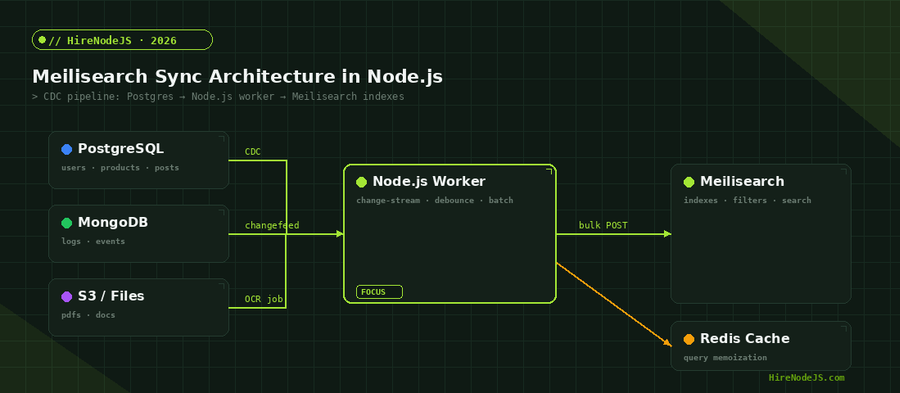
Meilisearch is never your database. It is a denormalised, query-optimised mirror of the subset of your data that users actually search. You keep Postgres (or MongoDB) as the source of truth and run a small Node.js worker that pipes changes into Meilisearch.
Three common ingestion patterns
Pattern one is dual-write: every time your API mutates a row, it also writes to Meilisearch. Simple, but you will eventually skew when the search call fails. Pattern two is outbox + worker: writes land in a Postgres outbox table, a worker drains it. This is the pattern most production Node.js teams settle on because it survives partial failures and lets you replay. Pattern three is change-data-capture using logical replication or a tool like Debezium — over-engineered for most teams under 25M documents.
Setting Up the Meilisearch Node.js SDK
The official meilisearch package ships first-class TypeScript types and a fully async/await API. If you are working in TypeScript — and in 2026, you should be — the developer experience is among the best of any search engine SDK. For deeper integration patterns we have also covered in our Node.js + TypeScript best practices guide.
Minimal viable client
// search/client.ts
import { MeiliSearch, type Index } from 'meilisearch'

const client = new MeiliSearch({
  host: process.env.MEILI_HOST!,         // e.g. http://meili:7700
  apiKey: process.env.MEILI_MASTER_KEY!, // use a scoped key in app code
  requestConfig: { timeout: 5_000 }
})

export type Product = {
  id: string
  name: string
  description: string
  brand: string
  price: number
  inStock: boolean
  tags: string[]
}

export const productsIndex: Index<Product> = client.index<Product>('products')

// Idempotent bootstrap — safe to run on every deploy
export async function ensureProductIndex() {
  await client.createIndex('products', { primaryKey: 'id' }).catch(() => {})
  await productsIndex.updateSettings({
    searchableAttributes: ['name', 'description', 'brand', 'tags'],
    filterableAttributes: ['brand', 'inStock', 'price', 'tags'],
    sortableAttributes:   ['price'],
    typoTolerance: { enabled: true, minWordSizeForTypos: { oneTypo: 4, twoTypos: 8 } },
    synonyms: { 'tee': ['t-shirt', 'tshirt'], 'sneakers': ['trainers'] },
    rankingRules: ['words', 'typo', 'proximity', 'attribute', 'sort', 'exactness']
  })
}
Indexing, Synonyms, and Typo Tolerance
Meilisearch's defaults are deliberately permissive: typo tolerance is on, prefix-matching is on, ranking is tuned for general relevance. Your job is to fine-tune the searchable attributes, filterables, sortables, and synonyms for your domain.
The searchable attributes order matters
The order of `searchableAttributes` is a ranking signal. Putting `name` before `description` tells Meilisearch that a hit in the product name beats a hit in the description text. Get this list right and you will rarely need to touch ranking rules.
Hire Pre-Vetted Node.js Developers
Skip the months-long search. Our exclusive talent network has senior Node.js experts ready to join your team in 48 hours.
Batch writes, not one-at-a-time
// search/sync.ts — debounced batch upserts from your outbox
import { productsIndex, type Product } from './client'

const BATCH = 1_000
const FLUSH_MS = 250

const queue: Product[] = []
let timer: NodeJS.Timeout | null = null

export function enqueue(p: Product) {
  queue.push(p)
  if (queue.length >= BATCH) return flush()
  timer ??= setTimeout(flush, FLUSH_MS)
}

async function flush() {
  if (timer) { clearTimeout(timer); timer = null }
  if (queue.length === 0) return
  const batch = queue.splice(0, BATCH)
  const task = await productsIndex.addDocuments(batch, { primaryKey: 'id' })
  // task is async on the Meilisearch side; await completion for tests, fire-and-forget in prod
  if (process.env.NODE_ENV === 'test') {
    await productsIndex.waitForTask(task.taskUid)
  }
}
Meilisearch's bulk endpoint is roughly 50× faster than per-document writes for the same payload. The pattern above buffers up to 1,000 documents or 250ms — whichever comes first — and is what we recommend in essentially every Node.js project we ship.
Filters, Facets, and Geo Search
Faceted search is what makes a search experience feel modern — the sidebar of brands, price ranges, and tags that narrows results as users click. Meilisearch handles facets natively and returns counts in the same response as the hits, so your backend developer doesn't need to make a second round trip.
Faceted query example
const result = await productsIndex.search('running shoes', {
  filter: ['brand IN [Nike, Adidas, Asics]', 'inStock = true', 'price < 200'],
  facets: ['brand', 'tags'],
  sort: ['price:asc'],
  limit: 24,
  attributesToHighlight: ['name', 'description'],
  highlightPreTag: '<mark>',
  highlightPostTag: '</mark>'
})

// result.facetDistribution → { brand: { Nike: 14, Adidas: 9, Asics: 3 }, tags: { ... } }
// Use this to render the sidebar checkboxes with live counts.
Geo search
If your documents have `_geo: { lat, lng }`, Meilisearch will sort by distance and filter by radius natively. No PostGIS required. This is one of the features that closed the gap with Elasticsearch in late 2024.
Production Hardening: Keys, Quotas, Backups
Once Meilisearch is running, the operational checklist is short but real. Generate scoped API keys per environment, restrict by index and action. Set up daily snapshots. Configure a max-payload size so a misbehaving client can't OOM the process. Monitor task queue depth. If you are running on Kubernetes, our Node.js on Kubernetes guide covers liveness probe patterns that work well for Meilisearch.
Scoped tenant tokens for multi-tenant SaaS
// Mint a per-tenant token in your auth/session route
import { generateTenantToken } from './client'

export async function tenantSearchToken(tenantId: string) {
  return client.generateTenantToken({
    searchRules: {
      products: { filter: `tenantId = "${tenantId}"` }
    },
    apiKey: process.env.MEILI_SEARCH_KEY!,
    expiresAt: new Date(Date.now() + 60 * 60 * 1000) // 1h
  })
}When Meilisearch Is the Wrong Choice
Meilisearch is excellent — but not for everything. There are three workloads where you should reach for Elasticsearch or OpenSearch instead. First, log analytics at petabyte scale: time-series search with aggregations across years of data is what Elasticsearch was built for. Second, complex relevance scoring with custom scripts: Elasticsearch's painless scripting and function_score queries have no equivalent in Meilisearch. Third, full-text search over very long documents (40+ pages each) where you need positional aggregations — Meilisearch handles long docs fine, but the relevance tuning is harder.
For everything else — product search, user search, document search, knowledge bases, customer support search — Meilisearch in 2026 is the default answer.
Hire Expert Node.js Developers — Ready in 48 Hours
Building a search-driven product is only half the battle — you need engineers who have shipped real search infrastructure before. HireNodeJS.com specialises exclusively in Node.js talent: every developer is pre-vetted on real-world Meilisearch, Postgres, and event-driven backend work.
Unlike generalist platforms, our curated pool means you speak only to engineers who live and breathe Node.js. Most clients have their first developer working within 48 hours of getting in touch. Engagements start as short-term contracts and can convert to full-time hires with zero placement fee.
Summary: Meilisearch Is the 2026 Default for Node.js Search
If you take one thing away: for any Node.js product where users type into a search box and expect results to appear before they finish typing, Meilisearch is the right starting point in 2026. It is fast, simple, deeply TypeScript-friendly, and operationally light enough that a single engineer can keep it running. The 90% of search workloads that used to justify a 3-node Elasticsearch cluster now run on a single Meilisearch process with money and engineering hours to spare.
Pair it with a clean outbox pattern, scoped tenant tokens, and a small batching worker, and you have search infrastructure that will carry you from your first 1,000 users to your first 10 million. And if you'd rather hand the build to an engineer who has done it before, HireNodeJS has a roster of Node.js developers who ship this exact stack every week.
Frequently Asked Questions
What is Meilisearch and how does it work with Node.js?
Meilisearch is an open-source search engine written in Rust that exposes a simple HTTP API. The official Node.js SDK gives you idiomatic async/await wrappers over indexing, search, and admin endpoints — most apps need fewer than 50 lines to wire it up.
How does Meilisearch compare to Elasticsearch for a Node.js backend?
Meilisearch ships sub-10ms query latency at the 1M-document scale with a 200MB binary and no JVM. Elasticsearch is more flexible at petabyte scale and supports advanced aggregations, but the operational overhead is far higher. For most Node.js apps under 50M documents, Meilisearch is faster, simpler, and cheaper.
Can I run Meilisearch alongside Postgres or do I have to replace my database?
Meilisearch is a search layer, not a primary database. You keep Postgres or MongoDB as your source of truth and sync changed rows into Meilisearch indexes — typically via change-data-capture, debounced writes, or a periodic worker.
Is Meilisearch production-ready in 2026?
Yes. The 1.x line is stable, used in production by companies like Bosch, Locale.ai and Codimite, and supports API keys with scoped permissions, snapshots, multi-tenant tokens, and ARM64 builds.
How much does Meilisearch cost compared to managed Elasticsearch?
Self-hosted Meilisearch runs comfortably on a $20/month VPS for tens of millions of documents. Meilisearch Cloud starts around $30/month. The same workload on managed Elasticsearch typically costs 3–10× more because of JVM memory requirements and replication overhead.
Where do I hire Node.js developers who know Meilisearch?
HireNodeJS connects you with pre-vetted senior Node.js engineers, many of whom have shipped Meilisearch and Typesense in production — typically available within 48 hours, no recruiter fees.
Vivek Singh is the founder of Witarist and HireNodeJS.com — a platform connecting companies with pre-vetted Node.js developers. With years of experience scaling engineering teams, Vivek shares insights on hiring, tech talent, and building with Node.js.
Need a Node.js engineer who has shipped Meilisearch in production?
HireNodeJS connects you with pre-vetted senior Node.js developers who have built search infrastructure with Meilisearch, Typesense, and Elasticsearch — available within 48 hours, no recruiter fees.