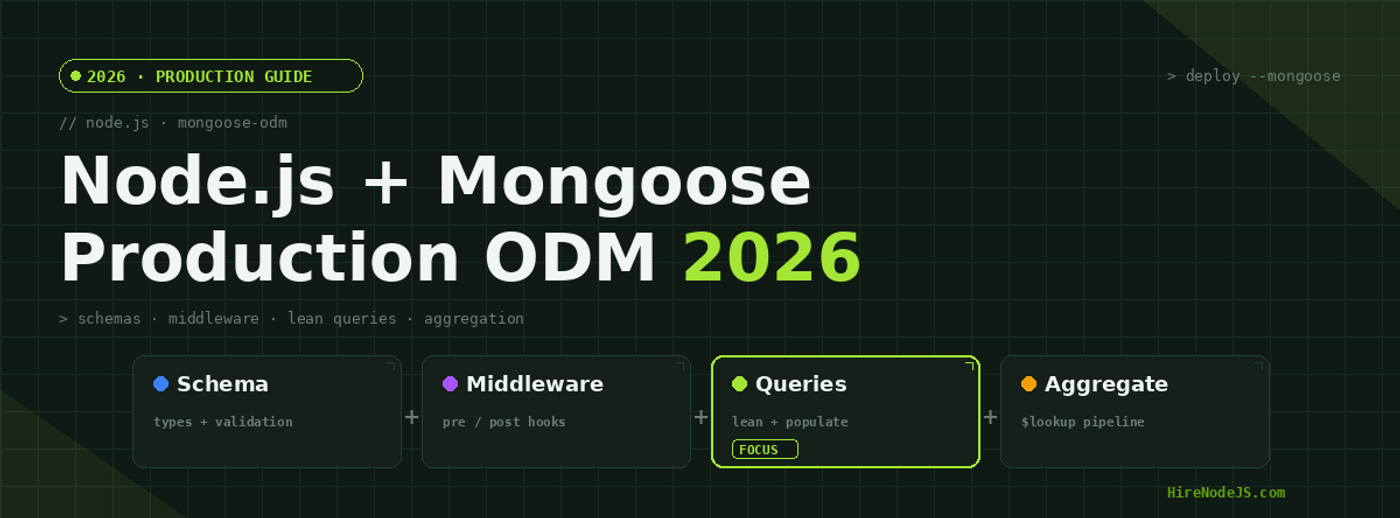
Node.js + Mongoose in 2026: Production ODM Patterns
Mongoose has quietly powered a huge share of production Node.js backends for over a decade, and in 2026 it is still the default object-document mapper teams reach for when they build on MongoDB. The reason is simple: most applications do not just read and write JSON blobs — they need validation, typed models, lifecycle hooks, and relationships that the raw driver leaves entirely to you. Mongoose packages all of that into a schema-first API that maps cleanly onto how engineers actually think about their data.
But the same convenience that makes Mongoose productive can quietly cost you performance and predictability if you use it carelessly. This guide walks through how to design schemas that scale, where the ODM's overhead is real, how to use lean queries and aggregation pipelines to claw back speed, and how to run Mongoose safely in production — plus what to look for when you hire engineers who genuinely understand it.
Why Mongoose Still Matters in 2026
The case for a schema-first ODM
MongoDB's flexibility is a double-edged sword: a document can hold anything, which means without discipline your collection drifts into a dozen subtly different shapes. Mongoose's schema layer is the antidote. It enforces types, applies defaults, validates input, and gives you a single source of truth for your data model. When you hire Node.js developers who know MongoDB well, schema design is usually the first thing they reach for — and Mongoose makes that design executable rather than aspirational.
When to skip the ODM
Mongoose is not free. Every document is hydrated into a full Mongoose model instance with getters, setters, change tracking, and virtuals attached. For high-throughput read paths — analytics rollups, bulk exports, hot cache-fill loops — that hydration is pure overhead you do not need. In those cases the native driver, or Mongoose's own lean() mode, is the right call. The skill is knowing which path each query belongs on.
Designing Schemas That Scale
Strict types, validation, and inferred TypeScript
A good Mongoose schema does three jobs at once: it documents your data, it validates writes, and — with InferSchemaType — it generates your TypeScript types so the model and the compiler never disagree. Define required fields, enums, and length limits at the schema level so bad data is rejected before it ever reaches the database, not three layers up the stack where it is far harder to trace.
Declare the indexes your queries actually need
The single most common Mongoose performance mistake in production is missing or accidental indexes. Mongoose will happily run an unindexed query that does a full collection scan, and it will feel fine on 500 documents and fall over at 5 million. Declare compound indexes that match your hot query paths, and turn off autoIndex in production so index builds are deliberate rather than triggered on every boot.
import { Schema, model, InferSchemaType } from 'mongoose';

const userSchema = new Schema(
  {
    email: { type: String, required: true, unique: true, lowercase: true, trim: true },
    name: { type: String, required: true, maxlength: 120 },
    role: { type: String, enum: ['admin', 'member', 'viewer'], default: 'member' },
    orgId: { type: Schema.Types.ObjectId, ref: 'Org', required: true, index: true },
    lastSeenAt: { type: Date },
  },
  { timestamps: true, versionKey: false }
);

// Compound index for the hot query path: active members of an org
userSchema.index({ orgId: 1, role: 1, lastSeenAt: -1 });

// Strong typing inferred straight from the schema — no duplicate interface
type User = InferSchemaType<typeof userSchema>;

export const UserModel = model<User>('User', userSchema);Middleware and Hooks Done Right
pre and post hooks for cross-cutting logic
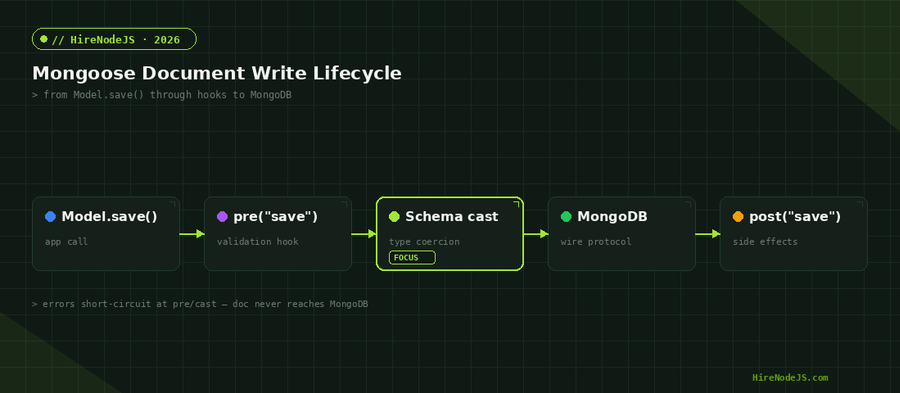
Mongoose middleware lets you attach behaviour to a document's lifecycle — hashing a password before save, emitting an event after create, cascading a soft-delete. Used well, hooks keep cross-cutting concerns out of your controllers. Used badly, they become invisible action-at-a-distance that makes every write unpredictable. The golden rule: keep hooks small, synchronous where possible, and never hide a network call inside one without making the latency obvious.
Crucially, document middleware like pre('save') does NOT fire on query operations like updateOne or findOneAndUpdate. This trips up almost everyone at least once: a password gets saved in plaintext because the update went through a query hook path that the save hook never touched. Know which hooks fire on which operations before you depend on them.
// Hash the password before persisting — runs on save(), not on updateOne()
userSchema.pre('save', async function () {
  if (!this.isModified('passwordHash')) return;
  this.passwordHash = await argon2.hash(this.passwordHash);
});

// Keep a denormalised counter in sync after a member is created
userSchema.post('save', async function (doc) {
  await OrgModel.updateOne({ _id: doc.orgId }, { $inc: { memberCount: 1 } });
});Hire Pre-Vetted Node.js Developers
Skip the months-long search. Our exclusive talent network has senior Node.js experts ready to join your team in 48 hours.
Query Performance: lean, populate, and Aggregation
Reach for lean() on read-only paths
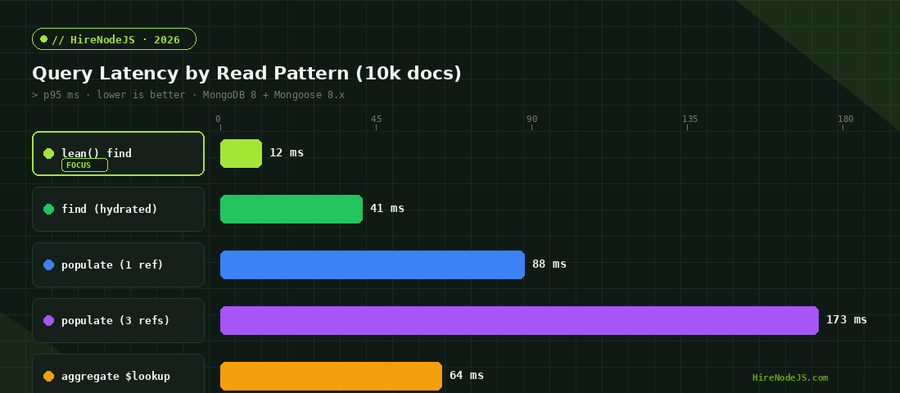
When you query data only to serialize it straight to JSON, you do not need a full Mongoose document — you need a plain object. Adding .lean() to a query skips hydration entirely and can cut read latency by 2–4x on large result sets. Make it the default for list endpoints and read APIs. Backend engineers building high-traffic services treat lean as the rule and hydration as the exception; it is one of the patterns we screen for when teams hire backend developers.
populate vs aggregation for relationships
populate() is convenient but it issues a second query per referenced collection and stitches the results in your Node.js process. For one shallow reference that is fine; for three nested references on a list endpoint it becomes the slowest line in your trace. When you need to join, filter, and shape data in one round trip, an aggregation pipeline with $lookup pushes that work into MongoDB where it belongs. The interactive scorecard below summarises the trade-offs across the wider Node.js data layer.
Connection Management and Production Pitfalls
Pool sizing and a single connection
Mongoose maintains a connection pool for you; the defaults are conservative. Under load you will want to tune maxPoolSize to match your concurrency and your database's connection limit, and you should establish exactly one connection at process start rather than connecting per request. In serverless environments, cache the connection across invocations so a cold start does not exhaust your cluster's connection budget.
Graceful shutdown
Always close the Mongoose connection on SIGTERM so in-flight writes finish and the pool drains cleanly during a deploy. Skipping this is how zero-downtime deploys turn into dropped requests. If your team needs help wiring up resilient, production-grade Node.js services, HireNodeJS can connect you with engineers who have done it at scale.
Hiring Node.js Developers Who Know Mongoose
A developer who is fluent with Mongoose can tell you, without hesitation, why a list endpoint is slow, when populate should become an aggregation, and which hooks fire on an update. Those instincts are hard to fake in an interview and expensive to learn in production. If you are building on MongoDB and want that expertise on day one, HireNodeJS connects you with pre-vetted senior Node.js developers available within 48 hours — without the recruiter overhead.
Hire Expert Node.js Developers — Ready in 48 Hours
Building the right data layer is only half the battle — you need the right engineers to build it. HireNodeJS.com specialises exclusively in Node.js talent: every developer is pre-vetted on real-world projects, schema design, query optimisation, and production MongoDB deployments.
Unlike generalist platforms, our curated pool means you speak only to engineers who live and breathe Node.js. Most clients have their first developer working within 48 hours of getting in touch. Engagements start as short-term contracts and can convert to full-time hires with zero placement fee.
Key Takeaways
Mongoose remains the most productive way to build on MongoDB in Node.js, but productivity is not a substitute for understanding what it does under the hood. Design schemas with explicit types and the right compound indexes, keep middleware small and know which hooks fire when, default to lean() on read paths, and reach for aggregation when populate starts to dominate your traces. Manage connections deliberately and shut down gracefully.
Do those things and Mongoose gives you the best of both worlds: the safety of a schema and the speed of MongoDB. Get them wrong and the ODM becomes the bottleneck everyone blames the database for. The difference, almost always, is the experience of the people writing the queries.
Frequently Asked Questions
Is Mongoose still worth using in 2026?
Yes. For most MongoDB-backed Node.js apps, Mongoose's schema validation, typed models, and lifecycle hooks save far more time than its overhead costs. You only outgrow it on extreme high-throughput read paths, where lean queries or the native driver are better.
What is the difference between lean() and a normal Mongoose query?
A normal query returns full Mongoose documents with getters, setters, virtuals, and change tracking. Adding .lean() returns plain JavaScript objects instead, skipping hydration. It is 2–4x faster for read-only endpoints but you lose document methods and save().
When should I use aggregation instead of populate in Mongoose?
Use populate for one or two shallow references. Once you are joining several collections or filtering across them on a list endpoint, switch to an aggregation pipeline with $lookup so the join happens inside MongoDB in a single round trip rather than as multiple queries stitched together in Node.js.
Why does my Mongoose pre('save') hook not run on updates?
Document middleware like pre('save') only fires on .save(). Query operations such as updateOne and findOneAndUpdate use separate query middleware. If you need logic on both paths, register hooks for both — this is a common source of bugs like unhashed passwords.
How do I run Mongoose efficiently in serverless environments?
Cache a single connection across invocations rather than connecting per request, set bufferCommands to false, and keep maxPoolSize small so concurrent cold starts do not exhaust your cluster's connection limit. Reusing the connection avoids cold-start connection storms.
How much does it cost to hire a Node.js developer who knows Mongoose?
Rates vary by region and seniority, but senior Node.js engineers with strong MongoDB and Mongoose experience typically command mid-to-upper market rates. Platforms like HireNodeJS provide pre-vetted developers within 48 hours without recruiter fees.
Vivek Singh is the founder of Witarist and HireNodeJS.com — a platform connecting companies with pre-vetted Node.js developers. With years of experience scaling engineering teams, Vivek shares insights on hiring, tech talent, and building with Node.js.
Need a Node.js + MongoDB Expert on Your Team?
HireNodeJS connects you with pre-vetted senior Node.js engineers who know Mongoose, schema design, and query optimisation — available within 48 hours. No recruiter fees, no lengthy screening.