Node.js Multi-Tenant SaaS in 2026: Patterns That Scale
Every Node.js SaaS reaches a moment where one decision dominates every other architectural choice: how do you serve thousands of customers from a single application without leaking data between them? In 2026, with new compliance regimes (EU AI Act, India DPDP, expanded HIPAA enforcement) and customer expectations of regional data residency, getting multi-tenancy wrong is no longer just an engineering problem — it is a sales blocker.
This guide walks through the patterns Node.js teams use today to build multi-tenant SaaS that scales from your first ten customers to ten thousand. We cover the three core isolation models, how to bind tenant context safely on every request, how Postgres row-level security enforces tenant boundaries at the database, and the operational realities of cost, observability, and per-tenant scaling. The goal is a working mental model you can apply on Monday morning.
Why Multi-Tenancy Matters in 2026
Multi-tenancy means a single deployment of your Node.js application serves many independent customers (tenants), each of whom sees only their own data. It is the architectural backbone of nearly every modern B2B SaaS — from billing platforms to project management to AI workflow tools — because it lets you amortise infrastructure, deployment, and on-call costs across thousands of accounts instead of running a separate stack per customer.
What changed in 2026
Three shifts have made multi-tenant design more demanding than it was even two years ago. First, regulators in the EU, India, and several US states now require demonstrable data isolation and regional storage for certain workloads. Second, AI features have pushed up per-tenant compute cost, making cost attribution and per-tenant rate limiting essential. Third, larger enterprise customers are routinely asking for SOC 2 Type II evidence of isolation before they sign — meaning your architecture has to survive an auditor's review, not just a code review.
What this guide covers
If you are building from scratch, this guide gives you a defensible architecture. If you are migrating from single-tenant, the patterns here let you do it incrementally. And if you are growing the team, the same patterns translate to a clear interview rubric for the senior backend engineers you hire to ship it.
The Three Isolation Models: Pool, Bridge, Silo
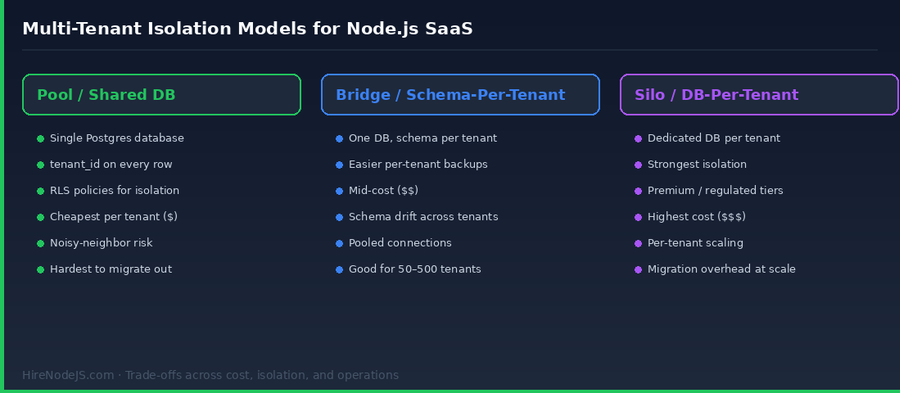
Almost every multi-tenant Node.js system is some combination of three patterns originally named by AWS in their SaaS Lens: Pool (shared everything), Bridge (shared infrastructure with per-tenant logical isolation), and Silo (dedicated infrastructure per tenant). Each model trades cost against isolation strength and operational complexity. The right choice often differs by tenant tier — startup customers on Pool, mid-market on Bridge, enterprise on Silo.
Pool model
Every tenant shares the same database and tables, with a tenant_id column on every row. This is the cheapest, fastest, and most operationally simple model — one schema migration covers every customer. The trade-offs are real: a noisy tenant can crowd out others, and you depend entirely on application-layer or RLS-layer filtering to enforce isolation. A single missing WHERE clause becomes a data breach.
Bridge model
Every tenant gets a dedicated Postgres schema (or a separate database on the same cluster) but you keep a single application deployment. You get per-tenant backups, easier per-tenant exports, and most query mistakes can no longer cross tenants. The downside is schema drift — every migration must run safely against every tenant, and connection pooling becomes more delicate because you cannot share a connection across schemas.
Silo model
Each tenant gets their own database — sometimes their own application instance, VPC, or even AWS account. This is the strongest isolation, the easiest sell to enterprise procurement, and the only sane option for some regulated workloads. It is also the most expensive: every tenant costs full infrastructure, and on-call complexity scales linearly with customer count.
Choosing the Right Tenant Identifier
Before any isolation model can work, every request entering your Node.js API must be unambiguously associated with exactly one tenant. There are three common ways to do this: subdomain (acme.app.com), URL path prefix (app.com/t/acme), or a JWT claim. The choice has real downstream consequences for caching, OAuth flows, and how easy it is for a customer to invite users from outside their company.
Subdomain-based tenancy
Subdomains are the most explicit option and integrate cleanly with per-tenant CNAMEs and certificates. They give you a clear cache boundary at the CDN, and they make tenant-scoped cookies trivial. The downside is wildcard TLS certificates and a slightly more complex Express or Fastify middleware to extract the tenant from the Host header reliably.
JWT claim tenancy
Storing tenantId inside the access token's claims is fast and stateless: no database lookup is needed to resolve the tenant. The catch is that JWTs are difficult to revoke, so a user who leaves a tenant may still hold a valid token until it expires. For sensitive operations, combine the JWT claim with a short-lived session lookup or a versioned tenant secret you can rotate.
Per-Request Tenant Context with AsyncLocalStorage
Once tenantId is resolved at the edge of your request, the hardest engineering problem becomes carrying it everywhere it is needed without polluting every function signature. Node's AsyncLocalStorage is the modern answer: it stores values that are visible to all async work spawned inside a request, including database queries, background micro-tasks, and outbound API calls.
Setting up the tenant context store
Below is the canonical setup. Notice we both extract the tenant from the request and verify that it matches the JWT claim — never trust a subdomain alone.
import { AsyncLocalStorage } from 'node:async_hooks';
import express from 'express';
import jwt from 'jsonwebtoken';

export const tenantStore = new AsyncLocalStorage();

export function tenantContext() {
  return tenantStore.getStore();
}

export function tenantMiddleware(req, res, next) {
  const subdomain = req.hostname.split('.')[0];
  const auth = req.headers.authorization?.replace(/^Bearer\s+/i, '');
  if (!auth) return res.status(401).json({ error: 'missing_token' });

  let claims;
  try {
    claims = jwt.verify(auth, process.env.JWT_SECRET);
  } catch (err) {
    return res.status(401).json({ error: 'invalid_token' });
  }

  // Critical: the resolved tenant MUST match the token's claim.
  if (claims.tenantId !== subdomain) {
    return res.status(403).json({ error: 'tenant_mismatch' });
  }

  tenantStore.run(
    { tenantId: claims.tenantId, userId: claims.sub, role: claims.role },
    () => next()
  );
}

const app = express();
app.use(tenantMiddleware);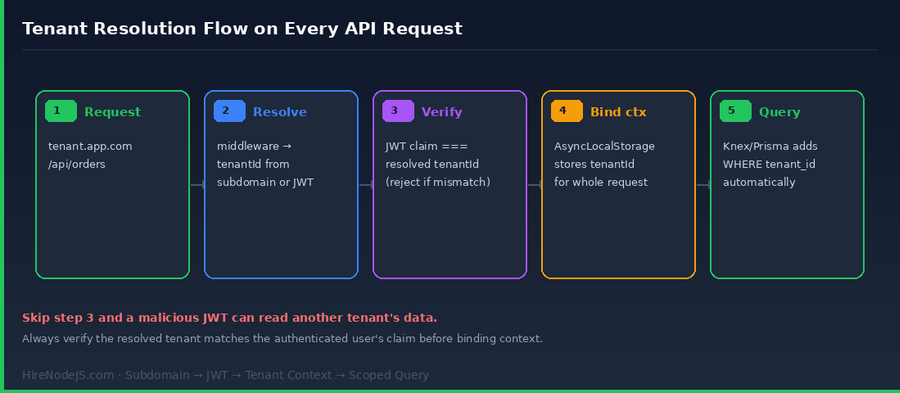
Database-Level Enforcement: Row-Level Security in Postgres
Hire Pre-Vetted Node.js Developers
Skip the months-long search. Our exclusive talent network has senior Node.js experts ready to join your team in 48 hours.
Application-layer filtering is necessary but not sufficient. The single most effective defence-in-depth pattern for Pool-model SaaS is Postgres row-level security (RLS). With RLS enabled, the database itself rejects any query that returns rows belonging to a different tenant — even if a developer forgets a WHERE clause or an ORM bug omits one.
Setting up an RLS policy
The setup is short. Enable RLS on each tenant-scoped table, define a policy that compares tenant_id to a session variable, and have your Node.js connection pool set that variable for every checkout.
-- 1. Add tenant_id and enable RLS
ALTER TABLE orders ADD COLUMN tenant_id uuid NOT NULL;
ALTER TABLE orders ENABLE ROW LEVEL SECURITY;

-- 2. Policy: a session can only see its own tenant's rows
CREATE POLICY tenant_isolation ON orders
  USING (tenant_id = current_setting('app.tenant_id')::uuid);

-- 3. The Node.js app sets the session variable on each connection
-- SET LOCAL app.tenant_id = '<uuid>';
Wiring RLS into a Node.js connection pool
import { Pool } from 'pg';
import { tenantContext } from './tenant-context.js';

const pool = new Pool({ connectionString: process.env.DATABASE_URL, max: 20 });

export async function withTenantConnection(fn) {
  const ctx = tenantContext();
  if (!ctx?.tenantId) throw new Error('no_tenant_context');

  const client = await pool.connect();
  try {
    await client.query('BEGIN');
    await client.query('SET LOCAL app.tenant_id = $1', [ctx.tenantId]);
    const result = await fn(client);
    await client.query('COMMIT');
    return result;
  } catch (err) {
    await client.query('ROLLBACK');
    throw err;
  } finally {
    client.release();
  }
}Scaling Strategies: Sharding, Pools, and Per-Tenant Resources
Beyond a few thousand active tenants, every Pool-model architecture starts to feel pressure. Hot tenants saturate connection pools, the largest tables grow past comfortable single-instance limits, and queries that were fast at 100 tenants suddenly drag at 5,000. The solution is rarely to abandon Pool — it is to shard within Pool, push the largest tenants to Bridge, and isolate the very largest into Silo.
Tenant-aware sharding
Hash the tenant_id into one of N shards and route the connection pool accordingly. This keeps each shard manageable in size and lets you migrate a hot tenant onto its own shard without changing application code. Tools like Citus (now part of Postgres on Azure) and Vitess for MySQL support this transparently; for raw Postgres you can implement a simple shard router as a thin layer above pg.
Per-tenant rate limiting and cost attribution
AI features make this acute. A single tenant running long LLM jobs can consume all your compute. Use a Redis-backed sliding window keyed by tenant_id, and emit per-tenant cost metrics from your inference layer. For a deeper dive into Redis patterns for Node, see our Redis caching guide.
Multi-Tenant Observability and Cost Attribution
Once tenants share infrastructure, every metric, log line, and trace must carry tenant_id as a first-class label. Otherwise your dashboards lie: a 99th percentile latency that looks fine in aggregate may be terrible for one specific tenant who happens to be your biggest paying customer. Tag everything, then alert on per-tenant SLOs, not just global ones.
OpenTelemetry resource attributes
Add tenant.id as a span attribute on every server span. Most modern APMs (Datadog, Honeycomb, Grafana Tempo) will let you facet by it, which makes per-tenant performance regressions trivial to spot. Be careful with PII rules — tenant_id is usually safe to log, but tenant_name often is not.
Cost attribution
Aggregate database CPU time, S3 bytes, LLM tokens, and outbound bandwidth per tenant nightly. Even a rough cost-per-tenant view will reveal the 5% of customers consuming 80% of your infrastructure — useful for both pricing decisions and capacity planning. Many teams underprice their largest customers for years before measuring this.
Common Multi-Tenancy Pitfalls to Avoid
After reviewing dozens of multi-tenant Node.js codebases, the same handful of mistakes keep appearing. Each one is cheap to fix early and expensive to fix late.
The five recurring failures
First, deriving tenant from a request body or query parameter — always trust an authenticated claim instead. Second, forgetting RLS on a brand-new table — make it a migration template, not a manual step. Third, sharing background workers without re-binding tenant context with AsyncLocalStorage.run when a job is dequeued. Fourth, allowing cross-tenant joins in admin dashboards without an explicit privileged role and audit trail. Fifth, treating storage (S3, blob) as separate from RLS — your file paths must include tenant_id and your bucket policies must reflect it.
Building this correctly takes experienced engineers. If you need senior backend talent who have shipped multi-tenant Node.js systems at scale, HireNodeJS connects you with pre-vetted developers available within 48 hours — no recruiter overhead, no lengthy screening.
Hire Expert Node.js Developers — Ready in 48 Hours
Building the right multi-tenant system is only half the battle — you need engineers who have shipped one before. HireNodeJS.com specialises exclusively in Node.js talent: every developer is pre-vetted on real-world projects, API design, event-driven architecture, and production deployments.
Unlike generalist platforms, our curated pool means you speak only to engineers who live and breathe Node.js. Most clients have their first developer working within 48 hours of getting in touch. Engagements start as short-term contracts and can convert to full-time hires with zero placement fee.
Conclusion: Pick a Default, Plan for Bridge and Silo
Most Node.js SaaS in 2026 should default to the Pool model with Postgres row-level security, AsyncLocalStorage-bound tenant context, and per-tenant observability from day one. That gets you to a few thousand healthy tenants on a small team budget, and it leaves the door open to lift specific tenants into Bridge or Silo as their needs (or your contracts) demand.
What you cannot get back later is the discipline of binding tenant context cleanly and enforcing it in the database. Make those two patterns non-negotiable — in code review, in CI, and in onboarding — and the rest of multi-tenant scaling becomes incremental engineering rather than emergency rewrites.
Frequently Asked Questions
What is multi-tenancy in a Node.js SaaS application?
Multi-tenancy is an architectural pattern where a single deployment of your Node.js application serves many independent customers (tenants), each seeing only their own data. It enables you to amortise infrastructure and operational costs across thousands of accounts.
Should I choose the Pool, Bridge, or Silo isolation model?
Default to Pool (shared database with tenant_id and RLS) for cost efficiency. Move large or regulated tenants to Bridge (schema-per-tenant) and reserve Silo (database-per-tenant) for premium or compliance-bound enterprise customers.
How do I prevent cross-tenant data leaks in Node.js?
Use defence in depth: bind tenant context per-request via AsyncLocalStorage, verify the resolved tenant matches the JWT claim, and enforce isolation in the database with Postgres row-level security so a missed WHERE clause cannot leak rows.
Is AsyncLocalStorage safe for multi-tenant Node.js APIs?
Yes — AsyncLocalStorage is the standard Node.js mechanism for carrying request-scoped values across async boundaries. Always start the store inside your authentication middleware and ensure background jobs re-bind the context when they dequeue work.
How does Postgres row-level security work for SaaS?
You enable RLS on each tenant-scoped table and define a policy comparing tenant_id to a session variable. The Node.js app sets that variable on every checkout from the connection pool, so the database itself rejects cross-tenant queries.
When should I shard a multi-tenant Postgres database?
Shard when a single Postgres instance can no longer comfortably hold the largest tables, or when one hot tenant saturates connection pools. Hash the tenant_id to choose a shard, and treat each shard as an independent Pool.
Vivek Singh is the founder of Witarist and HireNodeJS.com — a platform connecting companies with pre-vetted Node.js developers. With years of experience scaling engineering teams, Vivek shares insights on hiring, tech talent, and building with Node.js.
Building Multi-Tenant Node.js? Hire Engineers Who Have Done It at Scale.
HireNodeJS connects you with pre-vetted senior Node.js engineers experienced in multi-tenant SaaS, Postgres RLS, and production scaling. Available within 48 hours — no recruiter fees, no lengthy screening.