Node.js + NAPI-RS in 2026: Native Rust Addons for Production
Node.js owns the I/O-bound API world, but the moment you hit CPU-bound work — image processing, cryptography, parsing, compression, search ranking — the single-threaded event loop becomes a bottleneck. Worker threads help, WebAssembly helps more, but neither matches what you get when you call into a tight native binary directly. That is what NAPI-RS unlocks: production-grade Rust addons that load like ordinary npm packages and run at near-C++ speed without the safety hazards of writing C++.
In 2026, NAPI-RS has become the default way teams ship native code in Node.js. The combination of stable N-API, the Rust toolchain reaching ergonomics parity with Node tooling, and turnkey prebuilt binaries means you no longer have to choose between developer experience and raw throughput. This guide walks through the architecture, when to reach for it, how to build and ship one to production, and the pitfalls that bite teams the first time they cross the JavaScript-to-native boundary.
What Are Native Addons and Why NAPI-RS in 2026?
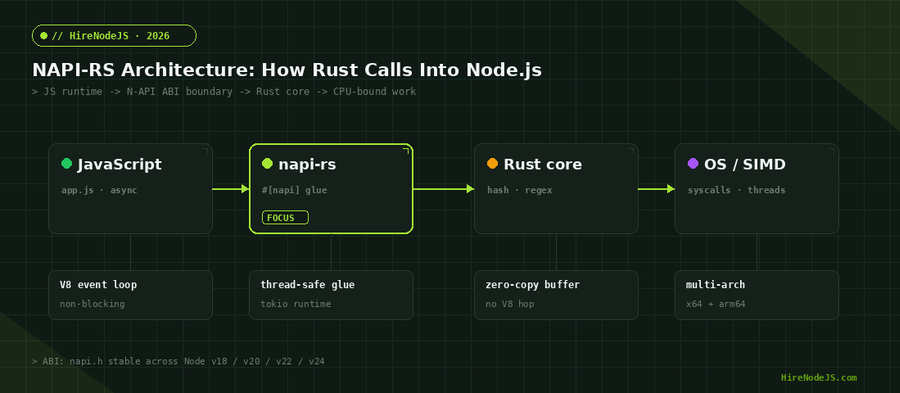
A Node.js native addon is a compiled binary — .node file — that exposes JavaScript-callable functions. The runtime loads it through dlopen, the binary calls back into V8 through the N-API ABI, and the result looks indistinguishable from any other npm module to the calling code. The difference is that the work happens in native CPU instructions rather than going through V8's JIT.
N-API: the boundary that finally stayed stable
Earlier addon APIs (nan, direct V8 headers) had a brutal upgrade story: every major Node release broke binary compatibility, and library authors had to rebuild for every version. N-API changed that by sitting on top of a stable ABI. A binary compiled against N-API v6 keeps working on every Node release that supports v6 or higher — Node 18, 20, 22, and 24 all run the same .node file. This is what makes shipping native code in 2026 reasonable: prebuild once per platform, distribute, and move on.
Why Rust instead of C++
C++ addons still exist, but the trade-off has shifted decisively toward Rust. The compiler eliminates whole categories of bugs — use-after-free, data races, buffer overflows — that show up as crashes in production for C++ code. Cargo handles dependencies the way npm does. And NAPI-RS gives you idiomatic Rust ergonomics with a single attribute macro: tag a function with #[napi] and it becomes callable from JavaScript with the right types, including Buffers, Promises, BigInts, and async iterators. The Rust ecosystem also has industrial-grade crates for the exact problems you would write an addon for: image processing (image, libvips bindings), hashing (blake3, ahash), regex (regex crate is the fastest in any ecosystem), compression (zstd, brotli), and serialization (serde).
Setting Up NAPI-RS: From Zero to First Module
Getting a working NAPI-RS project is a five-minute exercise once you have Rust installed. The official scaffold takes care of build configuration, GitHub Actions for prebuilds, and TypeScript type generation. Run npx @napi-rs/cli new my-addon, pick the target platforms, and the generated project already builds across macOS, Linux, and Windows on both x64 and arm64.
The minimal Rust function exposed to Node
Below is a complete, runnable NAPI-RS module that exposes a fast blake3 hash function to JavaScript. Note the #[napi] macro — that single annotation generates the binding glue, type definitions, and the .d.ts file your TypeScript code will consume.
// src/lib.rs
#![deny(clippy::all)]

use napi_derive::napi;
use napi::bindgen_prelude::*;

#[napi]
pub fn hash_blake3(input: Buffer) -> String {
  // input is a Node Buffer; zero-copy access on the Rust side.
  let mut hasher = blake3::Hasher::new();
  hasher.update(&input);
  hasher.finalize().to_hex().to_string()
}

#[napi]
pub async fn hash_file(path: String) -> Result<String> {
  // async fn becomes a JS Promise automatically.
  let bytes = tokio::fs::read(&path)
    .await
    .map_err(|e| Error::from_reason(e.to_string()))?;
  let mut hasher = blake3::Hasher::new();
  hasher.update(&bytes);
  Ok(hasher.finalize().to_hex().to_string())
}
From JavaScript, the consumer side is plain TypeScript with proper types autogenerated by the NAPI-RS CLI. There is no manual binding layer, no manual type definitions to maintain — the build emits an index.js, index.d.ts, and the platform-specific .node binary.
Build, package, distribute
The real production magic is in the GitHub Actions workflow the scaffold ships with. It builds your addon on every supported platform in CI, uploads the per-platform binaries as npm package optional dependencies, and your users install the package with npm install — npm picks the right binary for their OS and architecture automatically. No node-gyp errors, no system compiler required on the consumer machine.
When to Reach for Native Code (Decision Framework)
Native addons are powerful but not free — every team that adopts them adds Rust to its build, its hiring requirements, and its CI. Before reaching for NAPI-RS, the work needs to be both CPU-bound AND on a hot path. If the bottleneck is database I/O, network calls, or JSON parsing in an admin endpoint, native code will not help. If you are hiring Node.js developers to build standard REST APIs, you almost certainly do not need an addon — most of the throughput gains you imagine from native code are unrealised because the event loop is idle waiting on Postgres.
Good fits — where NAPI-RS pays for itself
Image and video processing pipelines (resize, transcode, perceptual hashing), cryptographic operations beyond what the built-in crypto module covers (Argon2 with custom parameters, post-quantum signatures, large-scale BLS aggregation), text search and ranking (custom tokenizers, BM25, embedding similarity), data parsing (Parquet, columnar formats, protobuf-style fast paths), and high-frequency game-loop physics or graphics math. These are the workloads where the JS engine spends 95% of CPU time on hot inner loops that native code crushes.
Bad fits — where you should stay in JavaScript
Anything I/O-bound (HTTP, database, file streaming), business logic with branchy control flow rather than tight numerical loops, CRUD endpoints, GraphQL resolvers, and anything where the existing npm ecosystem already wraps a C library (sharp for images, argon2 for password hashing, node-rdkafka for Kafka). If a battle-tested package already calls into native code via a maintained binding, use that package — do not rewrite it as an exercise.
Performance Benchmarks: NAPI-RS vs Pure Node vs WebAssembly
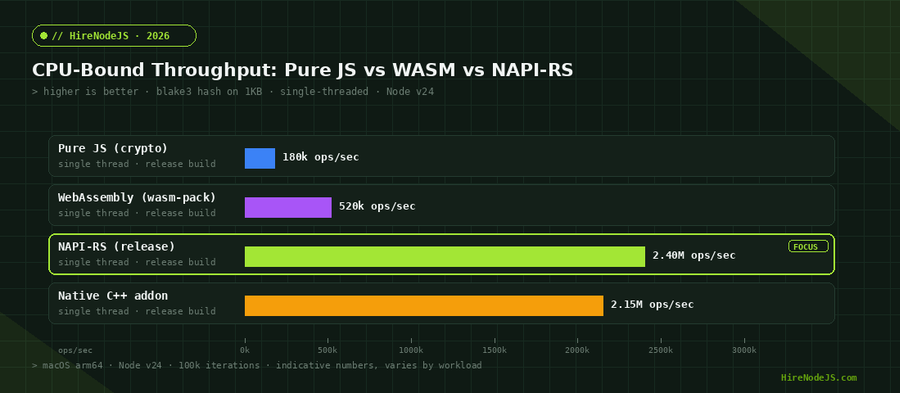
The performance picture is more nuanced than 'native is faster'. The cost of crossing the JavaScript-to-native boundary is real — for very small inputs and high call frequencies, a pure JS implementation can actually win because there is no FFI overhead. Native code wins when the per-call work is large enough to amortise the boundary cost.
Hire Pre-Vetted Node.js Developers
Skip the months-long search. Our exclusive talent network has senior Node.js experts ready to join your team in 48 hours.
Cold paths vs hot paths
A single call into a NAPI-RS function costs roughly 50-200 nanoseconds of boundary overhead. For a function that processes a 2MB image — taking tens of milliseconds — that overhead is invisible. For a function called a million times to hash 16-byte keys, it can be the dominant cost. Batch your calls: hash an entire array of inputs in one native call rather than crossing the boundary for each input.
WebAssembly: the close cousin
WebAssembly is the other option for shipping compiled code to Node, and it has its own advantages — no native binary distribution problem, identical execution on every platform, sandboxed memory. The trade-off is roughly 30-50% slower than native for the same algorithm, no SIMD on every platform, and an awkward boundary for non-numeric types. For libraries that target both Node and the browser, WASM still wins. For Node-only workloads where you control the deployment targets, NAPI-RS gives you the full CPU.
Production Patterns: Build, Distribution, and CI
Shipping a NAPI-RS addon to production is more about the build matrix than the Rust code. Every platform-architecture combination your users run on needs a precompiled binary in the published npm package, otherwise installs fall back to building from source — which requires Rust on the consumer's machine and breaks any deployment pipeline that does not have it.
The mandatory build matrix
At minimum, target these six combinations: macOS x64, macOS arm64, Linux x64 (glibc), Linux x64 (musl, for Alpine and Docker), Linux arm64, and Windows x64. The official @napi-rs/cli scaffold generates GitHub Actions jobs for all of them. If you are deploying to AWS Graviton or any ARM-based serverless environment, hiring DevOps engineers who understand multi-arch container builds is worth the investment — getting this matrix wrong means your container layers either explode in size or fail to install on production hosts.
Optional dependencies for per-platform binaries
The shipping pattern uses npm's optionalDependencies field: the main package declares optional dependencies on each platform-specific package (your-addon-darwin-arm64, your-addon-linux-x64-gnu, etc.), and at install time npm picks the right one based on os and cpu. The consumer never sees this complexity — they just npm install your-addon and it works. This is the same model sharp, swc, esbuild, and Turbopack all use.
{
  "name": "my-addon",
  "version": "1.0.0",
  "main": "index.js",
  "types": "index.d.ts",
  "files": ["index.js", "index.d.ts"],
  "napi": {
    "name": "my-addon",
    "triples": {
      "defaults": true,
      "additional": [
        "x86_64-unknown-linux-musl",
        "aarch64-unknown-linux-gnu",
        "aarch64-apple-darwin"
      ]
    }
  },
  "optionalDependencies": {
    "my-addon-darwin-x64": "1.0.0",
    "my-addon-darwin-arm64": "1.0.0",
    "my-addon-linux-x64-gnu": "1.0.0",
    "my-addon-linux-x64-musl": "1.0.0",
    "my-addon-linux-arm64-gnu": "1.0.0",
    "my-addon-win32-x64-msvc": "1.0.0"
  }
}
Common Pitfalls (Memory, Threads, Cross-Platform)
Even with Rust's safety guarantees, the seam between JavaScript and native code is where production bugs accumulate. The following pitfalls are the ones that bite real teams in the first six months.
Blocking the event loop
A synchronous #[napi] function runs on the JavaScript thread. If it does heavy work — say, 200ms of image processing — the event loop is frozen for that duration. The fix is straightforward: mark CPU-heavy functions as async, NAPI-RS will offload them to libuv's thread pool, and JavaScript code keeps running. The cost is a slightly more complex calling convention (Promises instead of return values), but every production addon should do this.
Tokio inside napi: don't double-runtime
Rust's tokio runtime and NAPI-RS's thread pool are not the same thing. If your Rust code uses async tokio APIs, you need to either use the napi-rs feature flag that hooks into libuv, or be very careful about where the work actually runs. Mixing the two carelessly causes deadlocks under load that do not reproduce on dev machines.
Buffer ownership and zero-copy
NAPI-RS lets you receive a Node Buffer as an &[u8] slice without copying. That is great for performance, but the slice is only valid for the duration of the synchronous call. If you spawn a tokio task and try to use the slice from another thread, you have a use-after-free in waiting. Either copy the buffer into a Vec<u8> for cross-thread work, or use the ToOwned methods NAPI-RS provides.
These are not theoretical edge cases — they are the bugs every team hits. Hiring a backend developer who has shipped Rust-backed addons before saves weeks of debugging across platforms.
Hire Expert Node.js Developers — Ready in 48 Hours
Native addons sit at the toughest seam in any Node.js stack — they require engineers comfortable with Rust, libuv internals, and multi-arch CI. HireNodeJS.com specialises exclusively in Node.js talent, including engineers who have shipped NAPI-RS, WASM, and worker-thread architectures to production. Every developer is pre-vetted on real-world projects, API design, and the operational realities of native code in Node.
Unlike generalist platforms, our curated pool means you speak only to engineers who live and breathe Node.js. Most clients have their first developer working within 48 hours of getting in touch. Engagements start as short-term contracts and can convert to full-time hires with zero placement fee.
Conclusion: Native Code Is Now a First-Class Node.js Pattern
NAPI-RS has turned native addons from a research project into a normal engineering tool. The stable N-API ABI, Rust's safety story, and the prebuild distribution model mean a small team can ship a fast native addon, support every major platform, and not regret the decision six months later. Use it where the work is genuinely CPU-bound and on a hot path — image pipelines, custom cryptography, search, parsing — and stay in JavaScript everywhere else.
The pattern to internalise is this: keep your business logic in JavaScript where developer velocity is highest, and push only the tight numerical loops down into Rust. That is the architecture used by sharp, swc, Turbopack, esbuild, and every other library that has shipped this trade-off successfully. With NAPI-RS in 2026, the same playbook is now within reach for any team willing to add cargo to their build.
Frequently Asked Questions
What is NAPI-RS and how does it differ from node-gyp or napi-rs?
NAPI-RS is a framework for writing Node.js native addons in Rust using the stable N-API. Unlike node-gyp (which builds C/C++ addons via Python and a system compiler), NAPI-RS uses Cargo, ships precompiled binaries via npm optionalDependencies, and requires no compiler on the consumer's machine.
Is NAPI-RS faster than WebAssembly for Node.js?
Yes, typically 30-50% faster for the same algorithm, because native code has access to SIMD, unrestricted threading, and avoids the WASM-to-host boundary cost. WebAssembly wins when you also need to run the same code in browsers or in sandboxed environments.
Do I need to know Rust to use NAPI-RS?
To author an addon, yes — but to consume one, no. Most production Node.js teams adopt NAPI-RS through existing packages (sharp, swc, @napi-rs/canvas, image-rs bindings) without writing any Rust themselves.
Does NAPI-RS work with Bun and Deno?
NAPI-RS targets Node.js's N-API. Bun supports a large subset of N-API and can load many NAPI-RS modules. Deno's Node compatibility layer also supports N-API in recent versions. Always test on your actual target runtime.
How do I distribute a NAPI-RS addon to multiple platforms?
Use the official @napi-rs/cli scaffold's GitHub Actions workflow. It cross-compiles for macOS x64/arm64, Linux x64 glibc/musl, Linux arm64, and Windows x64, publishes each as a separate npm package, and lists them as optionalDependencies on the main package so npm picks the right one at install time.
What's the typical performance overhead of crossing the Node-to-Rust boundary?
Around 50-200 nanoseconds per call. This is negligible for functions doing real work (image processing, hashing large buffers, parsing big payloads) but significant if you call into Rust millions of times per second on tiny inputs — batch your calls in that case.
Vivek Singh is the founder of Witarist and HireNodeJS.com — a platform connecting companies with pre-vetted Node.js developers. With years of experience scaling engineering teams, Vivek shares insights on hiring, tech talent, and building with Node.js.
Need a Node.js Engineer Who Ships Production Native Addons?
HireNodeJS connects you with pre-vetted senior engineers experienced in NAPI-RS, Rust, worker threads, and high-performance Node.js architectures — ready within 48 hours.