Node.js Native Test Runner: Complete Guide to node:test in 2026
The Node.js ecosystem has always had a rich selection of testing frameworks — from Mocha and Jasmine in the early days to Jest and Vitest dominating modern workflows. But since Node.js 18, a quiet revolution has been underway: the built-in node:test module. By 2026, it has matured into a production-ready test runner that eliminates external dependencies entirely, ships with mocking, coverage, and watch mode out of the box, and starts faster than any third-party alternative.
Whether you are starting a greenfield project or evaluating a migration from Jest, understanding the native test runner is now essential for any Node.js developer working on modern backend systems. This guide covers everything from basic test authoring to advanced patterns like subtests, snapshot testing, mocking timers, and integrating coverage into your CI pipeline.
Why the Native Test Runner Matters in 2026
For years, the JavaScript testing landscape was fragmented. Jest brought batteries-included testing to React projects but carried significant startup overhead for backend Node.js applications. Vitest solved the speed problem for Vite-based projects but added another dependency to manage. The native node:test module takes a fundamentally different approach: it is part of the Node.js runtime itself, requires zero installation, zero configuration, and starts executing tests in milliseconds rather than seconds.
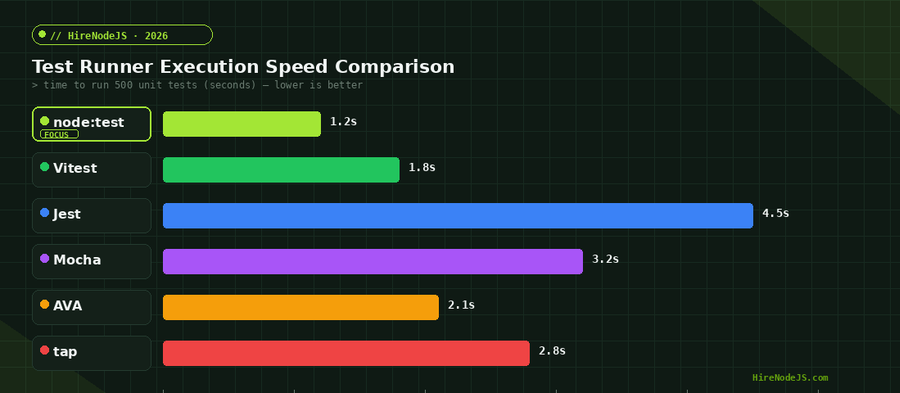
The performance advantage is not trivial. In benchmarks running 500 unit tests, node:test completes in approximately 1.2 seconds — roughly 3.7 times faster than Jest and 33 percent faster than Vitest. For teams running tests on every file save or in CI pipelines that execute thousands of test suites, this translates directly into developer productivity and reduced infrastructure costs.
Zero Dependencies, Zero Configuration
One of the most compelling reasons to adopt the native test runner is the elimination of dependency management overhead. A typical Jest setup pulls in over 50 transitive dependencies. Vitest is leaner but still requires vite as a peer dependency. With node:test, your package.json testing section is empty — the runtime provides everything. This means faster npm installs, smaller Docker images, fewer security vulnerabilities to track, and no version conflicts between testing framework updates and your application code.
Getting Started with node:test
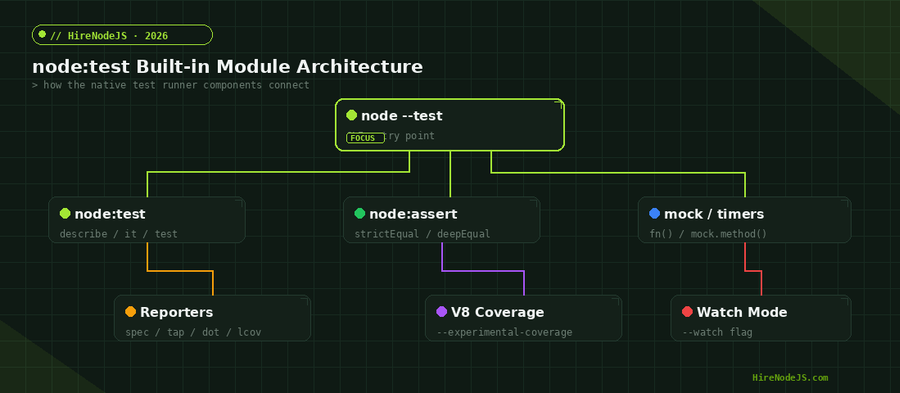
The API surface of node:test is deliberately minimal. You import test (or describe and it for BDD-style syntax) from the node:test module, write your assertions using node:assert, and run everything with the node --test CLI command. There is no configuration file, no preset system, and no plugin architecture to learn.
Your First Test File
Creating a test is as simple as importing two built-in modules. The test function accepts a name and an async callback. Inside the callback, you use standard assert methods to verify behavior. The runner automatically discovers files matching common test patterns like *.test.js, *.test.mjs, and files inside __tests__ directories.
import { describe, it } from 'node:test';
import assert from 'node:assert/strict';
import { UserService } from '../src/user-service.js';

describe('UserService', () => {
  it('should create a user with valid email', async () => {
    const service = new UserService();
    const user = await service.create({
      name: 'Alice',
      email: 'alice@example.com'
    });

    assert.strictEqual(user.name, 'Alice');
    assert.strictEqual(user.email, 'alice@example.com');
    assert.ok(user.id, 'User should have an auto-generated ID');
  });

  it('should reject invalid email formats', async () => {
    const service = new UserService();

    await assert.rejects(
      () => service.create({ name: 'Bob', email: 'not-an-email' }),
      { code: 'INVALID_EMAIL' }
    );
  });

  it('should hash passwords before storage', async () => {
    const service = new UserService();
    const user = await service.create({
      name: 'Charlie',
      email: 'charlie@example.com',
      password: 'securePass123'
    });

    assert.notStrictEqual(user.passwordHash, 'securePass123');
    assert.ok(user.passwordHash.startsWith('$2b$'), 'Should use bcrypt');
  });
});
Running Tests from the CLI
The node --test command is the entry point. It accepts glob patterns, concurrency settings, timeout values, and reporter choices. By default it runs all test files in parallel, using worker threads for isolation. You can control concurrency with --test-concurrency, set per-test timeouts with --test-timeout, and choose output format with --test-reporter.
Advanced Testing Patterns with node:test
Beyond basic assertions, node:test supports subtests (nested test contexts), lifecycle hooks (before, after, beforeEach, afterEach), test filtering with --test-name-pattern, and the ability to skip or mark tests as TODO. These features bring it to feature parity with most established frameworks for the vast majority of testing scenarios.
Subtests and Nested Contexts
Subtests allow you to group related assertions under a parent test. Each subtest runs in its own context, and the parent test only passes if all subtests succeed. This is particularly useful for testing different aspects of the same function or for parameterised testing patterns where you want to run the same logic across multiple input sets.
Lifecycle Hooks
The before, after, beforeEach, and afterEach hooks work exactly as you would expect from frameworks like Jest or Mocha. They execute at the appropriate points in the test lifecycle and are scoped to their enclosing describe block. This makes it straightforward for teams to migrate existing test suites without rewriting their setup and teardown logic.
Built-in Mocking and Test Doubles
One of the most significant additions to node:test is the built-in mock object. Prior to this, Node.js developers had to rely on external libraries like sinon, testdouble, or Jest's internal mocking system. The native mock API supports function mocks, method mocks on objects, timer mocks, and module mocks — covering the most common test double scenarios without any additional dependencies.
Function and Method Mocking
The mock.fn() function creates a tracked callable that records every invocation, its arguments, and return values. You can set specific return values, throw errors on demand, and inspect call history. For object methods, mock.method() replaces a method on an existing object while preserving the ability to restore the original implementation after the test completes.
Hire Pre-Vetted Node.js Developers
Skip the months-long search. Our exclusive talent network has senior Node.js experts ready to join your team in 48 hours.
Timer Mocking
Timer mocking is critical for testing code that uses setTimeout, setInterval, or Date.now(). The node:test mock.timers API lets you enable fake timers scoped to a specific test, advance time programmatically, and tick through scheduled callbacks deterministically. This is essential for any backend developer working with rate limiters, cache expiry, scheduled jobs, or retry logic.
Native Code Coverage with V8
Node.js leverages the V8 engine's built-in code coverage instrumentation, which means coverage data is collected at the engine level without any source code transformation or compilation step. This is fundamentally different from Istanbul or c8, which instrument your code before execution. The result is faster coverage collection, more accurate line and branch counts, and zero impact from source map misalignment.
Enabling Coverage
Coverage is enabled with a single flag: --experimental-test-coverage. The runner will output a summary table showing file-by-file line, branch, and function coverage percentages. For CI integration, you can combine this with the lcov reporter to generate reports compatible with tools like Codecov, Coveralls, or SonarQube: node --test --experimental-test-coverage --test-reporter=lcov > coverage.lcov.
Setting Coverage Thresholds
While the native runner does not yet have built-in threshold enforcement, you can script this easily by parsing the TAP or lcov output and failing the CI step if coverage drops below a target. Many teams using TypeScript with Node.js combine this approach with their build pipeline to maintain consistent quality standards across the codebase.
Watch Mode and Developer Experience
The --watch flag enables a file-watching mode that re-runs affected tests whenever source files change. Unlike Jest's watch mode, which requires chokidar and has known issues on certain operating systems, the native watch mode uses Node.js internal file system watchers and works reliably across macOS, Linux, and Windows without additional dependencies.
Filtering Tests
During development, you often want to run a subset of tests. The --test-name-pattern flag accepts a regular expression that filters tests by name. Combined with watch mode, this creates a tight feedback loop: node --test --watch --test-name-pattern='UserService' runs only matching tests on every save. You can also use the built-in test.only() and test.skip() methods for quick isolation during debugging sessions.
Custom Reporters
The native runner ships with spec, tap, and dot reporters. For custom output, you can write your own reporter as a transform stream — the runner emits test events (test:start, test:pass, test:fail, test:diagnostic) that your reporter consumes and formats. This streaming architecture means reporters never buffer the entire test run in memory, making it suitable for very large test suites.
Migrating from Jest to node:test
For teams currently using Jest, migration is straightforward but requires some planning. The core concepts map directly: describe, it, expect, beforeEach, and afterEach all have native equivalents. The main differences are in the assertion API (node:assert uses strictEqual instead of toEqual), mocking (mock.fn instead of jest.fn), and module mocking (which uses the --experimental-test-module-mocks flag).
Step-by-Step Migration Strategy
Start by running both Jest and node:test in parallel. Create new test files using node:test while leaving existing Jest tests intact. Gradually migrate test files one module at a time, starting with utility functions and pure logic that have minimal mocking requirements. Save complex integration tests with heavy mocking for last, as these may require the most adaptation of mock patterns.
Common Migration Pitfalls
The biggest friction points during migration are Jest-specific matchers (toMatchSnapshot, toHaveBeenCalledWith with asymmetric matchers) and automatic module mocking (jest.mock at the top of files). For snapshot testing, consider whether you actually need snapshots or if explicit assertions would be more maintainable. For complex mocking, the native mock.module API (available behind a flag in Node.js 22+) covers most use cases. If you need experienced engineers for this migration, HireNodeJS can connect you with developers who have completed this transition at scale.
Hire Expert Node.js Developers — Ready in 48 Hours
Building the right system is only half the battle — you need the right engineers to build it. HireNodeJS.com specialises exclusively in Node.js talent: every developer is pre-vetted on real-world projects, API design, event-driven architecture, and production deployments.
Unlike generalist platforms, our curated pool means you speak only to engineers who live and breathe Node.js. Most clients have their first developer working within 48 hours of getting in touch. Engagements start as short-term contracts and can convert to full-time hires with zero placement fee.
Conclusion
The Node.js native test runner has evolved from an experimental curiosity into a production-grade testing solution. With zero dependencies, millisecond startup times, built-in mocking, V8-native coverage, and reliable watch mode, it covers the needs of most Node.js projects without reaching for external frameworks. The adoption curve is steep — from 1 percent in 2022 to 34 percent projected usage in 2026 — and the trajectory suggests it will become the default choice for new Node.js projects within the next two years.
For teams building new projects, adopting node:test from day one eliminates an entire category of dependency management. For teams on Jest or Mocha, a gradual migration strategy lets you realise the performance and simplicity benefits incrementally. Either way, familiarity with the native test runner is becoming a core competency for any professional Node.js developer in 2026.
Frequently Asked Questions
Is the Node.js native test runner production-ready in 2026?
Yes. The node:test module has been stable since Node.js 20 and fully mature in Node.js 22+. It includes built-in mocking, coverage, watch mode, and multiple reporter formats suitable for production CI/CD pipelines.
How does node:test compare to Jest for backend testing?
node:test starts 3-4x faster than Jest due to zero dependency loading. It lacks some Jest-specific features like automatic module mocking and snapshot testing matchers, but covers the vast majority of backend testing needs with a simpler API.
Can I use node:test with TypeScript?
Yes. With Node.js 22+ and the --experimental-strip-types flag, you can run TypeScript test files directly. Alternatively, use a loader like tsx or ts-node to register TypeScript compilation before test execution.
How do I generate code coverage reports with node:test?
Add the --experimental-test-coverage flag to your test command. For CI-compatible output, use --test-reporter=lcov to generate lcov format reports that work with Codecov, Coveralls, and SonarQube.
Should I migrate my existing Jest tests to node:test?
It depends on your project. For new Node.js backend projects, node:test is the recommended starting point. For existing projects, a gradual migration running both frameworks in parallel is the safest approach. Start with simple utility tests and migrate complex integration tests last.
Does node:test support watch mode?
Yes. The --watch flag enables file-watching that re-runs affected tests on file changes. It uses Node.js internal file watchers and works reliably across macOS, Linux, and Windows without additional dependencies like chokidar.
Vivek Singh is the founder of Witarist and HireNodeJS.com — a platform connecting companies with pre-vetted Node.js developers. With years of experience scaling engineering teams, Vivek shares insights on hiring, tech talent, and building with Node.js.
Need Node.js Engineers Who Write Bulletproof Tests?
HireNodeJS connects you with pre-vetted senior Node.js developers who ship production-grade code with comprehensive test coverage. Available within 48 hours — no recruiter fees.