Node.js Observability with OpenTelemetry: The 2026 Guide
Node.js in 2026 looks nothing like the monolithic apps most of us shipped a few years ago. Teams run dozens of services on Kubernetes, mix Express with Fastify, blend REST, GraphQL, gRPC and serverless functions, and stream events through Kafka or SQS. When something breaks at 2am, a single stack trace is almost never enough — you need traces, metrics and logs from every hop the request touched, correlated on one screen.
This is what modern observability delivers, and OpenTelemetry (OTel) has become the de-facto standard that makes it vendor-neutral. In this guide you'll learn how observability differs from old-school monitoring, how to instrument a Node.js service with OpenTelemetry end-to-end, which backends are worth paying for in 2026, and the practical patterns — SLOs, tail-based sampling, structured logging — that separate a senior Node.js team from a junior one.
What Observability Actually Means in 2026
Monitoring answers known questions ("is CPU above 90%?"). Observability lets you answer questions you didn't think to ask in advance — by recording rich, high-cardinality signals about every request, then letting you slice them any way you need when something goes wrong. It's the difference between a smoke alarm and a fire marshal.
The three pillars: traces, metrics, logs
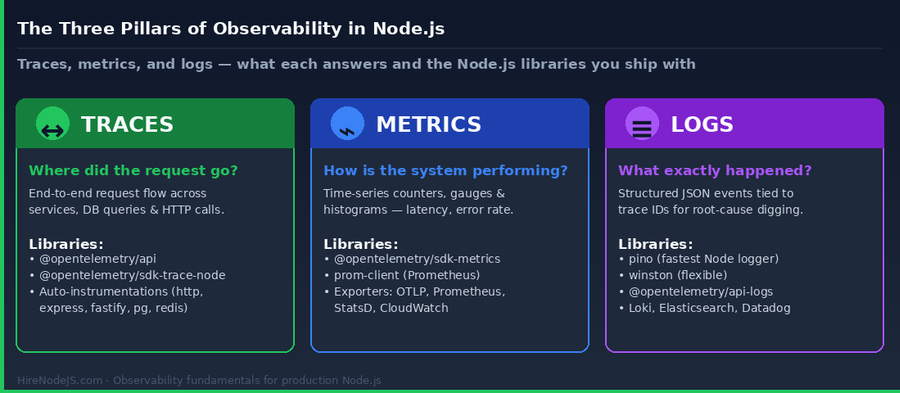
Traces show the path a single request took across services and the time each hop consumed. Metrics are cheap time-series aggregates — requests per second, p95 latency, event-loop lag. Logs are high-detail, structured events you emit when something worth recording happens. On their own each is useful; combined and cross-linked by trace ID they turn debugging into a graph traversal instead of a goose chase.
High cardinality and why it matters for Node.js
A Node.js process can spawn thousands of concurrent user journeys. Pre-aggregated metrics flatten those journeys into averages and lose the long-tail slow requests that users actually complain about. Modern observability platforms preserve per-request attributes (userId, tenantId, feature flag, build SHA) so you can filter to "show me the 1% of requests that took over 2 seconds for enterprise tenants on build 4c7f" in seconds.
Why OpenTelemetry Became the Default Standard
Five years ago every APM vendor shipped its own proprietary agent — you picked a vendor and got locked in. OpenTelemetry changed that: it's a CNCF-governed set of APIs, SDKs and wire protocols (OTLP) that produce signals any compliant backend can consume. You instrument once, then choose — or switch — between Datadog, New Relic, Honeycomb, Grafana Tempo, Jaeger or your own Prometheus + Loki stack without changing code.
What OTel gives you out of the box
For Node.js the key package is @opentelemetry/auto-instrumentations-node, which wraps 40+ popular libraries — Express, Fastify, NestJS, http, pg, mysql2, ioredis, mongoose, aws-sdk, graphql, grpc — and emits spans and metrics without a single line of app code. You add the SDK at process start, set an OTLP endpoint, and suddenly every HTTP request, DB query and outbound call is a span you can filter and graph.
The OTel Collector: your central nervous system
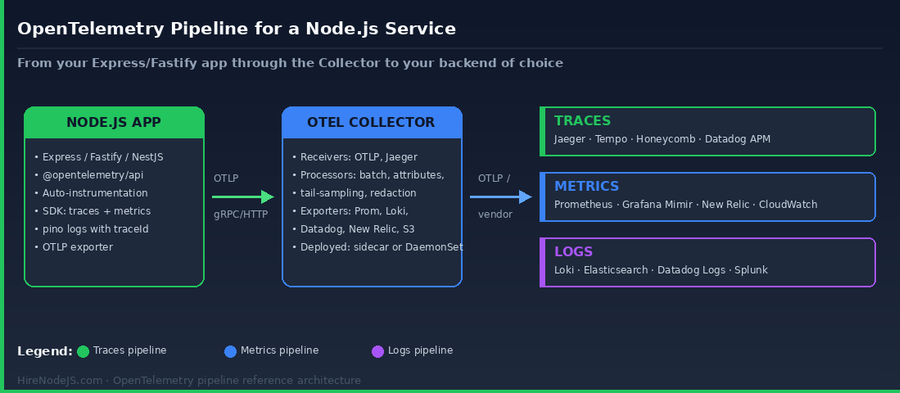
The Collector is a vendor-neutral pipeline that receives OTLP data from your apps, processes it (batching, tail sampling, redaction, enrichment) and fans it out to one or more backends. Running it as a sidecar or DaemonSet lets you switch vendors, add a new backend for A/B evaluation, or blackhole PII — without redeploying your Node.js services.
Instrumenting a Node.js Service with OpenTelemetry
Here's the minimum setup that gets you traces, metrics and log correlation for an Express or Fastify app in under fifty lines. The trick is to load the OTel SDK before your application code — do that and auto-instrumentation can patch modules as they're required.
The instrumentation file
Create otel.js at the root of your project. Start it with node --require ./otel.js app.js (or set NODE_OPTIONS=--require /app/otel.js in your container). This guarantees instrumentation runs before any imports that need to be patched.
// otel.js — load BEFORE your app code
const { NodeSDK } = require('@opentelemetry/sdk-node');
const { OTLPTraceExporter } = require('@opentelemetry/exporter-trace-otlp-http');
const { OTLPMetricExporter } = require('@opentelemetry/exporter-metrics-otlp-http');
const { PeriodicExportingMetricReader } = require('@opentelemetry/sdk-metrics');
const { getNodeAutoInstrumentations } = require('@opentelemetry/auto-instrumentations-node');
const { Resource } = require('@opentelemetry/resources');
const { SemanticResourceAttributes } = require('@opentelemetry/semantic-conventions');

const sdk = new NodeSDK({
  resource: new Resource({
    [SemanticResourceAttributes.SERVICE_NAME]: process.env.OTEL_SERVICE_NAME || 'checkout-api',
    [SemanticResourceAttributes.SERVICE_VERSION]: process.env.BUILD_SHA || 'dev',
    [SemanticResourceAttributes.DEPLOYMENT_ENVIRONMENT]: process.env.NODE_ENV || 'development',
  }),
  traceExporter: new OTLPTraceExporter({
    url: process.env.OTEL_EXPORTER_OTLP_ENDPOINT + '/v1/traces',
  }),
  metricReader: new PeriodicExportingMetricReader({
    exporter: new OTLPMetricExporter({
      url: process.env.OTEL_EXPORTER_OTLP_ENDPOINT + '/v1/metrics',
    }),
    exportIntervalMillis: 15_000,
  }),
  instrumentations: [getNodeAutoInstrumentations({
    '@opentelemetry/instrumentation-fs': { enabled: false },
  })],
});

sdk.start();

process.on('SIGTERM', () => {
  sdk.shutdown()
    .then(() => console.log('OTel SDK shut down'))
    .catch(err => console.error('Shutdown error', err))
    .finally(() => process.exit(0));
});
Adding a custom span for a business-critical path
Auto-instrumentation covers the plumbing, but you'll want hand-written spans for the parts of your code you care about most — the checkout flow, a payment attempt, a billing reconciliation. They show up in Jaeger/Datadog/Honeycomb exactly like auto-generated spans and let you attach business attributes for filtering.
// billing.js
const { trace, SpanStatusCode } = require('@opentelemetry/api');
const tracer = trace.getTracer('billing');

async function reconcileInvoice(invoiceId) {
  return tracer.startActiveSpan('billing.reconcile', async (span) => {
    span.setAttribute('invoice.id', invoiceId);
    span.setAttribute('billing.currency', 'USD');
    try {
      const invoice = await db.invoices.findById(invoiceId);
      span.setAttribute('invoice.amount_cents', invoice.amount_cents);
      const result = await stripe.charges.create({ amount: invoice.amount_cents });
      span.setAttribute('stripe.charge_id', result.id);
      span.setStatus({ code: SpanStatusCode.OK });
      return result;
    } catch (err) {
      span.recordException(err);
      span.setStatus({ code: SpanStatusCode.ERROR, message: err.message });
      throw err;
    } finally {
      span.end();
    }
  });
}
Hire Pre-Vetted Node.js Developers
Skip the months-long search. Our exclusive talent network has senior Node.js experts ready to join your team in 48 hours.
Structured Logging and Trace Correlation
Logs without a trace ID are orphans. In 2026 the pattern every serious Node.js team uses is: structured JSON logs (pino) that include the active trace ID, shipped to Loki or Elasticsearch, so you can click any span in Jaeger/Datadog and instantly see the exact log lines that request produced.
Hooking pino into OpenTelemetry context
// logger.js
const pino = require('pino');
const { trace, context } = require('@opentelemetry/api');

const logger = pino({
  level: process.env.LOG_LEVEL || 'info',
  formatters: {
    log(obj) {
      const span = trace.getSpan(context.active());
      if (span) {
        const { traceId, spanId, traceFlags } = span.spanContext();
        return { ...obj, trace_id: traceId, span_id: spanId, trace_flags: traceFlags };
      }
      return obj;
    },
  },
  timestamp: pino.stdTimeFunctions.isoTime,
});

module.exports = logger;
Every log line now carries trace_id and span_id. Grafana, Datadog and Honeycomb all understand these attributes out of the box and render "view logs for this trace" links automatically — the single feature that reduces incident triage time more than any other, according to 2026 DevOps Pulse.
Sampling, Cost Control and SLOs
Full-fidelity tracing of a 10,000 RPS service generates terabytes per day. You don't need all of it — but you do need to keep the interesting traces. Tail-based sampling in the OTel Collector is the answer: it buffers a complete trace, then decides whether to keep or drop based on policies you define (always keep errors, always keep slow requests, keep 1% of successful traffic).
A sensible tail-sampling policy
# otel-collector-config.yaml
processors:
  tail_sampling:
    decision_wait: 10s
    num_traces: 50000
    policies:
      - name: errors
        type: status_code
        status_code: { status_codes: [ERROR] }
      - name: slow
        type: latency
        latency: { threshold_ms: 500 }
      - name: sample-healthy
        type: probabilistic
        probabilistic: { sampling_percentage: 1 }
      - name: always-keep-checkout
        type: string_attribute
        string_attribute: { key: http.route, values: [/checkout, /payments] }
Turning observability data into SLOs
Once you have metrics, promote the ones your users actually care about — request success rate, p95 latency on the checkout path — into Service Level Objectives. An SLO of "99.9% of checkout requests succeed within 400ms over a 28-day window" gives your team a shared, numeric definition of "healthy" that's far more useful than dashboard gut-checks. Error budgets then tell you when to freeze feature work and pay down reliability debt. Backend engineers who think in SLOs tend to own incidents rather than react to them.
Common Pitfalls When Rolling Out Observability
Cardinality explosion
Putting a raw user ID or request ID into a metric label is the single most common way teams blow up their Prometheus instance. Metric labels should have bounded cardinality (http.route, status_code, region). High-cardinality attributes (user.id, order.id) belong on spans and logs, which are indexed by trace ID and don't suffer the same explosion.
Async context loss
OpenTelemetry for Node.js relies on AsyncLocalStorage to propagate context across async boundaries. Callback-based libraries that predate AsyncLocalStorage (old versions of mysql, some queue libraries) can lose the active span, breaking trace correlation. Fix: upgrade, or wrap the library with context.bind() on every callback you hand it.
Instrumenting everything on day one
Teams that enable every auto-instrumentation plus verbose custom spans ship 10x more data than they can afford. Start with HTTP, DB, outbound calls and your top three business operations. Add more only once you have a trace or metric you needed and couldn't find.
Observability rollouts look simple in a tutorial and messy in production — context propagation bugs, cardinality gotchas, and cost control tradeoffs only show up at scale. If you're rolling this out and want engineers who've already done it on high-traffic Node.js platforms, HireNodeJS connects you with pre-vetted senior developers — most clients have someone working on the problem within 48 hours. No recruiter fees, no lengthy screening.
Hire Expert Node.js Developers — Ready in 48 Hours
Instrumenting your services is half the battle — you still need engineers who understand Node.js internals, event-loop behavior, async context propagation and the production tradeoffs that observability surfaces. HireNodeJS.com specialises exclusively in Node.js talent: every developer is pre-vetted on real-world projects, API design, event-driven architecture, and production deployments — with skills spanning NestJS, TypeScript, Docker and Kubernetes.
Unlike generalist platforms, our curated pool means you speak only to engineers who live and breathe Node.js. Most clients have their first developer working within 48 hours of getting in touch — take a look at how it works. Engagements start as short-term contracts and can convert to full-time hires with zero placement fee.
Conclusion: Observability is a Hiring Signal
Every Node.js team in 2026 will adopt OpenTelemetry eventually — the standard has won. The question is whether yours rolls it out as a box-ticking exercise or as a lever for faster debugging, better reliability, and lower cloud spend. The teams that win treat observability as first-class engineering: they instrument business operations as carefully as they write tests, they budget for log/trace cost the way they budget for compute, and they hire engineers who think in SLOs, not dashboards.
Start with auto-instrumentation and a single Collector. Add trace-correlated structured logs. Graduate to tail-based sampling and SLO-driven alerting. By the time you've done all three, your MTTR will look like the right-most bar in the chart above — and your on-call rotation will sleep better.
Frequently Asked Questions
What is Node.js observability and how is it different from monitoring?
Monitoring tracks predefined metrics and alerts on known failure modes. Observability makes a Node.js system inspectable from the outside using traces, metrics and logs combined, so you can debug issues you didn't anticipate — including tail-latency, rare errors and cross-service dependencies.
Why should I use OpenTelemetry in Node.js instead of a vendor agent?
OpenTelemetry is a CNCF standard supported by every major APM vendor (Datadog, New Relic, Honeycomb, Grafana, Dynatrace). Instrumenting once with OTel lets you switch or combine backends without touching app code, which eliminates vendor lock-in and keeps your costs negotiable.
Does OpenTelemetry slow down Node.js applications?
Overhead for auto-instrumentation is typically 1–5% CPU and a small increase in memory for context propagation. For most production Node.js services this is far less than a single unoptimised database query. Disable the filesystem instrumentation in hot paths if you see high span volume.
How much does observability cost for a Node.js team in 2026?
It varies by signal volume and retention. A team shipping ~50M spans per day on a managed SaaS (Datadog, New Relic) typically spends $2k–$8k per month, while the same load on a self-hosted Grafana + Tempo + Loki stack costs $400–$1.2k per month in infrastructure plus engineer time.
What is the best logging library for Node.js with OpenTelemetry?
pino is the fastest and plays well with OTel — you can hook into the log formatter to inject the active trace_id and span_id, which instantly makes logs clickable from your tracing backend. Winston works too but is slower and has a larger dependency footprint.
Should I trace every single request in production?
Generate spans for every request, but sample exports. Tail-based sampling in the OTel Collector keeps 100% of errors and slow requests plus a small probabilistic sample of healthy traffic — giving you debugging fidelity without unbounded storage cost.
Vivek Singh is the founder of Witarist and HireNodeJS.com — a platform connecting companies with pre-vetted Node.js developers. With years of experience scaling engineering teams, Vivek shares insights on hiring, tech talent, and building with Node.js.
Need a Node.js Engineer Who Thinks in Traces and SLOs?
HireNodeJS connects you with pre-vetted senior Node.js developers who've rolled out OpenTelemetry on production systems. Available within 48 hours — no recruiter fees, no lengthy screening.