OpenAPI 3.1 & Swagger UI in Node.js: The Definitive 2026 Guide
API documentation is no longer optional. In 2026, teams that ship undocumented APIs lose velocity to debugging, onboarding friction, and breaking change incidents that a proper OpenAPI contract would have caught in CI. The OpenAPI Specification (OAS) — formerly Swagger — is the industry standard for describing REST APIs, and its 3.1 release brought full JSON Schema alignment, webhooks support, and improved security scheme definitions.
This guide covers everything you need to integrate OpenAPI 3.1 into a Node.js project: code-first vs spec-first, live Swagger UI, production security, and CI contract testing. If your team needs engineers who live and breathe API design, HireNodeJS connects you with pre-vetted Node.js developers available within 48 hours.
Why API Documentation Matters in 2026
The Cost of Undocumented APIs
A 2025 State of API Developer Survey found that engineers spend on average 4.3 hours per week decoding undocumented internal APIs — the equivalent of losing over five full weeks of productivity per developer per year. When contracts live only in someone's head or an outdated Confluence page, onboarding new engineers, spinning up third-party integrations, and safely evolving endpoints all become exponentially harder.
OpenAPI as a Living Source of Truth
When your OpenAPI spec is generated from the same code that runs in production — via libraries like zod-to-openapi or @nestjs/swagger — the spec can never drift from reality. This single property unlocks an entire ecosystem: auto-generated client SDKs, mock servers, API portals, and contract-test suites that block breaking changes at merge time.
OpenAPI 3.1 vs 3.0: What Changed and Why It Matters
Full JSON Schema Alignment
OpenAPI 3.0 used a subset of JSON Schema Draft 4 with proprietary extensions (nullable, x-* keywords). OpenAPI 3.1 replaced that with full JSON Schema 2020-12 compatibility, meaning every valid JSON Schema is now a valid OAS schema. This matters because Zod, TypeBox, and AJV all emit standard JSON Schema natively — so code-first generation is far more reliable in 3.1.
Webhooks and Shared Path Items
OAS 3.1 adds a top-level webhooks field and supports $ref-ing entire Path Item Objects. For event-driven Node.js services that publish webhook events, you can now document both the REST API and the outbound webhook payloads in the same spec file — invaluable for teams building SaaS products that send webhooks to their consumers.
Code-First Approach: Generating OAS from Zod Schemas
Why Code-First Works Well for TypeScript Projects
In a TypeScript-first codebase you already have a single source of truth for data shapes: Zod schemas, TypeBox types, or class-validator decorators. Code-first OpenAPI generation reads those types at runtime and emits a compliant OAS 3.1 document, meaning your docs automatically update every time you change a schema. The tradeoff is that spec accuracy depends on how well the generator translates advanced TypeScript generics.
Setting Up zod-to-openapi with Express
The @asteasolutions/zod-to-openapi library is the most feature-complete code-first generator for Zod projects. You register schemas and paths against an OpenAPIRegistry, then call OpenApiGeneratorV31 to produce the final document. The example below wires this up to swagger-ui-express in under 60 lines of TypeScript:
// server.ts — OpenAPI 3.1 code-first with zod-to-openapi + swagger-ui-express
import express from 'express';
import swaggerUi from 'swagger-ui-express';
import { OpenAPIRegistry, OpenApiGeneratorV31 } from '@asteasolutions/zod-to-openapi';
import { z } from 'zod';

const registry = new OpenAPIRegistry();

// 1. Register a reusable schema
const UserSchema = registry.register(
  'User',
  z.object({
    id: z.string().uuid(),
    name: z.string().min(1).max(100),
    email: z.string().email(),
    role: z.enum(['admin', 'editor', 'viewer']),
    createdAt: z.string().datetime(),
  })
);

// 2. Register a route path
registry.registerPath({
  method: 'get',
  path: '/users/{id}',
  summary: 'Get a user by ID',
  tags: ['Users'],
  request: {
    params: z.object({ id: z.string().uuid().describe('User UUID') }),
  },
  responses: {
    200: {
      description: 'User found',
      content: { 'application/json': { schema: UserSchema } },
    },
    404: { description: 'User not found' },
  },
});

// 3. Generate the OAS 3.1 spec
const generator = new OpenApiGeneratorV31(registry.definitions);
const spec = generator.generateDocument({
  openapi: '3.1.0',
  info: { title: 'My Node.js API', version: '1.0.0' },
  servers: [{ url: '/api/v1', description: 'Production' }],
});

// 4. Serve Swagger UI and raw JSON
const app = express();
app.use('/api-docs', swaggerUi.serve, swaggerUi.setup(spec, {
  customSiteTitle: 'My API Docs',
  swaggerOptions: { persistAuthorization: true },
}));
app.get('/openapi.json', (_req, res) => res.json(spec));
app.listen(3000, () => console.log('Docs at http://localhost:3000/api-docs'));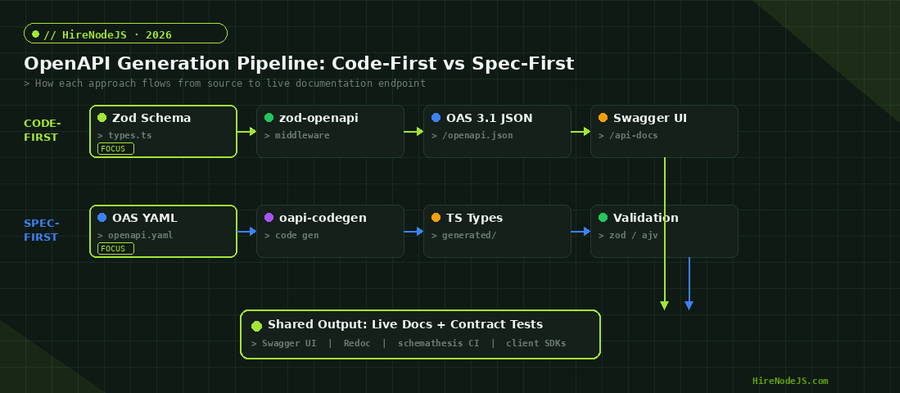
Spec-First Approach: Writing YAML, Generating TypeScript
When Spec-First Is the Better Choice
Spec-first works best when your API is designed by committee — multiple teams, external partners, or a dedicated API design team — or when strict contractual guarantees are required before any code is written. You author the YAML manually or via a GUI like Stoplight Studio, review it in pull requests, then generate TypeScript server stubs and client SDKs from the approved spec. Generated code is guardrailed — any drift triggers a CI failure.
oapi-codegen and openapi-typescript
Two tools dominate spec-first TypeScript generation. oapi-codegen generates full Express or Fastify server interfaces with request and response types inferred from the spec. openapi-typescript generates TypeScript types only — lighter and faster, ideal for frontend SDK generation. Pair either tool with express-openapi-validator for runtime request validation against the spec.
Serving Swagger UI and Redoc in Express, Fastify & NestJS
Hire Pre-Vetted Node.js Developers
Skip the months-long search. Our exclusive talent network has senior Node.js experts ready to join your team in 48 hours.
Express: swagger-ui-express
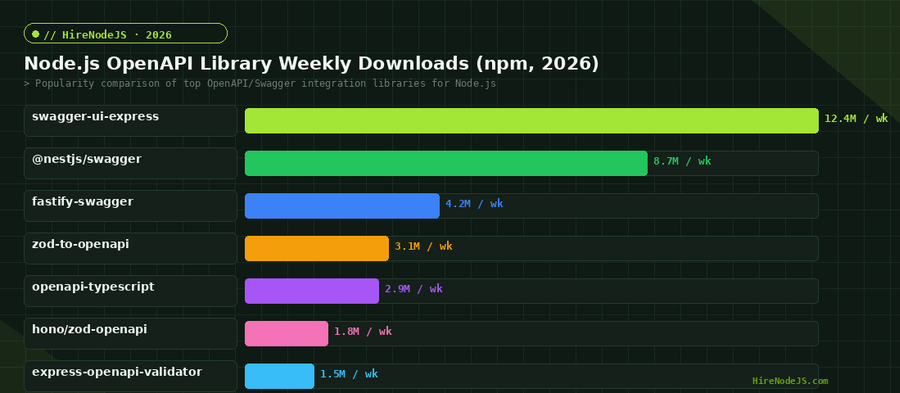
swagger-ui-express (12.4M weekly downloads) is the go-to choice for Express projects. Mount it after your routes, passing the generated spec object. Set persistAuthorization: true in swaggerOptions so testers do not lose their bearer tokens on page refresh. For production, always gate the /api-docs endpoint behind an IP allowlist or auth middleware — you never want your internal spec publicly indexable by crawlers.
Fastify: @fastify/swagger + @fastify/swagger-ui
Fastify's official swagger plugin generates the spec from your route schemas automatically, since Fastify already uses JSON Schema for request and response validation. Register @fastify/swagger first, configure the openapi document metadata, then add @fastify/swagger-ui with a routePrefix of /api-docs. The spec is available at /api-docs/json and /api-docs/yaml with zero additional code.
NestJS: @nestjs/swagger
NestJS has the most powerful decorator-driven OpenAPI integration. @ApiProperty, @ApiOperation, @ApiResponse, and @ApiBearerAuth decorators live alongside your DTOs and controllers — the swagger plugin reads them via TypeScript reflection at startup. For teams building enterprise-grade APIs, NestJS developers who know @nestjs/swagger can save days of manual spec maintenance.
Securing Your OpenAPI Docs: Bearer Tokens, OAuth2 & API Keys
Defining Security Schemes in OAS 3.1
OAS 3.1 supports three main security scheme types: http (Bearer/Basic), apiKey (header, query, or cookie), and oauth2. Define them under components.securitySchemes and reference them per-operation or globally. If your API uses JWTs, declare an http Bearer scheme — Swagger UI renders an Authorize dialog where testers paste a token that auto-populates every request header in the Try It Out UI.
Protecting the /api-docs Route in Production
Never expose Swagger UI to the public internet in a production environment — spec enumeration is a real attack surface. Common patterns include: serving /api-docs only on an internal VPC endpoint, protecting it with a secret header checked by Express middleware, or requiring a valid admin session cookie. For public-facing APIs, consider Redoc as a read-only portal hosted on a separate docs subdomain instead.
Testing Your API Against the OpenAPI Spec with schemathesis
Contract Testing in CI
schemathesis is a stateful property-based testing tool that reads your OAS 3.1 spec and automatically generates hundreds of test cases — including edge-case values, boundary conditions, and malformed inputs. A single CI step (npx schemathesis run ./openapi.json --base-url http://localhost:3000) can surface missing null checks, unvalidated query params, and status-code mismatches that hand-written unit tests rarely catch.
express-openapi-validator for Runtime Validation
For spec-first projects, express-openapi-validator middleware validates every incoming request and outgoing response against the spec at runtime, returning precise 400/500 errors with field-level messages before your controller code runs. This approach is particularly popular among senior backend developers who want a single spec driving both documentation and validation without maintaining parallel Zod schemas.
Dredd for Happy-Path Smoke Testing
Dredd parses your OAS spec and runs one real HTTP request per documented example, checking that the actual response matches the documented schema and status codes. It integrates with any CI pipeline via a simple dredd.yml config and supports authentication hooks for state setup. While schemathesis finds edge cases, Dredd is excellent for verifying the happy path documented in your spec after every deployment.
Hire Expert Node.js Developers — Ready in 48 Hours
Building the right API documentation pipeline is only half the battle — you need engineers who can own it end-to-end. HireNodeJS.com specialises exclusively in Node.js talent: every developer is pre-vetted on real-world API design, OpenAPI specification, TypeScript, and production deployments.
Unlike generalist platforms, our curated pool means you speak only to engineers who live and breathe Node.js. Most clients have their first developer working within 48 hours. Engagements start as short-term contracts and can convert to full-time hires with zero placement fee.
Conclusion: Choosing the Right OpenAPI Approach for Your Node.js Project
Code-first is the right choice if you already have Zod or TypeScript types and want zero schema drift with minimal setup overhead. Spec-first wins when your API is a formal product with strict contracts, multiple consumer teams, or design-first workflows. In both cases the goal is identical: a living OAS 3.1 document that drives Swagger UI, Redoc, runtime validation, client SDK generation, and CI contract tests from a single authoritative source.
Invest in your toolchain from day one — retrofitting OpenAPI onto a 200-route undocumented API is genuinely painful. Start as you mean to go on, register schemas as you write them, and gate every PR on a schemathesis run. If you need experienced Node.js engineers who already know this workflow, browse available developers at HireNodeJS — most engagements start within 48 hours.
Frequently Asked Questions
What is OpenAPI 3.1 and why should I use it with Node.js?
OpenAPI 3.1 is the latest version of the OpenAPI Specification with full JSON Schema 2020-12 alignment, webhooks support, and improved security definitions. In Node.js, libraries like zod-to-openapi and @nestjs/swagger generate OAS 3.1 docs directly from your TypeScript schemas, keeping documentation always in sync with your code.
What is the difference between code-first and spec-first OpenAPI in Node.js?
Code-first generates the OpenAPI spec from your existing TypeScript or Zod schemas at runtime — minimal overhead but spec accuracy depends on the generator. Spec-first starts with a hand-authored YAML spec and generates TypeScript types and server stubs from it — better for multi-team APIs with strict contracts, but requires discipline to prevent drift.
How do I add Swagger UI to an Express.js app?
Install swagger-ui-express and @asteasolutions/zod-to-openapi, generate the spec object at startup, then mount app.use('/api-docs', swaggerUi.serve, swaggerUi.setup(spec)). Always protect this route in production with auth middleware or VPC network restrictions.
Can I use Zod schemas to automatically generate OpenAPI documentation?
Yes. The @asteasolutions/zod-to-openapi library lets you register Zod schemas and route definitions against an OpenAPIRegistry, then call OpenApiGeneratorV31 to produce a valid OAS 3.1 document. Your docs and runtime validation then share the same source of truth.
How do I secure my Swagger UI endpoint in production?
Restrict /api-docs to internal network access only (VPC, private subnet), or add Express middleware that checks for a secret header or a valid admin session. Alternatively, use Redoc with the noTryOut option as a public-facing docs portal and keep interactive Swagger UI on an internal endpoint only.
What is the best OpenAPI library for NestJS in 2026?
@nestjs/swagger (8.7M weekly downloads) is the official and most widely used option. It reads TypeScript decorator metadata to generate OAS 3.1 specs automatically. Use the NestJS CLI plugin (--swaggerPlugin flag) to avoid writing @ApiProperty on every DTO field — the plugin infers types from TypeScript automatically.
Vivek Singh is the founder of Witarist and HireNodeJS.com — a platform connecting companies with pre-vetted Node.js developers. With years of experience scaling engineering teams, Vivek shares insights on hiring, tech talent, and building with Node.js.
Need a Node.js Developer Who Masters API Design?
HireNodeJS connects you with pre-vetted senior Node.js engineers experienced in OpenAPI, Swagger UI, Zod, NestJS, and full API lifecycle management — available within 48 hours. No recruiter fees.