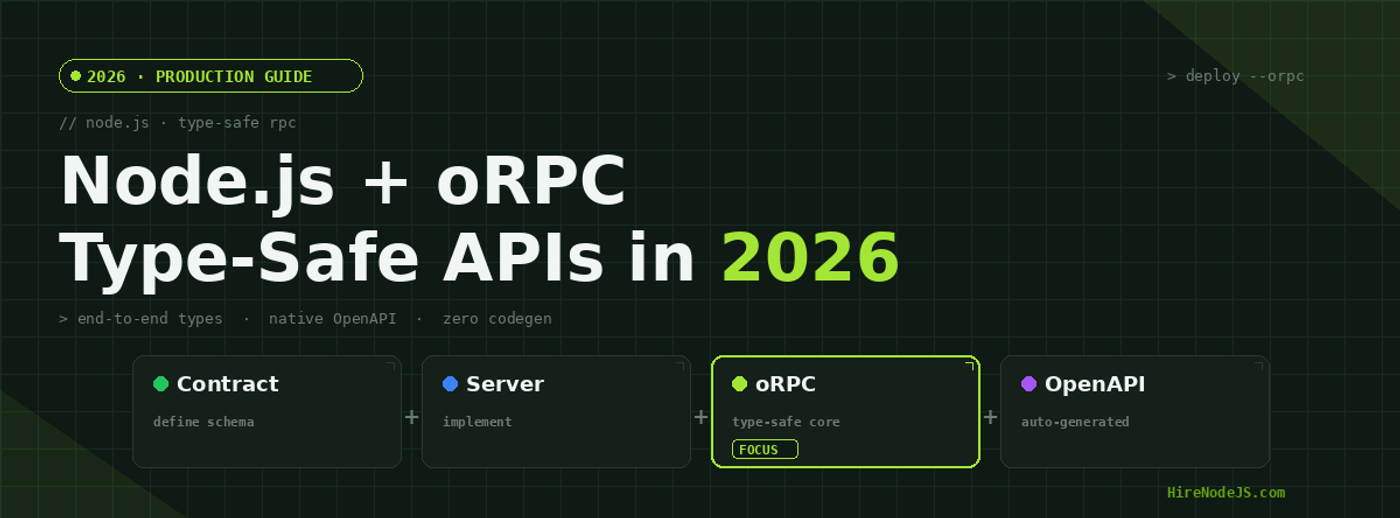
Node.js + oRPC in 2026: Type-Safe APIs with OpenAPI
For three years, tRPC defined what type-safe APIs felt like in the Node.js world: change a procedure on the server and your client lights up red before you even save the file. It was magical — but it was also a walled garden. Your endpoints only existed inside TypeScript, invisible to mobile apps, external partners, or any consumer that wanted a plain REST contract. In 2026, oRPC has emerged as the framework that keeps the magic while tearing down the wall.
oRPC gives you the same end-to-end inference developers love, but every procedure is also a real HTTP endpoint with an automatically generated OpenAPI 3.1 specification. That means one contract powers your typed client, your Swagger docs, and your polyglot consumers at the same time — no plugins, no duplicate schemas, no drift. This guide walks through why that matters, how oRPC works, and the production patterns you need to ship it confidently.
Why Type-Safe APIs Matter in 2026
The cost of contract drift
The single most expensive bug class in any client-server system is the silent contract mismatch: the backend renames a field, ships it, and three frontends break in production hours later. Traditional REST stacks paper over this with hand-written OpenAPI files that rot the moment someone forgets to update them. Type-safe RPC frameworks eliminate the gap by making the schema the single source of truth — the types your client consumes are literally derived from the code your server runs.
Why teams are revisiting the stack now
Two forces converged in 2026. First, edge runtimes like Cloudflare Workers and Vercel Functions made bundle size and cold starts a hiring-level concern, pushing teams toward leaner libraries. Second, the rise of AI agents and third-party integrations made machine-readable OpenAPI specs non-negotiable — an agent cannot call a tRPC procedure it cannot introspect. oRPC sits exactly at that intersection: type-safe for humans, OpenAPI-described for machines.
What Is oRPC and How It Differs from tRPC
A shared mental model
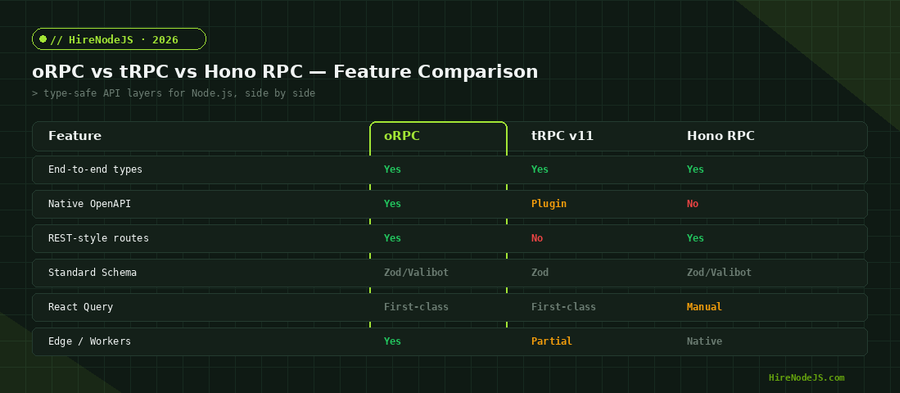
If you have used tRPC, oRPC will feel instantly familiar: you define procedures, attach input and output schemas, and implement a handler. The difference is what happens underneath. Where tRPC speaks its own JSON-RPC-flavored protocol, oRPC speaks standard HTTP with real routes, status codes, and headers. That single design choice is why it can emit OpenAPI natively. Teams that already hire a Node.js backend developer for REST-heavy systems find the transition almost frictionless.
Standard Schema support
oRPC is built on the Standard Schema specification, so you are not married to Zod. You can validate with Zod, Valibot, ArkType, or anything that produces a compatible JSON Schema. That flexibility matters for edge deployments where Valibot's tree-shakeable bundle can shave kilobytes off your cold start compared to Zod. tRPC, by contrast, remains effectively Zod-first in most real codebases.
Building Your First oRPC Endpoint
The fastest way to understand oRPC is to read a minimal but complete example. Below, a single contract defines an input schema, the handler implements the business logic, and the same definition can be served over HTTP and consumed by a fully typed client. Notice there is no code generation step — the client type is inferred directly from the router.
import { os } from '@orpc/server';
import { z } from 'zod';

// 1. Define a procedure: input schema -> handler
export const getUser = os
  .input(z.object({ id: z.string().uuid() }))
  .output(z.object({ id: z.string(), name: z.string(), email: z.string() }))
  .handler(async ({ input }) => {
    const user = await db.users.findById(input.id);
    if (!user) throw new ORPCError('NOT_FOUND', { message: 'User not found' });
    return user;
  });

// 2. Compose procedures into a router
export const router = { user: { get: getUser } };

// 3. Serve it over standard HTTP (works on Node, Bun, Workers)
import { RPCHandler } from '@orpc/server/fetch';
const handler = new RPCHandler(router);

export default {
  fetch: (request) => handler.handle(request).then(r => r.response),
};
On the client, you import the router type and get full autocomplete with zero runtime coupling. If a teammate changes the output schema, every call site that depends on the removed field fails to compile. This is the same workflow that makes strong TypeScript skills so valuable on a backend team — the compiler becomes your integration test.
Native OpenAPI: One Contract, Many Consumers
From procedure to spec, automatically
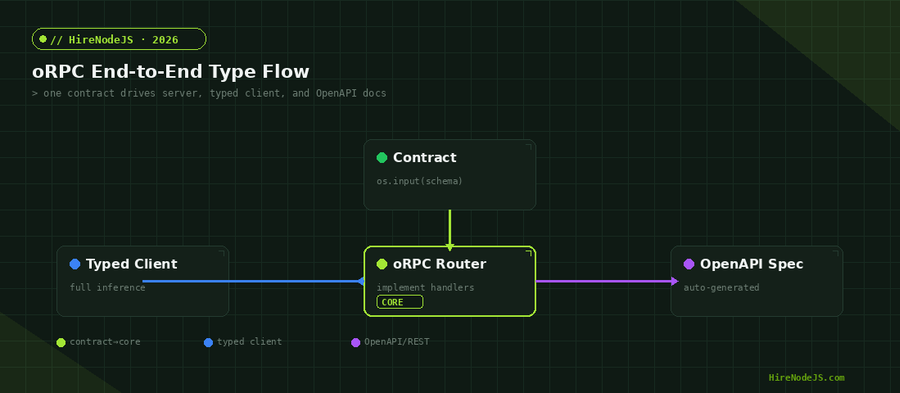
The headline feature is that oRPC can serve an OpenAPI document and a Scalar/Swagger UI straight from your router with a few lines of setup. Your input and output schemas become request and response definitions; your route metadata becomes paths and tags. There is no second artifact to keep in sync because the spec is generated from the exact code that runs.
This unlocks consumers that tRPC structurally cannot reach. A Python data team can generate a client from your OpenAPI file. An AI agent can read the spec and call your endpoints as tools. A partner integration can hit your routes with plain curl. The diagram below shows how a single contract fans out into a typed client, a running server, and machine-readable docs.
Hire Pre-Vetted Node.js Developers
Skip the months-long search. Our exclusive talent network has senior Node.js experts ready to join your team in 48 hours.
oRPC vs tRPC vs Hono RPC: Choosing the Right Layer
Where each one wins
tRPC v11 remains the safest default for a tightly coupled Next.js application where the same team owns both ends and lives inside React Query. Its ecosystem, documentation, and community are unmatched. Hono RPC is the leanest option and shines on the edge, but its type inference is thinner and it has no first-class OpenAPI story. oRPC threads the needle: tRPC-grade inference, Hono-grade portability, and OpenAPI out of the box.
The adoption curve tells its own story. Since the v1 release, oRPC's weekly npm downloads have climbed steeply as teams that need both type safety and a public REST surface adopt it. The interactive trend below illustrates that trajectory.
A simple decision rule
Choose tRPC when your API is private and TypeScript-only. Choose Hono RPC when raw edge performance and minimal bundle size dominate every other concern. Choose oRPC when you need end-to-end types and a real, documented HTTP API that non-TypeScript consumers can use — which, increasingly, describes most production backends in 2026.
Production Patterns: Validation, Errors, and Middleware
Typed errors that survive the wire
oRPC ships a typed error system: you declare the errors a procedure can throw, and clients receive them with full type information and correct HTTP status codes. This is a meaningful upgrade over throwing generic exceptions, because your frontend can switch on error codes with compiler help rather than parsing strings.
Composable middleware
Authentication, rate limiting, logging, and tenant resolution all live in middleware that runs before your handler and can enrich the typed context. Because the context type flows through to the handler, accessing the authenticated user is fully typed — no casting, no any. This mirrors the middleware ergonomics backend engineers already expect from Express and Fastify, but with inference carried end to end.
When oRPC Is the Right Call — and When It Isn't
oRPC is an excellent fit when you are building a backend that must serve both a TypeScript frontend and external or machine consumers, when OpenAPI is a requirement rather than a nice-to-have, or when you want to standardize on one contract layer across web, mobile, and partner integrations. It is probably overkill for a tiny internal tool with a single React client and no external surface, where tRPC's deeper ecosystem may simply be more convenient.
Whichever layer you choose, the harder part is usually staffing engineers who can design clean contracts and reason about type inference at scale. If you're building a Node.js system and need that expertise fast, HireNodeJS connects you with pre-vetted senior developers available within 48 hours — and you can see exactly how the process works before you commit.
Hire Expert Node.js Developers — Ready in 48 Hours
Building the right system is only half the battle — you need the right engineers to build it. HireNodeJS.com specialises exclusively in Node.js talent: every developer is pre-vetted on real-world projects, API design, type-safe architecture, and production deployments.
Unlike generalist platforms, our curated pool means you speak only to engineers who live and breathe Node.js. Most clients have their first developer working within 48 hours of getting in touch. Engagements start as short-term contracts and can convert to full-time hires with zero placement fee.
Conclusion: The Best of Both Worlds
oRPC represents the maturation of type-safe APIs in the Node.js ecosystem. It keeps everything developers loved about tRPC — instant inference, a single source of truth, no codegen — and adds the one thing that kept tRPC out of so many architectures: a real, standards-based HTTP surface with automatic OpenAPI. For teams in 2026 building backends that serve humans and machines alike, it is rapidly becoming the default recommendation.
Start small: wrap one existing endpoint in an oRPC procedure, expose its OpenAPI doc, and watch your typed client and Swagger UI light up from the same definition. Once you feel how much drift disappears, you'll understand why adoption is accelerating — and why it's worth getting the architecture right from day one.
Frequently Asked Questions
What is oRPC in Node.js?
oRPC is a TypeScript-first framework for building type-safe APIs in Node.js. It gives you end-to-end type inference like tRPC, but every procedure is also a standard HTTP endpoint with an automatically generated OpenAPI specification.
How is oRPC different from tRPC?
Both provide end-to-end type safety, but oRPC speaks standard HTTP and generates OpenAPI docs natively, so non-TypeScript clients and AI agents can consume your API. tRPC uses its own protocol and needs a plugin for OpenAPI.
Does oRPC require code generation?
No. Like tRPC, oRPC infers the client types directly from your router definition at compile time. There is no separate codegen step to run or keep in sync.
Can I use Valibot or ArkType instead of Zod with oRPC?
Yes. oRPC is built on the Standard Schema specification, so it works with Zod, Valibot, ArkType, or any compatible validator — which is helpful for trimming bundle size on edge runtimes.
Is oRPC production-ready in 2026?
Yes. Since its v1 release oRPC has stabilized its API, ships typed errors and composable middleware, and runs on Node.js, Bun, and edge runtimes. Adoption has grown steadily as teams need both type safety and OpenAPI.
When should I choose tRPC over oRPC?
Choose tRPC for a private, TypeScript-only API tightly coupled to a Next.js app with React Query, where its larger ecosystem is an advantage. Choose oRPC when you also need a documented REST surface for external or machine consumers.
Vivek Singh is the founder of Witarist and HireNodeJS.com — a platform connecting companies with pre-vetted Node.js developers. With years of experience scaling engineering teams, Vivek shares insights on hiring, tech talent, and building with Node.js.
Need a Node.js engineer who ships type-safe, well-documented APIs?
HireNodeJS connects you with pre-vetted senior Node.js engineers experienced in oRPC, tRPC, and OpenAPI-driven architectures — available within 48 hours. No recruiter fees, no lengthy screening.