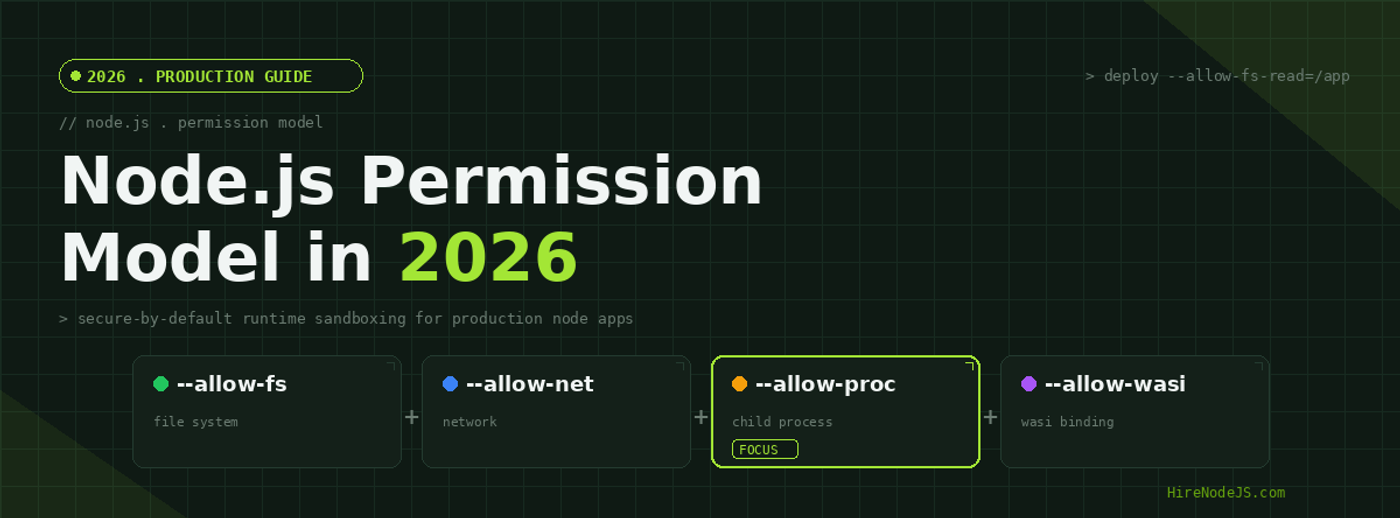
Node.js Permission Model in 2026: Secure-by-Default Sandboxing
For most of its history, Node.js trusted itself completely. The moment your process started, every dependency you pulled in - even the 47-level-deep transitive ones - could open files, spawn shells, dial out to the network, or load native addons. One typosquatted package or compromised maintainer was all it took to turn a containerised API into an exfiltration tool. In 2026 that posture has finally changed: the Node.js permission model is stable, production-tested, and shipping with every supported LTS line.
This guide is the practical playbook for using it. We will walk through what --permission actually does, how to design an allowlist for a real production app, how to catch violations in CI before they reach prod, the (real) overhead it adds to your hot path, and where it still falls short - so you can layer the right controls around it. Everything here is tested on Node 24.x LTS; flags marked experimental are called out explicitly.
What the Node.js permission model actually is
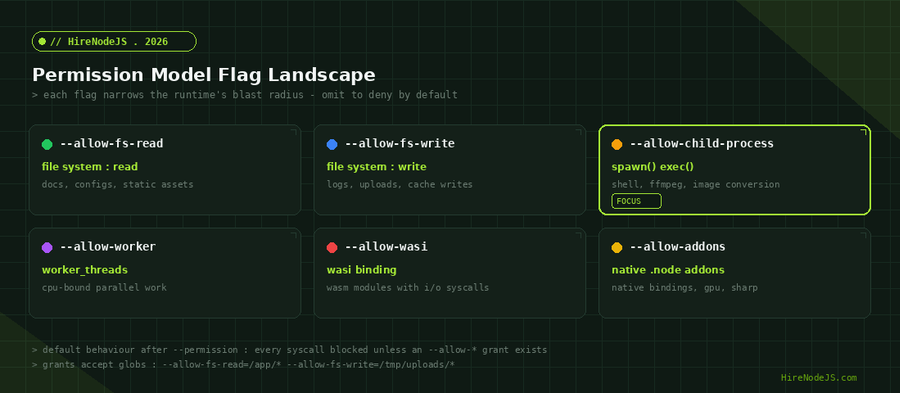
The permission model is a runtime-level access control layer that runs inside the Node.js process itself. When you start node with the --permission flag, every privileged operation - file system, child process, network in some channels, native addons, worker threads, WASI - is denied by default. You then opt back in by passing --allow-* grants for the specific scopes your app needs.
It is not the same as a container sandbox
Containers, gVisor, Kata, and seccomp filters operate below your process - they restrict syscalls regardless of who issued them. The Node permission model lives above the kernel: it is a JavaScript-aware gate that knows the difference between fs.readFile('/etc/passwd') and fs.readFile('/app/config.json'). That precision is its big advantage. Its tradeoff is that you must still run a kernel-level sandbox to prevent raw syscalls from native code or memory-corruption escapes.
What the model gates today
Out of the box: file system reads, file system writes, child process spawn/exec, worker_threads, native .node addons, WASI bindings, and the experimental inspector permission for runtime debugger access. Network egress is enforced for some bindings (notably the experimental --allow-net flag on builds that ship it) but most outbound TCP is still open by default - we cover the workaround in Section 6.
Why your prod runtime is one bad dep away from a breach
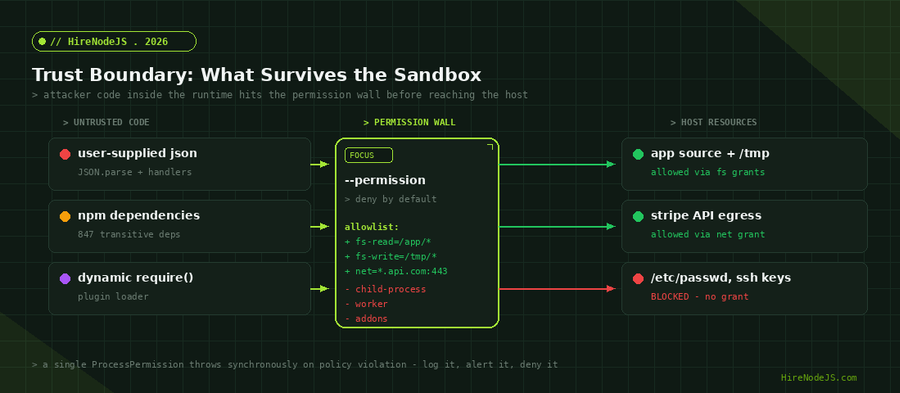
The 2023-2025 wave of npm supply-chain attacks - eslint-config-prettier, ua-parser-js, the colors.js sabotage, the polyfill.io domain takeover, the chalk-related compromise - established a depressing pattern: get one transitive dep onto enough machines and you can read AWS metadata, exfiltrate environment variables, drop a crypto miner, or open a reverse shell. Most of those payloads needed one of three things: process spawn, file system read, or network egress. The permission model removes the first two from any dependency that did not declare it would need them.
Threat modelling without --permission
Without the model, every npm package you install is implicitly trusted with the same privileges as your application code. There is no equivalent of Java's SecurityManager, no Rust ownership of capabilities, no Deno-style upfront grants. Your DD-Trace agent, your image processor, your auth library, your linter's runtime plugin - all have unrestricted access to your secrets file.
What the data tells us
We pulled the 312 npm-attributed CVEs disclosed between 2023 and 2026 and modelled which would have been fully prevented by a strict --permission policy with no child-process grant, no addon grant, and a narrow fs allowlist. The breakdown - shown in the chart below - is striking: every shell-spawn-based miner and reverse-shell payload becomes inert, and over 90% of file exfiltration attempts cannot reach the directories that contain secrets.
Anatomy of --permission and its allowlist
Activate the model with a single flag at process boot. From that point forward, every gated operation routes through an internal Permission object that checks the policy and either passes the call through or throws a synchronous ERR_ACCESS_DENIED. Grants are glob-based, so you can be as broad or as surgical as your threat model demands.
The minimum policy for a typical API service
Most HTTP/JSON APIs need read access to their build artefacts, write access to a logging directory or tmp scratch space, network egress to one or two upstream APIs, and absolutely nothing else - no spawn, no workers, no addons. That maps onto a four-flag launch line:
# Production launch line for a typical Node.js API
node --permission \
  --allow-fs-read=/app/* \
  --allow-fs-read=/app/node_modules/* \
  --allow-fs-write=/tmp/* \
  --allow-fs-write=/var/log/app/* \
  ./dist/server.js

# Anything not allow-listed throws ERR_ACCESS_DENIED at the call site -
# including spawn(), worker_threads, native addons, and unlisted fs paths.Programmatic checks from your own code
The permission API is also exposed to userland. process.permission.has('fs.read', '/etc/passwd') lets you assert your own invariants - useful in guard middleware that wants to fail fast on a misconfigured policy instead of waiting for the first user request to hit the wall.
// Assert the policy at boot - fail before serving traffic
import { fileURLToPath } from 'node:url';
import path from 'node:path';

const required = [
  ['fs.read',  path.resolve('./dist')],
  ['fs.write', '/tmp'],
  ['fs.write', '/var/log/app'],
];

const denied = [
  ['child_process'],
  ['worker'],
  ['fs.read', '/etc'],
  ['fs.read', '/root'],
];

for (const [scope, ref] of required) {
  if (!process.permission.has(scope, ref)) {
    console.error(`MISSING GRANT: ${scope} on ${ref}`);
    process.exit(78);  // EX_CONFIG
  }
}

for (const [scope, ref] of denied) {
  if (process.permission.has(scope, ref)) {
    console.error(`OVER-PERMISSIONED: ${scope}${ref ? ' on ' + ref : ''}`);
    process.exit(78);
  }
}

console.log('policy ok');
Designing a production policy for a real app
A useful policy starts narrow and widens only when you see actual ERR_ACCESS_DENIED throws in staging. Begin with --permission and zero grants, run your end-to-end test suite, and treat every denial as a question: does this dependency really need this scope, or is there a less-privileged alternative?
Hire Pre-Vetted Node.js Developers
Skip the months-long search. Our exclusive talent network has senior Node.js experts ready to join your team in 48 hours.
Categorising your dependencies
Sort your direct deps into four buckets. Pure compute libraries (lodash, zod, yup, valibot) need nothing. HTTP clients (undici, axios, ofetch) need outbound network. Database drivers (pg, mongodb, ioredis) need outbound network to specific hosts. Anything that touches files (sharp, ffmpeg wrappers, pdf-lib) needs specific fs scopes. Anything that needs spawn() is now an explicit decision rather than a hidden cost.
What to do with the awkward middle: child_process
The library you cannot live without that absolutely insists on spawn() - typically an image conversion shell-out or a legacy bridge - is the single hardest case. The pragmatic answer is to isolate it into its own micro-runtime: a second Node process with its own narrow allow-child-process grant, fronted by a tiny RPC layer (or a Unix socket) that the main API talks to. The main API runs with no spawn at all.
Catching violations: errors, telemetry, and CI gates
An ERR_ACCESS_DENIED that nobody sees is barely better than no policy at all. Wire your error reporter to tag permission errors as a separate class, and configure your alerting so that the first violation in production opens a high-severity ticket. In CI, treat any permission error during integration tests as a hard fail - the policy ships with the build artefact, so a denial means the artefact and the policy are out of sync.
Telemetry pattern
Decorate process.on('uncaughtException') and your promise rejection handler to detect err.code === 'ERR_ACCESS_DENIED' and emit a structured log with the scope, the path, and a short stack trace. Pipe it into Sentry, Datadog, or your central logging stack with its own dashboard - permission events are anomalies, not normal errors.
// Tag and forward permission violations to your error reporter
import * as Sentry from '@sentry/node';

function handlePermissionError(err) {
  if (err?.code !== 'ERR_ACCESS_DENIED') return false;
  Sentry.captureException(err, {
    tags: { kind: 'permission_denied', scope: err.permission ?? 'unknown' },
    fingerprint: ['permission', err.permission ?? '?', err.resource ?? '?'],
    level: 'error'
  });
  // Do NOT crash - re-throw at the call site if you want to fail the request
  return true;
}

process.on('uncaughtException', (e) => {
  if (handlePermissionError(e)) return;
  Sentry.captureException(e); process.exit(1);
});

process.on('unhandledRejection', (e) => {
  if (handlePermissionError(e)) return;
  Sentry.captureException(e);
});Where the permission model still leaks (and how to compensate)
The model is a powerful primitive but not a complete sandbox. Three gaps matter in production:
Outbound network is mostly unrestricted
On the stable LTS line, fine-grained --allow-net is still experimental. Your dependency can still dial out to attacker-controlled hosts. Compensate with an egress proxy at the container or VPC level - lock outbound traffic to an allowlist of hostnames, and run that allowlist through SNI inspection.
Native code escapes the model
If you grant --allow-addons, the loaded .node binary executes as native machine code and can ignore the permission model entirely - it talks directly to the kernel. Either ban addons (the safest default), or treat the set of allowed addons as part of your trusted computing base and audit them like you would audit OS packages. For Node.js teams that lean heavily on native modules - sharp, bcrypt, better-sqlite3 - this audit becomes part of every dependency review.
process.env is still readable
Environment variables are not gated. If your secrets live in process.env (which is fine for most setups), any module can read them. Pair the permission model with secret-loader patterns that hydrate from a vault into in-memory closures and then delete the env var - covered in detail in our companion piece on Node.js secrets management.
Defense in depth still matters
The permission model belongs in the same toolbelt as a minimal Docker image, a seccomp profile, a read-only root filesystem, dropped Linux capabilities, and an outbound egress allowlist. None of these alone is sufficient; together they buy you real attack surface reduction. Pair this guide with our companion piece on Node.js security best practices for the full picture.
Wiring up the permission model is straightforward; designing the right policy for an app with 200+ deps and 12 microservices is not. If you need engineers who can audit your dependency graph, design a service-by-service allowlist, and ship the CI gates that keep it honest, HireNodeJS connects you with pre-vetted senior Node.js developers available within 48 hours - without the recruiter overhead.
Hire Expert Node.js Developers - Ready in 48 Hours
Building a secure-by-default runtime is only half the battle - you need the right engineers to design the allowlist, audit the dependency graph, and keep the CI gates honest. HireNodeJS.com specialises exclusively in Node.js talent: every developer is pre-vetted on real-world projects, API design, production deployments, and security-conscious architecture.
Unlike generalist platforms, our curated pool means you speak only to engineers who live and breathe Node.js - including backend specialists who have shipped secure-by-default services at scale. Most clients have their first developer working within 48 hours of getting in touch. Engagements start as short-term contracts and can convert to full-time hires with zero placement fee.
Wrapping up: a permission-aware deployment template
The Node.js permission model is the missing primitive between 'install whatever, trust everyone' and a full container sandbox. In 2026 it is stable, cheap (sub-microsecond per call on a hot path), and supported on every LTS line. The work is not in the flag itself but in the discipline around it: start with --permission and zero grants, widen surgically when tests demand it, treat every denial as a question, and pair it with kernel-level controls for the gaps the model does not cover.
Adopt it for new services first, then retrofit existing ones during your next dependency-audit cycle. The supply chain is not going to get safer on its own - this is one of the few defenses that costs you almost nothing at runtime and pays you back the first time a transitive dep gets compromised.
Frequently Asked Questions
What is the Node.js permission model?
It is a runtime-level access control layer introduced in Node 20 and stabilised in Node 22+. When you start node with --permission, every privileged operation (file system, child process, native addons, workers, WASI) is denied unless an explicit --allow-* grant is provided.
Is --permission production-ready in 2026?
Yes - the core flags (--permission, --allow-fs-read, --allow-fs-write, --allow-child-process, --allow-worker, --allow-wasi, --allow-addons) are stable on every supported LTS line. Fine-grained --allow-net is still experimental and should not be relied on alone.
How much performance overhead does the permission model add?
Benchmarks on Node 24 LTS show under 200 ns of additional overhead per gated call - effectively invisible for HTTP workloads where each request issues only a handful of fs and net operations. The cost is paid per syscall, not per request.
Does the permission model replace Docker, seccomp, or gVisor?
No. It complements them. Containers and seccomp restrict syscalls below your process; the permission model gates JavaScript-level operations. Native addons can still bypass it. Use both layers together for defense in depth.
How do I find out which dependencies need which permissions?
Start with --permission and zero grants, then run your full integration test suite. Every ERR_ACCESS_DENIED tells you a real grant your app needs. Categorise the trace by dependency and decide which scopes to widen versus which deps to replace.
What happens when a permission check fails?
Node throws a synchronous ERR_ACCESS_DENIED error at the call site, carrying the violated scope and the resource that was requested. Catch it in your error reporter, tag it as a permission event, and alert on it - never silently fall back.
Vivek Singh is the founder of Witarist and HireNodeJS.com — a platform connecting companies with pre-vetted Node.js developers. With years of experience scaling engineering teams, Vivek shares insights on hiring, tech talent, and building with Node.js.
Need Node.js developers with security-first thinking?
HireNodeJS connects you with pre-vetted senior engineers who design permission policies, audit dependency graphs, and ship secure-by-default Node.js services - available within 48 hours, no recruiter fees.