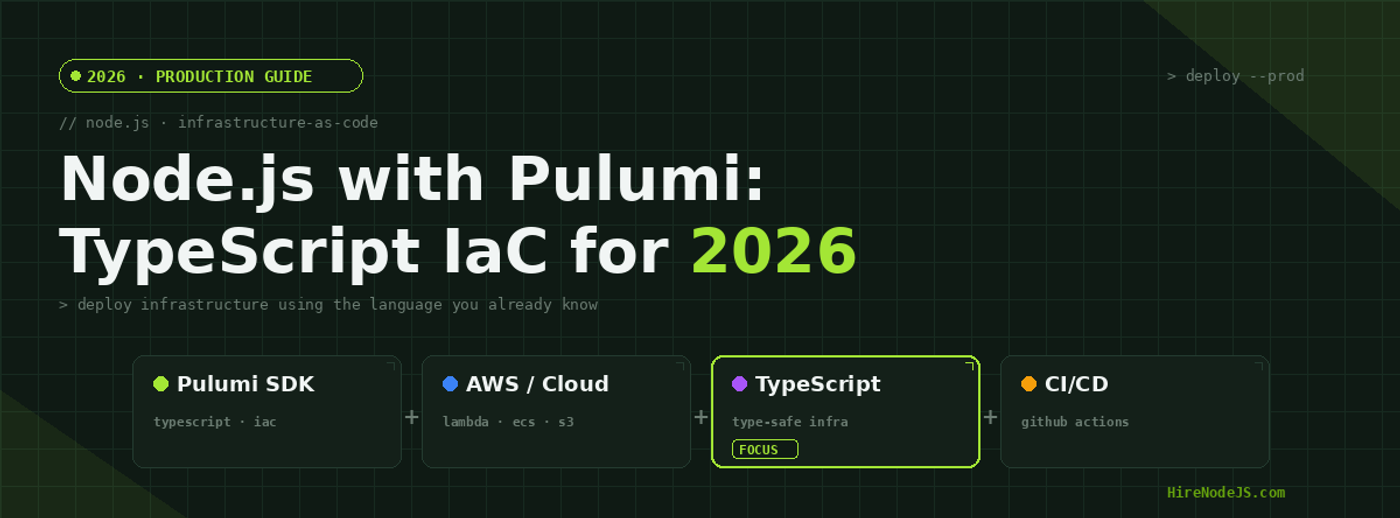
Node.js with Pulumi: TypeScript Infrastructure as Code for 2026
Infrastructure as Code has become a non-negotiable practice for production Node.js deployments. Yet many Node.js teams still wrestle with YAML-heavy tools like CloudFormation or domain-specific languages like HCL, creating a cognitive gap between the application code they write daily and the infrastructure definitions they maintain. Pulumi eliminates that gap entirely by letting you define, deploy, and manage cloud infrastructure using TypeScript — the same language your Node.js application is already written in.
In this guide, we walk through everything a Node.js team needs to adopt Pulumi in production: from project setup and core concepts to advanced patterns like component resources, stack references, and CI/CD integration. Whether you are provisioning a single Lambda function or orchestrating a multi-service Kubernetes deployment, Pulumi gives you the type safety, testability, and composability that modern Node.js developers expect from their toolchain.
What Is Pulumi and Why Should Node.js Teams Care
Pulumi is an open-source Infrastructure as Code platform that lets you provision and manage cloud resources using general-purpose programming languages. Unlike Terraform, which requires learning HCL, or CloudFormation, which demands verbose YAML or JSON templates, Pulumi supports TypeScript, JavaScript, Python, Go, and .NET. For Node.js teams, the TypeScript support is the killer feature — you get full IntelliSense, compile-time type checking, and access to the entire npm ecosystem directly in your infrastructure code.
The Core Mental Model
Pulumi introduces three key concepts: programs, stacks, and resources. A program is your TypeScript code that declares the desired state of your infrastructure. A stack is an isolated instance of that program — typically one per environment like dev, staging, and production. Resources are the individual cloud components you create: S3 buckets, Lambda functions, ECS services, RDS instances, and hundreds more across every major cloud provider.
How Pulumi Differs from Terraform and CDK
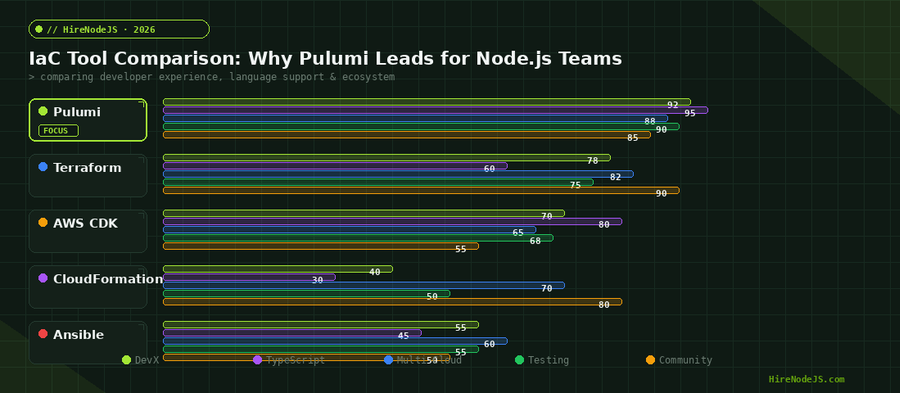
Terraform uses a declarative configuration language called HCL. While powerful, HCL lacks the expressiveness of a real programming language — you cannot write complex conditionals, loops, or abstractions without hitting its limitations. AWS CDK generates CloudFormation templates under the hood, which means you inherit CloudFormation's stack size limits, slow deployments, and opaque error messages. Pulumi operates differently: it communicates directly with cloud provider APIs through a resource provider model, giving you faster feedback loops and more transparent error handling.
Setting Up Pulumi for a Node.js Project
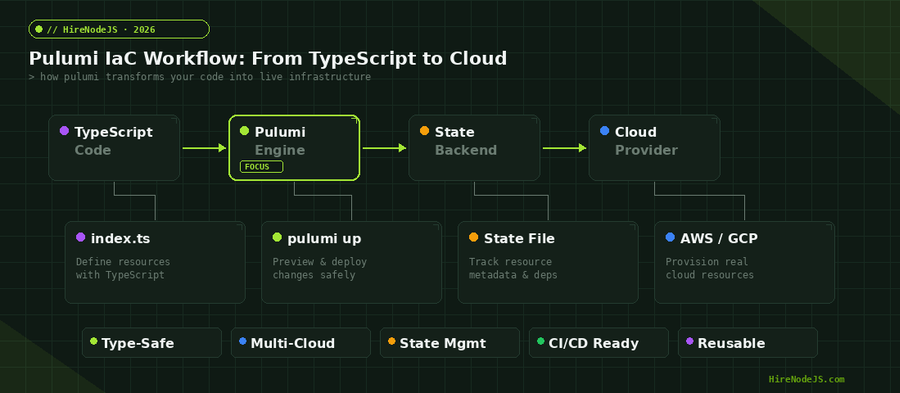
Getting started with Pulumi takes less than five minutes. Install the CLI, create a new project, and you have a fully typed TypeScript infrastructure project ready to deploy. The developer experience is remarkably smooth because Pulumi leverages the Node.js ecosystem you already know — npm for package management, tsconfig for TypeScript configuration, and familiar project structures.
Installation and Project Scaffolding
Install the Pulumi CLI via your package manager of choice, then run the new project command with the TypeScript template for your target cloud. Pulumi generates a complete project skeleton including a Pulumi.yaml configuration file, a tsconfig.json, and an index.ts entry point where you define your resources.
import * as pulumi from "@pulumi/pulumi";
import * as aws from "@pulumi/aws";

// Create an S3 bucket for static assets
const assetsBucket = new aws.s3.Bucket("assets-bucket", {
  acl: "private",
  versioning: { enabled: true },
  serverSideEncryptionConfiguration: {
    rule: {
      applyServerSideEncryptionByDefault: {
        sseAlgorithm: "AES256",
      },
    },
  },
  tags: {
    Environment: pulumi.getStack(),
    ManagedBy: "pulumi",
  },
});

// Create a Lambda function
const apiHandler = new aws.lambda.Function("api-handler", {
  runtime: aws.lambda.Runtime.NodeJS20dX,
  handler: "index.handler",
  code: new pulumi.asset.AssetArchive({
    ".": new pulumi.asset.FileArchive("./dist"),
  }),
  memorySize: 256,
  timeout: 30,
  environment: {
    variables: {
      BUCKET_NAME: assetsBucket.bucket,
      NODE_ENV: "production",
    },
  },
});

// Export the bucket name and Lambda ARN
export const bucketName = assetsBucket.bucket;
export const lambdaArn = apiHandler.arn;Configuration and Secrets Management
Pulumi has built-in secrets management that encrypts sensitive values like database passwords and API keys. Unlike environment variables or .env files, Pulumi secrets are encrypted at rest in your state backend and decrypted only during deployment. This is critical for teams building production backend services where credential management directly impacts security posture.
Core Pulumi Concepts for TypeScript Developers
Pulumi's programming model maps cleanly onto concepts TypeScript developers already understand. Resources are class instances, stack outputs are exported constants, and configuration is loaded through typed accessors. This familiarity dramatically reduces the learning curve compared to tools that require mastering a new syntax or paradigm.
Inputs, Outputs, and the Async Resource Model
Every Pulumi resource property is either an Input or an Output. Inputs are the values you provide when creating a resource — they can be plain values or references to other resources' outputs. Outputs represent values that are only known after deployment, similar to Promises in JavaScript. Pulumi's type system ensures you cannot accidentally use an unresolved Output where a plain string is expected, catching entire categories of deployment bugs at compile time.
Stack References for Multi-Stack Architectures
Real-world Node.js applications rarely fit into a single stack. You might have a networking stack that provisions your VPC and subnets, a database stack for RDS instances, and an application stack for your ECS services or Lambda functions. Pulumi stack references let these stacks communicate type-safely: the networking stack exports its VPC ID and subnet IDs, and the application stack imports them with full type information. Refactoring is safe because the TypeScript compiler catches mismatched types immediately.
Advanced Patterns — Component Resources and Abstractions
One of Pulumi's most powerful features is the ability to create reusable component resources using plain TypeScript classes. A component resource groups related infrastructure into a single abstraction that your team can instantiate across projects. Think of it as creating your own higher-level building blocks on top of primitive cloud resources — the same way you build React components on top of HTML elements.
Building a Reusable Node.js Service Component
Hire Pre-Vetted Node.js Developers
Skip the months-long search. Our exclusive talent network has senior Node.js experts ready to join your team in 48 hours.
Imagine every microservice your team deploys needs an ALB target group, an ECS service, a CloudWatch log group, and an IAM role. Without abstraction, each new service means copy-pasting hundreds of lines of infrastructure code. With a Pulumi component resource, you define a NodeService class once and instantiate it with different configurations. This pattern is especially valuable for teams practicing full-stack development where multiple services share common infrastructure patterns.
Dynamic Providers for Custom Resources
When you need to manage a resource that no existing Pulumi provider covers — perhaps a custom internal API or a niche SaaS tool — dynamic providers let you implement create, read, update, and delete operations in TypeScript. The dynamic provider API gives you full control over the resource lifecycle while still integrating with Pulumi's state management and dependency graph. This extensibility means Pulumi can manage your entire infrastructure, not just the parts covered by official providers.
Testing Infrastructure Code with TypeScript
One of the strongest arguments for Pulumi over HCL-based tools is testability. Because your infrastructure is real TypeScript code, you can test it with the same tools you use for application code — Jest, Vitest, or the native Node.js test runner. Pulumi provides a mocking framework that lets you unit test resource configurations without actually provisioning anything.
Unit Testing with Pulumi Mocks
Pulumi's unit testing approach works by replacing the deployment engine with a mock that records which resources your program creates and with what properties. You can then assert that specific resources exist, that their configurations match your security policies, and that dependencies are wired correctly. A typical test might verify that every S3 bucket has encryption enabled, every Lambda function has a timeout under 30 seconds, or every IAM role follows least-privilege principles.
Integration and Property Testing
Beyond unit tests, Pulumi supports integration tests that deploy real resources to a temporary stack, run validation logic against the live infrastructure, and then tear everything down. Property tests go further by defining policies that run against every deployment — for example, ensuring no security group allows unrestricted inbound access or that all databases are deployed in private subnets. These policy-as-code checks integrate directly into your CI pipeline, catching misconfigurations before they reach production.
CI/CD Integration and GitOps Workflows
Pulumi integrates with every major CI/CD platform: GitHub Actions, GitLab CI, CircleCI, Jenkins, and more. The typical workflow is straightforward — run pulumi preview on pull requests and pulumi up on merges to main. For teams that already have CI/CD pipelines with GitHub Actions, adding Pulumi is a matter of adding a few workflow steps.
GitHub Actions Workflow for Pulumi
A production-ready GitHub Actions workflow for Pulumi typically includes three jobs: preview on pull requests, deploy to staging on merge to main, and promote to production on manual approval or tag creation. Each job uses the official Pulumi GitHub Action, which handles CLI installation, authentication, and stack selection automatically. Environment-specific configuration is stored in Pulumi stack config files, keeping secrets encrypted and environment differences explicit.
Drift Detection and Remediation
Infrastructure drift — when the actual state of your cloud resources diverges from your declared state — is a persistent challenge for DevOps teams. Pulumi provides built-in drift detection through the pulumi refresh command, which compares your state file against actual cloud resources. Running refresh on a schedule catches manual changes, accidental modifications, and external updates before they cause deployment failures. When drift is detected, you can choose to update your code to match reality or re-deploy to enforce your declared state.
Pulumi for Serverless Node.js Applications
Serverless architectures are a natural fit for Pulumi because the number of managed resources grows quickly — each Lambda function needs an IAM role, a log group, optional event source mappings, and API Gateway integrations. Defining these manually in YAML is error-prone and tedious. With Pulumi and TypeScript, you can create factory functions that generate entire serverless endpoint stacks from a single function call. Teams building serverless applications on AWS find that Pulumi reduces infrastructure boilerplate by 60 to 70 percent compared to raw CloudFormation.
Lambda Function Patterns
Pulumi offers both low-level Lambda resource definitions and high-level abstractions through the @pulumi/aws-apigateway package. The high-level API lets you define an entire REST API by mapping routes to handler functions, with Pulumi automatically creating the necessary API Gateway resources, Lambda permissions, and CloudWatch log groups. For more control, the low-level approach gives you explicit access to every configuration option while still benefiting from TypeScript's type checking.
Event-Driven Architectures with Pulumi
Beyond HTTP APIs, Pulumi excels at wiring up event-driven architectures. You can define SQS queues, SNS topics, EventBridge rules, and DynamoDB streams as resources, then connect them to Lambda handlers with type-safe event source mappings. The dependency graph Pulumi maintains ensures resources are created in the correct order, and the event-driven patterns your team uses in application code translate naturally to infrastructure definitions.
Hire Expert Node.js Developers — Ready in 48 Hours
Building the right system is only half the battle — you need the right engineers to build it. HireNodeJS.com specialises exclusively in Node.js talent: every developer is pre-vetted on real-world projects, API design, event-driven architecture, and production deployments.
Unlike generalist platforms, our curated pool means you speak only to engineers who live and breathe Node.js. Most clients have their first developer working within 48 hours of getting in touch. Engagements start as short-term contracts and can convert to full-time hires with zero placement fee.
Conclusion — TypeScript All the Way Down
Pulumi represents a paradigm shift for Node.js teams managing cloud infrastructure. By using TypeScript for both application code and infrastructure definitions, you eliminate the context-switching overhead of learning HCL or wrestling with YAML templates. You gain type safety, testability, and the full power of the npm ecosystem in your infrastructure layer. The result is faster deployments, fewer misconfigurations, and infrastructure code that your entire engineering team — not just a dedicated DevOps specialist — can understand, review, and maintain.
Whether you are migrating from Terraform, replacing CloudFormation, or setting up infrastructure automation for the first time, Pulumi with TypeScript is the most productive choice for Node.js teams in 2026. Start with a single stack, build reusable components as patterns emerge, and integrate deployments into your existing CI/CD pipeline. The learning curve is minimal for any developer who already writes TypeScript, and the productivity gains compound with every new service you deploy. If your team needs experienced engineers to implement this, HireNodeJS can connect you with senior Node.js developers who have production Pulumi experience.
Frequently Asked Questions
What is the best infrastructure as code tool for Node.js developers in 2026?
Pulumi is the best IaC tool for Node.js developers because it uses TypeScript natively, provides full type safety, and integrates with the npm ecosystem. Unlike Terraform or CloudFormation, there is no new language to learn.
How does Pulumi compare to Terraform for TypeScript projects?
Pulumi lets you write infrastructure in TypeScript with full IDE support, while Terraform requires HCL. Pulumi also supports real unit testing with Jest or Vitest, provides built-in secrets management, and communicates directly with cloud APIs for faster deployments.
Can I use Pulumi with existing AWS CloudFormation stacks?
Yes. Pulumi can import existing CloudFormation stacks and individual cloud resources into its state management. This lets you migrate incrementally rather than rewriting everything at once.
Is Pulumi free for production use?
Pulumi's core engine and CLI are open source and free. The optional Pulumi Cloud service offers team collaboration features with a free tier for individual developers and paid plans for teams needing advanced features like RBAC and audit logs.
How do I test Pulumi infrastructure code?
Pulumi provides a mocking framework that lets you unit test resource configurations with Jest or Vitest without provisioning real resources. You can also run integration tests against temporary stacks and define policy-as-code rules that enforce compliance on every deployment.
How much does it cost to hire a Node.js developer with Pulumi experience?
Senior Node.js developers with Pulumi and DevOps experience typically command rates between $80 and $150 per hour depending on location and seniority. HireNodeJS.com connects you with pre-vetted engineers at competitive rates with no recruiter fees.
Vivek Singh is the founder of Witarist and HireNodeJS.com — a platform connecting companies with pre-vetted Node.js developers. With years of experience scaling engineering teams, Vivek shares insights on hiring, tech talent, and building with Node.js.
Need a DevOps-Savvy Node.js Engineer?
HireNodeJS connects you with pre-vetted senior Node.js engineers who understand infrastructure as code, CI/CD pipelines, and cloud architecture. Get your first developer within 48 hours — no recruiter fees, no lengthy screening.