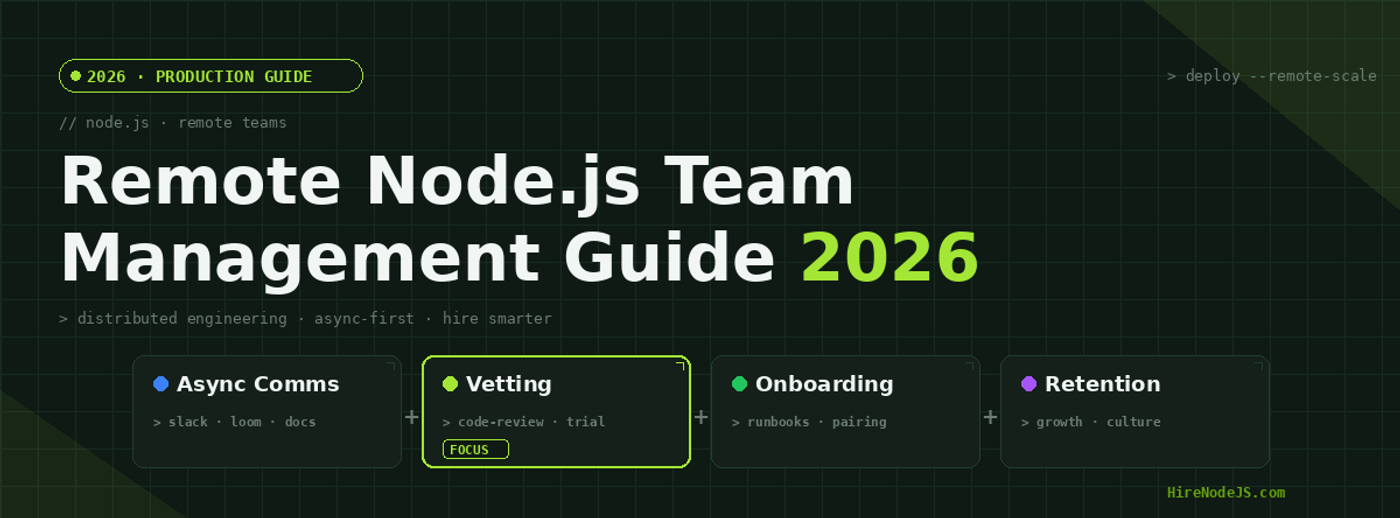
How to Manage a Remote Node.js Development Team in 2026
The era of requiring Node.js developers to sit in the same office ended years ago, but managing a distributed engineering team effectively remains one of the hardest challenges in software leadership. In 2026, remote-first is no longer a perk — it is a competitive advantage that unlocks global talent, reduces overhead, and accelerates delivery cycles when executed correctly.
Whether you are scaling a startup with three developers across time zones or running a 20-person Node.js backend team spanning four continents, this guide covers every aspect of remote team management — from hiring and vetting to async workflows, tooling, and retention strategies that actually work in production environments.
Why Remote Node.js Teams Win in 2026
Remote engineering teams consistently outperform their on-site counterparts on several critical metrics. Studies show remote developers average 6.2 hours of deep work per day compared to 4.8 hours in traditional office settings — a 29 percent increase in focused coding time. For Node.js teams working on event-driven architectures and real-time APIs, that extra focus time translates directly into faster feature delivery.
The Talent Pool Advantage
Companies with location-flexible hiring policies report three to four times larger applicant pools compared to office-mandated competitors. When you hire Node.js developers from a global pool, you are not limited to whoever lives within commuting distance of your headquarters. The best NestJS architect for your project might be in Krakow, and the ideal TypeScript expert could be in Buenos Aires.
Cost Efficiency Without Sacrificing Quality
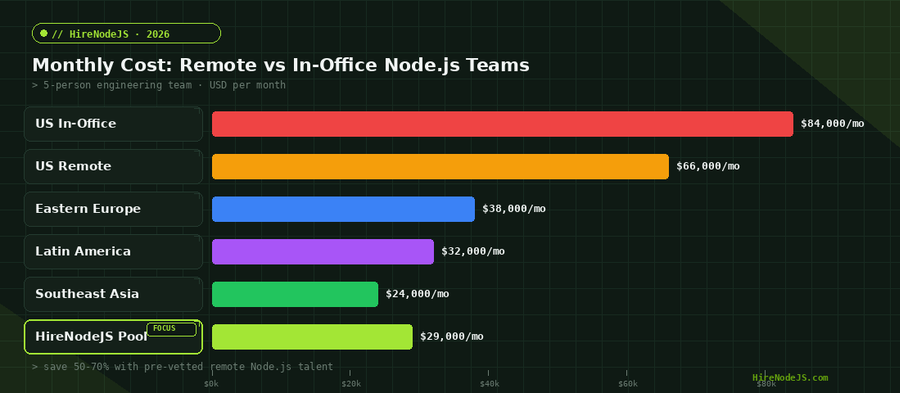
A dedicated five-person remote Node.js team costs between 18,000 and 29,000 USD per month when sourced from Southeast Asia or Eastern Europe, compared to 66,000 to 84,000 USD per month for the same caliber of engineers in a US office. This is not about hiring cheap talent — it is about accessing senior developers in regions where the cost of living allows competitive salaries at lower price points for the employer.
Hiring and Vetting Remote Node.js Developers
The biggest risk in remote hiring is not geographical distance — it is inadequate vetting. A developer who interviews well over video may struggle with asynchronous communication, self-directed work, or the specific production demands of your Node.js stack. Your vetting process must evaluate both technical skill and remote readiness.
Technical Assessment Beyond the Whiteboard
Forget algorithmic puzzles. For remote Node.js roles, assess candidates with paid take-home projects that mirror your actual codebase. A 4-hour assignment building a REST API with Express or Fastify, including error handling, input validation with Zod, and a basic test suite, reveals far more than a 45-minute LeetCode session. Platforms like HireNodeJS pre-vet developers with real-world project assessments, saving you weeks of screening.
Evaluating Remote Readiness
Screen for remote-specific traits during the interview process: written communication quality, experience working across time zones, comfort with asynchronous decision-making, and a track record of self-directed delivery. Ask candidates to describe how they handled a production incident while working remotely, or how they communicated a complex architectural decision in writing rather than in a meeting.
Building an Async-First Communication Culture
The single biggest predictor of remote team success is not the tools you use — it is your communication culture. Async-first means that the default mode of communication is written and asynchronous, with synchronous meetings reserved for high-bandwidth discussions like architecture reviews, sprint planning, and incident response.
The Async Communication Stack
Every remote Node.js team needs four communication layers: a real-time messaging tool like Slack or Discord for quick questions with a 4-hour response expectation, a project management system like Linear or Jira for task tracking and sprint workflow, a documentation platform like Notion or Confluence for architecture decision records and runbooks, and an async video tool like Loom for code walkthroughs and complex explanations that benefit from visual context.
Documentation as Infrastructure
High-performing distributed teams treat documentation as code. Every architectural decision gets an ADR (Architecture Decision Record). Every deployment process has a runbook. Every service has an up-to-date README with setup instructions that actually work. Teams that invest in an internal engineering wiki report new developer onboarding time dropping from four weeks to under ten days.
Tooling and Infrastructure for Remote Node.js Teams
Remote teams need a more robust developer experience than co-located teams because there is no walking over to someone's desk to debug a failing build. Your CI/CD pipeline, development environment setup, and observability stack must be self-service and well-documented.
Standardized Development Environments
Hire Pre-Vetted Node.js Developers
Skip the months-long search. Our exclusive talent network has senior Node.js experts ready to join your team in 48 hours.
Use Docker Compose or devcontainers to ensure every developer runs the same environment regardless of their operating system. A new team member should be able to run a single command and have the entire Node.js application, database, Redis cache, and message queue running locally within 15 minutes. If your Docker setup takes longer than that, it is a sign your development infrastructure needs investment.
// scripts/health-check.mjs — Remote team daily health dashboard
import http from 'node:http';

const SERVICES = [
  { name: 'API Gateway',   url: 'http://localhost:3000/health' },
  { name: 'Auth Service',  url: 'http://localhost:3001/health' },
  { name: 'Worker Queue',  url: 'http://localhost:3002/health' },
  { name: 'WebSocket Hub', url: 'http://localhost:3003/health' },
];

async function checkService({ name, url }) {
  const start = performance.now();
  try {
    const res = await fetch(url, { signal: AbortSignal.timeout(5000) });
    const latency = Math.round(performance.now() - start);
    const body = await res.json();
    return { name, status: res.ok ? 'healthy' : 'degraded', latency, uptime: body.uptime ?? 'N/A' };
  } catch (err) {
    return { name, status: 'down', latency: -1, error: err.message };
  }
}

async function runHealthCheck() {
  const results = await Promise.all(SERVICES.map(checkService));
  const timestamp = new Date().toISOString();

  console.log(`\n=== Service Health Report — ${timestamp} ===\n`);
  for (const r of results) {
    const icon = r.status === 'healthy' ? '✅' : r.status === 'degraded' ? '⚠️' : '❌';
    console.log(`${icon} ${r.name.padEnd(16)} | ${r.status.padEnd(8)} | ${r.latency}ms`);
  }

  const downCount = results.filter(r => r.status === 'down').length;
  if (downCount > 0) {
    console.log(`\n🚨 ${downCount} service(s) down — post to #incidents Slack channel`);
    // In production: trigger PagerDuty or Slack webhook
  }
  return results;
}

runHealthCheck();Time Zone Management and Follow-the-Sun Delivery
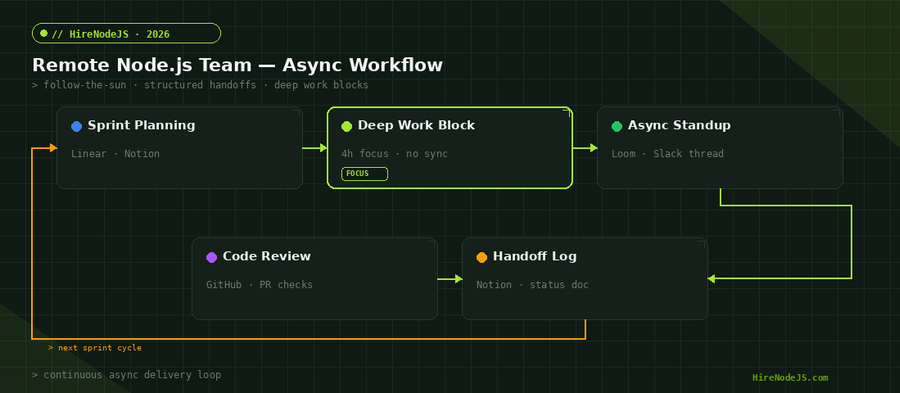
Time zones are not a liability — they are an asset when managed correctly. A team spread across UTC-5, UTC+1, and UTC+8 can achieve nearly 24-hour coverage. When your US-based engineers finish their day, the Asian team picks up the baton with a structured handoff document that details what was accomplished, what is blocked, and what needs attention next.
Structured Handoff Templates
Create a standardized handoff template that every developer fills in at the end of their working day. It should include completed tasks with PR links, work in progress with current status and any blockers, questions or decisions needed from the next shift, and any incidents or alerts that occurred. Post this in a dedicated Slack channel or Notion page so the incoming team has immediate context without needing a synchronous call.
Maximizing Overlap Windows
Identify the 2-3 hour overlap between time zones and protect that window ruthlessly. Use overlap time exclusively for high-bandwidth activities: pair programming on complex problems, architecture discussions, sprint planning, and retrospectives. Everything else — code reviews, status updates, design feedback — should happen asynchronously.
Onboarding Remote Developers for Maximum Velocity
The first 30 days of a remote developer's tenure determine whether they become a productive team member or a costly mis-hire. Remote onboarding requires more structure than in-office onboarding because there are no organic opportunities to absorb context from overhearing conversations or walking to the whiteboard.
The 30-60-90 Day Onboarding Plan
Days 1-30 focus on environment setup, codebase orientation, and shipping the first small PR. Assign a dedicated onboarding buddy in a similar time zone who is available for daily 15-minute check-ins. Days 31-60 ramp up to independent feature work with regular code review from senior team members. Days 61-90 mark the transition to full autonomy, with the developer owning a service or feature area end-to-end and participating in on-call rotations.
Retention Strategies for Remote Node.js Engineers
Remote developers show 25 percent lower turnover than office-based developers according to 2026 hiring data, but only when companies invest in retention deliberately. The flexibility of remote work cuts both ways — your developers can work for anyone in the world, which means the competition for retention is also global.
Continuous Learning and Career Growth
Budget for conference attendance, online courses, and certification programs. Allocate 10 percent of each sprint for tech debt reduction and exploration of new tools. Encourage developers to deepen their expertise in specific areas — whether that is TypeScript advanced patterns, performance optimization, or security hardening. Engineers who feel they are growing stay longer.
Fair Compensation Across Geographies
While location-based pay adjustments are common — 71 percent of companies use them — the trend in 2026 is moving toward value-based compensation. Pay for the value the developer delivers, not for where they happen to live. Remote developers earn 4 to 7 percent more than their office counterparts on average, reflecting the premium on self-directed productivity. Review compensation quarterly against market benchmarks to avoid losing top talent to competitors offering better rates.
Hire Expert Node.js Developers — Ready in 48 Hours
Building the right system is only half the battle — you need the right engineers to build it. HireNodeJS.com specialises exclusively in Node.js talent: every developer is pre-vetted on real-world projects, API design, event-driven architecture, and production deployments.
Unlike generalist platforms, our curated pool means you speak only to engineers who live and breathe Node.js. Most clients have their first developer working within 48 hours of getting in touch. Engagements start as short-term contracts and can convert to full-time hires with zero placement fee.
Key Takeaways for Remote Node.js Team Success
Managing a remote Node.js team in 2026 requires deliberate investment in async-first communication, structured onboarding, robust tooling, and fair compensation. The payoff is substantial: access to a global talent pool, significant cost savings, higher developer satisfaction, and round-the-clock delivery capability. The companies that master remote engineering management are not just surviving — they are shipping faster, retaining better talent, and building more resilient systems than their office-bound competitors.
Start with your communication culture, invest in documentation as infrastructure, standardize your development environments, and vet for remote readiness alongside technical skill. The future of Node.js development is distributed — make sure your team management practices are ready for it.
Frequently Asked Questions
How much does it cost to hire a remote Node.js development team in 2026?
A five-person remote Node.js team costs between 18,000 and 29,000 USD per month when sourced from Southeast Asia or Eastern Europe, compared to 66,000 to 84,000 USD per month for equivalent US-based in-office engineers.
What tools do remote Node.js teams need for async communication?
Remote Node.js teams need four communication layers: real-time messaging like Slack, project management like Linear or Jira, documentation like Notion, and async video tools like Loom for code walkthroughs.
How do you onboard a remote Node.js developer effectively?
Use a structured 30-60-90 day plan with a dedicated onboarding buddy, Docker-based environment setup that takes under 15 minutes, and clear milestones from first PR to independent feature ownership.
How do you manage time zones in a distributed Node.js team?
Use follow-the-sun delivery with structured handoff templates at each shift change. Protect the 2-3 hour overlap window for high-bandwidth activities like pair programming and architecture reviews.
What is the best way to vet remote Node.js developers?
Use paid take-home projects that mirror your actual codebase — building a REST API with error handling and tests reveals far more than algorithmic puzzles. Also evaluate written communication and async work experience.
How do you retain remote Node.js developers long-term?
Invest in continuous learning budgets, allocate sprint time for tech debt and exploration, use value-based compensation reviewed quarterly against market benchmarks, and build a strong async-first team culture.
Vivek Singh is the founder of Witarist and HireNodeJS.com — a platform connecting companies with pre-vetted Node.js developers. With years of experience scaling engineering teams, Vivek shares insights on hiring, tech talent, and building with Node.js.
Skip the Search — Hire Pre-Vetted Remote Node.js Developers in 48 Hours
HireNodeJS connects you with senior Node.js engineers who are remote-ready, pre-vetted on real-world projects, and available to start immediately. No recruiter fees, no lengthy screening — just top distributed talent ready to ship.