Node.js Resilience Patterns 2026: Circuit Breakers, Retries & Bulkheads
A Node.js service in 2026 rarely runs alone. It calls a payment processor, a vector database, an LLM provider, a feature flag service, an internal microservice, and three queues — and any of them can degrade at the wrong moment. Without resilience patterns, a single slow downstream turns a fast API into a thread-bound mess that drags every other endpoint down with it.
Resilience engineering is no longer an optional concern reserved for Netflix-scale systems. It is the baseline expectation for any production Node.js service that fronts real users. This guide walks through the four patterns every senior engineer should know — circuit breakers, retries with jittered backoff, timeouts, and bulkheads — with runnable code, real benchmark data, and clear failure-mode trade-offs. If you are looking to hire Node.js developers who treat failure as a first-class concern, the patterns below are the ones to interview for.
Why Resilience Patterns Matter in 2026
The fundamental problem is that Node.js services are coordination layers. A typical request fans out to several downstream calls, and the slowest one defines the user-visible latency. When a downstream is healthy, the cost of resilience is invisible — a few microseconds of bookkeeping. When a downstream degrades, resilience is the difference between a localized issue and a full outage.
The three failure modes you will hit
In production, downstream services fail in three predictable ways: hard failures (connection refused, DNS resolution errors), soft failures (degraded latency where requests still complete but take seconds), and partial failures (a fraction of requests return errors while others succeed). Each demands a different response: hard failures want fast rejection, soft failures want timeouts, and partial failures want retries with backoff.
The compounding cost of unprotected calls
Without protection, a soft failure in a single downstream can saturate your event loop. Each request holds a socket, a Promise, and stack memory for the full timeout duration. With 1,000 requests per second and a 30-second hung downstream, you accumulate 30,000 in-flight requests in under a minute — long before that, your process is out of file descriptors, your load balancer marks the instance unhealthy, and the cascade begins.
The 2026 baseline: more dependencies, tighter SLAs
Modern Node.js stacks routinely depend on a dozen managed services per request: an authentication provider, a feature flag service, a payments processor, two or three internal microservices, a vector store, an LLM provider, a queue, and a cache. Each of those introduces a failure mode that did not exist in a monolithic Rails app a decade ago. The Stack Overflow 2025 Developer Survey confirmed Node.js as the most-used backend runtime — and with that adoption came expectation: customers and SLAs now assume four-nines availability even when half the internet is on fire.
Adding resilience patterns is not a heroic feat; it is the table-stakes engineering work that separates production-grade services from prototypes. Every code path that touches the network needs to assume that the network will, at some point in the next 24 hours, behave in a way you did not expect. Designing for that assumption is what resilience patterns formalize.
Circuit Breakers: The First Line of Defence
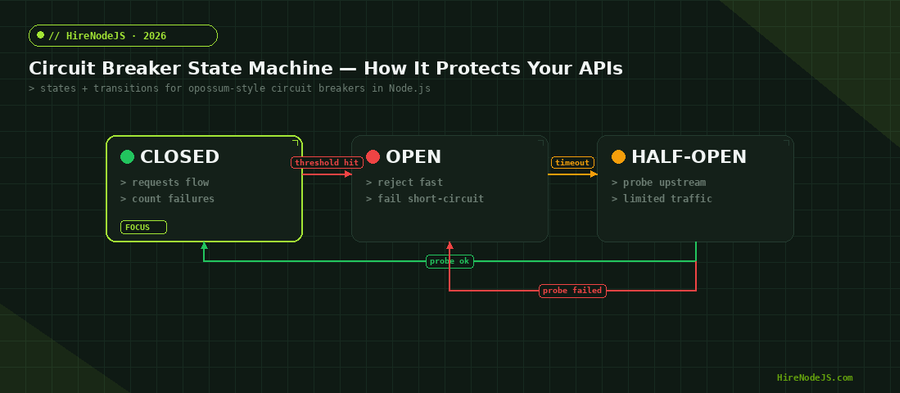
A circuit breaker wraps a function call and tracks its failure rate. When failures cross a threshold within a sliding window, the breaker "opens" and immediately rejects subsequent calls without touching the downstream — protecting both your process and the struggling service from further load. After a cooldown period, the breaker transitions to HALF-OPEN, allowing a probe request through. If the probe succeeds, the breaker closes; if it fails, the breaker re-opens for another cooldown cycle.
The opossum library — the de facto standard
The opossum library, maintained by Red Hat, is the canonical circuit breaker implementation for Node.js. It wraps any async function in a state machine that emits events you can hook into for metrics. Below is a production-ready wrapper around a flaky payment API call.
import CircuitBreaker from 'opossum';
import { fetch } from 'undici';

// The raw async function we want to protect.
async function chargeCard(amount, token) {
  const res = await fetch('https://api.payments.example.com/charge', {
    method: 'POST',
    headers: { 'content-type': 'application/json' },
    body: JSON.stringify({ amount, token }),
    signal: AbortSignal.timeout(2500),  // hard ceiling
  });
  if (!res.ok) throw new Error(`charge failed: ${res.status}`);
  return res.json();
}

// Production tunings: small error budget, fast cooldown, monitored events.
const breaker = new CircuitBreaker(chargeCard, {
  timeout: 3000,                  // ms before a call counts as failed
  errorThresholdPercentage: 50,   // open at >=50% failures
  resetTimeout: 10000,            // ms in OPEN before HALF-OPEN probe
  rollingCountTimeout: 10000,     // window for failure stats
  rollingCountBuckets: 10,        // 10x 1-second buckets
  volumeThreshold: 20,            // need 20 calls before tripping
});

// Fallback when the breaker is OPEN — keeps callers responsive.
breaker.fallback(() => ({ status: 'queued_for_retry', retryAfterMs: 5000 }));

// Hook into events for metrics + alerting.
breaker.on('open',   () => metrics.increment('payments.breaker.open'));
breaker.on('close',  () => metrics.increment('payments.breaker.close'));
breaker.on('reject', () => metrics.increment('payments.breaker.short_circuit'));

export async function safeCharge(amount, token) {
  return breaker.fire(amount, token);
}Threshold tuning: the most common mistake
Many teams ship a breaker with the defaults (50% error threshold, 10-second rolling window, 30-second cooldown) and call it done. Those defaults are reasonable starting points, but they are not correct for every downstream. A payments processor that handles 50 requests per second deserves a tighter threshold than a metrics endpoint that handles 5,000. Run a chaos drill — inject latency and errors, watch when your breaker actually trips, and adjust the volumeThreshold and errorThresholdPercentage until the breaker fires within 5 seconds of a real degradation but ignores transient blips.
A breaker with no observability is worse than no breaker at all — you lose visibility into the downstream while still routing around it. Always attach the open, close, and halfOpen events to your metrics pipeline so you can correlate breaker state with downstream health in your dashboards.
Retries with Jittered Exponential Backoff
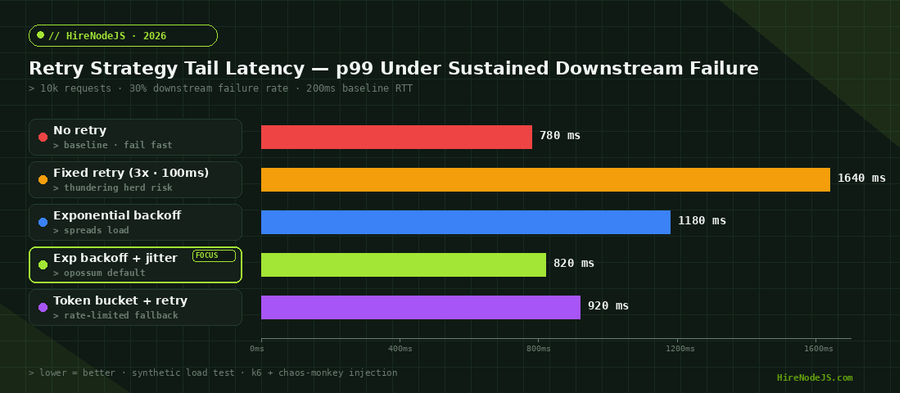
Retries are the most misused resilience pattern. The naive version — "if it fails, try again immediately" — creates a thundering herd that hits the recovering service at exactly the wrong moment, often turning a brief blip into a full outage. The correct pattern is exponential backoff with random jitter, capped at a maximum delay, and bounded by a maximum attempt count.
Why jitter matters more than backoff
The AWS Architecture Blog post on exponential backoff and jitter makes a counterintuitive point: pure exponential backoff still produces synchronized retry storms because all clients started at the same moment. Adding random jitter — picking a random delay within the backoff window — spreads the retry attempts across time and dramatically reduces peak load on the recovering downstream.
// Production-ready retry with full jitter + abort signal support.
async function retryWithJitter(fn, options = {}) {
  const {
    maxAttempts = 4,
    baseDelayMs = 100,
    maxDelayMs = 5000,
    retryableErrors = (err) => err.code === 'ETIMEDOUT'
                            || err.code === 'ECONNRESET'
                            || (err.status >= 500 && err.status < 600),
    signal,
  } = options;

  let lastError;
  for (let attempt = 1; attempt <= maxAttempts; attempt++) {
    if (signal?.aborted) throw new Error('aborted');
    try {
      return await fn(attempt);
    } catch (err) {
      lastError = err;
      if (attempt === maxAttempts || !retryableErrors(err)) throw err;

      // Full jitter: random in [0, min(cap, base * 2^attempt))
      const exp = Math.min(maxDelayMs, baseDelayMs * 2 ** (attempt - 1));
      const delay = Math.floor(Math.random() * exp);
      await new Promise((resolve, reject) => {
        const t = setTimeout(resolve, delay);
        signal?.addEventListener('abort', () => { clearTimeout(t); reject(new Error('aborted')); });
      });
    }
  }
  throw lastError;
}

// Usage
const result = await retryWithJitter(
  (attempt) => fetchUserProfile(userId, { signal: AbortSignal.timeout(2000) }),
  { maxAttempts: 4, baseDelayMs: 200, maxDelayMs: 4000 }
);Building idempotency into your downstream calls
Even with perfect retry logic, you can double-charge customers, send duplicate emails, or process the same event twice — unless every state-changing call carries an idempotency key that the downstream uses to deduplicate. The pattern is straightforward: generate a UUID at the start of the operation, pass it as an Idempotency-Key header on every retry, and have the downstream cache responses keyed by that UUID for at least 24 hours.
Most modern APIs (Stripe, Square, Adyen, Twilio) support idempotency keys natively. For your own internal services, build it in from day one — the cost is a small Redis cache; the alternative is an incident retrospective with the word "duplicate" in the title.
Timeouts: The Forgotten Foundation
Every external call in your Node.js service should have an explicit timeout. The default for the global fetch in Node.js is "wait until the OS gives up" — which on a hung TCP socket can be minutes. The undici client used by Node.js fetch supports per-request AbortSignal timeouts that you should set aggressively.
Hire Pre-Vetted Node.js Developers
Skip the months-long search. Our exclusive talent network has senior Node.js experts ready to join your team in 48 hours.
Layered timeouts with AbortSignal
Modern Node.js supports composable AbortSignal timeouts via AbortSignal.timeout() and AbortSignal.any(). The any() combinator lets you create a signal that aborts when any of its inputs abort — perfect for combining a request-deadline with a per-call ceiling.
// Composing per-call + request-deadline timeouts.
function callWithDeadline(deadlineSignal, perCallMs, fn) {
  const perCall = AbortSignal.timeout(perCallMs);
  // AbortSignal.any returns a signal that aborts when ANY input aborts.
  const combined = AbortSignal.any([deadlineSignal, perCall]);
  return fn(combined);
}

// Usage inside an Express handler
app.post('/checkout', async (req, res) => {
  // Total request budget: 8 seconds (excluding event loop overhead).
  const deadline = AbortSignal.timeout(8000);

  try {
    const cart   = await callWithDeadline(deadline, 1500, (s) => cartSvc.get(req.userId,   { signal: s }));
    const stock  = await callWithDeadline(deadline, 2000, (s) => stockSvc.check(cart.ids,  { signal: s }));
    const charge = await callWithDeadline(deadline, 3000, (s) => paySvc.charge(req.body,   { signal: s }));
    res.json({ ok: true, chargeId: charge.id });
  } catch (err) {
    if (err.name === 'TimeoutError') return res.status(504).json({ error: 'deadline exceeded' });
    throw err;
  }
});Bulkheads: Isolate Failures Before They Spread
The bulkhead pattern, named after ship compartments, isolates resources so that a failure in one consumer cannot exhaust resources for others. In Node.js this typically means giving each downstream its own connection pool, semaphore, or worker pool — so a slow Postgres query cannot starve your Redis calls of event loop attention.
Semaphore-based bulkhead
A simple bulkhead caps the number of concurrent in-flight calls to a given downstream. New calls that would exceed the limit are either queued briefly or rejected outright — both protect the event loop from being overwhelmed by a single slow service.
class Bulkhead {
  #permits;
  #waiting = [];

  constructor({ maxConcurrent, maxQueue = 0 }) {
    this.#permits = maxConcurrent;
    this.maxQueue = maxQueue;
  }

  async run(fn) {
    if (this.#permits > 0) {
      this.#permits--;
      try { return await fn(); }
      finally { this.#release(); }
    }
    if (this.#waiting.length >= this.maxQueue) {
      const err = new Error('bulkhead full'); err.code = 'BULKHEAD_FULL';
      throw err;
    }
    await new Promise((resolve) => this.#waiting.push(resolve));
    try { return await fn(); }
    finally { this.#release(); }
  }

  #release() {
    const next = this.#waiting.shift();
    if (next) next();
    else this.#permits++;
  }
}

// One bulkhead per downstream — sizes tuned to that service\'s capacity.
const pgBulkhead     = new Bulkhead({ maxConcurrent: 50, maxQueue: 100 });
const paymentsBulkhead = new Bulkhead({ maxConcurrent: 20, maxQueue: 40 });
const llmBulkhead    = new Bulkhead({ maxConcurrent: 8,  maxQueue: 0 }); // reject excess

export const safeLlmCall = (req) => llmBulkhead.run(() => openai.chat.completions.create(req));Putting It All Together: The Resilience Stack
A single pattern is not enough. Production-grade calls layer all four — bulkhead, timeout, circuit breaker, retry — in a specific order. The retry sits outermost (so it can re-enter the breaker), the breaker sits inside the retry, the timeout sits inside the breaker, and the bulkhead wraps the whole stack to cap concurrency.
A composed wrapper for any downstream call
import CircuitBreaker from 'opossum';
import { retryWithJitter } from './retry.js';
import { Bulkhead } from './bulkhead.js';

function makeResilientClient({ name, fn, breakerOptions, bulkheadOptions, retryOptions }) {
  const bulkhead = new Bulkhead(bulkheadOptions);
  const breaker  = new CircuitBreaker(fn, breakerOptions);

  breaker.fallback((...args) => ({ degraded: true, args }));
  breaker.on('open',  () => log.warn(`[${name}] breaker open`));
  breaker.on('close', () => log.info(`[${name}] breaker closed`));

  return async function call(...args) {
    return bulkhead.run(() =>
      retryWithJitter(
        (attempt) => breaker.fire(...args),
        retryOptions
      )
    );
  };
}

export const callPayments = makeResilientClient({
  name: 'payments',
  fn: chargeCard,
  breakerOptions: { timeout: 3000, errorThresholdPercentage: 50, resetTimeout: 10000, volumeThreshold: 20 },
  bulkheadOptions: { maxConcurrent: 20, maxQueue: 40 },
  retryOptions: { maxAttempts: 3, baseDelayMs: 200, maxDelayMs: 2000 },
});
Observability: You Cannot Fix What You Cannot See
Every resilience event — a breaker opening, a retry firing, a bulkhead rejecting — is a signal about your downstream health. Emit each one as a metric and log it with structured context. Pair this with OpenTelemetry tracing and you can pinpoint cascades within minutes of them starting.
The four metrics every resilience layer should emit
At minimum, emit: (1) call_total — every attempt; (2) call_success — successful completions; (3) breaker_state — gauge of 0/1/2 for CLOSED/OPEN/HALF-OPEN per breaker; (4) bulkhead_rejections — counter for full-bulkhead rejections. Alert on sustained breaker_state > 0 and on bulkhead_rejections rate > 0.
Common Anti-Patterns That Make Things Worse
After reviewing dozens of post-incident reports, the same anti-patterns appear over and over. They typically look defensible in code review and only reveal their cost during the next real outage.
Anti-pattern 1: Unbounded retries inside event handlers
A retry loop inside a queue consumer that never gives up will eventually wedge the entire consumer pool when one message references a service that is permanently down. Always cap attempts, dead-letter the message after the cap, and emit a metric on dead-letter rate. The dead-letter queue is the single most useful operational tool you will build this year.
Anti-pattern 2: Retrying through your circuit breaker
If a retry sits inside a breaker that opened, every retry attempt immediately fails on the short-circuit path. That sounds harmless until you measure the cost: each retry still walks the JavaScript event loop, allocates a Promise, and runs your retry math. Under enough load, the cost adds up. Place the retry outside the breaker (as shown in our composed example above) so retried calls actually wait for the breaker to half-open before reattempting. Engineers we vet through our hiring process are tested on exactly this kind of layering — it is a reliable indicator of senior-level systems thinking.
Anti-pattern 3: Single global timeout for all downstreams
A single environment variable like REQUEST_TIMEOUT_MS=5000 applied to every downstream call hides important context. Your payments call may need a 3-second ceiling while your search call could happily wait 8 seconds. Per-downstream timeouts encoded into the client (or read from a per-service config) prevent slow downstreams from eating their downstream-neighbours' budget.
Hire Expert Node.js Developers — Ready in 48 Hours
Building resilient Node.js systems requires engineers who have lived through real outages and learned what actually keeps the lights on. HireNodeJS.com specialises exclusively in senior Node.js talent: every developer is pre-vetted on real-world projects, fault-tolerant API design, event-driven architecture, and production incident response.
Unlike generalist platforms, our curated pool means you speak only to engineers who live and breathe Node.js. Most clients have their first developer working within 48 hours of getting in touch. Engagements start as short-term contracts and can convert to full-time hires with zero placement fee.
Conclusion: Treat Resilience as a Property, Not a Library
The four patterns covered here — circuit breakers, retries with jittered backoff, timeouts, and bulkheads — are the load-bearing primitives of every Node.js service that stays up under real-world conditions. They are not difficult to implement. The difficulty is in tuning them: choosing the right thresholds, sizing the bulkheads to your actual capacity, and observing them well enough to catch drift before it becomes an outage.
Adopt them one at a time, validate each with a chaos drill, and emit metrics on every event. The next time a downstream provider has a bad day, your users will not notice — and that is the only metric that matters.
Frequently Asked Questions
What are the most important Node.js resilience patterns in 2026?
The four foundational patterns are circuit breakers, retries with jittered exponential backoff, timeouts on every external call, and bulkheads to isolate downstream pools. Together they protect your event loop from cascading failures and keep your service responsive even when downstreams degrade.
Which circuit breaker library should I use for Node.js?
Opossum is the de facto standard — it is mature, actively maintained by Red Hat, and emits events you can hook into for metrics. Configure it with errorThresholdPercentage, volumeThreshold, and resetTimeout based on the specific downstream you are guarding.
Why do I need jitter in my retry strategy?
Without jitter, all clients that started at the same moment retry at the same moment, hitting the recovering downstream with a synchronized thundering herd. Adding random jitter spreads the retry attempts across time and dramatically reduces peak load, often turning a near-outage into a smooth recovery.
How do I set timeouts in modern Node.js?
Use AbortSignal.timeout(ms) for per-call timeouts and AbortSignal.any([signal1, signal2]) to compose deadlines with per-call ceilings. Every external call — fetch, database, queue — should accept an AbortSignal and respect it. The Node.js fetch implementation handles this natively in modern Node.js versions.
When should I use the bulkhead pattern in Node.js?
Use bulkheads whenever a single slow downstream could exhaust event loop attention from other endpoints. In practice, that means anywhere you have multiple distinct downstreams (database, payments, LLM provider, internal services) being called from the same Node.js process — give each its own concurrency limit.
Does retrying always make things better?
No. Retries amplify load and can turn a brief failure into a sustained outage if you retry too aggressively or without idempotency protection. Always cap retry attempts, use jittered backoff, validate that the operation is safe to retry, and never retry without an idempotency key for state-changing operations.
Vivek Singh is the founder of Witarist and HireNodeJS.com — a platform connecting companies with pre-vetted Node.js developers. With years of experience scaling engineering teams, Vivek shares insights on hiring, tech talent, and building with Node.js.
Need a Node.js engineer who builds fault-tolerant systems?
HireNodeJS connects you with pre-vetted senior Node.js engineers who design for failure from day one — circuit breakers, observability, and chaos-tested deploys included. Available within 48 hours.