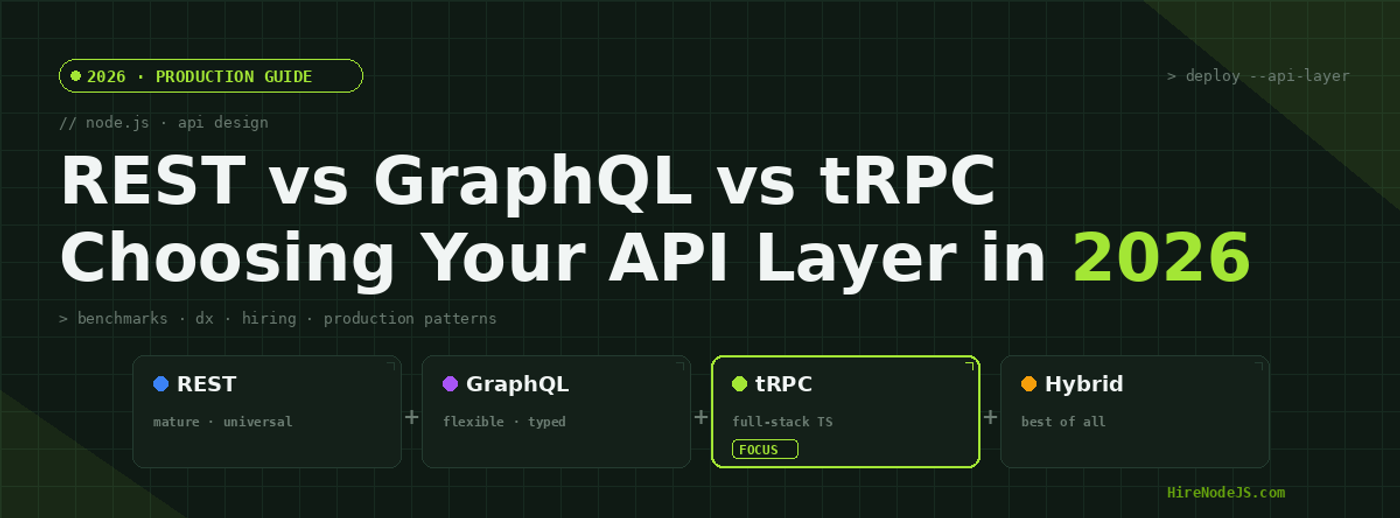
REST vs GraphQL vs tRPC: Choosing Your Node.js API Layer in 2026
Choosing the right API layer is one of the most consequential architectural decisions in any Node.js project. In 2026, the landscape has matured dramatically: REST remains the universal standard, GraphQL has carved out a dominant niche in complex frontend-heavy applications, and tRPC has emerged as the darling of full-stack TypeScript teams who want end-to-end type safety without code generation. Each approach brings genuine strengths — and real tradeoffs that only surface once you hit production scale.
This guide breaks down REST, GraphQL, and tRPC across every dimension that matters: raw performance, developer experience, type safety, ecosystem maturity, caching, and hiring availability. Whether you are building a greenfield startup or scaling an enterprise platform, you will walk away knowing exactly which API layer fits your team and your constraints. If you are looking to hire Node.js developers who are already proficient in these patterns, understanding the tradeoffs will help you ask the right interview questions too.
Understanding REST in 2026
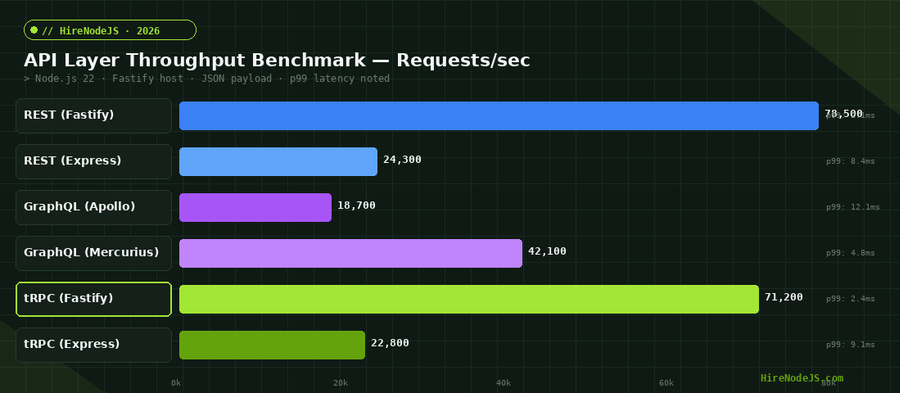
REST — Representational State Transfer — is the foundational API paradigm that has powered the web for over two decades. In 2026, REST is far from obsolete. Frameworks like Fastify have pushed Node.js REST performance to extraordinary levels, regularly exceeding 78,000 requests per second on a single core with JSON serialization. Express, while slower, remains the most-used HTTP framework in the Node.js ecosystem thanks to its unmatched middleware library.
REST Strengths in Production
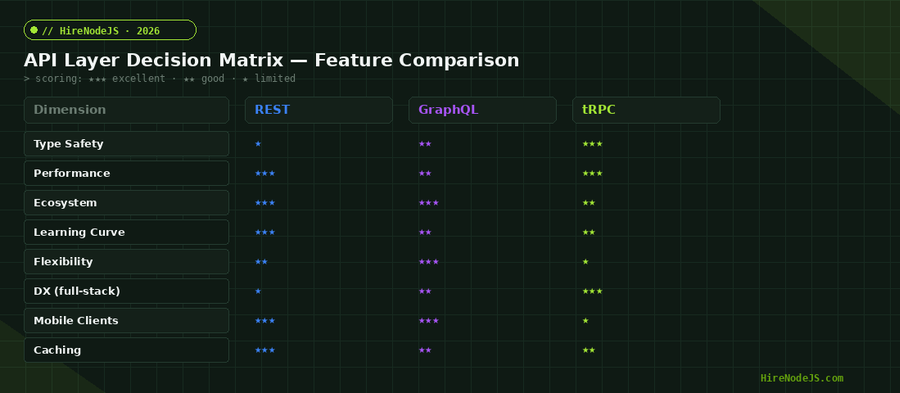
REST shines in scenarios where HTTP caching is critical. Every CDN, reverse proxy, and browser cache natively understands REST semantics — GET requests are cacheable by default, ETags work out of the box, and cache invalidation follows standard HTTP headers. For public APIs consumed by mobile apps, third-party integrations, and services outside your organization, REST is still the pragmatic default. OpenAPI and Swagger provide excellent documentation tooling, and virtually every developer on the planet has shipped a REST API.
REST Limitations
The primary limitation of REST in a TypeScript-dominant world is the lack of built-in type safety. You can layer OpenAPI code generation on top, but it adds a build step and introduces drift risk between your schema and your implementation. Over-fetching and under-fetching remain structural problems — a mobile client that needs three fields still receives the entire resource object, wasting bandwidth and parse time. Nested resource relationships often require multiple round-trips or custom endpoints, which erodes the simplicity REST promises.
GraphQL — The Query Language for Complex UIs
GraphQL was born at Facebook to solve a specific problem: mobile clients with constrained bandwidth needed to fetch exactly the data they required in a single round-trip. In 2026, GraphQL has evolved far beyond that origin story. Apollo Server, Mercurius (for Fastify), and Yoga provide mature, production-grade server implementations for Node.js. The type system is intrinsic — your schema is your contract, and tools like GraphQL Code Generator produce TypeScript types automatically.
When GraphQL Wins
GraphQL excels when your frontend team needs autonomy. Instead of negotiating new endpoints for every feature, frontend engineers write queries that declare exactly what they need. This decoupling accelerates iteration speed dramatically in organizations with separate frontend and backend teams. Federation via Apollo Federation or Schema Stitching allows multiple backend development teams to own their subgraphs independently, which maps well to domain-driven microservice architectures.
tRPC — End-to-End Type Safety Without Code Generation
tRPC has rapidly become the standard for full-stack TypeScript applications. The core idea is elegantly simple: your server-side router defines procedures with Zod input validators, and the client infers the complete type signature at compile time — no schema files, no code generation step, no drift. When you change a procedure's input shape, your IDE immediately shows type errors on the client side. This feedback loop is measured in milliseconds, not minutes.
tRPC Architecture Fundamentals
tRPC works by sharing TypeScript types between server and client through a monorepo or package reference. The server defines a router with queries, mutations, and subscriptions. The client imports only the type of that router — no runtime code crosses the boundary. Under the hood, tRPC uses HTTP POST for mutations and HTTP GET for queries (enabling HTTP caching), but the developer never thinks in HTTP verbs. Procedures are called like local functions with full autocompletion.
tRPC Limitations
tRPC is purpose-built for TypeScript monorepos. If your clients include a Swift iOS app, a Kotlin Android app, or a Python data pipeline, tRPC cannot serve them — it has no language-agnostic schema. The ecosystem, while growing rapidly, is still smaller than REST or GraphQL. Community middleware, authentication plugins, and monitoring integrations are less mature. For teams that need to expose a public API to external consumers, tRPC is not the right choice — at least not as the primary layer.
Performance Benchmarks — Real Numbers for 2026
Performance benchmarks need context. Raw requests-per-second numbers tell you about framework overhead, not about your application's actual bottleneck — which is almost always database queries, external API calls, or business logic computation. That said, framework overhead matters at scale, and the differences between approaches are significant.
Hire Pre-Vetted Node.js Developers
Skip the months-long search. Our exclusive talent network has senior Node.js experts ready to join your team in 48 hours.
On Fastify with Node.js 22, a simple JSON REST endpoint serves around 78,500 requests per second. tRPC on the same Fastify host reaches 71,200 req/sec — the overhead of Zod validation and procedure routing costs roughly 9 percent. GraphQL through Mercurius manages 42,100 req/sec due to the query parsing and resolution pipeline. Apollo Server, with its richer feature set, sits around 18,700 req/sec. On Express, all three approaches are roughly 3x slower due to Express's middleware chain overhead.
When to Use Each — A Decision Framework
Choose REST When
You need a public API consumed by external developers, mobile apps in different languages, or IoT devices. REST is also the right choice when HTTP caching is a primary performance strategy, when your team includes junior developers who need a gentle learning curve, or when you are integrating with legacy systems that speak HTTP natively. If your API is resource-oriented and CRUD-heavy with predictable access patterns, REST maps cleanly to your domain.
Choose GraphQL When
Your frontend team is distinct from your backend team and needs autonomy to iterate without backend changes. GraphQL is ideal when you serve multiple client types with different data requirements, when your data graph is deeply nested with complex relationships, or when you are building a federated API gateway over multiple microservices. Content-rich applications, dashboards, and social platforms benefit enormously from GraphQL's flexibility.
Choose tRPC When
Your entire stack is TypeScript, you control both client and server, and you want the fastest possible development feedback loop. tRPC is perfect for internal tools, admin dashboards, SaaS products with a single web client, and startups that prioritize velocity over API consumer diversity. If you are using Next.js, Nuxt, or SvelteKit with a Node.js backend, tRPC is likely the most productive choice available.
The Hybrid Approach — Combining API Layers
The most sophisticated Node.js architectures in 2026 do not pick one API layer exclusively — they compose them. A common pattern is tRPC for internal full-stack communication (admin panel, internal dashboards), REST for public-facing API endpoints consumed by third parties, and GraphQL as a federated gateway that aggregates data from multiple backend services. This is not overengineering — it is matching each boundary to the tool that serves it best.
import { initTRPC } from '@trpc/server';
import { createHTTPServer } from '@trpc/server/adapters/standalone';
import { z } from 'zod';

const t = initTRPC.create();

// Define your procedures with full type safety
const appRouter = t.router({
  // Query — automatically uses HTTP GET (cacheable)
  getUser: t.procedure
    .input(z.object({ id: z.string().uuid() }))
    .query(async ({ input }) => {
      const user = await db.user.findUnique({ where: { id: input.id } });
      if (!user) throw new TRPCError({ code: 'NOT_FOUND' });
      return user; // Return type is inferred by the client
    }),

  // Mutation — uses HTTP POST
  updateProfile: t.procedure
    .input(z.object({
      name: z.string().min(2).max(100),
      bio: z.string().max(500).optional(),
      skills: z.array(z.string()).max(20),
    }))
    .mutation(async ({ input, ctx }) => {
      return db.user.update({
        where: { id: ctx.userId },
        data: input,
      });
    }),
});

// Export the router type — this is what the client imports
export type AppRouter = typeof appRouter;

// Start the server
createHTTPServer({ router: appRouter }).listen(3000);
console.log('tRPC server running on :3000');
The code above shows a minimal tRPC server with Zod validation. The client imports only the AppRouter type — no runtime code is shared. When the client calls trpc.getUser.query({ id: '...' }), the return type is automatically inferred from the server implementation. Change the return shape on the server, and the client gets a compile error instantly.
Hiring Considerations — Finding the Right API Engineers
Your API layer choice directly impacts your hiring strategy. REST developers are the most abundant — virtually every Node.js developer has built REST APIs. GraphQL engineers are increasingly common but command a premium, especially those with federation experience. tRPC expertise is concentrated in the TypeScript-forward community and is harder to find at scale, though the learning curve for a strong TypeScript developer is measured in days, not weeks.
When interviewing candidates for API-heavy roles, focus on their understanding of the tradeoffs rather than their experience with a specific tool. A developer who can articulate why they chose GraphQL over REST for a particular project — and what problems it introduced — is more valuable than one who has only ever used one approach. If you need to scale your Node.js team quickly, platforms like HireNodeJS specialize in connecting you with pre-vetted engineers who understand these architectural decisions at a production level.
Hire Expert Node.js Developers — Ready in 48 Hours
Building the right system is only half the battle — you need the right engineers to build it. HireNodeJS.com specialises exclusively in Node.js talent: every developer is pre-vetted on real-world projects, API design, event-driven architecture, and production deployments.
Unlike generalist platforms, our curated pool means you speak only to engineers who live and breathe Node.js. Most clients have their first developer working within 48 hours of getting in touch. Engagements start as short-term contracts and can convert to full-time hires with zero placement fee.
Conclusion — Choosing Your API Layer
There is no universally correct API layer — only the right one for your constraints. REST remains the safe, performant, and universally understood default. GraphQL unlocks frontend autonomy and eliminates over-fetching at the cost of added complexity. tRPC delivers the best developer experience in TypeScript monorepos but is limited to that ecosystem. The best teams in 2026 evaluate these tradeoffs honestly, choose the right tool for each boundary in their system, and invest in engineers who understand why the choice matters — not just how to use the tool.
Whatever API layer you choose, the quality of your engineering team is the multiplier that determines whether your architecture succeeds or struggles. Invest in developers who think in tradeoffs, not dogma — and you will build systems that scale gracefully as your product evolves.
Frequently Asked Questions
What is the fastest API framework for Node.js in 2026?
Fastify with a REST endpoint is the fastest single-framework option, exceeding 78,000 requests per second on Node.js 22. tRPC on Fastify is close behind at around 71,000 req/sec with full type safety included.
Should I use tRPC or GraphQL for my Node.js project?
Use tRPC if your entire stack is TypeScript and you control both client and server. Use GraphQL if you serve multiple client types (web, mobile, third-party) or need frontend teams to iterate independently of backend changes.
Can I use REST, GraphQL, and tRPC together in one Node.js application?
Yes, hybrid architectures are increasingly common. Many teams use tRPC for internal admin tools, REST for public APIs, and GraphQL as a federated gateway over microservices.
Is GraphQL slower than REST for Node.js APIs?
GraphQL adds overhead from query parsing and field resolution. On the same Fastify host, a GraphQL endpoint typically serves 40-55% fewer requests per second than a REST endpoint. However, GraphQL can reduce total round-trips by fetching nested data in a single request.
How do I hire Node.js developers with tRPC experience?
tRPC expertise is growing but still relatively niche. Look for developers with strong TypeScript and Zod experience — they can learn tRPC in days. Platforms like HireNodeJS.com pre-vet engineers for advanced TypeScript and API design skills.
What are the main disadvantages of tRPC?
tRPC requires TypeScript on both client and server, has a smaller ecosystem than REST or GraphQL, and cannot serve non-TypeScript clients. It is not suitable for public APIs consumed by external developers using different programming languages.
Vivek Singh is the founder of Witarist and HireNodeJS.com — a platform connecting companies with pre-vetted Node.js developers. With years of experience scaling engineering teams, Vivek shares insights on hiring, tech talent, and building with Node.js.
Need Node.js Engineers Who Understand API Architecture?
HireNodeJS connects you with pre-vetted senior Node.js developers who have real production experience with REST, GraphQL, and tRPC. Get your first engineer within 48 hours — no recruiter fees, no lengthy vetting.