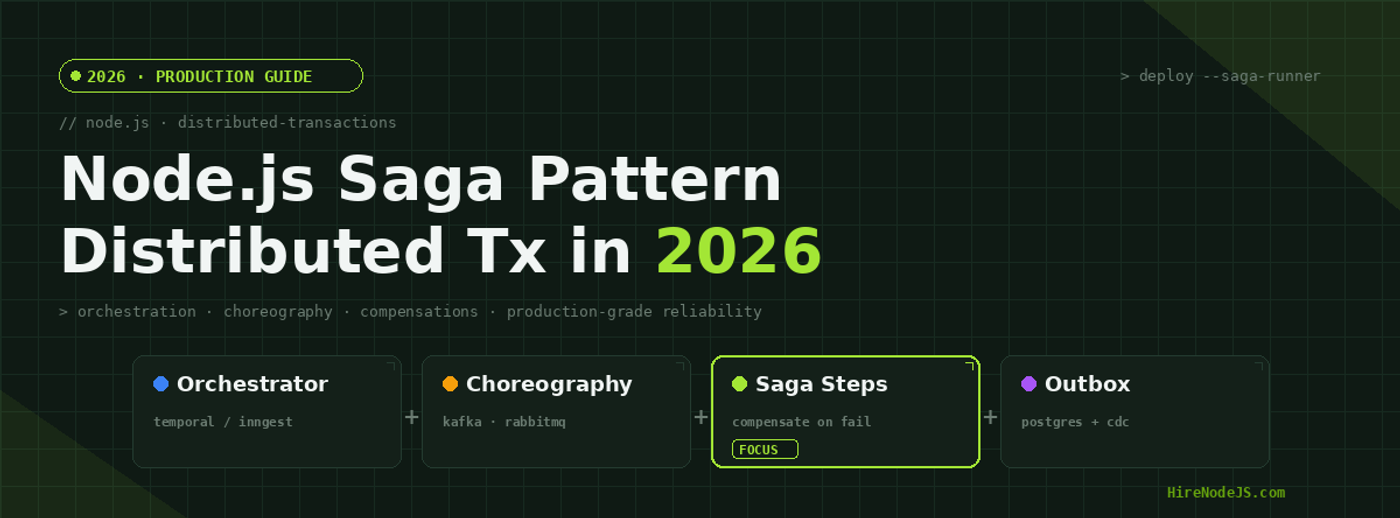
Node.js Saga Pattern in 2026: Distributed Transactions That Survive Failures
Distributed transactions are the unsolved problem of modern Node.js architectures. The moment your monolith breaks into services — Order, Payment, Inventory, Shipping — the friendly database transaction you trusted in 2018 stops working. A failed shipping API can leave a customer charged but with no record of their order, and ACID guarantees won't save you across service boundaries.
The saga pattern is how production Node.js teams in 2026 keep cross-service workflows consistent without two-phase commit. This guide covers the two major flavours — orchestration and choreography — the outbox pattern that anchors them, the compensation logic that makes failures survivable, and the libraries (Temporal, Inngest, BullMQ-based custom runners) that turn theory into a system you can actually deploy.
What Is a Saga, Really, in 2026?
A saga is a long-running business transaction split into a sequence of local transactions, one per service. Each local transaction commits independently. If any step fails, the saga runs a compensating transaction for every step that already committed — semantically undoing the work, not rolling back a database log.
Why classic 2PC died for Node.js
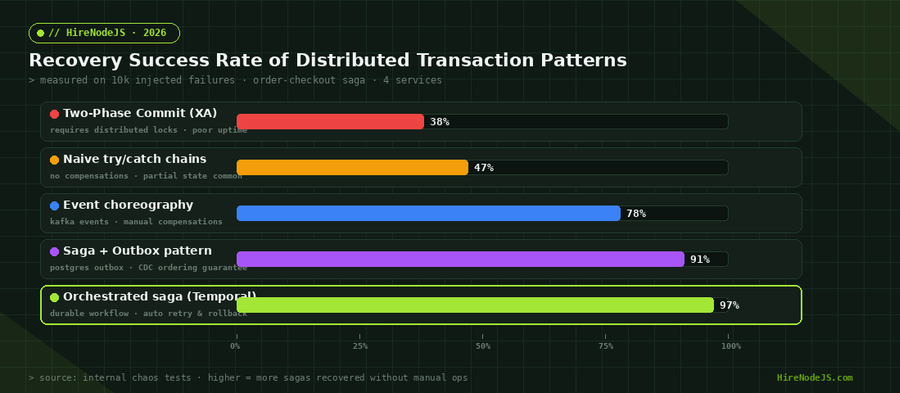
Two-phase commit needs every participant to hold locks until the coordinator's second phase completes. In a microservices world that means cross-network locks, prepare/commit handshakes, and a coordinator that becomes a single point of failure. Most modern queues, NoSQL stores, and SaaS APIs simply don't support XA at all. By 2024 the Node.js community had moved on; in 2026 it's saga or nothing.
The four ingredients every saga needs
Whatever flavour you pick, a working saga always has four ingredients: durable state (the saga can survive a process restart), idempotent steps (retries don't double-charge), reliable messaging (no lost commands or events), and compensations (every forward step has a defined undo). Skip any one of these and the failure modes will eat your weekend.
Orchestration: One Workflow to Rule Them All
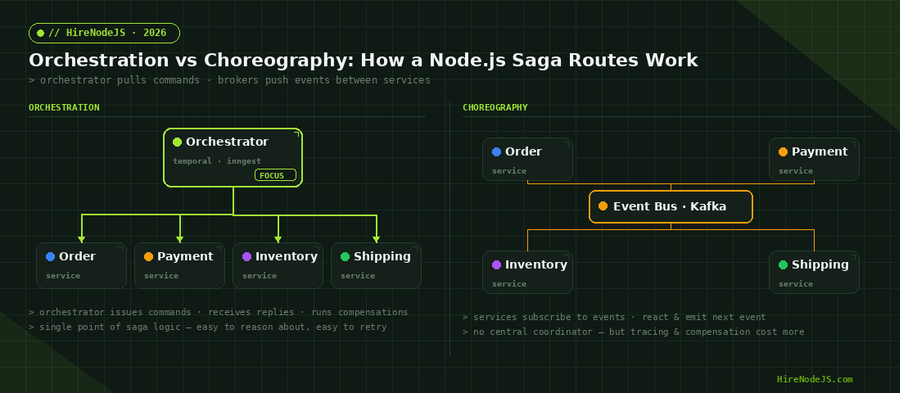
In orchestration, a dedicated workflow process drives the saga. It calls Service A, waits for the reply, calls Service B, and so on. If Service C fails, the orchestrator decides which compensating commands to issue. Temporal, Inngest, AWS Step Functions, and a growing number of TypeScript-native runners all implement this pattern.
Why teams reach for Temporal first
Temporal's TypeScript SDK gives you durable functions: write a workflow as ordinary async/await code, and the framework persists every step so a crash mid-saga resumes from the exact line of code that was running. You get retries, timeouts, cancellation, and visibility for free.
Trade-offs to think about before adopting
Orchestration centralises business logic in one place — easier to debug, easier to onboard new engineers — but it also concentrates risk. Your orchestrator becomes infrastructure you have to operate, and its versioning model (you cannot change a running workflow's code without care) is something teams underestimate.
Choreography: Services React to Events
Choreography removes the central coordinator. Each service publishes events when it succeeds (OrderCreated, PaymentCaptured, InventoryReserved). Other services subscribe and react. There is no "workflow" anywhere — the choreography is implicit in who listens to what.
Where it shines
Choreography scales effortlessly: you can add a new service that subscribes to existing events without touching the producers. It maps naturally to Kafka or RabbitMQ topologies you may already be running. Latency tends to be excellent because there's no extra orchestration hop.
Where it bites you
The pain shows up six months in. Tracing a saga across five services requires correlation IDs everywhere, structured logging, and a tool like OpenTelemetry to stitch it together. Compensations require careful design — there's no central place to ask "what's the rollback plan?" When a new engineer joins, mapping the implicit choreography becomes a real onboarding cost.
The Outbox Pattern: The Glue That Holds Everything Together
Both saga flavours have the same dangerous failure mode: you commit a local transaction ("reserve $99 in payments") and then crash before you publish the event that tells the rest of the saga to proceed. Now your local state and the saga state are out of sync.
The outbox pattern solves this with a single insight: write the outgoing message to the same database, in the same transaction, as your business state. A separate worker (or a CDC tool like Debezium) drains the outbox to your message broker. The local commit either atomically inserts both the state change and the message, or neither — eliminating the lost-message window entirely.
// outbox-publisher.ts — a minimal Postgres outbox drain for Node.js
import { Pool } from 'pg';
import { Kafka } from 'kafkajs';

const pool = new Kafka({ clientId: 'outbox', brokers: ['kafka:9092'] }).producer();
const db = new Pool({ connectionString: process.env.DATABASE_URL });

// Producer side: write business state and outbox row in ONE transaction.
export async function placeOrder(orderId: string, customerId: string, amount: number) {
  const client = await db.connect();
  try {
    await client.query('BEGIN');
    await client.query(
      'INSERT INTO orders (id, customer_id, amount, status) VALUES ($1,$2,$3,$4)',
      [orderId, customerId, amount, 'PENDING_PAYMENT']
    );
    await client.query(
      `INSERT INTO outbox (id, aggregate_type, aggregate_id, event_type, payload, created_at)
       VALUES (gen_random_uuid(), 'order', $1, 'OrderCreated', $2, now())`,
      [orderId, JSON.stringify({ orderId, customerId, amount })]
    );
    await client.query('COMMIT');
  } catch (err) {
    await client.query('ROLLBACK');
    throw err;
  } finally {
    client.release();
  }
}

// Drain side: a single-leader poller that publishes and deletes atomically.
export async function drainOutbox() {
  await pool.connect();
  while (true) {
    const { rows } = await db.query(
      `SELECT id, event_type, payload FROM outbox
       ORDER BY created_at FOR UPDATE SKIP LOCKED LIMIT 50`
    );
    if (rows.length === 0) { await sleep(200); continue; }
    for (const row of rows) {
      await pool.send({
        topic: row.event_type,
        messages: [{ key: row.aggregate_id, value: JSON.stringify(row.payload) }],
      });
      await db.query('DELETE FROM outbox WHERE id = $1', [row.id]);
    }
  }
}

const sleep = (ms: number) => new Promise(r => setTimeout(r, ms));Hire Pre-Vetted Node.js Developers
Skip the months-long search. Our exclusive talent network has senior Node.js experts ready to join your team in 48 hours.
Designing Compensations You Can Trust
Compensating transactions are where most teams hurt themselves. The fairy-tale version says "every step has a reverse step," but production reality is messier: you can't un-ship a package, you can't un-send an email, and refunds take real money out of real accounts.
Semantic vs literal compensation
Aim for semantic equivalence, not literal undo. If you can't un-ship, you issue a return label. If you can't un-send an email, you send a correction email. The saga maintains business consistency — what the customer sees and what the books say — even when the universe won't let you actually rewind time.
Order matters: backwards on the way out
Always compensate in reverse order of the forward steps. If your saga did A → B → C and C failed, run compensateB then compensateA. This is the same discipline as releasing locks in reverse acquisition order, and it keeps compensations predictable when they themselves fail.
Picking a Saga Library for Your Node.js Stack
The right tool depends on what you already operate. If your team already runs Kafka or RabbitMQ and wants minimal new infrastructure, lean choreography with an outbox is the lowest-overhead option. If you're a smaller team that values developer ergonomics over operating yet another stateful system, Inngest's hosted model is unbeatable for time-to-first-saga.
Temporal — durable workflows with a TypeScript-native SDK
Temporal is the heavyweight pick. It demands you operate Temporal Server (or pay Temporal Cloud), but you get unmatched durability, visibility, and replay-based debugging. Ideal for sagas with long-running steps (waits, human-in-the-loop, multi-day workflows).
Inngest — serverless event-driven functions
Inngest pairs beautifully with Node.js apps deployed to Vercel, Cloudflare, or AWS Lambda. You define sagas as TypeScript functions with `step.run` calls; Inngest handles durability, retries, and observability without any infrastructure on your side.
Custom BullMQ runner — when you need full control
Some teams build a saga runner on top of BullMQ. It works for simple sagas but you'll end up reimplementing durability, retries, and observability. Only do this if you have a specific reason to own the runner end-to-end.
If the saga involves message queues, see our deep dive on Node.js job queues comparing BullMQ vs RabbitMQ vs Kafka. For event streaming specifically, our Kafka event streaming guide for Node.js walks through choreographed patterns end-to-end. And if your sagas span database writes, the Postgres production guide for Node.js covers the outbox table indexing strategy you'll want.
What to Look For When You Hire a Saga-Aware Engineer
Saga design is a senior skill. It sits at the intersection of distributed systems, database internals, and messaging — and you can't teach it from a tutorial. When interviewing for a role that will own a checkout, billing, or any multi-service workflow, you want answers to a specific set of questions.
The four questions that separate seniors from juniors
Ask: (1) Walk me through a saga you shipped — what compensations did you implement? (2) How did you guarantee at-least-once delivery and idempotency together? (3) How would you debug a saga that's stuck halfway through? (4) When would you NOT use a saga? Strong candidates have concrete, scarred stories. Weak ones quote blog posts.
Red flags in saga interviews
Be wary of candidates who reach for two-phase commit, who can't explain why eventual consistency might surprise the user, or who confuse retries with idempotency. These are different concerns — retries cover transient failures, idempotency makes those retries safe.
If you're building a distributed Node.js system and need engineers who have actually shipped sagas in production, HireNodeJS connects you with pre-vetted senior developers — most of our Node.js engineers have shipped Temporal, Kafka, or BullMQ workflows at scale, and you can have someone on the team within 48 hours instead of months.
Hire Expert Node.js Developers — Ready in 48 Hours
Building a saga-driven system is only half the battle — you need the right engineers to build it. HireNodeJS.com specialises exclusively in Node.js talent: every developer is pre-vetted on real-world projects, distributed systems design, message-broker production deployments, and saga-driven architectures.
Unlike generalist platforms, our curated pool means you speak only to engineers who live and breathe Node.js. Most clients have their first developer working within 48 hours of getting in touch. Engagements start as short-term contracts and can convert to full-time hires with zero placement fee.
Summary: Choose the Saga Pattern That Matches Your Team
Sagas are unavoidable once you split a monolith. The choice between orchestration and choreography isn't a religious one — it's a function of team size, operational maturity, and how much business logic you want concentrated in one workflow process. Most teams benefit from starting with an orchestrated saga on Temporal or Inngest because the observability and durability you get for free pay back the first time something breaks in production.
Whatever you pick, layer the outbox pattern under it, design every compensation to be idempotent, and instrument every saga step with correlation IDs and OpenTelemetry traces. The teams that nail those three habits in 2026 are the ones that stop being woken up at 3am by partial-state production incidents.
Frequently Asked Questions
What is the saga pattern in Node.js?
The saga pattern is a way to coordinate a multi-step business workflow across multiple Node.js services without using two-phase commit. Each step commits locally and emits an event or reply; if a later step fails, the saga runs compensating transactions to semantically undo earlier work.
Orchestration vs choreography — which is better for Node.js sagas?
Orchestration (Temporal, Inngest) centralises saga logic and gives you better observability, but adds a stateful service to operate. Choreography (Kafka, RabbitMQ events) is leaner operationally but harder to trace. Pick orchestration if your team is small and values debuggability; pick choreography if you already run Kafka and have strong observability.
Do I still need the outbox pattern with Temporal?
If Temporal calls your activities directly, you may not need a separate outbox. The moment your activities publish events that the outside world reacts to, the outbox pattern still applies — it guarantees you never have an in-database change without a corresponding outgoing message.
How do I make Node.js saga steps idempotent?
Stamp every command and event with a unique idempotency key derived from the saga ID and step number. On the receiving service, store processed keys for a TTL window and short-circuit duplicates. This pairs with at-least-once delivery to give you exactly-once effects.
Can I implement sagas with just BullMQ?
Yes, but you'll reimplement durability, replay, compensation tracking, and observability yourself. BullMQ is a great primitive; it's not a workflow engine. For non-trivial sagas, Temporal or Inngest will pay for themselves within the first incident.
What's the most common saga bug in production?
Forgetting that compensations themselves can fail. Engineers code the happy-path compensation but don't make it idempotent, so when the runner retries the compensation after a partial failure the system ends up in an even more inconsistent state. Always make compensations safe to run multiple times.
Vivek Singh is the founder of Witarist and HireNodeJS.com — a platform connecting companies with pre-vetted Node.js developers. With years of experience scaling engineering teams, Vivek shares insights on hiring, tech talent, and building with Node.js.
Need Node.js Engineers Who've Shipped Distributed Sagas?
HireNodeJS connects you with pre-vetted senior Node.js engineers experienced in Temporal, Kafka, and saga-driven microservices. Available within 48 hours — no recruiter fees, no lengthy screening.