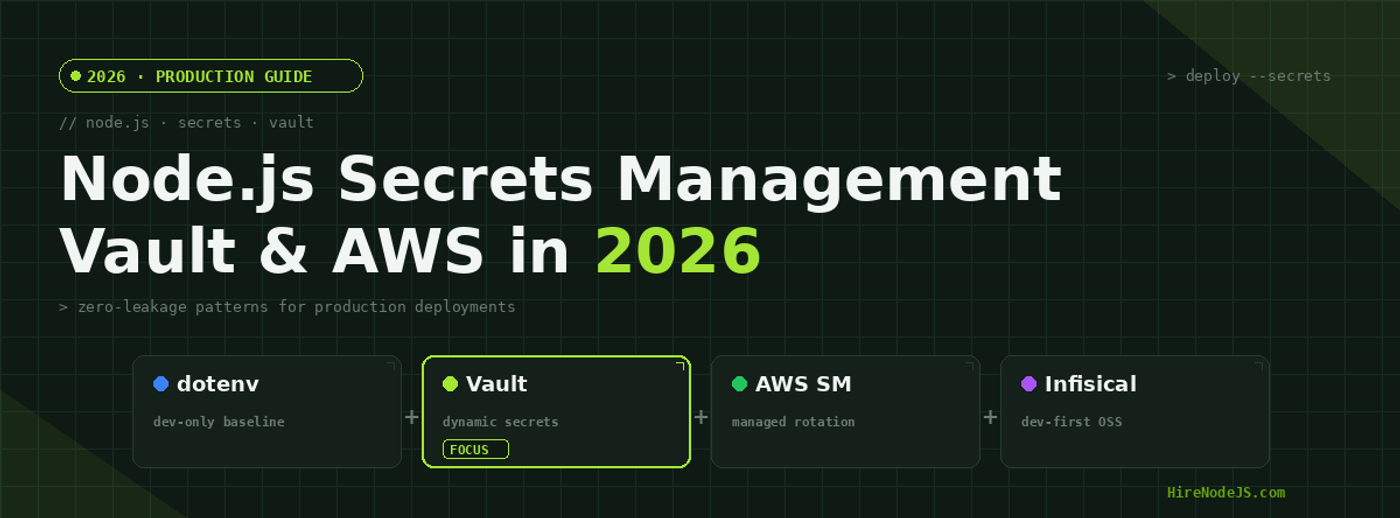
Node.js Secrets Management: Vault, AWS & Zero-Leakage Patterns
Secrets management is the single most overlooked security concern in Node.js applications. A leaked database credential, an exposed API key committed to Git, or a plaintext token sitting in a .env file on a production server can unravel months of careful engineering in seconds. In 2026, with supply-chain attacks on the rise and compliance frameworks tightening their grip, treating secrets as an afterthought is no longer an option.
This guide walks you through the complete secrets management lifecycle for Node.js production systems — from the basics of environment variables to enterprise-grade solutions like HashiCorp Vault and AWS Secrets Manager. Whether you are a solo developer or leading a team of Node.js engineers, you will leave with a clear, actionable strategy for zero-leakage secret handling.
Why .env Files Are Not Enough
The dotenv pattern revolutionised how developers handle configuration in Node.js. Drop a .env file in your project root, call require('dotenv').config(), and every key-value pair lands in process.env. It is simple, portable, and every Node.js developer knows it. But simplicity comes at a cost when you move from localhost to production.
The fundamental problem with .env files in production is threefold. First, they have no access control — anyone who can read the filesystem can read every secret. Second, there is no audit trail — you have no idea who accessed a credential or when. Third, there is no rotation mechanism — changing a database password means redeploying every service that uses it, typically during a stressful incident.
The Real-World Cost of Leaked Secrets
According to the 2025 IBM Cost of a Data Breach report, compromised credentials remain the most common initial attack vector, accounting for roughly 16 percent of breaches with an average cost exceeding 4.5 million dollars. In the Node.js ecosystem, the npm supply-chain attack surface makes this even more acute — a single malicious package dependency can exfiltrate process.env in milliseconds.
HashiCorp Vault for Node.js — Dynamic Secrets at Scale
HashiCorp Vault is the gold standard for secrets management in production environments. Unlike static secret stores, Vault can generate dynamic, short-lived credentials on demand — a database user that exists for exactly 60 seconds, just long enough for your Node.js service to complete its operation. When the lease expires, the credential is automatically revoked.
Setting Up the node-vault Client
The official node-vault package provides a clean API for interacting with Vault from any Node.js application. You authenticate once using an AppRole, Kubernetes service account, or AWS IAM role, and then request secrets as needed. The critical architectural decision is whether to use the Vault Agent sidecar pattern — where a co-process handles authentication and caches secrets locally — or make direct API calls from your application code.
const vault = require('node-vault')({
  endpoint: process.env.VAULT_ADDR || 'https://vault.internal:8200',
  token: process.env.VAULT_TOKEN // Only for dev — use AppRole in production
});

// Read a static secret from KV v2
async function getDbCredentials() {
  const { data } = await vault.read('secret/data/myapp/database');
  return {
    host: data.data.host,
    user: data.data.username,
    password: data.data.password
  };
}

// Generate a dynamic PostgreSQL credential (60s TTL)
async function getDynamicDbCred() {
  const lease = await vault.read('database/creds/myapp-readonly');
  console.log(`Dynamic cred created — TTL: ${lease.lease_duration}s`);
  return {
    user: lease.data.username,
    password: lease.data.password
  };
}

// Renew a lease before expiry
async function renewLease(leaseId) {
  await vault.write('sys/leases/renew', { lease_id: leaseId, increment: 3600 });
}
Vault Agent Sidecar Pattern
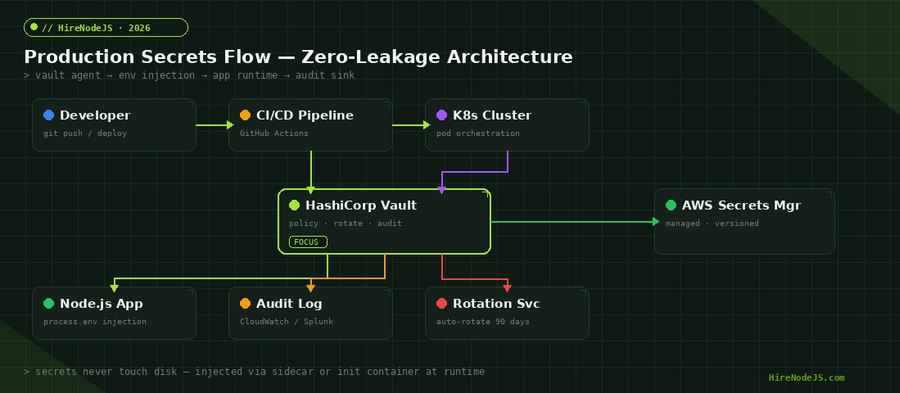
For Kubernetes deployments, the Vault Agent Injector is the recommended approach. It runs as an init container and sidecar alongside your Node.js pods, automatically authenticating with Vault using the pod's service account and writing secrets to a shared tmpfs volume. Your application reads credentials from files rather than making HTTP calls, which means zero code changes to your existing backend application. The agent handles renewal and rotation transparently.
AWS Secrets Manager — Managed Rotation for Node.js
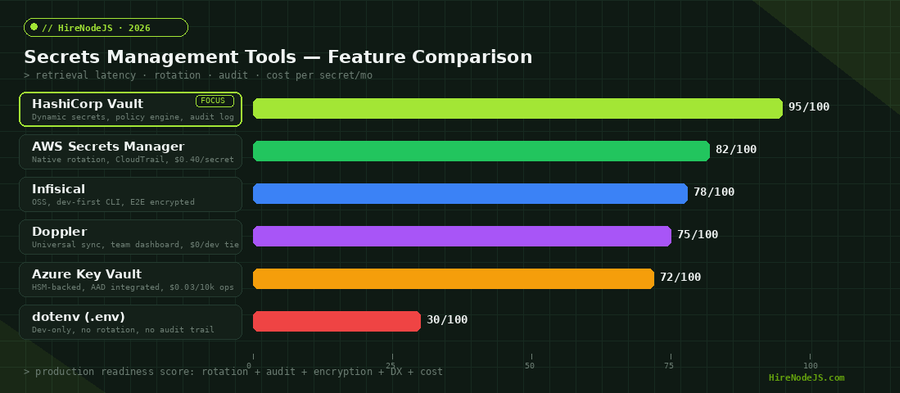
If your Node.js infrastructure already lives on AWS, Secrets Manager offers a compelling managed alternative to self-hosting Vault. At 0.40 dollars per secret per month plus 0.05 dollars per 10,000 API calls, it eliminates the operational overhead of running a Vault cluster while providing native integration with RDS, Redshift, DocumentDB, and other AWS services.
Retrieving Secrets with the AWS SDK
The AWS SDK v3 for JavaScript provides a modular client that only bundles the services you actually use. Secret retrieval typically completes in 12 to 15 milliseconds from within the same region, making it suitable for application startup but too slow for hot-path per-request lookups without caching.
Automatic Rotation with Lambda
AWS Secrets Manager can automatically rotate secrets on a schedule you define — typically every 30, 60, or 90 days. For RDS databases, AWS provides pre-built Lambda rotation functions that handle the entire lifecycle: creating a new credential, updating the database, testing the connection, and marking the new version as current. For custom secrets like third-party API keys, you write a rotation Lambda that implements the four-step rotation protocol: createSecret, setSecret, testSecret, and finishSecret.
Infisical and Open-Source Alternatives
Hire Pre-Vetted Node.js Developers
Skip the months-long search. Our exclusive talent network has senior Node.js experts ready to join your team in 48 hours.
Not every team needs the complexity of Vault or the AWS lock-in of Secrets Manager. Infisical has emerged as the developer-first open-source alternative that bridges the gap between dotenv convenience and enterprise security. It offers end-to-end encryption, a clean CLI that syncs secrets to your local .env file, and a dashboard that gives your team visibility into who accessed what and when.
Doppler — The Universal Secrets Orchestrator
Doppler takes a different approach by positioning itself as a universal sync layer. You define secrets in Doppler once, and it pushes them to every environment — local dev, staging, CI, and production — through native integrations with Vercel, AWS, GCP, Kubernetes, and more. The free tier supports up to five team members with unlimited secrets, making it an excellent choice for startups and small teams.
When to Choose What
For teams running complex multi-cloud architectures with strict compliance requirements, Vault remains the best choice. AWS-native shops that want minimal operational overhead should lean toward Secrets Manager. Startups and dev-centric teams that prioritise developer experience should evaluate Infisical or Doppler. If you need help making this decision for your specific stack, our Node.js architects have implemented secrets management across hundreds of production systems.
Zero-Leakage Patterns for Node.js Applications
Choosing a secrets manager is only half the battle. You also need defensive coding patterns that prevent secrets from leaking through error messages, stack traces, logs, and memory dumps. These patterns should be enforced at the framework level so individual developers do not need to remember them on every line of code.
Redacting Secrets from Logs
The most common leakage vector in Node.js is logging. A debug statement that logs the full request object will include authorization headers. An unhandled promise rejection that dumps the database connection config will include the password. Use a structured logger like Pino with redaction paths configured at the transport level to strip sensitive fields before they hit your log aggregator.
const pino = require('pino');

const logger = pino({
  redact: {
    paths: [
      'req.headers.authorization',
      'req.headers.cookie',
      'req.body.password',
      'req.body.token',
      'req.body.secret',
      'db.password',
      'config.apiKey',
      '*.connectionString'
    ],
    censor: '[REDACTED]'
  },
  transport: {
    target: 'pino-pretty',
    options: { colorize: true }
  }
});

// This will log: { db: { host: 'pg.internal', password: '[REDACTED]' } }
logger.info({ db: { host: 'pg.internal', password: 'super-secret-pw' } }, 'DB config loaded');
Freezing process.env
Once your application has loaded its configuration at startup, freeze the process.env object to prevent runtime mutations. This blocks dependency code from reading or modifying environment variables after initialisation, closing a common supply-chain attack vector where a malicious package reads process.env and exfiltrates its contents.
CI/CD Secrets Hygiene — GitHub Actions and Beyond
Your CI/CD pipeline is one of the highest-risk surfaces for secret exposure. GitHub Actions runners, for example, have access to every repository secret and environment variable you configure. A single malicious or compromised action in your workflow can exfiltrate all of them. The principle of least privilege is essential here: scope secrets to specific environments, use OIDC federation instead of long-lived tokens, and audit your third-party actions regularly.
OIDC Federation — No More Static Tokens
Both AWS and GCP now support OpenID Connect federation with GitHub Actions, meaning your workflows can assume a cloud IAM role without storing any static credentials. This eliminates the most dangerous category of CI/CD secrets — long-lived cloud provider access keys that, if leaked, grant broad access to your infrastructure. Your DevOps engineers should implement OIDC federation as a priority if you are still using static AWS access keys in GitHub Actions.
Scanning for Leaked Secrets in Git History
Tools like trufflehog, gitleaks, and GitHub's built-in secret scanning can detect credentials that have been accidentally committed to your repository — including in historical commits that are no longer visible in the current branch. Run these scanners in your CI pipeline on every pull request, and configure them to block merges when secrets are detected. Remember that removing a secret from a file does not remove it from Git history — you need to use git filter-repo or BFG Repo-Cleaner to purge the commit entirely.
Hire Expert Node.js Developers — Ready in 48 Hours
Building the right system is only half the battle — you need the right engineers to build it. HireNodeJS.com specialises exclusively in Node.js talent: every developer is pre-vetted on real-world projects, API design, event-driven architecture, and production deployments.
Unlike generalist platforms, our curated pool means you speak only to engineers who live and breathe Node.js. Most clients have their first developer working within 48 hours of getting in touch. Engagements start as short-term contracts and can convert to full-time hires with zero placement fee.
Conclusion — Build a Secrets-First Culture
Secrets management is not a one-time infrastructure task — it is an ongoing discipline that must be embedded in your team's engineering culture. Start with the basics: eliminate .env files from production, centralise credentials in a dedicated secrets manager, and enforce rotation policies. Then layer on zero-leakage patterns — log redaction, process.env freezing, and CI pipeline scanning — to close the remaining gaps.
The tooling has never been better. HashiCorp Vault offers unmatched flexibility for complex multi-cloud setups. AWS Secrets Manager provides turnkey rotation for AWS-native stacks. Infisical and Doppler deliver developer-friendly experiences that make security the path of least resistance. Whichever you choose, the investment pays for itself the first time it prevents a credential leak. And if you need experienced Node.js developers who understand production security from day one, HireNodeJS has you covered.
Frequently Asked Questions
What is the best secrets management tool for Node.js in 2026?
HashiCorp Vault leads for complex multi-cloud setups with its dynamic secrets and policy engine. AWS Secrets Manager is the best managed option for AWS-native stacks. Infisical and Doppler offer excellent developer experience for smaller teams.
How do I migrate from .env files to a secrets manager?
Start by inventorying all secrets in your .env files across environments. Move them to your chosen secrets manager, update your application to fetch secrets at startup via the provider SDK, and remove .env files from production. Keep .env.example files with placeholder values for developer onboarding.
How much does AWS Secrets Manager cost for a Node.js application?
AWS Secrets Manager charges $0.40 per secret per month plus $0.05 per 10,000 API calls. A typical Node.js microservice with 10 secrets and moderate traffic costs roughly $4-5 per month. Caching secrets at startup reduces API call costs significantly.
Can I use HashiCorp Vault with Kubernetes for Node.js deployments?
Yes. The Vault Agent Injector runs as a sidecar alongside your Node.js pods, authenticating via the Kubernetes service account and writing secrets to a shared tmpfs volume. Your application reads secrets from files with zero code changes required.
How often should I rotate secrets in a Node.js production environment?
Follow the NIST SP 800-63B recommendation of rotating credentials at least every 90 days. For high-sensitivity secrets like database passwords and API keys, rotate every 30 days. HashiCorp Vault's dynamic secrets can provide per-request credentials with TTLs as short as 60 seconds.
How do I prevent secrets from leaking in Node.js application logs?
Use a structured logger like Pino with redaction paths configured to strip sensitive fields such as authorization headers, passwords, and API keys. Additionally, freeze process.env after startup with Object.freeze() to prevent runtime exfiltration by malicious dependencies.
Vivek Singh is the founder of Witarist and HireNodeJS.com — a platform connecting companies with pre-vetted Node.js developers. With years of experience scaling engineering teams, Vivek shares insights on hiring, tech talent, and building with Node.js.
Need Node.js Developers with Security-First Thinking?
HireNodeJS connects you with pre-vetted senior Node.js engineers who understand secrets management, zero-trust architecture, and production security. Get your first developer within 48 hours — no recruiter fees, no lengthy screening.