Node.js Interview Questions in 2026: The Senior Hiring Playbook
Hiring a senior Node.js engineer in 2026 looks nothing like it did three years ago. The tooling has fragmented across Node, Bun, and Deno; serverless, edge runtimes, and long-running queues now coexist in the same codebase; and AI-generated code has made shallow technical screens almost meaningless. The interview pipeline you used in 2023 will quietly let mediocre candidates through and turn off the strong ones.
This playbook is the structured pipeline we use at HireNodeJS to vet senior Node.js engineers - 50+ questions across five focused stages, real take-home tasks, scoring rubrics, and the red flags that separate the people who can architect a production system from the people who can talk about one. Whether you are a CTO scaling your first team or an engineering manager replacing a star hire, every section here is built to make your decisions defensible.
Why Generic Node.js Interviews Miss Senior Talent
Most engineering teams interview Node.js engineers using a template borrowed from generalist software roles: a coding screen, two algorithm rounds, and one behavioural conversation. The format is fast to run, easy to score, and almost completely uncorrelated with how someone performs once they are shipping production Node.js code. Senior Node.js work is overwhelmingly about async correctness, failure boundaries, and architectural restraint - almost none of which surfaces in a 30-minute LeetCode round.
Algorithm rounds optimise for the wrong skill
A senior Node.js engineer rarely writes a custom data structure - they pick the right library, instrument it, and reason about what happens when it fails in production at 3 a.m. Whiteboard algorithm questions reward candidates who memorise patterns, not those who think clearly under uncertainty. They also disproportionately filter out experienced engineers who have not grinded competitive programming in a decade.
AI-assisted candidates break shallow screens
Anything a senior candidate could solve in 15 minutes by typing a problem statement into Claude or Copilot is no longer a useful filter. The questions that still differentiate are open-ended ones where the candidate has to make trade-offs, defend choices, and respond to real follow-ups. The bar is no longer 'can you write this code?' - it is 'can you reason about this system?'
The 5-Stage Senior Interview Pipeline
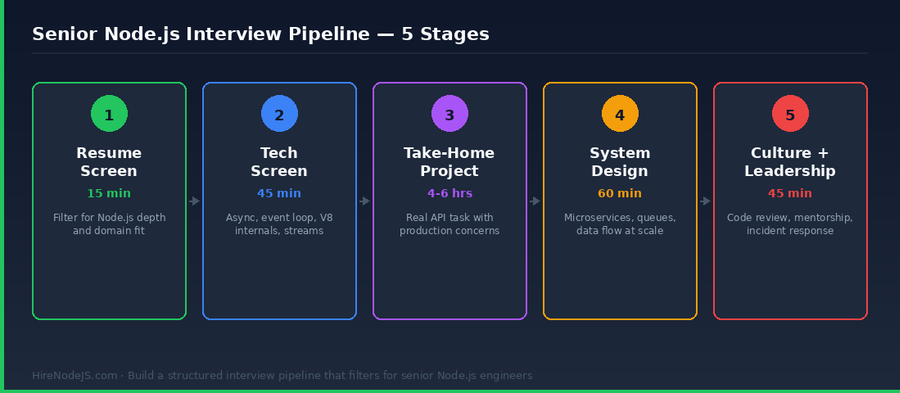
A senior Node.js pipeline should respect the candidate's time, surface real signal, and produce a defensible scoring sheet. Five stages, run over 7-10 calendar days, hits that target without the seven-round death march that pushes top candidates to faster competitors.
Stage 1 - Resume screen (15 min)
Read for depth not breadth. A senior Node.js CV should show two or three production systems they owned end-to-end, not a buzzword cloud. Look for evidence of operating Node.js in production: incident write-ups, perf wins, library contributions, or measurable business impact.
Stage 2 - Technical screen (45 min)
Live conversation about Node.js internals plus a small live-coding task. The goal is to confirm the candidate has the model, not to test whether they can recite docs. The five questions in the next section cover what we ask in this stage.
Stages 3-5 - Take-home, system design, culture
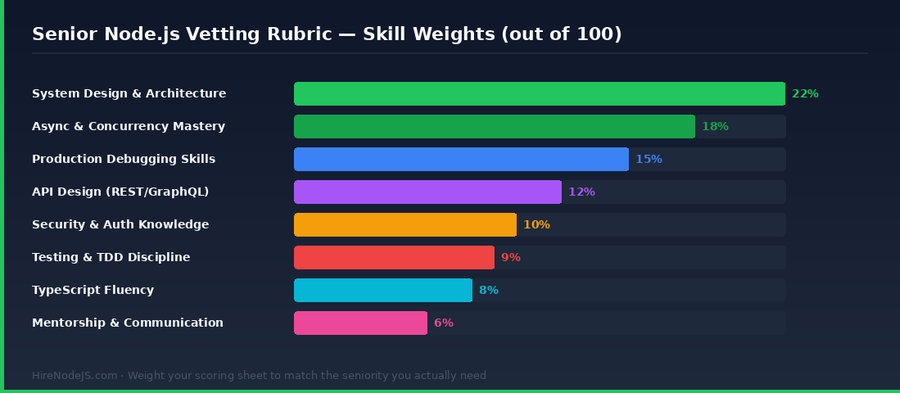
The take-home tests production thinking, system design tests architectural reasoning, and the culture round tests judgement and ownership. Every stage feeds into a single weighted scoring sheet - see the rubric below for how we weight skills, and our broader hiring process guide for the calibration steps that keep scoring honest across interviewers.
Core Technical Questions (with Ideal Answers)
These are the five questions we still find irreplaceable in a senior tech screen. They take 30-40 minutes if the candidate is strong, and the gaps in their answers tell you exactly which area to probe deeper in the next stage.
1. Walk me through the event loop and the microtask queue
Strong answers describe the libuv phases (timers, pending callbacks, idle/prepare, poll, check, close), distinguish the microtask queue (Promise.then, queueMicrotask, process.nextTick) from the task queue, and note that microtasks drain after every task - which is why a tight Promise loop can starve I/O. Weak answers say 'Node.js is single-threaded' and stop.
2. What is backpressure and how do Node.js streams handle it?
Senior answer: when a Writable cannot keep up with a Readable, write() returns false and the producer should pause until 'drain' fires. They mention pipeline() over manual .pipe() chains because pipeline() handles errors and cleanup properly. They probably name a real bug they hit because someone ignored the drain signal.
3. How would you safely catch errors across async boundaries?
Look for: try/await around promises, an Express/Fastify-style centralised error middleware, distinct typed errors for known cases, AsyncLocalStorage to propagate request context, and process-level handlers for unhandledRejection and uncaughtException that crash the process and let the supervisor restart it. A senior never says 'just swallow it' or 'use domains'.
// errors.js - production-grade error wrapping for Node.js
import { AsyncLocalStorage } from 'node:async_hooks';

export const requestContext = new AsyncLocalStorage();

export class AppError extends Error {
  constructor(message, { status = 500, code = 'INTERNAL', cause } = {}) {
    super(message, { cause });
    this.status = status;
    this.code = code;
    this.requestId = requestContext.getStore()?.requestId;
  }
}

// Async-safe wrapper for Express-style handlers
export const asyncHandler = (fn) => (req, res, next) =>
  Promise.resolve(fn(req, res, next)).catch(next);

// Centralised error middleware
export function errorMiddleware(err, req, res, _next) {
  const status = err.status ?? 500;
  req.log?.error({ err, requestId: err.requestId }, 'request failed');
  res.status(status).json({
    error: { code: err.code ?? 'INTERNAL', message: err.message },
  });
}

// Process-level safety net - let the supervisor restart on hard failures
process.on('unhandledRejection', (reason) => {
  console.error('unhandledRejection', reason);
  process.exit(1);
});
4. How do you debug a Node.js memory leak in production?
Strong answers describe a workflow: confirm the leak with RSS/heap-used metrics, capture heap snapshots with --inspect or heapdump, diff snapshots to find the retained set, then drill into typical culprits - closures over large request bodies, listeners not removed, caches without eviction. Our deep dive on Node.js production debugging covers the full toolkit if you need a refresher before the interview.
5. When would you reach for worker_threads vs cluster vs a queue?
Senior framing: cluster horizontally scales the same workload across cores; worker_threads parallelises CPU-bound work inside a single process with shared memory via SharedArrayBuffer; a queue (BullMQ, Kafka) decouples producers and consumers across services and survives a process restart. The wrong choice has architectural consequences that show up six months later.
Hire Pre-Vetted Node.js Developers
Skip the months-long search. Our exclusive talent network has senior Node.js experts ready to join your team in 48 hours.
System Design Prompts That Reveal Real Seniority
System design is where the gap between mid-level and senior becomes obvious within minutes. The prompts below force the candidate to make architectural trade-offs in a Node.js context, not draw boxes on a whiteboard for an hour.
Prompt: Design a webhook delivery service
Goal: deliver 5M webhooks per day to customer endpoints with retries and signed payloads. A senior naturally introduces a queue (BullMQ/Kafka), discusses idempotency keys, exponential backoff, dead-letter queues, signature schemes (HMAC-SHA256), and per-tenant rate limiting. They surface the failure mode where one slow customer endpoint clogs the queue and propose isolation per customer.
Prompt: Design a real-time multiplayer presence system
WebSocket-heavy. Strong candidates discuss sticky sessions vs Redis pub/sub fan-out, heartbeat intervals, presence diffing, sharding by room ID, and graceful reconnection. Bonus: they raise the hard problem of presence accuracy on rolling deployments.
Prompt: Design a multi-tenant SaaS billing pipeline
Look for: idempotent event ingestion, exactly-once processing into Stripe, replayability, and clean tenant isolation. Senior candidates discuss back-dated corrections, currency rounding, and the audit trail needed when finance asks 'why did this customer get billed twice?' If you have built this before, our backend developer hiring page has more on the architecture skill bar we use to score senior backend candidates.
Take-Home Tests That Don't Waste Anyone's Time
A take-home is the highest-signal stage in the entire pipeline - and the one most teams ruin by making it too long, too vague, or too generic. The bar is simple: under four hours of focused work, asks the candidate to make production decisions, and gives them something they can actually be proud of.
What to ask for
Build a small REST API on top of a provided dataset. Requirements: pagination, validation, idempotent POST, structured logging, basic caching, two integration tests, and a SHORT_README explaining trade-offs. The README is non-negotiable - it is where senior thinking shows up.
How to score it
Score in four buckets: correctness (30%), code quality (25%), production thinking (25%), and clarity of trade-offs in the README (20%). Have two engineers grade independently, then calibrate. If their scores disagree by more than 20%, the rubric - not the candidate - is the problem.
Red Flags and How to Spot Them
These are the patterns that show up across hundreds of senior Node.js interviews and tend to predict trouble inside six months. None of them is automatically disqualifying - they are prompts to dig deeper.
Talks about frameworks more than systems
Senior engineers describe systems first and frameworks second. Candidates who lead with 'I am an Express expert' or 'I prefer NestJS' without context tend to be shallower than their CV suggests. Probe with: 'When would you NOT use NestJS?' - a senior answers in 30 seconds.
Cannot articulate a single production incident
Every senior engineer has been on call for something painful. If a candidate cannot tell you about a real incident, the root cause they found, and what changed afterwards, they probably have not operated software at senior scope. This is the single best behavioural question we know.
Defensive when challenged on a design choice
Push back on something specific in their take-home README. The right answer is curiosity ('oh, that is interesting - let me think about it'). The wrong answer is defensiveness or status-pulling. The candidate's first reaction to gentle challenge is the reaction your engineers will see during a code review fight.
Hire Expert Node.js Developers - Ready in 48 Hours
Designing a great interview pipeline is one job - running it dozens of times to fill an open seat is another. HireNodeJS.com specialises exclusively in Node.js talent: every developer in our network has already cleared the structured technical screen, take-home review, and system design conversation described in this playbook.
Unlike generalist platforms, our curated pool means you speak only to engineers who live and breathe Node.js - async patterns, event-driven architecture, production deployments. Most clients have their first developer working within 48 hours of getting in touch. Engagements start as short-term contracts and can convert to full-time hires with zero placement fee.
Final Word: Hire for Production Judgement
The single biggest lever in senior Node.js hiring is replacing trivia with production judgement. Ask candidates to design real systems, debug real failures, and explain real trade-offs. Let them spend their interview time doing the work they would actually do - and weight your scoring sheet for the skills that matter once they are shipping. Do that, and the question stops being 'is this candidate technically strong enough?' and starts being 'is this the engineer I want next to me when production is on fire?'
If you would rather hand the entire pipeline to a team that runs it every day, browse pre-vetted Node.js engineers and skip straight to the offer letter.
Frequently Asked Questions
What are the most important Node.js interview questions for senior engineers?
Focus on the event loop and microtask queue, backpressure in streams, error handling across async boundaries, V8 memory tuning, and architectural trade-offs around microservices, queues, and caching. Behavioural questions about production incidents matter just as much as theory.
How long should a senior Node.js interview process take?
A focused pipeline runs in 3-4 hours of candidate time across 5 stages: a 15-minute screen, a 45-minute technical screen, a 4-6 hour take-home, a 60-minute system design, and a 45-minute culture conversation. Stretching beyond that loses strong candidates to faster competitors.
Should I use whiteboard algorithm questions for Node.js interviews?
Generally no. Pure algorithm whiteboards correlate poorly with on-the-job Node.js performance. Replace them with realistic API tasks, debugging exercises, and system design discussions that mirror the work the engineer will actually do.
What's a good take-home test for a senior Node.js developer?
A 4-6 hour task that asks the candidate to design a small but realistic API: pagination, caching, validation, error handling, tests, and a brief README explaining trade-offs. Pay candidates for take-homes longer than 4 hours, and never accept tests over 8 hours.
How do I evaluate Node.js system design answers?
Score for problem framing, capacity estimation, data flow choices, async boundaries, failure modes, and observability. Senior engineers explain trade-offs explicitly, name the option they'd avoid and why, and revisit assumptions when constraints change.
How fast can HireNodeJS supply pre-vetted senior Node.js engineers?
HireNodeJS connects you with pre-vetted senior Node.js engineers within 48 hours. Every candidate has already passed a structured technical interview, take-home review, and reference check, so you skip the screening overhead entirely.
Vivek Singh is the founder of Witarist and HireNodeJS.com — a platform connecting companies with pre-vetted Node.js developers. With years of experience scaling engineering teams, Vivek shares insights on hiring, tech talent, and building with Node.js.
Skip the Search - Hire Pre-Vetted Senior Node.js Developers in 48 Hours
HireNodeJS connects you with senior Node.js engineers who have already cleared a structured technical interview and take-home review. No recruiter fees, no months-long pipelines - just talent ready to ship from day one.